U.S. Attack on Iran Triggers a Fast Escalation Ladder—and a Hard Ceiling
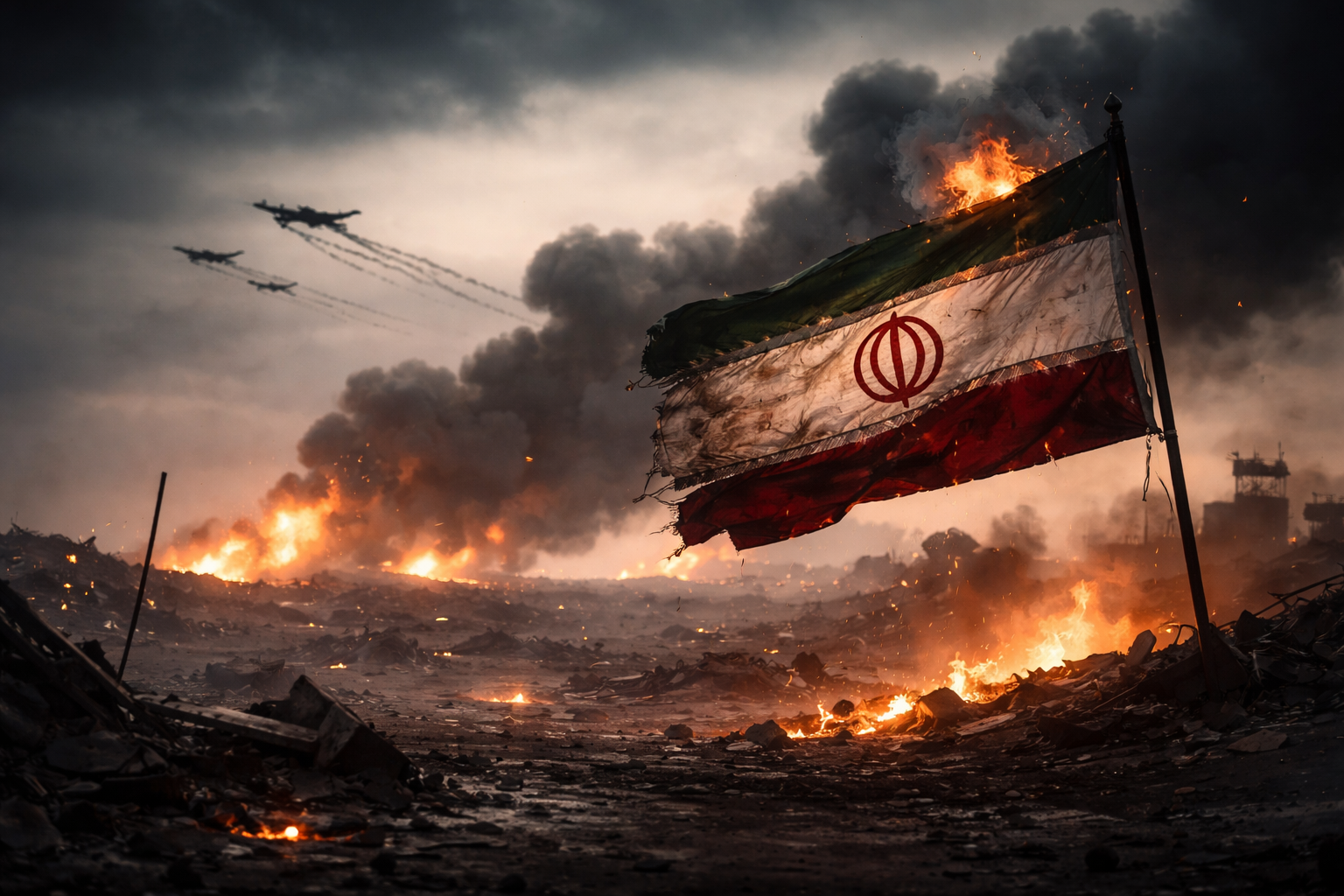
After U.S. Strikes, Iran’s Retaliation Choice Sets the Region’s Risk Ceiling
The U.S.–Iran Crisis Is Back—and the Escalation Ladder Looks Different This Time
The U.S. has now carried out major strikes on Iranian targets, and Iran is preparing a response. On February 28, 2026, President Donald Trump said the U.S. was conducting “major combat operations,” with reporting describing strikes aimed at Iranian missile systems and naval forces. This act is being framed publicly as a campaign, not a single raid.
The central tension is simple: Washington wants to suppress Iran’s ability to retaliate without sliding into a regional war; Tehran wants to restore deterrence without inviting regime-threatening escalation.
The story turns on whether Iran chooses retaliation that is symbolically huge but operationally bounded or retaliation that forces the U.S. into repeated, widening strikes.
Key Points
The U.S. has announced large-scale military action against Iran, with reporting describing strikes focused on missile and naval capabilities and warnings that U.S. casualties are possible.
Iran’s next move is likely to aim at credibility: it will seek a response that looks decisive to domestic and regional audiences while managing the risk of catastrophic escalation.
The escalation ladder is not linear. It’s a feedback loop: each side’s “defensive” move can create new incentives for the other to expand target sets and timelines.
Markets, airlines, and maritime insurers can become a real-world “thermostat” on escalation by raising the economic cost of prolonged disruption and widening the pressure on allies.
Regional spillovers matter as much as direct U.S.–Iran exchanges: proxies, bases, shipping lanes, and airspace closures are where escalation can spread fastest.
This crisis is part of a bigger fight in the region over missiles, drones, access to the sea, and networks of influence.
Iran’s deterrence has historically combined direct capabilities (ballistic missiles, drones, and naval forces) with indirect leverage through aligned militias and partners across the region.
In a direct strike phase, the U.S. usually focuses on air and sea control. This means damaging launch systems, surveillance nodes, and command-and-control so that follow-up attacks are harder and more expensive.
Iran typically employs three types of retaliation strategies: direct strikes using missiles or drones, indirect pressure on U.S. partners or forces, and economic disruption through the use of maritime risk and energy markets.
The boundary and pressure: “deterrence restoration” vs. “war avoidance”
The U.S. has incentives to demonstrate dominance and protect forces and allies, but it also wants a ceiling: no open-ended ground war, no regional ignition that forces constant reinforcement, and no crisis that fractures allied coordination.
Iran has incentives to avoid appearing helpless. But it also faces a constraint: a retaliation that kills large numbers of Americans or triggers a dramatic regional collapse can invite a sustained campaign that threatens regime stability.
This creates a narrow corridor where Iran may try to strike in ways that are dramatic, deniable, or geographically dispersed—yet still “bounded” enough to avoid forcing U.S. maximal escalation.
Competing models of Iran’s next step: symbolic shock or operational grind
One model is symbolic shock: a short, sharp retaliation designed for headlines and internal legitimacy—possibly involving missiles or drones—followed by calls for de-escalation through diplomatic channels.
Another model is operational grind: sustained pressure through proxies and maritime harassment, aiming to keep the region unstable and impose steady costs on U.S. forces and partners without a single clear “red line” moment.
A key signal that separates the models is tempo. If Iran moves quickly and publicly, it’s likely aiming for the “shock-and-stop” pattern. If it slows down and fragments actions across multiple arenas, it’s likely choosing a longer campaign with more room to calibrate.
The core constraint: the target-set trap and the base-defense dilemma
Once U.S. forces are attacked—or a proxy attack is attributed to Iran—Washington faces a target-set problem. Striking only proxy units may not restore deterrence. Striking Iranian state assets can widen the war.
At the same time, base defense creates its own pressure. If U.S. leaders believe bases and ships remain at risk, they have incentives to expand strikes from launchers to the broader system that enables them: sensors, command nodes, logistics, and leadership-linked infrastructure.
The constraint is that every expansion increases the chance of miscalculation, civilian harm, and political backlash that makes “stopping” harder than “starting.”
The hinge: civilian airspace and maritime insurance as the conflict’s hidden thermostat
Here’s the under-emphasized lever: commercial disruption can become the fastest measurable limit on escalation, because airline suspensions, rerouted flights, port risk, and war-risk insurance costs force governments and businesses into crisis decisions even when militaries think they are still operating “below war.”
Mechanism matters. When airspace and shipping become unsafe or too expensive, allies face domestic pressure and supply chain disruptions. That pushes more actors to demand restraint, but it can also push them to quietly support harder strikes that “end it faster.”
Watch two signposts. First, how quickly regional airspace closures and flight cancellations spread beyond immediate conflict zones. Second, whether major shipping insurers and carriers begin formal route avoidance at scale, which is a real-world vote that the situation is not “contained.”
The measurable test: what would confirm a move up the escalation ladder
The escalation ladder is best understood as rungs that change incentives:
Rung 1 is a direct U.S.–Iran exchange contained to military targets, with both sides signaling limits.
Rung 2 is retaliation that damages but avoids mass casualties, followed by visible diplomatic positioning, including urgent international forums.
Rung 3 is proxy expansion: repeated attacks on U.S. forces, partners, or critical infrastructure, with ambiguity designed to complicate response.
Rung 4 is maritime disruption: sustained harassment or strikes that threaten commercial shipping, elevating energy and insurance shocks.
Rung 5 is regionalization: multiple states pulled in through strikes, interceptions, or base attacks, making the conflict harder to compartmentalize.
Rung 6 is campaign logic: either side signals that the objective is no longer “deterrence” but forced political change, which dramatically reduces off-ramps.
What Most Coverage Misses
The hinge is this: the commercial layer—airspace, shipping, and insurance—can turn a “military exchange” into a multi-country economic crisis faster than leaders can negotiate off-ramps.
That changes incentives because governments that can tolerate short military operations often cannot tolerate prolonged disruptions to flights, ports, energy costs, and imported goods. The pressure does not just push toward restraint; it can push toward escalation that aims to reassert control quickly.
Two signposts will confirm it. One is sustained, widening flight suspensions across the region rather than short-term reroutes. The other is a documented surge in war-risk premiums and carrier route changes that persist, indicating businesses believe the instability is structural, not temporary.
What Happens Next
In the next 24–72 hours, the main question is whether Iran selects a retaliation that is vivid but bounded or whether it chooses a dispersed campaign that increases uncertainty and pressure across multiple fronts.
Over the next weeks, escalation risk rises if repeated attacks produce a “protection spiral,” where defense measures and limited strikes fail to reduce perceived risk, pushing leaders toward broader target sets.
The main consequence is that every additional arena—bases, proxies, maritime routes, airspace—creates new tripwires, because each arena has different thresholds for attribution, response, and domestic politics.
Decisions to watch include any urgent international security meetings and any explicit announcements about airspace, maritime advisories, or changes in force posture that indicate leaders expect the conflict to persist.
Real-World Impact
Family planning travel may see sudden cancellations, reroutes, and price spikes as airlines avoid risky corridors and crews face new restrictions.
A logistics manager may face delays and higher costs if shipping lanes are treated as high-risk, pushing goods to slower routes and raising insurance premiums.
An energy-intensive business may see more volatile fuel and electricity pricing if maritime risk widens and markets price in supply disruption fears.
Base-defense posture shifts and force repositioning to deter follow-on attacks may lead to increased deployment tempo and uncertainty for a military family.
The forward pressure: containment is a choice, but it needs proof
This moment is not defined only by who struck first, but by whether leaders can prove boundaries through actions that reduce risk, not just speeches.
If retaliation and counter-retaliation keep expanding the list of arenas, the conflict becomes self-sustaining because leaders must keep acting to avoid looking weak.
The signposts are concrete: whether attack tempo slows, whether commercial disruption stabilizes, and whether official statements narrow objectives instead of widening them.
However it unfolds, February 2026 will likely be remembered as a turning point where the Middle East’s military balance, commercial lifelines, and political legitimacy contests collided in real time.
