US Strikes Iran From The Gulf To The Caspian Coast In Expanding War
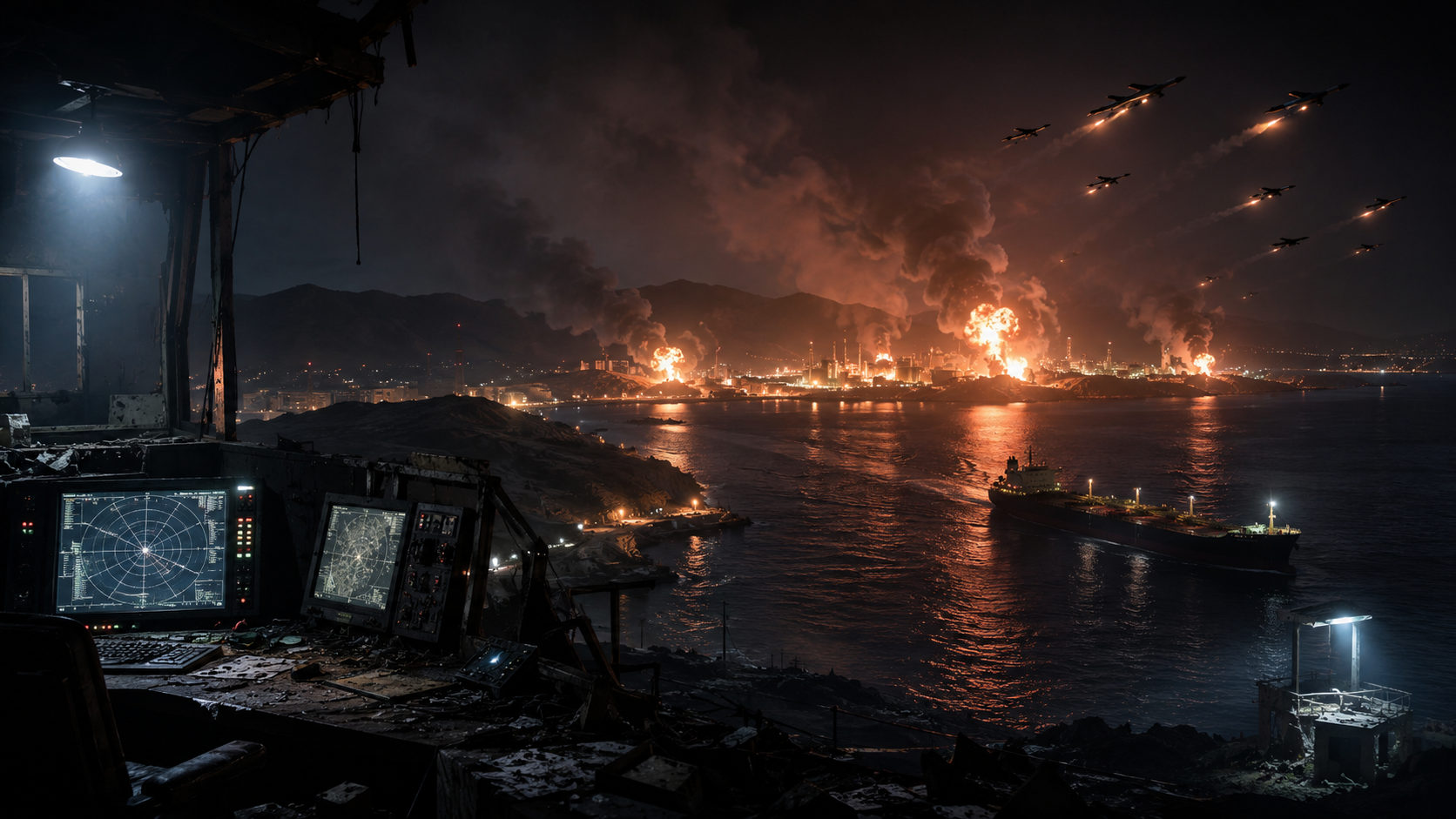
US Bombs Iran For 13th Consecutive Night As Regional War Intensifies
America’s 13th Night Of Strikes Pushes Iran War Towards A Far More Dangerous Phase
The United States has completed a thirteenth consecutive night of strikes against Iran, extending what began as a concentrated military campaign into a sustained attempt to weaken Tehran’s command structure, drone forces and ability to threaten international shipping. The latest attacks lasted more than two hours and struck targets across Iran, while Iranian forces answered with new operations against American military facilities elsewhere in the Middle East.
This is no longer merely a sequence of retaliatory raids. The conflict is becoming geographically wider, economically more damaging and increasingly difficult for either side to contain without appearing to retreat.
What The United States Targeted
US Central Command said the latest operation struck Iranian military command centres, drone storage facilities, communications networks, coastal surveillance sites and maritime capabilities. The declared purpose was to reduce Iran’s ability to threaten civilian mariners and commercial vessels using the Strait of Hormuz.
That target list reveals the central American strategy. Washington is not only destroying weapons immediately capable of hitting US personnel. It is attacking the network that allows Iran to observe shipping, communicate with forces, store unmanned aircraft, coordinate attacks and exercise military control along its coastline.
Reports indicate that the strikes extended from southern Iran towards areas close to the Caspian coast, suggesting a broader target set than a limited coastal suppression campaign. Sites in or around Gilan province, Ahvaz, Bandar Abbas and Qeshm Island have all been connected to the latest phase of American operations, although the precise scale of destruction at individual locations remains difficult to verify independently.
The previous night’s operation had already targeted maritime capabilities, missile and drone storage facilities, coastal surveillance systems and air-defence assets. US forces have now hit dozens of military sites during July while enforcing a maritime blockade that Washington says has redirected or disabled vessels attempting to enter or leave Iranian ports.
How Much Damage Has Been Caused
The physical damage appears substantial, but neither side has released enough verifiable information to calculate the full effect on Iran’s military capacity. American strike footage shows precision weapons producing large explosions at unidentified sites, while Washington says the campaign is progressively degrading Iran’s command, surveillance, drone and maritime infrastructure.
Iranian authorities have acknowledged attacks in several provinces, and reports from the latest operation said at least four people were killed in strikes affecting northern Iran and the Ahvaz area. Those figures remain provisional, and the absence of unrestricted access, reliable local communications and independent battlefield assessment means the real casualty and infrastructure totals could be higher.
The most important damage may not be a single destroyed building. Repeated attacks can force Iran to disperse aircraft, relocate drones, reduce radar activity, move commanders, abandon exposed communications systems and rely on slower or less secure methods of coordination.
That creates cumulative pressure. A storage depot can eventually be rebuilt, but a military organisation repeatedly forced to move personnel and equipment becomes less efficient, less predictable and more vulnerable to further strikes.
There is still no evidence that the campaign has eliminated Iran’s ability to retaliate. Tehran continues to launch drones and missiles, threaten commercial shipping and activate aligned forces across the region. The strikes therefore appear to be weakening parts of Iran’s military network without yet breaking its capacity or willingness to fight.
Is The War Becoming More Intense?
Yes. The most significant evidence is not simply that the bombing has continued for thirteen nights, but that the conflict is spreading into additional countries and strategic waterways.
Earlier American operations were heavily focused on Iran’s missile, drone, air-defence and maritime infrastructure around the Persian Gulf. The current phase now includes attacks from southern Iran towards the north, while Tehran is attempting to hit US-linked facilities in Kuwait, Bahrain, Jordan and Iraq.
Iran’s Houthi allies have also attacked Saudi oil tankers near the Bab el-Mandeb strait, extending the economic battlefield from the Strait of Hormuz into the Red Sea. This matters because the two waterways sit on opposite sides of the Arabian Peninsula and together carry a vast volume of international energy and commercial traffic.
The United States is therefore facing pressure at two maritime chokepoints rather than one. Protecting Hormuz requires aircraft, ships, surveillance platforms, minesweeping resources and missile defences in the Gulf. Protecting Red Sea traffic adds another operational theatre around Yemen, Saudi Arabia and the approaches to the Suez Canal.
President Donald Trump has responded by promising major military punishment for Iran and the Houthis. He has also said Tehran will be held financially responsible for damage caused to vessels, raising the possibility that frozen Iranian funds could become part of an economic retaliation campaign alongside conventional military action.
The threat of a larger American assault means the thirteenth night may become a bridge to a more aggressive phase rather than the peak of the campaign.
How Iran Is Responding
Iran’s immediate strategy is to make the war expensive, dispersed and politically uncomfortable for Washington.
The Iranian military says it has launched drones against American facilities at Isa Air Base in Bahrain, Al-Azraq Air Base in Jordan, and Camp Udairi, Camp Doha and Camp Arifjan in Kuwait. Tehran has claimed that fuel tanks, ammunition storage, equipment warehouses, barracks and aircraft-maintenance facilities were targeted.
Iran has also claimed attacks against Ali Al Salem Air Base in Kuwait and American-linked facilities in northern Iraq. Explosions and drone interceptions have been reported around several locations, but Iranian claims of destroyed ammunition depots and US casualties have not been independently confirmed.
Jordan reported intercepting seven missiles and six drones without casualties or damage. That demonstrates the strength of regional air defences, but every interception also consumes expensive ammunition and requires military personnel to remain at continuous readiness.
Tehran has warned civilians in countries hosting American troops to stay away from US military installations. This warning serves both a military and political purpose: it signals that bases across the region remain targets while increasing public pressure on Gulf governments whose territory supports American operations.
Iran’s broader response includes threatening or attacking shipping in the Strait of Hormuz, supporting Houthi pressure in the Red Sea and maintaining the ability to launch relatively inexpensive drones against distant bases. It does not need to defeat the United States in a conventional confrontation. Its objective is to stretch American defences, disrupt trade, raise oil prices and persuade neighbouring governments that hosting US forces carries an unacceptable risk.
What Iran Is Likely To Do Next
Iran is unlikely to answer American air power by attempting a symmetrical bombing campaign. It has fewer aircraft, weaker conventional air power and greater exposure to US surveillance and long-range weapons.
Its more probable response is continued asymmetric escalation. That could include larger drone salvos, ballistic-missile attacks, maritime mines, attacks on radar or desalination infrastructure, harassment of commercial vessels, cyber operations and additional action by aligned groups in Yemen or Iraq.
Tehran may also deliberately vary the intensity of its attacks. A limited operation against an isolated warehouse could be followed by a larger barrage designed to overwhelm missile defences. Unpredictability forces Washington and its partners to protect dozens of potential targets simultaneously.
The most dangerous possibility would be a successful Iranian strike causing substantial American casualties. Such an attack would create enormous pressure on Trump to launch the major offensive he has already threatened, potentially expanding the US target list from military facilities to energy, industrial or government infrastructure.
Iran could also increase pressure on Saudi Arabia. Houthi attacks on Saudi tankers create an indirect route for Tehran to impose economic damage while complicating attribution and retaliation. Washington has made clear that it intends to hold Iran responsible for future Houthi attacks, reducing Tehran’s ability to distance itself from the consequences.
The Global Economic Threat
The conflict’s most immediate global consequence is the growing risk to energy supplies and maritime trade.
Brent crude moved above $100 a barrel after the attacks on Saudi tankers and the expansion of fighting around a second shipping route. The rise reflects fears that disruption could affect both exports from the Gulf and traffic moving between the Indian Ocean, Red Sea, Suez Canal and European markets.
Higher oil prices feed directly into petrol, diesel, aviation, manufacturing, food distribution and household energy costs. Marine insurance premiums are also likely to remain elevated, while shipping companies may demand greater security guarantees or divert vessels onto longer routes.
The United States insists that the Strait of Hormuz remains open with American military support. Formal openness, however, is not the same as normal commercial use. Shipowners must assess the risk of drones, missiles, mines, seizures and accidental confrontation before allowing crews and expensive cargoes to enter the area.
The presence of thousands of stranded seafarers adds a human dimension to the crisis. A prolonged disruption could transform what is currently a military and energy emergency into a wider humanitarian and supply-chain problem.
The Pressure On America’s Allies
Bahrain, Kuwait, Jordan and Iraq are now being pulled deeper into a war many of their governments would prefer to contain.
These states host American personnel or facilities but remain geographically exposed to Iranian missiles and drones. Their leaders must preserve security relationships with Washington while reassuring their populations that foreign military bases are not turning their countries into permanent battlefields.
Repeated Iranian attacks could strengthen regional cooperation with the United States, especially on missile defence and intelligence sharing. They could also produce the opposite political effect by increasing pressure to restrict how American forces use local bases.
Saudi Arabia faces an additional dilemma. It is a major US partner and a direct target of Houthi maritime pressure, but a sustained regional war threatens its energy exports, investment strategy and domestic transformation plans. Riyadh may therefore support stronger protection while continuing to search for a diplomatic exit.
Iraq is particularly vulnerable. Drone attacks around Irbil and the presence of Iran-aligned armed groups create a risk that Iraqi territory becomes both a launch platform and a target, weakening Baghdad’s control over its own security environment.
Russia, China And The Wider Power Struggle
Russia and China stand to gain strategically from prolonged American distraction, but both also face serious risks.
A long war absorbs US aircraft, interceptors, naval assets and political attention that might otherwise be directed towards Europe or the Indo-Pacific. It may also increase energy revenues for exporters able to benefit from higher prices.
However, neither Moscow nor Beijing wants uncontrolled disruption to Gulf shipping. China depends heavily on imported energy and stable trade routes, while Russia must avoid actions that could trigger a direct confrontation with the United States.
US intelligence is reportedly examining whether Russia has provided assistance to Iran. Any confirmed transfer of targeting information, air-defence support or advanced military technology would deepen the confrontation beyond the Middle East and increase pressure for American retaliation against Russian interests elsewhere.
China is more likely to push for de-escalation while blaming American military pressure for the instability. Beijing could use the crisis to present itself as a diplomatic alternative, but its influence will be tested if neither Washington nor Tehran sees compromise as politically acceptable.
Why The Thirteenth Night Matters
The latest strikes matter because they demonstrate that neither side has yet reached the point where the cost of continuing exceeds the political cost of stopping.
The United States believes sustained precision attacks can progressively strip Iran of the systems needed to threaten troops and shipping. Iran believes drones, missiles, proxies and economic disruption can prevent Washington from achieving that objective at an acceptable cost.
Both strategies can operate for some time without producing a decisive military result. That is precisely what makes the conflict dangerous.
Thirteen nights of American strikes have damaged Iranian military infrastructure and forced Tehran into a more defensive posture. They have not ended Iran’s attacks, secured normal commercial movement through the region or produced a diplomatic settlement.
The next turning point may come not from a planned strategic decision but from a missile that reaches its target, an intercepted drone that falls into a populated area, a tanker sinking in a major waterway or an attack that kills a large number of American personnel.
The war is becoming more intense because every new front creates another opportunity for miscalculation. The United States is demonstrating overwhelming strike capacity, but Iran is demonstrating that it can spread instability across a region whose military bases, cities, energy facilities and shipping routes are packed closely together. Unless one side changes course, the fourteenth and fifteenth nights could carry consequences far beyond anything destroyed during the thirteenth.
