US–Iran Pressure Cycle: How a “Limited Strike” Threat Could Spiral Fast
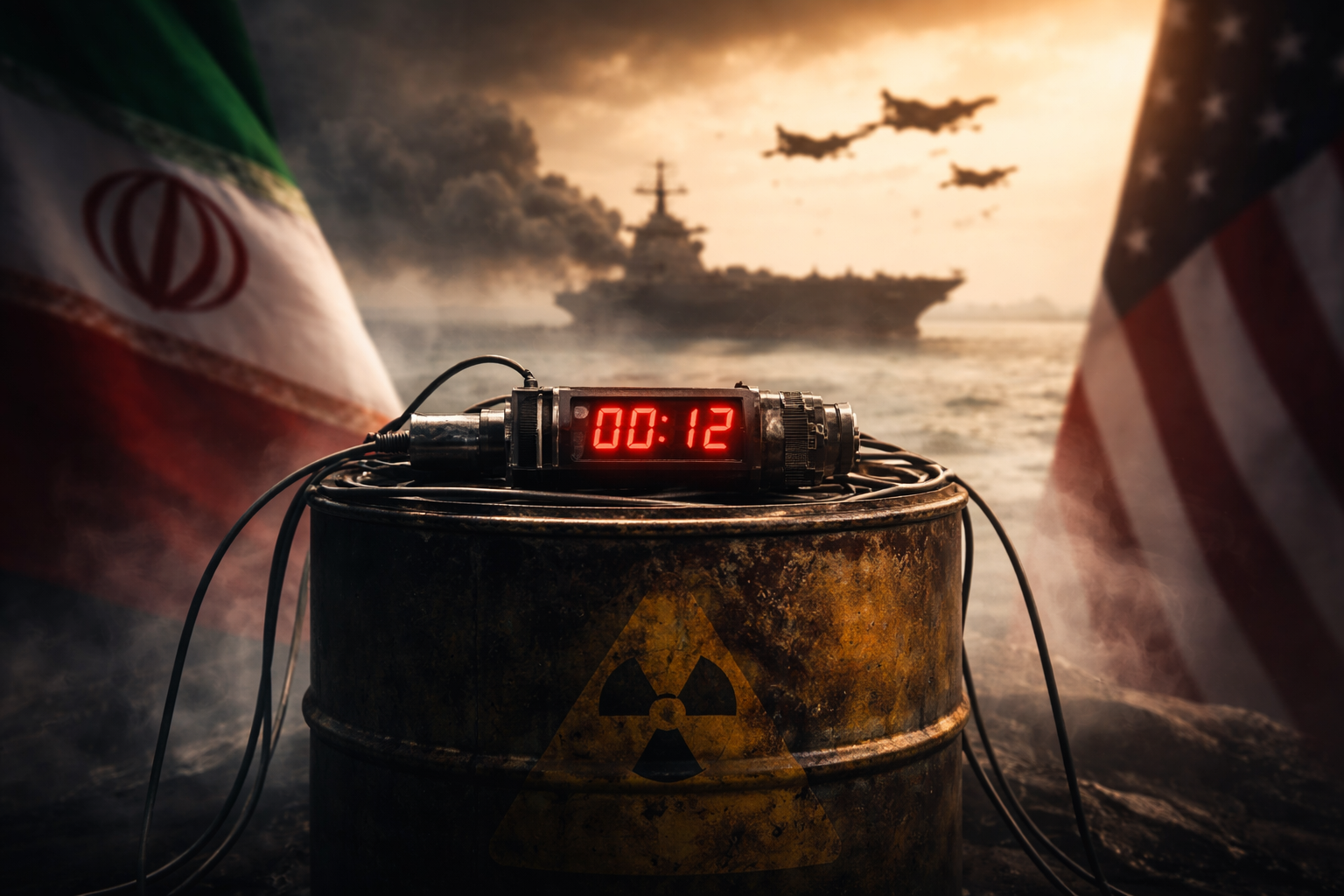
US–Iran Nuclear Talks Stall as Force Posture Rises: The Escalation Trap
The Gulf Buildup That Shrinks the Room for a Deal
A negotiation can look alive right up to the moment it stops being one.
In the past week, reporting has described nuclear diplomacy with Iran as stuck while the US military footprint around the Gulf appears to be rising sharply. The result is a familiar countdown mood: every statement, deployment, or “deadline” becomes a market-moving signal.
What’s new is not the existence of red lines. It’s how fast the red lines collide when military posture and diplomatic sequencing move at different speeds.
The story turns on whether verification can restart fast enough to make any nuclear limits believable before coercive options take over.
Key Points
Recent reporting has described stalled US–Iran nuclear diplomacy alongside a larger US military posture in and around the Gulf, raising fears of miscalculation.
The core bargaining fight is usually framed as enrichment versus sanctions relief, but verification and monitoring constraints increasingly decide what either side can safely agree to.
Missiles and regional deterrence are not side issues; they shape whether Tehran believes concessions invite pressure and whether Washington believes restraint invites acceleration.
“Who moves first” is the practical deadlock: Iran wants economic relief before irreversible steps, while the US wants nuclear steps before meaningful relief.
The fastest path to de-escalation is a sequenced package: limited, reversible nuclear steps matched to limited, reversible economic steps, tied to measurable inspections.
The fastest path to escalation is a trigger cascade: a new nuclear move, a strike or near-strike event, or a domestic political shock that hardens positions.
Watch for concrete verification actions and specific, scoped sanctions mechanisms; those are the rare signals that change the game.
Iran’s nuclear program is centrally about two things.
Capability and confidence. Capability is what Iran can do with uranium enrichment and related infrastructure. Outside parties' confidence lies in their ability to verify Iran's possessions, location, and intended uses.
The 2015 nuclear deal model traded constraints and monitoring for sanctions relief. Since the US exit from that framework, the negotiation problem has been rebuilding a bargain under worse trust and tighter timelines.
Key terms: simply, "enrichment" is how uranium is processed to increase the proportion of a fissile isotope. “Verification” is the inspection, monitoring, and accounting system that lets others know what is happening, not just what is promised.
Missiles matter because they shape deterrence and coercion. Even if a nuclear bargain is possible on paper, the region’s strike capabilities and defenses affect how each side values time, risk, and concessions.
The escalation trap: when “leverage” becomes a deadline you can’t walk back
A military buildup is meant to create bargaining power. But it also creates a clock.
Once leaders surge forces, they confront a credibility dilemma: if their posture yields no results, it may appear as a bluff. If it produces an outcome, it can reward brinkmanship and make the next crisis more likely.
This phenomenon is why the same deployment can be read in opposite ways. Allies may treat it as reassurance. Markets may treat it as probability. Tehran may treat it as a sign that diplomacy is a cover for coercion and harden rather than yield.
In that environment, even neutral events become interpreted as moves. A routine exercise can be read as preparation. One could interpret a diplomatic pause as a strategy to gain time. The risk is not just conflict by choice, but conflict by accumulated inference.
The red-line collision: enrichment vs verification vs missiles vs sanctions
The public headline fight is often seen as enrichment. Washington signals it cannot accept a path that leaves Iran close to a rapid breakout capability. Tehran signals it cannot accept a deal that strips what it calls sovereign rights or leaves it economically strangled.
However, verification is crucial for the success or failure of any deal. If inspectors cannot credibly confirm inventories, access, and continuity of knowledge, then even a “good” enrichment number can fail to reassure. This creates pressure for harsher terms, leading to rejection and coercion.
Missiles are the “insurance policy” variable. Tehran’s view is that missile limits weaken deterrence in a region where it expects threats. Washington and regional partners view missile capability as the delivery and coercion layer that makes nuclear latency more dangerous.
Sanctions relief is the irreversible-versus-reversible argument. Tehran wants relief that is real, usable, and not easily reimposed. Washington often prefers relief that is staged and conditional, precisely because trust is thin.
The first-move dilemma: why “move first” feels like surrender on both sides
Negotiations break when each side believes the first step is the only thing that matters.
Iran’s leadership has reasons to fear a one-sided sequence: reduce nuclear leverage first, then wait for relief that can be delayed, diluted, or undone. The US is apprehensive about a scenario where it grants economic relief first, only to witness the nuclear steps stall or reverse.
So the “first move” needs to be redefined as a pair of moves that are both limited and both measurable. The technical trick is reversibility. The political trick is selling reversibility as strength, not weakness.
This is why narrow, testable steps matter more than grand announcements. A deal becomes possible when both sides can claim they traded something, not when one side is asked to trust words.
The decision tree: the few triggers that actually decide the next phase
Branch 1: Confidence-building succeeds (de-escalation path)
If Iran allows concrete verification steps that restore continuity of knowledge, and if the US pairs that with specific, scoped economic relief that Iran can actually use, then talks can shift from slogans to implementation. The trigger is not a promise of future access, but observable access that produces verifiable accounting.
Constraint: Iran will resist steps that look like capitulation or open-ended intrusion. The US will resist relief that looks permanent without durable nuclear limits. The solution is time-boxed, measurable trades.
Branch 2: Diplomacy stalls but remains “managed” (holding pattern)
If both sides keep talking while posture stays high, the system becomes a stress test of discipline. The trigger here is restraint: no new major nuclear steps, no kinetic incidents, and no maximalist public ultimatums that corner leaders.
Constraint: holding patterns decay. As the posture persists, the likelihood of an incident, a domestic political shock, or a misinterpreted signal compelling a decision increases.
Branch 3: Trigger cascade to limited strikes (coercion path)
If Washington concludes the time window for a deal has closed, it may consider limited strikes framed as enforcing boundaries rather than starting a war. The trigger is often a perceived crossing: enrichment expansion, reduced inspector access, a regional attack, or a clear intelligence warning.
Constraint: “limited” is hard to keep limited. Iran’s incentives may shift toward retaliation to restore deterrence, especially if it believes restraint invites more strikes.
Branch 4: Escalation to regional conflict (failure path)
If retaliation hits US forces, partners, shipping, or critical infrastructure, the political demand for a larger response rises. The trigger is not just damage; it is attribution and domestic pressure. Once leaders feel trapped by credibility, escalation becomes a substitute for strategy.
Constraint: neither side may want full war, but both sides may accept higher risk to avoid looking weak. That is how brinkmanship ends badly.
The measurable signals: what confirms compromise or confirms collapse
Compromise signals are usually boring on purpose. Look for verification language that is specific about access, inventories, and timelines. Look for sanctions mechanisms that are scoped, sequenced, and legally workable.
Collapse signals tend to be theatrical. Watch for hard deadlines paired with public maximalist demands or for steps that reduce monitoring and transparency. Watch for abrupt regional warnings, evacuations, or explicit changes in rules of engagement language.
Most importantly, watch whether verification becomes the center of the conversation. When it does, a deal architecture exists. When it doesn’t, the dispute remains rhetorical and unstable.
What Most Coverage Misses
The hinge is not whether Iran enriches, but whether verification can be restored quickly enough to make any limits enforceable and politically saleable.
That mechanism changes the incentive structure. Weak verification pushes the US side toward harsher demands or coercive options because it cannot prove compliance. Strong verification makes enforcement credible, which allows the US side to accept more stringent nuclear terms. For Iran, robust verification can be framed as a pathway to real economic relief, not as humiliation, if it is paired with relief that is immediate, usable, and reversible only if Iran reverses first.
Two indicators would verify that events are being driven by the pivot point. First, concrete inspector access actions and public mention of specific monitoring steps should be prioritized over generic “transparency.” Second, sanctions relief is being described in precise, limited instruments tied to verification milestones, not broad promises.
What Happens Next
In the short term, the next 24–72 hours are about signals and self-control. A single statement can be read as a commitment, and a single deployment can be read as a deadline. Allies will recalibrate risk fast, because shipping, energy, and force protection decisions cannot wait for perfect clarity.
In the medium term, the next few weeks become a sequencing contest: who concedes something measurable first, and whether that concession is reversible enough to survive domestic politics. The key consequence is that time pressure compresses choices, because a sustained high posture is politically and operationally hard to maintain without either a diplomatic deliverable or an escalation.
Watch for discrete decisions: verification steps announced with timelines; any phased relief described with conditions; any explicit narrowing of demands on enrichment or missiles; and any formal shift from “talks continuing” language to “window closing” language that implies coercion.
Real-World Impact
A UK-based importer watches insurance costs on shipments and worries about sudden route disruptions, because underwriters react to threat perception, not just actual incidents.
A Gulf-based airline operations team quietly plans reroutes and contingencies for airspace disruptions, because a single night of closures can ripple through schedules for days.
An energy-intensive manufacturer sees price volatility hit hedging costs because markets reprice risk immediately when escalation odds rise.
A diaspora family pauses travel plans and remittances, because uncertainty changes everyday decisions long before policy does.
The fork that defines this phase of the crisis
This is a contest between escalation momentum and verification momentum.
Escalation momentum is built on posture, deadlines, and credibility narratives. Verification momentum is built from access, measurement, and reversible steps that convert trust from a feeling into a process.
If verification momentum wins, a narrow, enforceable deal becomes plausible even under poor trust. If escalation momentum wins, diplomacy becomes a sideshow to coercion, and the region enters a period where accidents and retaliation carry strategic weight.
The historical significance of this moment is that it tests whether modern brinkmanship can still be deactivated by measurable verification—or whether force posture has become the default language of negotiation.
