WHO Sounds Global Emergency Alarm As Rare Ebola Virus Spreads Across Borders Without A Vaccine
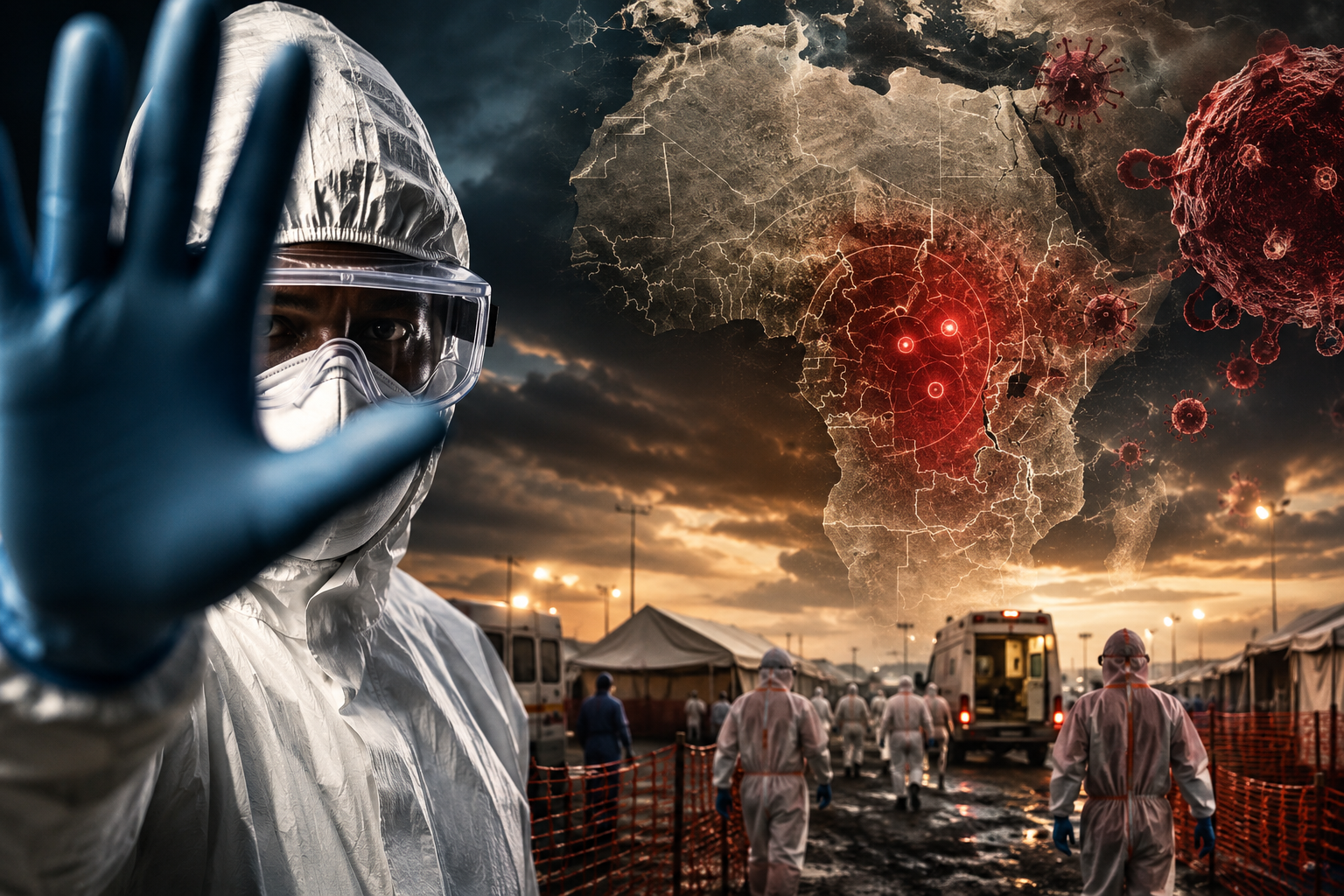
The Ebola Outbreak Health Officials Fear Could Spiral Faster Than Expected
The Detail Making This Outbreak Far More Dangerous
The World Health Organization has now declared the Ebola outbreak spreading across parts of the Democratic Republic of Congo and Uganda a public health emergency of international concern, immediately elevating global concern around the crisis. The move applies to situations that carry serious international risk, especially when cross-border spread has already begun.
What makes this outbreak especially alarming is not simply Ebola itself but the specific strain involved. Officials say the outbreak is linked to the rare Bundibugyo strain of the virus—a variant for which there are currently no approved vaccines or targeted therapeutics.
That changes the psychological atmosphere instantly.
Modern Ebola response systems have increasingly relied on rapid ring vaccination strategies to contain outbreaks before they spiral. For the more common Zaire strain, approved vaccines exist and have previously helped slow transmission. But Bundibugyo removes one of the biggest weapons global health agencies normally depend on.
The result is a situation that feels significantly less controlled than many previous Ebola scares.
The Numbers Alone Are Starting To Worry Experts
Official figures remain fluid, but health agencies have already linked the outbreak to hundreds of suspected infections and dozens of deaths. Multiple reports indicate that the number of suspected cases may now exceed 300.
The deeper concern is that confirmed numbers may only represent part of the real picture.
Health officials and outbreak analysts are increasingly worried that delayed detection, conflict conditions, overwhelmed healthcare infrastructure, and cross-border population movement may have allowed the virus to circulate for weeks before the full scale became visible.
One of the most troubling details emerging from the outbreak response is the suggestion that some early laboratory testing may have initially focused on the wrong Ebola strain, slowing confirmation efforts during a critical window.
That matters enormously with Ebola.
The virus spreads through direct contact with infected bodily fluids, contaminated surfaces, and infected corpses during burial practices. Once transmission chains begin forming in dense or unstable environments, containment becomes exponentially harder.
The border spread changes everything.
For weeks, many outbreaks remained geographically concentrated enough to create some sense of containment.
This one no longer fits that description.
Confirmed cases have now appeared in both the Democratic Republic of Congo and Uganda, dramatically increasing fears around regional spread.
Cross-border movement is one of the biggest nightmare scenarios in infectious disease containment because the virus begins moving through transport networks, trade routes, refugee corridors, urban hospitals, and crowded transit systems before authorities can fully map transmission chains.
Officials are especially worried about the role of conflict-hit regions and high population mobility near eastern Congo. Several affected areas already suffer from weak healthcare infrastructure, humanitarian instability, and distrust of authorities — all factors that historically make Ebola outbreaks significantly harder to control.
The fear is not necessarily that the outbreak becomes a global pandemic tomorrow.
The fear is that containment becomes messy enough for the outbreak to keep generating new hotspots faster than authorities can shut them down.
Why The Vaccine Problem Matters So Much
The phrase “no approved vaccine” is doing enormous psychological damage to public confidence because most people now assume vaccines exist for Ebola generally.
That assumption is only partially true.
Approved vaccines exist for the Zaire strain of Ebola, particularly the Ervebo vaccine that became central to several previous containment operations.
But Ebola is not one single uniform virus.
Different strains behave differently, spread differently, and respond differently to medical countermeasures. The Bundibugyo variant involved in this outbreak sits in a far more uncertain zone scientifically.
There have been candidate vaccine efforts and experimental treatments involving other non-Zaire Ebola strains in previous outbreaks, including Sudan virus outbreaks in Uganda.
But “candidate” is not the same as “approved.”
That distinction suddenly becomes terrifying once fatalities start climbing.
The Part Of The Story Most People Are Missing
The outbreak is exposing something much larger than one regional health emergency.
It is revealing how vulnerable the global system still is when an outbreak emerges outside the narrow group of pathogens the world has heavily prepared for.
The uncomfortable reality is that modern outbreak readiness often depends on having the right tools for the right variant at exactly the right moment. Once a less familiar strain appears inside politically unstable or resource-stretched regions, uncertainty rises extremely fast.
That is why WHO’s emergency declaration matters psychologically as much as medically.
The declaration signals that international agencies believe the situation carries genuine cross-border risk, requires coordinated international action, and cannot safely be treated as a purely localized issue anymore.
It also sends a message to governments worldwide that preparedness reviews, border monitoring, airport screening, laboratory readiness, and healthcare surveillance may need to intensify quickly if the outbreak worsens.
The Next Few Weeks Could Define The Entire Crisis
Ebola outbreaks often hinge on speed.
Speed of detection.
Speed of isolation.
Speed of tracing contacts.
Speed of public trust.
Currently, health officials appear deeply focused on preventing the outbreak from becoming embedded across wider regional population networks. The faster we identify new chains, the greater the chance we can still box the outbreak in geographically.
But if hidden transmission chains continue growing beneath official visibility, the situation could become substantially harder to reverse.
That is the real pressure behind the current global alarm.
Don't panic. Not Hollywood-style apocalypse narratives.
Uncertainty.
And in infectious disease outbreaks, uncertainty is often the most dangerous phase of all.
