The San Diego Mosque Shooting Is Triggering New Fears About Radicalisation In America
Why The San Diego Mosque Shooting Could Become A Major National Turning Point
Police Were Warned Before The San Diego Mosque Attack—But Three People Still Died
A deadly attack outside one of California’s largest mosques is now forcing America to confront another terrifying question: how many warning signs are being missed before violence erupts?
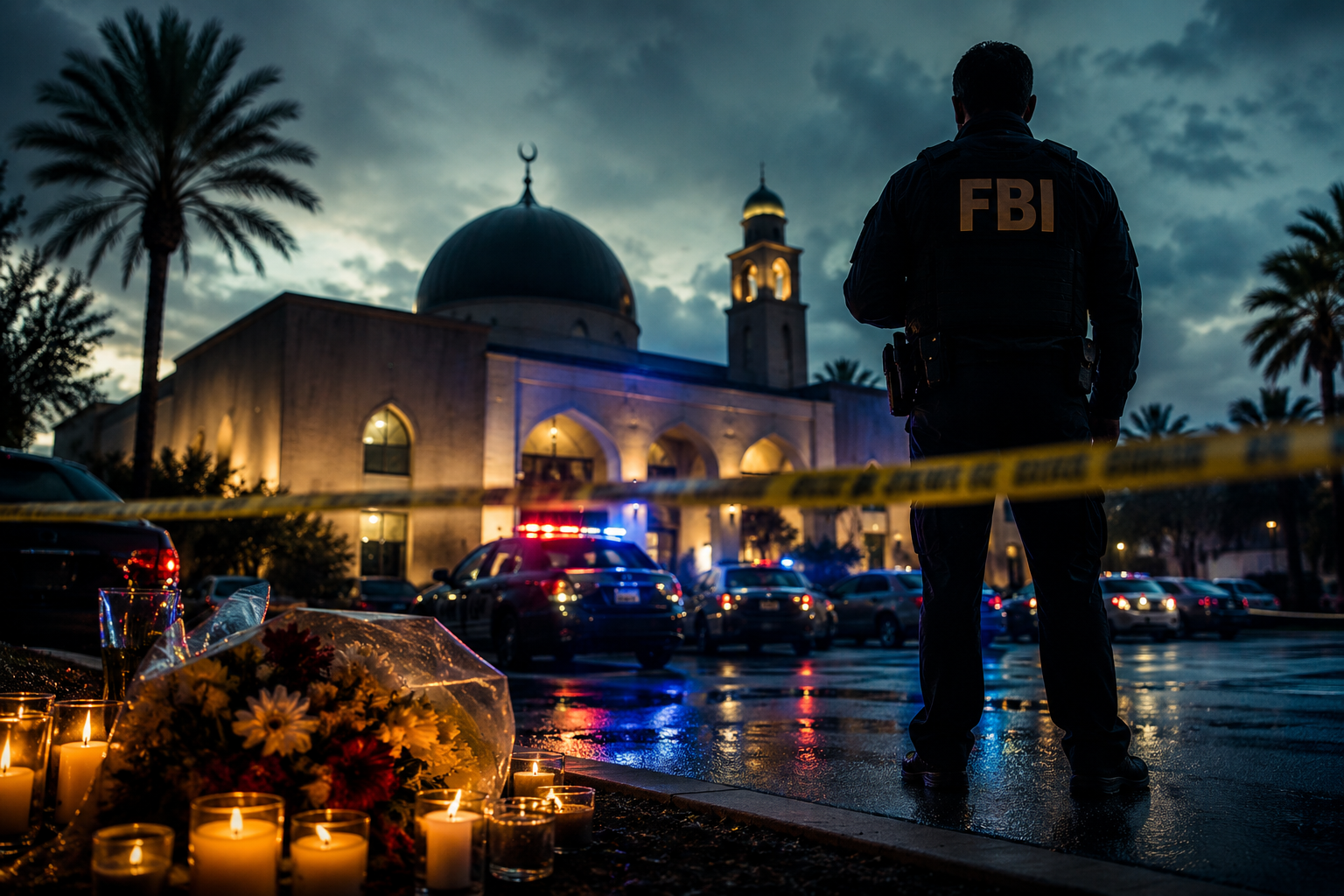
Three people were killed after two teenage suspects opened fire outside the Islamic Center of San Diego, according to authorities investigating the attack. The suspects later died from apparent self-inflicted gunshot wounds, while federal investigators are now examining whether the attack was motivated by religious hatred or extremist ideology.
The attack has instantly become one of the biggest national stories in America because it appears to touch multiple political fault lines at once: religious violence, radicalization, hate crime fears, gun access, online extremism, and questions over whether authorities had enough warning to intervene earlier.
The timing has made the story even more explosive.
The Islamic Center of San Diego is one of the largest mosques in California and serves a huge local Muslim community, including families and children attending the attached Al Rashid School. Authorities confirmed that children inside the complex were safely evacuated during the chaos.
What has intensified national attention even further is the timing. The shooting happened during one of the holiest periods in the Islamic calendar, just ahead of Eid al-Adha celebrations. For many Muslims across the United States, that has transformed the attack from a local tragedy into something psychologically much larger—an assault occurring during a sacred religious moment.
The symbolism matters because attacks on religious spaces tend to reverberate far beyond the immediate victims. Churches, synagogues, mosques, and temples are not just buildings. They are emotional safe zones for communities. Once violence enters those spaces, fear spreads rapidly.
The warning before the attack is becoming a central question.
One of the most disturbing elements emerging from the investigation is the reported warning call made before the shooting unfolded.
Authorities confirmed that the mother of one suspect had contacted police earlier, reportedly warning that her son was suicidal, armed, and had taken weapons from the home. Police were already searching for the vehicle connected to the suspects before the shooting occurred.
That detail is now becoming one of the defining parts of the story because it feeds directly into a wider American fear: that warning signs are repeatedly appearing before mass violence, but systems still fail to stop attacks in time.
The issue is politically explosive because there is rarely a simple answer. Even when authorities receive warnings, legal thresholds, response times, constitutional rights, incomplete information, and the speed of unfolding events can all limit what police are realistically able to do. But once an attack happens, the public conversation immediately shifts toward prevention failures.
That pattern has appeared repeatedly across previous American mass casualty incidents. The question is no longer just who carried out the violence. It becomes about whether the attack could realistically have been prevented before the first shot was fired.
The FBI’s Involvement Changes The National Stakes
Federal investigators are now heavily involved in the case, and authorities have said the shooting is being treated as a possible hate crime. Police also referenced evidence of hate rhetoric connected to the suspects.
That instantly changes the scale of the story.
Once the FBI enters an investigation involving potential ideological or religious targeting, the conversation shifts from local criminal violence to domestic extremism and national security concerns. America has spent years focused on fears surrounding political polarization and online radicalization, but incidents like this revive anxiety that ideological hatred is becoming harder to contain.
The United States has already experienced multiple high-profile attacks targeting religious groups over the past decade, including attacks on synagogues, Black churches, anthey safely evacuated children inside the complexd mosques. San Diego itself still carries memories of previous hate-linked violence, including the 2019 Poway synagogue shooting and an attempted mosque arson attack in nearby Escondido.
That history is one reason this story is resonating so strongly. Many Americans no longer see attacks on religious communities as isolated incidents. They increasingly fear a broader pattern of radicalization, grievance politics, and ideological violence spreading through parts of society.
The Heroic Detail Emerging From The Chaos
Amid the horror, one detail has deeply affected people following the story.
Authorities and community leaders say a mosque security guard played a major role in preventing the attack from becoming even deadlier. According to officials and religious leaders, he reportedly warned teachers to lock classroom doors as gunfire erupted outside.
The guard, identified as Amin Abdullah, has already become a symbol of courage inside the local community. Reports describe him as a father of eight who stayed focused on protecting others during the attack.
Stories like that often become emotionally central after mass casualty events because they cut through the political arguments and reveal the human reality underneath. Long after the investigations end, communities tend to remember the individuals who tried to save others while chaos unfolded around them.
The Bigger Fear Beneath The Headlines
The San Diego mosque shooting is not just generating fear because people died. It is generating fear because many Americans increasingly feel that ideological violence can erupt almost anywhere.
Schools, shopping centers, religious buildings, concerts, workplaces, political rallies, and public streets have all become part of America’s long-running anxiety around mass shootings. Every new attack deepens the psychological sense that no location feels fully protected anymore.
The political atmosphere also matters. America remains deeply polarized across religion, race, identity, immigration, geopolitics, and culture war politics. In that climate, every ideologically charged act of violence risks becoming part of a much larger national argument.
That does not mean broader communities are responsible for the actions of individuals. But it does mean emotionally charged attacks can rapidly inflame tensions far beyond the original crime scene.
The danger for the United States is not only the violence itself. It is the slow erosion of trust and safety between communities when people begin to fear that hatred is becoming normalized.
Why This Story Could Continue Growing
The San Diego mosque shooting is still developing, and many major questions remain unanswered. Investigators are still working to establish motive, determine whether others knew about the attack plans, and examine the suspects’ backgrounds and online activity.
But even before all the facts are known, the story has already crossed into something much larger than a local California tragedy.
It combines nearly every pressure point currently haunting modern America: mass shootings, ideological extremism, religious fear, online radicalization, police warning systems, and the growing sense that society is becoming more unstable under pressure.
That is why this story is spreading so quickly across the country.
For many Americans, the San Diego attack does not feel isolated. It feels like another warning flare in a country already struggling to contain political rage, social fragmentation, and recurring acts of ideological violence.
