

Why Governments Are Making Transport Free Overnight
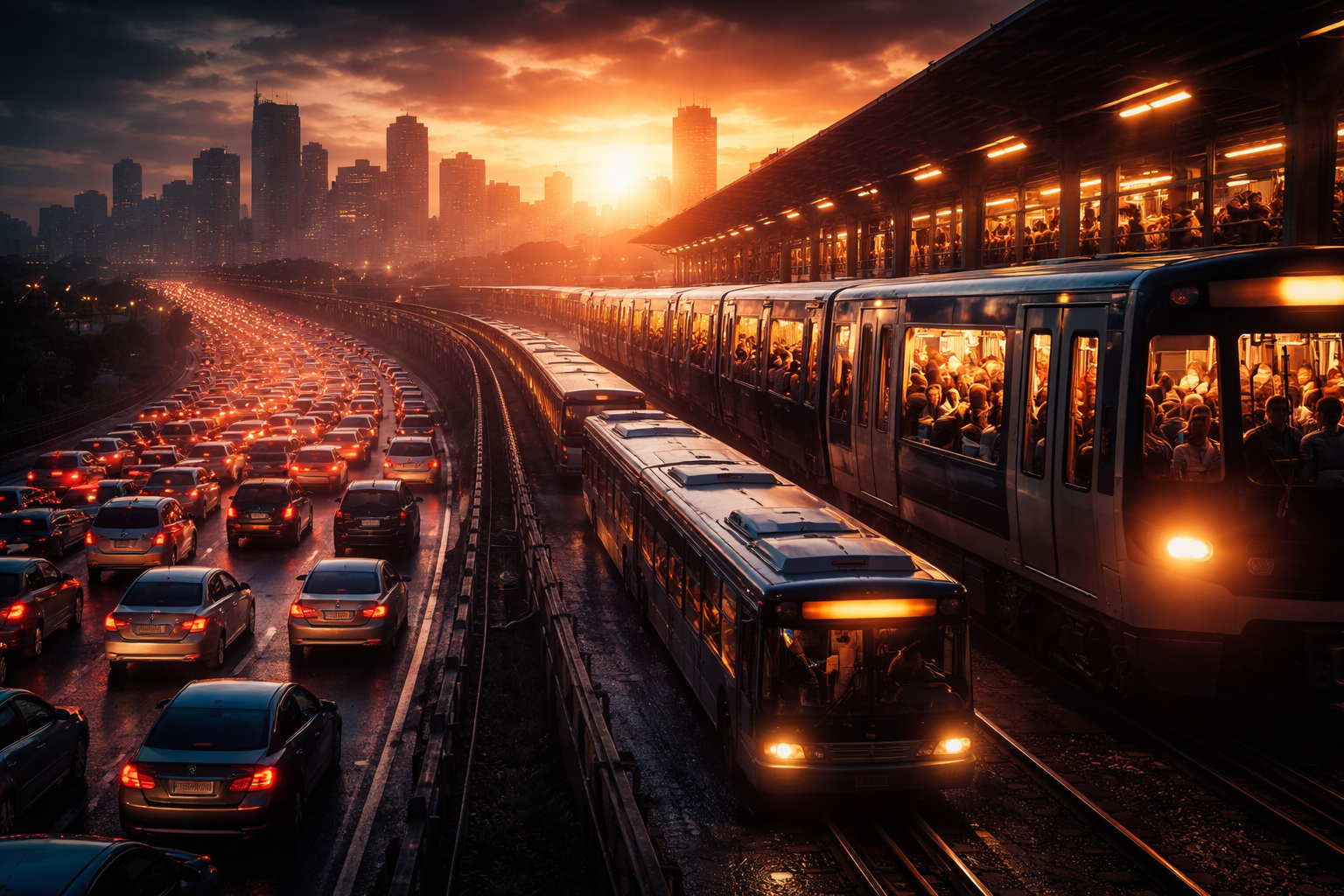
Free Public Transport Introduced — But Can It Last?
Free Public Transport Announced to Counter Fuel Costs — Emergency Fix or Economic Signal?
Multiple governments have begun offering free public transport in response to a sudden surge in fuel prices triggered by global energy disruption. The move is designed to ease household costs and reduce fuel demand—but it raises a deeper question: Is this a short-term relief policy or the early shape of a structural shift in how transportation is funded more profoundly?
In Australia, the states of Victoria and Tasmania have taken the lead, announcing temporary zero-fare transport across buses, trains, and ferries.
The policy looks simple—remove fares—but the real story sits beneath it: governments are quietly testing whether public transport can function as a fully subsidized utility during crisis conditions.
The story turns on whether free public transport becomes a temporary shock absorber—or a permanent redefinition of how mobility is funded.
Key Points
Victoria will make all public transport free for one month starting March 31, while Tasmania will extend free services until July 1.
The move is a direct response to rising fuel costs driven by global supply shocks linked to Middle East tensions.
Some regions are refusing to follow, citing long-term cost concerns and the scale of the crisis.
Governments aim to reduce fuel demand and shift commuters away from cars.
Early evidence suggests transport usage rises when fares are removed—but not always enough to significantly reduce driving.
The policy exposes a deeper economic question: who should pay for mobility—users, taxpayers, or employers?
Where This Policy Really Begins
The immediate trigger is simple: fuel prices have surged sharply following geopolitical disruption, with some regions seeing double-digit increases in household fuel costs in just weeks.
That shock has a direct effect on daily life. Commuting becomes more expensive overnight. Businesses face higher logistics costs. Inflation pressure builds quickly.
Governments are responding with the fastest lever available—transport fares.
Free public transport is not a new idea. It has been trialed in cities and even entire countries, often framed as a way to reduce inequality or emissions. But in this case, it is being deployed as an emergency economic stabilizer.
How the Policy Is Being Deployed
The rollout is highly targeted and temporary.
Victoria’s approach is short and sharp: one month of completely free travel across trains, trams, and buses.
Tasmania is taking a longer view, offering free buses and ferries for three months, explicitly framed as cost-of-living relief.
Other states, however, are resisting.
Governments in New South Wales, Western Australia, Queensland, and South Australia have rejected the idea, arguing that:
the crisis may last longer than the subsidy
the cost could escalate rapidly
resources may be better used elsewhere
This split reveals something important: free transport is not just a policy choice—it is a fiscal gamble.
The Real Economic Trade-Off
At first glance, free public transport looks like a win-win.
Commuters save money. Fuel demand drops. Public transport use increases. expenses
But the economics are more complex.
Fare revenue typically only covers a fraction of operating expenses—often around 10% in some systems—meaning governments already subsidize most transport spending.
Removing fares entirely shifts that remaining burden fully onto taxpayers.
That creates three immediate pressures:
Budget strain: Governments must absorb lost revenue at scale
Capacity risk: More passengers without proportional service expansion
Policy substitution: Money spent on fares cannot be spent elsewhere
This is why some regions are holding back. The cost of free transport grows fast—and does not shrink easily once introduced.
What It Means for People Right Now
For households, the impact is immediate and tangible.
Free public transport can save commuters significant weekly costs, especially those who rely on buses or trains daily.
It also changes behavior—at least temporarily:
Some drivers switch to public transport
Others increase travel because it is now free
Peak demand rises quickly
But the key question is whether the increase reduces car usage in a meaningful way.
Evidence from previous experiments suggests the answer is mixed. Ridership increases, but much of that shift comes from walking or cycling—not from cars.
That limits the policy’s impact on fuel demand.
What Most Coverage Misses
The critical hinge is not cost-of-living relief—it is demand management.
Free public transport is being used as a tool to influence behavior under supply shock conditions. Governments are not just helping commuters—they are trying to reduce national fuel consumption.
That matters because fuel shortages are not just about price. They are about availability, logistics, and strategic reserves.
Every commuter who leaves their car at home frees up fuel for:
freight
agriculture
emergency services
critical infrastructure
This approach turns public transport into a form of resource allocation policy.
The deeper implication is that mobility is being reframed as a shared system under stress—not an individual consumer choice.
Who Gains, Who Loses
The winners are clear:
Urban commuters with access to public transport
Lower-income households
Governments seeking short-term political relief
But there are also losers or constraints:
Rural populations with limited transport alternatives
Public transport systems under capacity pressure
Government budgets already under strain
Once governments remove fares, reintroducing them can pose a political challenge.
The Global Pattern Emerging
This trend is not happening in isolation.
Around the world, governments are experimenting with different responses to the same energy shock:
fuel subsidies
rationing
reduced working weeks
public transport incentives
Free transport is one of the fastest to implement—but not necessarily the most sustainable.
It works best as a temporary shock absorber, not a permanent system.
What Happens Next
The next phase will depend on three signals:
Fuel prices: If they stabilize, free transport will likely end quickly
Usage patterns: If demand overwhelms systems, governments may scale back
Fiscal pressure: Rising costs could force early policy reversal
If fuel disruption persists, governments face a harder choice: extend subsidies or redesign transport funding entirely.
This is where the real shift could occur.
Because once mobility becomes a public utility in crisis, it raises a larger question: should it ever fully return to a pay-per-use model?
The answer will shape not just transport but the broader economic model of daily life.
