Why The Latest Kyiv Attack Is Bigger Than Another Night Of Russian Terror
Russia’s Kyiv Assault Reveals The Brutal Weakness Putin Is Still Testing
The Night Kyiv Was Forced To Measure Survival In Missiles
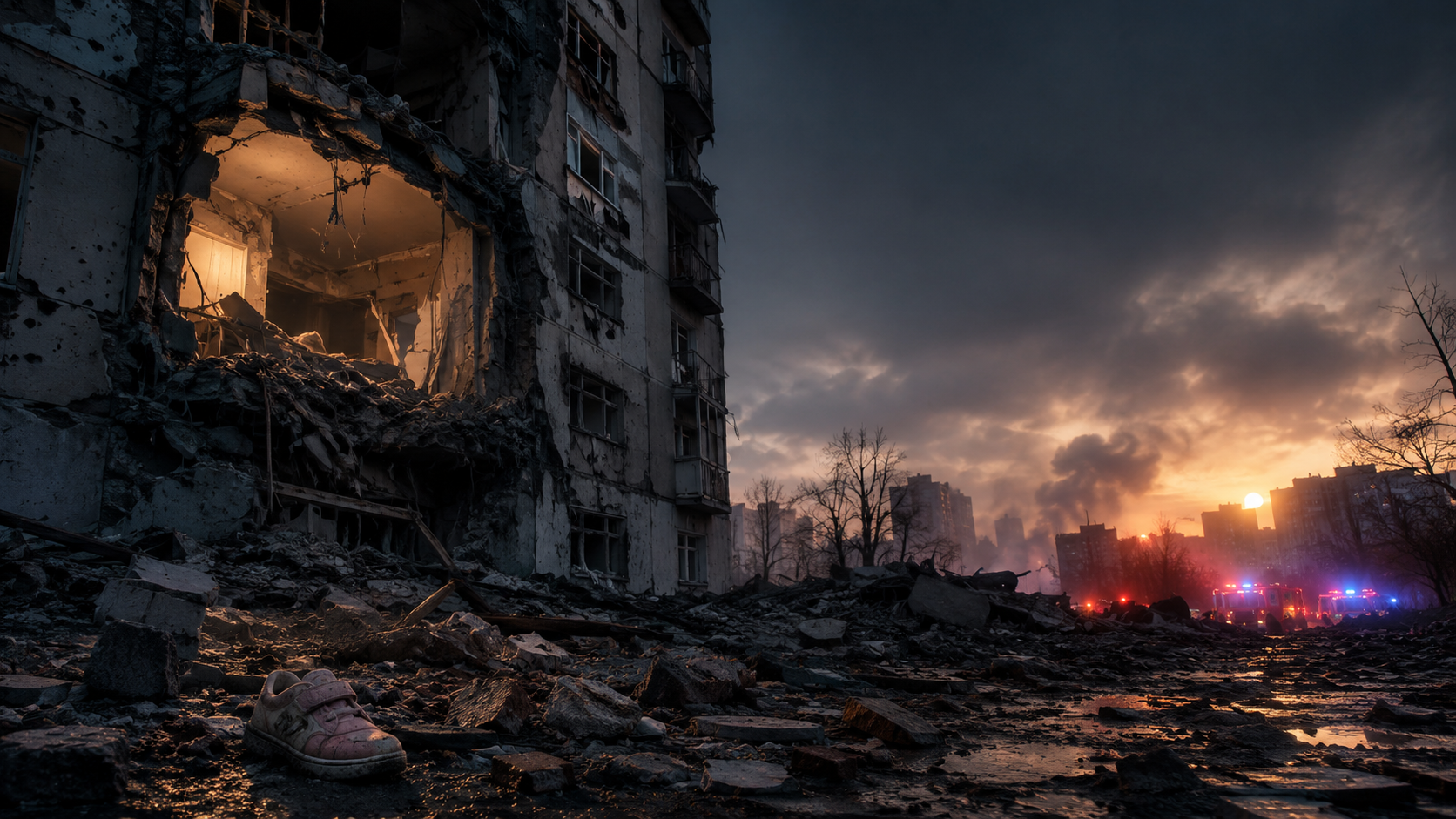
Russia’s Strike Turned Kyiv Into The Centre Of The War AgainRussia launched one of its deadliest attacks on Kyiv this year in a massive overnight barrage of missiles and drones. At least 17 people were reported killed and more than 90 injured, after an assault that damaged residential buildings, civilian infrastructure, and parts of the Ukrainian capital across multiple districts. Ukrainian officials said Russia fired 74 missiles and 496 drones during the attack.
The numbers matter because they show a method, not just a moment. Russia is not only striking front lines or military positions. It is using scale, repetition, and fear to force Ukrainian cities into a permanent state of alert, where the ordinary rhythm of civilian life depends on whether air defences can hold through another night.
The Damage Was Civilian, Visible, And Designed To Be Felt
Kyiv’s mayor reported damage across dozens of sites, including residential buildings, with parts of apartment blocks collapsing after direct hits or nearby impacts. Emergency workers searched through rubble while residents were forced into shelters and metro stations during hours of explosions over the capital. Ukrainian officials also said children and emergency workers were among the wounded.
That is why this attack cannot be treated as a routine exchange in a long war. The visible target may be Kyiv, but the psychological target is normal life. Every damaged apartment block tells civilians that distance from the front line is not safety, and every night in a shelter turns endurance into a public test.
The Air Defence Question Is Now The Hardest Question
Ukraine’s air defence systems intercepted many incoming weapons, but enough missiles and drones got through to kill, injure, and tear open the city. The most dangerous threat remains ballistic missiles, because they are faster, harder to stop, and require advanced interceptors such as Patriot systems. President Volodymyr Zelenskyy had warned shortly before the attack that Ukraine had intelligence about preparations for another major Russian strike.
The deeper issue is not whether Ukraine can resist. It has proved that repeatedly. The harder issue is whether Ukraine can protect enough civilians while Russia keeps launching mass attacks at a tempo designed to drain interceptors, exhaust emergency services, and expose gaps in Western supply. That same pressure has shaped wider Taylor Tailored coverage of Zelenskyy’s warning over Moscow, where the war’s escalation is no longer confined to battlefield language.
Moscow Is Testing More Than Kyiv
Russia claimed the strike targeted military and energy infrastructure, while Ukrainian officials pointed to the heavy civilian damage across the capital. The attack also came after Ukrainian strikes on Russian energy infrastructure, including oil facilities, which have put pressure on Moscow’s fuel system and widened the war’s economic consequences.
That creates the central danger. Each side is now striking deeper into the other’s system, while civilians absorb the fear, uncertainty, and retaliation cycle. Russia wants to show that Ukrainian pressure on Russian infrastructure will carry a price. Ukraine wants to show that Russia cannot attack its cities without consequence. The risk is a war that becomes broader in practice even when neither side formally declares a new phase.
The West’s Delay Has A Human Cost
Ukraine’s repeated demand is simple: more air defence, faster delivery, and enough interceptors to meet the scale of Russian attacks. Zelenskyy has previously said Ukraine’s interception rate would be higher with enough funding and missiles against ballistic threats. That statement now feels less like a military complaint and more like a civilian warning.
For Ukraine’s allies, the question is no longer abstract. Every delay in air defence supply changes what happens inside Kyiv apartment blocks when the next barrage arrives. The issue is not whether Western support matters. It is whether it arrives at the speed of the war Russia is actually fighting, rather than the speed of diplomatic process.
This Was Not The Deadliest Attack, But It Was One Of The Clearest Warnings
Kyiv has already endured even deadlier attacks this year. City authorities reported that a massive Russian attack on the night of May 14 killed 24 people and injured 57, making it one of the capital’s worst strikes of 2026.
That matters because the July attack is part of a pattern, not an exception. The city is being hit again and again with large mixed barrages of drones and missiles, forcing Ukraine to spend precious interceptors while Russia tests the limits of Western-backed protection. The public story is the death toll. The strategic story is the pressure being placed on Ukraine’s ability to defend its skies over time.
The War Is Moving Toward A Test Of Endurance
Russia’s latest assault on Kyiv shows how the war has become a contest between destruction and replenishment. Russia can keep building waves of drones and missiles. Ukraine can keep intercepting many of them. But the question that decides civilian survival is what happens to the weapons that get through.
That is the pressure now facing Kyiv, Washington, London, Brussels, and every capital that has promised Ukraine it will not be left exposed. Russia does not need every missile to land to make civilians feel vulnerable. It only needs enough to break buildings, fill hospitals, and remind the world that in this phase of the war, the sky above Kyiv is still one of the most important battlefields in Europe.
