Why Three Deaths In Karachi Could Trigger A Much Bigger Security Crisis
The Karachi Attack That Could Pull Pakistan Into A More Dangerous Phase
The Attack Was Local, But The Pressure Is National
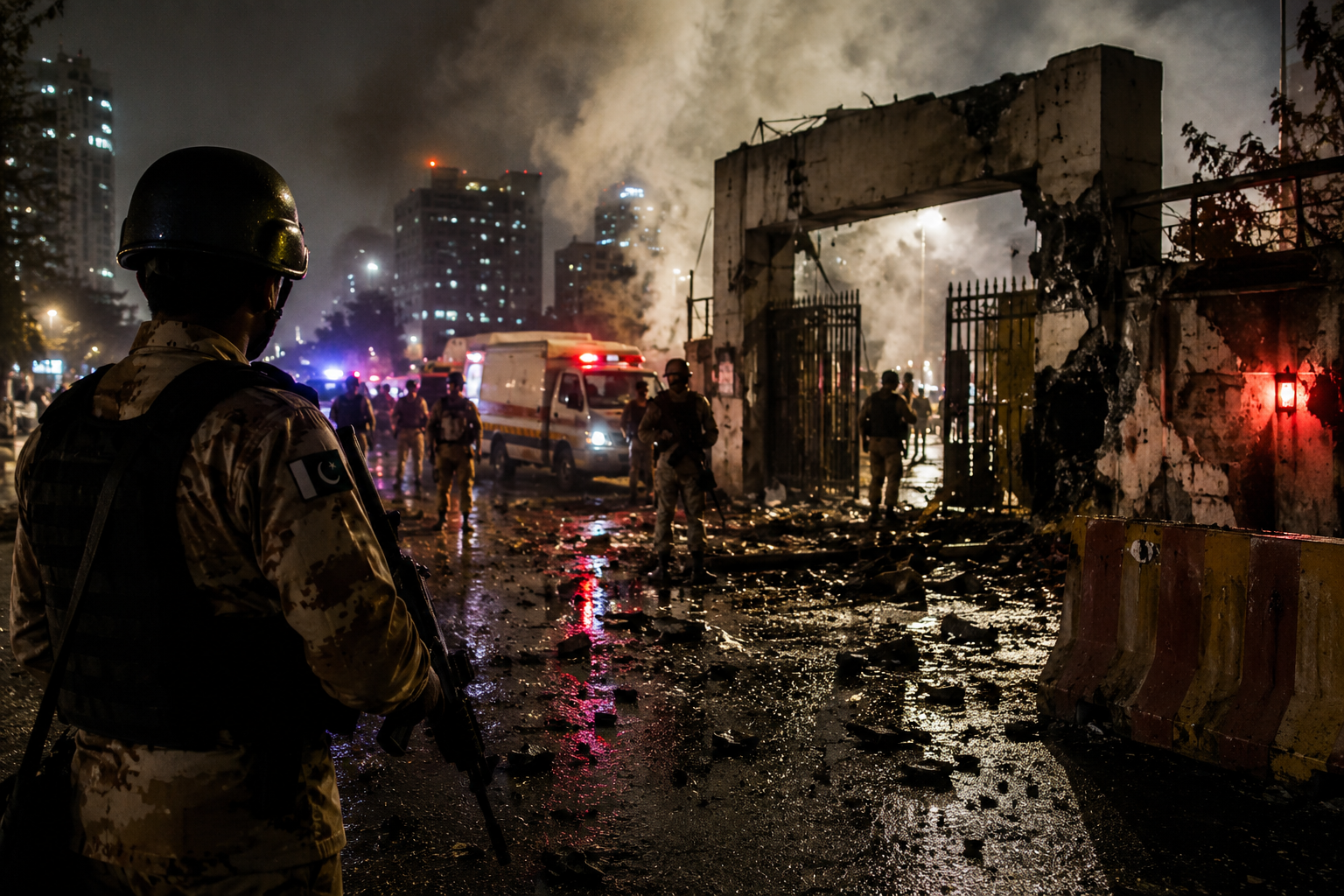
Karachi Has Been Pulled Back Into Pakistan’s Security StoryThree Pakistan Rangers were killed and four others were wounded after militants attacked a Sindh Rangers facility in Karachi’s Gulistan-i-Jauhar area on June 27, turning a major urban security site into the latest test of Pakistan’s counterterrorism strength. The known sequence is stark: attackers detonated explosives at the entrance, tried to breach the camp, exchanged fire with security forces, and were eventually stopped. Security forces killed three attackers and captured a fourth, identified by Pakistan’s military as an Afghan national.
That matters because Karachi is not a remote battlefield. It is Pakistan’s commercial nerve centre, a port city, a financial hub, and a place where any major security breach carries meaning beyond the immediate casualty count. When militants target a Rangers facility there, the message is not just that they can kill; it is that they want to show they can reach hardened state power inside one of Pakistan’s most important cities.
The Target Was The Real Message
The immediate facts are severe enough on their own. A paramilitary facility was attacked, three Rangers were killed, and Pakistan’s military said the attackers belonged to Jamaat-ul-Ahrar, a faction linked to the Pakistani Taliban. The group has been identified in reporting as having claimed responsibility, while the Pakistani military has vowed retribution operations against the perpetrators.
The deeper significance is the choice of target. Attacking civilians is designed to spread fear through the public. Attacking a security headquarters is designed to humiliate the state. It challenges the perception that official installations are protected, that militant capability is geographically contained, and that Pakistan’s major urban centres are insulated from the worst violence seen elsewhere.
This is why the attack lands with more force than its numbers alone suggest. Three deaths in a country already familiar with militant violence can look, from a distance, like another entry in a long and grim pattern. But the location, method, and target change the meaning. The attack was not simply a killing; it was a test of reach, planning, and state response.
Pakistan Now Faces The Retaliation Trap
Pakistan’s military response will matter as much as the attack itself. When a state promises retaliation after a high-profile assault, it gains room to act, but it also narrows its political options. Doing too little can look weak. Doing too much can create new blowback, especially if operations widen beyond the immediate network behind the attack.
The most likely short-term response is an expansion of counterterrorism operations. That could mean raids, arrests, intelligence sweeps, security reviews, and heavier protection around sensitive sites in Karachi and other cities. It could also mean renewed pressure in areas where militant groups are believed to operate, particularly if investigators conclude the attackers had support networks beyond Karachi.
The danger is that retaliation becomes a performance as well as a security measure. Governments under pressure often need visible action, not just effective action. Pakistan’s leadership will want to reassure the public, the military, investors, and foreign partners that the state remains in control. That creates a powerful incentive to move quickly, even while the full chain behind the attack may still be under investigation.
Afghanistan Is The Wider Pressure Point
The most dangerous consequence may not be inside Karachi at all. Pakistan has repeatedly accused militants of using Afghan territory as a sanctuary, while the Afghan Taliban government rejects those allegations. The capture of an attacker identified by Pakistan’s military as an Afghan national gives Islamabad a politically explosive detail, even if nationality alone does not prove state involvement or command responsibility.
That is where the story can escalate. If Pakistan frames the attack as part of a cross-border militant pipeline, the pressure for strikes, border tightening, or covert action could increase. Relations between Pakistan and Afghanistan have already been strained by militant violence, accusations, and intermittent clashes. A deadly attack in Karachi gives that tension a new urban symbol.
This does not mean a major conflict is inevitable. The more realistic risk is a cycle of limited escalation: Pakistan launches operations, Afghanistan denies responsibility, militant groups exploit the confrontation, and both sides harden their positions. That kind of pattern rarely produces a single dramatic turning point. It produces a slow deterioration, where each attack makes the next response easier to justify.
Karachi’s Calm Looks More Fragile Now
Karachi has a long history of political, sectarian, criminal, and militant violence, but major attacks in Pakistan’s largest cities have become less common in recent years. That relative calm is part of what makes this assault so significant. The attack raises the uncomfortable question of whether militant networks are regaining the ability to strike major urban targets after years in which the most intense violence was often associated with border regions and security forces elsewhere.
Urban terrorism has a different psychological effect from violence in remote areas. It travels faster through media, disrupts business confidence more easily, and makes ordinary people feel that the state’s security perimeter is thinner than they believed. Karachi’s universities, offices, roads, ports, and commercial districts are not symbolic abstractions. They are the working machinery of Pakistan’s economy.
That is the hidden cost of attacks like this. Even when the immediate damage is contained, the uncertainty spreads. Security tightens. Movement slows. Investors recalculate. Residents become more alert to checkpoints, sirens, and closures. The attack may have been stopped at the facility, but the pressure moves outward into the city.
The Militant Message Is About Survival And Relevance
For Jamaat-ul-Ahrar and similar factions, an attack like this is not only about casualties. It is also about visibility. Militant groups need to prove to recruits, rivals, funders, and enemies that they remain operational. A successful assault on a security target in Karachi gives them propaganda value even if the attackers are killed.
That does not make them stronger than the state. It means they are trying to shape the perception of strength. In insurgency and terrorism, perception is part of the battlefield. A group that can force national headlines, trigger security alerts, and make senior officials promise revenge has already achieved part of its objective.
This is the moral reversal inside the story. The state may kill the attackers and still lose some sense of control if the attack persuades the public that militants can choose the time and place of confrontation. Pakistan’s next challenge is therefore not just to punish those responsible, but to prevent the attack from becoming proof that urban militancy is returning.
The Economic Stakes Are Easy To Underestimate
Karachi is too important for repeated security shocks to remain isolated from the economy. It is a major port city and commercial centre, meaning fear in Karachi does not stay local for long. One attack will not derail Pakistan’s economy, but a pattern of attacks could increase insurance costs, disrupt logistics, weaken investor confidence, and force businesses to spend more on private security.
The financial damage from terrorism is rarely limited to buildings and casualties. It appears in delayed investment, nervous capital, lower mobility, and the quiet tax imposed by fear. If militants can make major cities feel vulnerable again, they do not need to shut the economy down to damage it. They only need to make normal life more expensive and less predictable.
That is why the attack should not be viewed only through the lens of policing. It is a confidence event. Pakistan’s government must now show that this was contained, that the network can be dismantled, and that Karachi is not entering a new cycle of high-profile security incidents.
What Happens Next Will Define The Meaning Of The Attack
The next stage will determine whether this becomes a contained security incident or the opening signal of a broader campaign. The key questions are direct: who planned it, where the attackers came from, who supported them, whether there are remaining cells, and whether the captured suspect produces actionable intelligence. Pakistan’s military has said operations were continuing to eliminate accomplices, which suggests authorities are treating the attack as part of a wider network rather than a single isolated act.
The most likely outcome is a tougher internal counterterrorism push, especially around Karachi and other sensitive urban centres. The more dangerous outcome is a cross-border escalation if Islamabad concludes that the attack had support from Afghan soil. The most destabilising outcome would be follow-up attacks, because a second strike would make it harder for Pakistan to present the Karachi assault as contained.
For now, the attack has created a test of state credibility. Pakistan must respond firmly enough to deter further attacks, carefully enough to avoid uncontrolled escalation, and intelligently enough to dismantle the network behind it rather than simply punish the visible attackers. The real consequence of Karachi may not be what happened at the gate, but whether it marks the moment Pakistan’s urban security problem became impossible to dismiss.
