Why Wembanyama’s Ceiling Is Unlike Anything The NBA Has Ever Seen
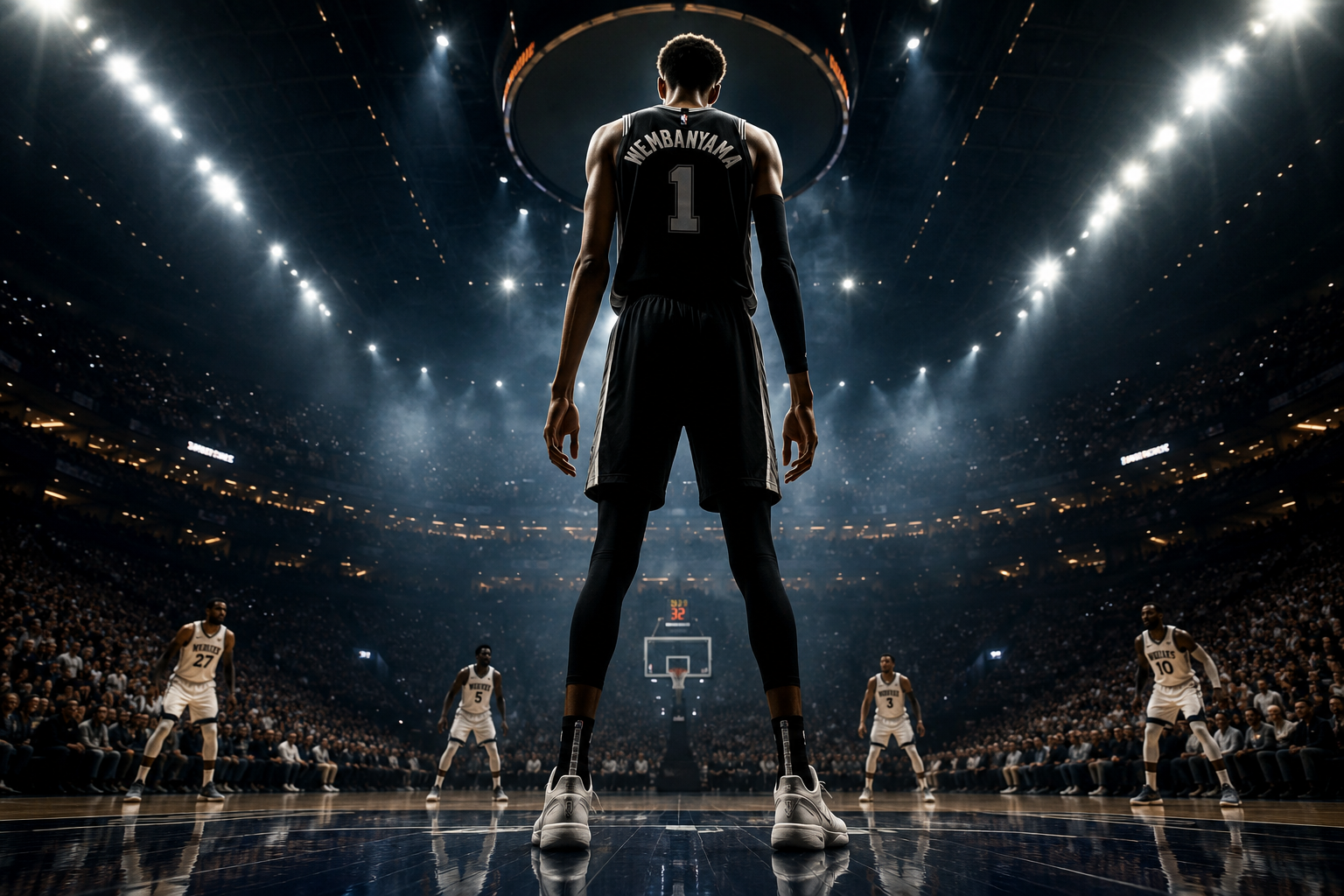
Victor Wembanyama Could Break The GOAT Debate
The NBA Has Never Had To Solve A Player Built Quite Like This
The Question Sounds Absurd Until You Watch HimCould Victor Wembanyama become the greatest basketball player ever? The honest answer is yes, but with a heavy condition attached: he has the physical and technical ceiling to enter the conversation, but the GOAT argument is not built on ceiling. It is built on years of dominance, playoff pressure, titles, durability, adaptation and the ability to become inevitable when every opponent knows exactly what is coming.
That is why Wembanyama is so fascinating. He is not simply a tall prospect with skills. He is a 7-foot-4, 235-pound forward-center from France, drafted first overall by San Antonio in 2023, already producing elite scoring, rebounding and defensive numbers while still only 22 years old. NBA.com lists him at 25.0 points, 11.5 rebounds and 3.1 assists per game, with a frame that already makes normal basketball geometry look outdated.
The GOAT question normally belongs to finished careers: Michael Jordan’s killer six-for-six Finals mythology, LeBron James’s two-decade statistical empire, Kareem Abdul-Jabbar’s longevity and scoring dominance, Bill Russell’s championship mountain. Wembanyama is nowhere near that résumé yet. But he has something more dangerous than early hype: a realistic path to becoming the most complete two-way basketball player ever.
His History Was Not Normal Prospect Hype
Wembanyama did not arrive from nowhere. He was treated as a future global basketball event before he played an NBA minute. He developed through the French system, with Nanterre, ASVEL and Metropolitans 92 forming the pre-NBA runway. Britannica lists that path clearly: Nanterre 92 from 2019–21, ASVEL Basket from 2021–22, Metropolitans 92 from 2022–23, then San Antonio from 2023 onward.
By the time San Antonio selected him with the first overall pick in the 2023 NBA Draft, the league already understood the scale of the gamble and the opportunity. The Spurs formally announced the selection on June 22, 2023, immediately placing him into the lineage of a franchise that had already built title eras around David Robinson and Tim Duncan.
That matters because San Antonio is not just a random landing spot. Wembanyama joined a franchise with institutional memory of how to build around elite big men, how to be patient, and how to let a generational player become the organizing principle of the whole system. Not every superstar gets that. Some are drafted into chaos. Wembanyama was drafted into a basketball laboratory.
His Genetics And Physique Are The Real Cheat Code
The easiest mistake is to describe Wembanyama as “tall” and stop there. The height is only the first layer. At 7-foot-4 with an enormous wingspan, he has the vertical reach of a traditional rim protector, but he does not move like a traditional rim protector. He can handle, step into threes, contest shots without leaving the floor, recover from impossible angles and turn broken defensive possessions into blocked shots that look physically unfair.
Basketball has had giants before. Manute Bol, Gheorghe Mureșan, Yao Ming and Shawn Bradley all changed sightlines. But Wembanyama is not simply a giant. He is closer to a guard’s coordination system installed inside a center’s body, with the defensive radius of a one-man zone. That is what makes the phrase “unique genetics” relevant: not because height alone wins, but because his length, mobility, balance, timing and coordination appear in a combination the sport has barely seen.
The strongest comparison is not one player. It is fragments of several. He has a version of Rudy Gobert’s defensive deterrence, Kevin Durant’s high-release shooting concept, Anthony Davis’s ground coverage, Kristaps Porziņģis’s size-skill outline, and a young Hakeem Olajuwon’s sense that the paint is being personally patrolled. But none of those comparisons fully works, because none of those players entered the league with this exact mix of length, skill ambition and defensive statistical violence.
The Accomplishments Are Already Serious
Wembanyama’s rookie season was not just good. It was historically strange. NBA.com’s Rookie of the Year announcement noted that he led all rookies in points, rebounds and blocks per game, ranked fourth among rookies in assists and second in steals, and became only the second rookie after Manute Bol to lead the entire NBA in blocks per game.
The same NBA summary recorded two even more revealing milestones: he became the first player to average at least 20 points, 10 rebounds and 3 blocks in fewer than 30 minutes per game, and the first player ever to record at least 1,500 points, 700 rebounds, 250 assists, 250 blocks and 100 made threes in a season. That is not normal rookie production. That is a statistical category having to bend around a new body type.
His shot-blocking records are already entering historical territory. In December 2025, he became only the third player to block at least one shot in 100 straight regular-season games, joining Patrick Ewing and Dikembe Mutombo. The same NBA report noted that Mutombo reached 116 straight games and Ewing reached 145, placing Wembanyama in one of the most intimidating defensive streak categories in modern league history.
Then came the playoff proof. In May 2026, NBA.com reported that Wembanyama set a single-game NBA playoff record with 12 blocked shots in Game 1 of San Antonio’s Western Conference semifinal against Minnesota. That is the kind of record that changes opponent psychology. It does not just remove shots; it removes confidence.
When Will He Most Likely Peak?
Most NBA superstars peak somewhere between 26 and 31. Guards can peak earlier because their rhythm, scoring and decision-making mature quickly. Big men often need longer because their defensive responsibility, physical strength, foul discipline, passing reads and playoff counters take time. Wembanyama’s likely peak window is therefore around age 26 to 30, which would point roughly to the late 2020s and early 2030s.
That should terrify the rest of the league. He is already producing like an All-NBA-level player while still years away from what should be his adult physical and tactical prime. The biggest gains are likely to come from strength, screen-setting, post leverage, passing patience, foul control and learning which shots he can get every night against playoff-level game plans.
His statistical peak may not simply mean scoring 35 a night. His greatest version may be something more oppressive: 28–32 points, 12–14 rebounds, 4–6 assists, elite efficiency, league-leading blocks and the best defensive impact in basketball. If that version wins titles, the GOAT conversation stops being fantasy and becomes a genuine future problem.
Are The Spurs Building A Dynasty?
The Spurs have one enormous advantage: they appear to have moved from rebuild to contention faster than expected. Recent roster reporting describes a team coming off an NBA Finals run with nine of its top ten scorers under contract, while also highlighting a crowded but talented backcourt involving De’Aaron Fox, Stephon Castle and Dylan Harper.
That is the outline of a dynasty, but not the proof of one. Dynasties need more than talent. They need contract timing, health, defensive identity, shooting, playoff hierarchy, internal sacrifice and management brave enough to move good players when the fit is not championship-perfect. Wembanyama gives the Spurs the rarest piece first: the player around whom everything else can be arranged.
The tension is the backcourt. Fox gives the team speed and shot creation. Castle gives defensive force and two-way growth. Harper gives another high-ceiling creation piece. That is a huge amount of young and prime-age talent, but it also creates usage, salary and role questions. If San Antonio solves that structure cleanly, it can build a multi-year title window. If it hesitates, it could become talented but slightly misaligned.
His Ceiling Is Almost Absurd
Wembanyama’s ceiling is the best defensive player in the world and a top-three offensive player at the same time. That is the rarest basketball combination. Jordan was an elite defensive guard and the greatest scorer of his era. LeBron was a freight-train playmaker with defensive peaks. Kareem had the most reliable shot in basketball history. Hakeem may be the cleanest two-way big-man comparison. But Wembanyama’s version could be different: a player who bends both the rim and the perimeter.
His defensive ceiling is not merely blocks. Blocks are the loud statistic. The more important effect is deterrence. Players drive, see him, hesitate, pump fake, throw the ball out, or take a worse shot. A normal center protects the rim. Wembanyama can protect the rim, recover to the corner, erase floaters, challenge lobs and turn late rotations into blocked shots.
Offensively, the ceiling depends on shot selection and physical development. If he becomes an efficient three-level scorer who can punish switches in the post, shoot over contests, pass out of doubles and stay healthy through deep playoff runs, the league has a structural problem. You cannot go small against him. You cannot simply play drop coverage. You cannot ignore him on the perimeter. You cannot attack him in space as easily as most giants. That is the nightmare.
What Could Hold Him Back?
The first risk is health. Wembanyama’s frame is extraordinary, but extraordinary frames carry extraordinary management demands. The Spurs announced in February 2025 that he had been diagnosed with deep vein thrombosis in his right shoulder, and NBA.com reported that he was expected to miss the rest of that season.
That does not mean his future is doomed. It means durability is the central variable in any GOAT projection. To become the greatest ever, he cannot simply dominate in bursts. He needs 10 to 15 years of elite availability, repeated playoff runs, and enough physical continuity to keep improving rather than constantly rebuilding his body and rhythm.
The second risk is offensive temptation. Because Wembanyama can do almost everything, he may sometimes be tempted to do too much. The best version of him is not a 7-foot-4 guard taking difficult jumpers for style points. It is a ruthless matchup destroyer who uses guard skills selectively, forces high-value shots, lives at the line, bends defenses and turns his passing into a weapon.
The third risk is team construction. The wrong spacing, the wrong guards, the wrong second star, or the wrong financial decisions could cap even his brilliance. The Spurs do not need to rush, but they do need to be cold. Once a player like this exists, sentimentality becomes expensive.
The Comparisons Still Fail
Against Jordan, Wembanyama lacks the résumé, titles and playoff mythology. Against LeBron, he lacks longevity, creation volume and two decades of proof. Against Kareem, he lacks the unstoppable scoring signature and championship record. Against Duncan, he still lacks the quiet playoff certainty that made San Antonio a machine. Against Hakeem, he has not yet shown the full offensive footwork package or title-level carry job.
But Wembanyama has something none of them had in this exact form: the possibility of being the league’s best rim protector, a perimeter-capable scorer, a transition weapon, a shot-blocking record threat, a floor-spacing big and a defensive system by himself. He is not ahead of the legends yet. He is not close in historical achievement. But physically and technically, his theoretical ceiling is wider than anyone’s.
That is why his career feels bigger than normal superstar development. Wembanyama is not just trying to become great inside basketball’s existing categories. He is forcing the categories to update. If he stays healthy, adds strength, becomes more efficient, wins MVPs, captures championships and turns San Antonio into the league’s next dynasty, the GOAT debate will eventually have to make room for a player who looked impossible before he looked inevitable.
