AI Fraudster Used Fake Songs And 10,000 Bots To Beat Taylor Swift's Streaming Figures — Then Stole $8 Million
Fake Songs, Fake Fans, Real Millions: Inside The AI Music Scam That Outstreamed Taylor Swift
The $8 Million AI Music Fraud: How One Man Turned Thousands Of Bots Into A Royalty Fortune
A Fake Music Empire That Outstreamed Taylor Swift And Stole Millions
A North Carolina musician has been sentenced to 18 months in prison after using artificial intelligence to manufacture hundreds of thousands of songs, deploying thousands of automated listeners and collecting more than $8 million in fraudulent music royalties.
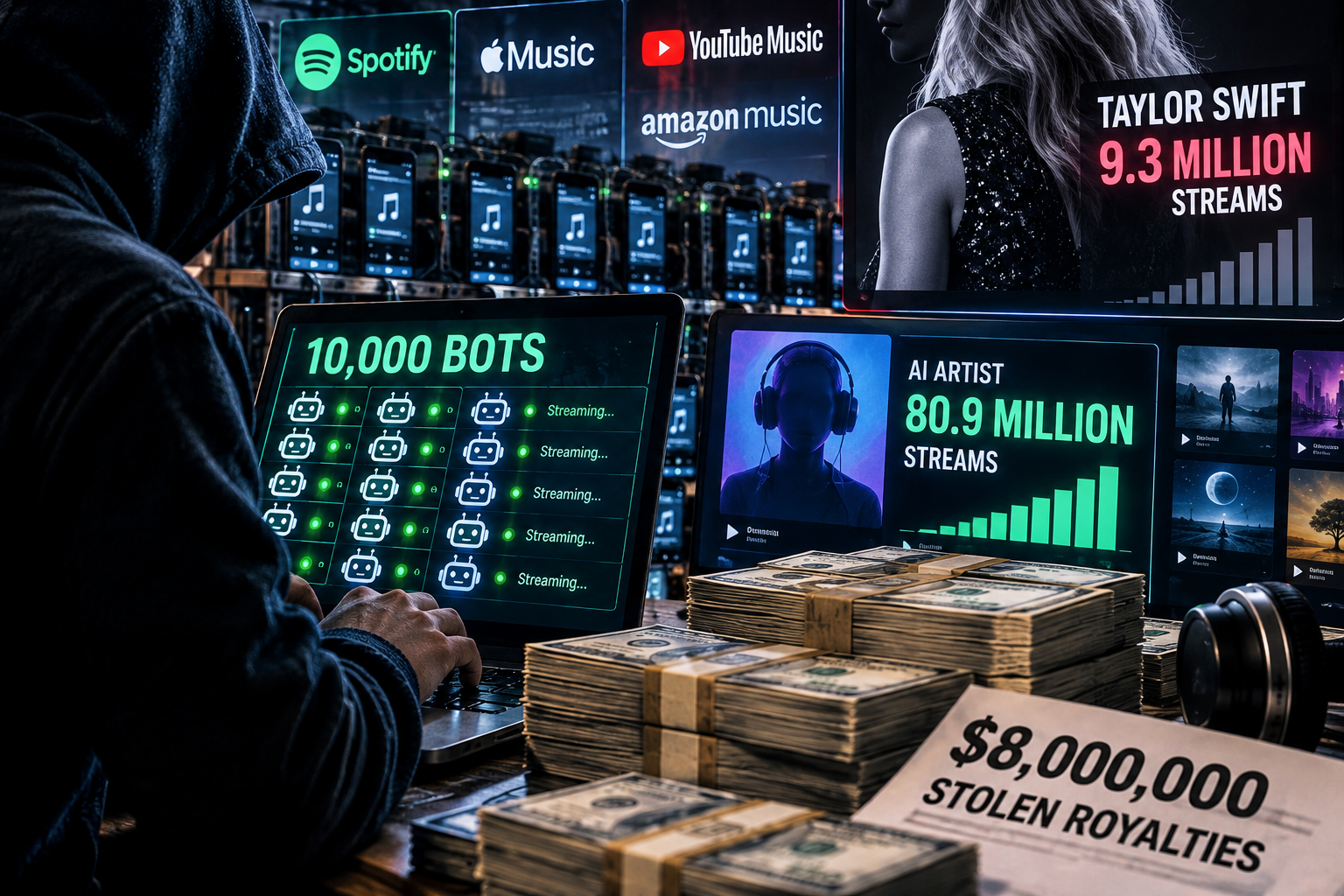
His operation became so large that, during one month in 2023, his fake accounts generated nearly nine times as many streams as Taylor Swift's entire catalogue in a specific category of YouTube Music listening.
The figures were extraordinary. The listeners were not real. And the money was being collected from a system intended to reward genuine musical creativity.
Michael Smith, 54, of Cornelius, North Carolina, pleaded guilty to conspiracy to commit wire fraud in March 2026. On 6 October, US District Judge John G. Koeltl sentenced him to 18 months in prison, followed by two years of supervised release.
Smith was also ordered to forfeit $8,091,843.64.
His scheme ran from 2017 until 2024, exploiting weaknesses in the way music platforms count listening activity and distribute royalties.
The case provides an unusually clear example of how artificial intelligence can turn a relatively straightforward financial deception into an industrial-scale operation.
How Fake Music Beat Taylor Swift's Streaming Numbers
The most remarkable comparison emerged from YouTube Music data examined during the prosecution.
In April 2023, Taylor Swift's entire catalogue attracted approximately 9.3 million streams through family-plan subscriptions on YouTube Music.
During that same month, Smith's automated accounts generated approximately 80.9 million fraudulent streams through family plans on the platform.
<text color="default" weight="medium">The comparison from April 2023</text>
YouTube Music family-plan streamsPlaysMichael Smith's fraudulent streams80.9 millionTaylor Swift's entire catalogue9.3 million
That meant Smith's operation produced roughly 8.7 times as many streams as Swift within the specific category being measured.
It does not mean his AI music surpassed Swift's total worldwide streams across every service or listening category. The comparison concerns YouTube Music family-plan activity during one month.
Nevertheless, it illustrates the extraordinary scale of the manipulation.
Swift's music was being played by genuine listeners. Smith's statistics came from automated accounts programmed to generate listening activity without human demand.
The system recorded plays, regardless of whether a real person had chosen the music.
Smith had discovered a way to make large volumes of artificial consumption look like valuable music streaming activity.
The 10,000 Bots Behind The Music Fraud
The mechanics of the fraud were straightforward, even if the scale was not.
Smith created thousands of accounts on streaming platforms, including Spotify, Apple Music, Amazon Music and YouTube Music.
He used fake email addresses and fraudulently obtained debit cards to establish accounts that appeared to belong to ordinary customers.
Software then controlled those accounts, directing them to repeatedly play music associated with Smith's operation.
At certain points, prosecutors established that he was using as many as 10,000 automated accounts simultaneously.
Each account could produce a steady flow of apparently legitimate listening activity.
One fake listener was worth very little. Thousands operating continuously, however, could generate enormous numbers of streams.
Streaming platforms pay royalties according to rules that take account of listening activity and allocated revenue. By manufacturing plays, Smith created a false claim on money that should have been distributed according to legitimate listening.
The deception did not require millions of people to be fooled into enjoying his songs.
It required software systems to accept automated listening as genuine consumer behaviour.
Why Smith Needed Hundreds Of Thousands Of AI Songs
The greatest obstacle to Smith's operation was detection.
A single obscure song receiving hundreds of millions of streams would attract attention. Streaming companies could reasonably question why an unknown artist was suddenly generating figures associated with international superstars.
Smith responded by spreading the fraudulent activity across an enormous catalogue.
Instead of directing all his bots towards a handful of tracks, he distributed the streams among thousands of different songs.
The strategy reduced the number of suspicious plays attached to any individual recording.
But maintaining that approach required an enormous supply of music.
In December 2018, Smith explained the problem in an email to two associates.
He wrote that they needed "a TON of songs fast" to work around the platforms' anti-fraud policies.
Artificial intelligence provided the answer.
Starting around 2018, Smith worked with the head of an AI music company and a music promoter to obtain large quantities of computer-generated songs.
The music company supplied thousands of recordings each week, allowing the operation to expand without requiring musicians to compose and record every track.
Eventually, the catalogue contained hundreds of thousands of AI-generated songs.
One associate described the output in a 2019 email as "instant music".
It was a useful description of the technology's role.
The recordings did not need to become cultural hits. Their purpose was to provide enough apparent variety to make the streaming activity harder to identify as fraudulent.
The Strange Fake Artists Who Filled His Catalogue
The scheme required more than sound files.
Songs needed titles, and recordings needed artist identities. Smith used randomly generated names to make the uploads appear to represent a large collection of different musicians.
Prosecutors identified fictional artist names including Calliope Bloom, Calm Baseball, Calm Innovation and Calorie Screams.
Some track titles were equally unusual, including Zygophyceae, Zygotic Lanie and Zymoplastic.
The names did not need to be memorable or commercially attractive.
They simply needed to populate streaming catalogues and create the appearance of distinct recordings.
Many of the underlying audio files had initially been supplied with names consisting of random characters rather than recognisable song titles.
Smith turned these files into a vast collection of apparently separate musical works.
There is an important distinction between creating AI-generated music and committing streaming fraud.
Artificially generated music is not automatically fraudulent merely because software helped create it. Musicians and producers can use technology as part of legitimate creative work.
Smith's criminal conduct involved manipulating streaming activity to obtain royalty payments to which he was not entitled.
The AI recordings supplied the inventory. The bots manufactured the demand.
Together, they allowed the scheme to grow.
How The Fraud Generated Millions Of Dollars
Music streaming royalties are distributed through payment systems involving streaming services, distributors, publishers, artists and other rights holders.
The precise arrangements differ between platforms and contracts.
Broadly, however, money is allocated according to eligible streaming activity and the rules governing a particular payment pool.
That creates a financial incentive to increase genuine listening.
Smith exploited the same incentive by generating fraudulent activity.
The prosecution established that he understood the economic potential of his accounts well before the scheme reached its greatest scale.
At one stage, he estimated that his automated system could generate approximately 661,440 streams every day.
He calculated that this could produce around $1.2 million in annual royalty payments.
The operation eventually grew far beyond those early projections.
By using artificial intelligence to supply recordings and automated software to stream them, Smith built an operation that could continue producing revenue without needing a meaningful audience.
His fraudulent royalties came at the expense of legitimate participants in the streaming economy.
Where eligible royalties are distributed from shared pools, artificial streams can reduce the proportion available to genuine artists and rights holders.
The financial damage cannot be attributed equally to every musician. Nor does the case establish precisely how much any individual artist lost.
But it demonstrates why streaming manipulation is not merely a problem involving misleading popularity statistics.
It can change who receives real money.
Seven Years Of Fraud Before The Criminal Case
The operation began in 2017, before the current wave of generative AI music tools became widely familiar to the public.
Smith initially relied on the automated streaming accounts, then expanded the scheme using AI-generated music.
As technology improved, the catalogue could grow more quickly.
The charging documents also described efforts to conceal the manipulation from companies involved in music distribution and royalty payments.
Smith's activities continued until 2024, when federal authorities brought criminal charges.
On 4 September 2024, prosecutors announced his arrest and accused him of running a scheme that had generated billions of artificial streams.
At that stage, authorities alleged fraudulent royalty payments exceeding $10 million.
The later guilty plea and sentencing established the amount subject to forfeiture at $8,091,843.64.
Those figures come from different stages of the proceedings. The higher amount appeared in the original charging allegations, while the approximately $8.09 million figure was specified in the final sentencing announcement.
Smith pleaded guilty on 19 March 2026 to one count of conspiracy to commit wire fraud.
His sentence followed on 6 October 2026.
The case was described by the US Department of Justice as its first criminal prosecution involving AI-assisted music streaming fraud.
Why An 18-Month Sentence Matters
Smith's conviction establishes a legal consequence for an activity that can otherwise appear to exist entirely within digital platforms.
The fraudulent streams did not involve customers handing money directly to Smith. They were generated through automated accounts, manipulated records and royalty distribution systems.
The financial proceeds, however, were real.
Federal prosecutors argued that the scheme deprived genuine musicians and songwriters of money and undermined the integrity of streaming markets.
Judge Koeltl imposed an 18-month prison sentence, with two years of supervised release to follow.
The forfeiture order requires Smith to surrender assets or proceeds worth more than $8 million.
Forfeiture is not identical to proof that every affected musician will receive direct repayment. The order establishes the value Smith must forfeit, rather than a detailed distribution of compensation to individual artists.
The sentence also signals that automated manipulation of digital markets can attract criminal liability when it forms part of a deliberate fraud.
The Wider Problem Of Artificial Music And Fake Audiences
Smith's prosecution arrived during a period of rapid change in the music industry.
Artificial intelligence can now assist with composing melodies, producing instrumental recordings and generating synthetic vocals.
Those capabilities can lower costs for legitimate creators.
They also make it easier to produce huge catalogues of music without the expense and time required by conventional recording.
The problem becomes more serious when mass-produced content is combined with fake engagement.
Similar concerns exist throughout the digital economy, where artificial activity can distort advertising impressions, social media popularity, website traffic and online recommendations.
A manipulated number can affect decisions even when nobody directly believes the underlying content is valuable.
In music, the immediate consequence is financial because listening statistics help determine royalty allocations.
The wider dispute over Taylor Swift and AI-generated imitation raises a related but distinct issue: whether technology should be permitted to reproduce an artist's recognisable identity without authorisation.
Smith's case did not depend on impersonating Swift.
Her name appeared as a comparison demonstrating the extraordinary quantity of fraudulent listening his accounts generated.
That distinction matters. AI impersonation concerns identity and rights, while streaming manipulation concerns false activity and payments.
Both reveal the difficulties of establishing trust when synthetic content can be produced at scale.
Can Spotify And Other Platforms Stop AI Streaming Fraud?
The central challenge for streaming platforms is separating legitimate consumption from manufactured activity.
An account playing a song repeatedly is not necessarily evidence of fraud.
Some listeners genuinely replay favourite tracks for hours. Music can also play in workplaces, shops and households where the same recordings are heard repeatedly.
Fraud detection therefore requires more than identifying high listening numbers.
Services can examine patterns across accounts, devices, payment details, timing, repeated behaviour and relationships between tracks.
But sophisticated manipulation can be designed to avoid obvious statistical anomalies.
Smith's operation demonstrated the problem directly.
He distributed enormous numbers of plays across many songs, rather than creating one conspicuously popular recording.
The approach was intended to make the traffic look more natural.
The growing difficulty of detecting AI-generated deception extends beyond music. Digital platforms increasingly need to establish not just what content exists, but whether the apparent human activity surrounding it is authentic.
New detection systems may make certain types of manipulation harder.
They cannot, on their own, prove that every stream originates from a genuine listener or that every suspicious account is fraudulent.
The public details of Smith's prosecution do not establish that any particular streaming platform's current safeguards would fail against the same operation today.
They do show that his methods succeeded for years before the criminal proceedings brought them to an end.
What The Case Means For Musicians And The Future Of Streaming
The practical consequences fall most heavily on an industry in which recorded music earns revenue through complex licensing and royalty arrangements.
Independent musicians, established artists, composers and publishers all depend on accurate reporting of eligible listening.
If automated activity can enter those calculations undetected, payment systems risk rewarding manufactured engagement rather than genuine demand.
That does not mean artificial intelligence has no legitimate place in music.
It means platforms must distinguish between the origin of a recording and the authenticity of the activity generating income from it.
An AI-created song can attract real listeners.
A human-written song can be fraudulently streamed by bots.
Both distinctions matter when deciding whether payments are legitimate.
Smith's operation crossed the line by deliberately making automated accounts appear to be paying audiences.
The courts have now imposed a prison sentence and an $8.09 million forfeiture order.
For music services, the outstanding challenge is whether systems designed to detect unusual listening can identify sophisticated manipulation before enormous royalty payments have already been distributed.
For legitimate artists, the answer will help determine how much trust they can place in the figures on which their livelihoods depend.
Sources
US Department of Justice — North Carolina Man Sentenced To 18 Months In Prison For AI-Assisted Music Streaming Fraud — Official sentencing announcement dated 6 October 2026, confirming the prison term, forfeiture, number of bots and Taylor Swift streaming comparison.
US Department of Justice — North Carolina Musician Charged With Music Streaming Fraud Aided By Artificial Intelligence — Original 4 September 2024 prosecution announcement detailing the operation, fictional artists, use of AI-generated recordings and efforts to evade detection.
Ars Technica — Fraudster Jailed For Using 10K Bots And AI Songs To Outstream Taylor Swift — Independent coverage published 7 October 2026 explaining the conviction, fraudulent streams and effect on royalty distribution.
Next Reads
How Taylor Swift’s AI Clone Crackdown Could Change The Internet Forever — Explore the legal and commercial risks of artificial intelligence reproducing a famous artist's voice and identity.
Taylor Swift’s New AI Fight Is Sending Shockwaves Through Hollywood — Understand the growing debate over celebrity likenesses, AI impersonation and intellectual property.
Deepfakes Explained: How They Work, How To Spot Them And Why They Are Becoming Dangerous — Discover how AI-generated media can undermine trust and enable digital fraud.
