China’s Moon Landing Plan Could Beat the US to Space Dominance
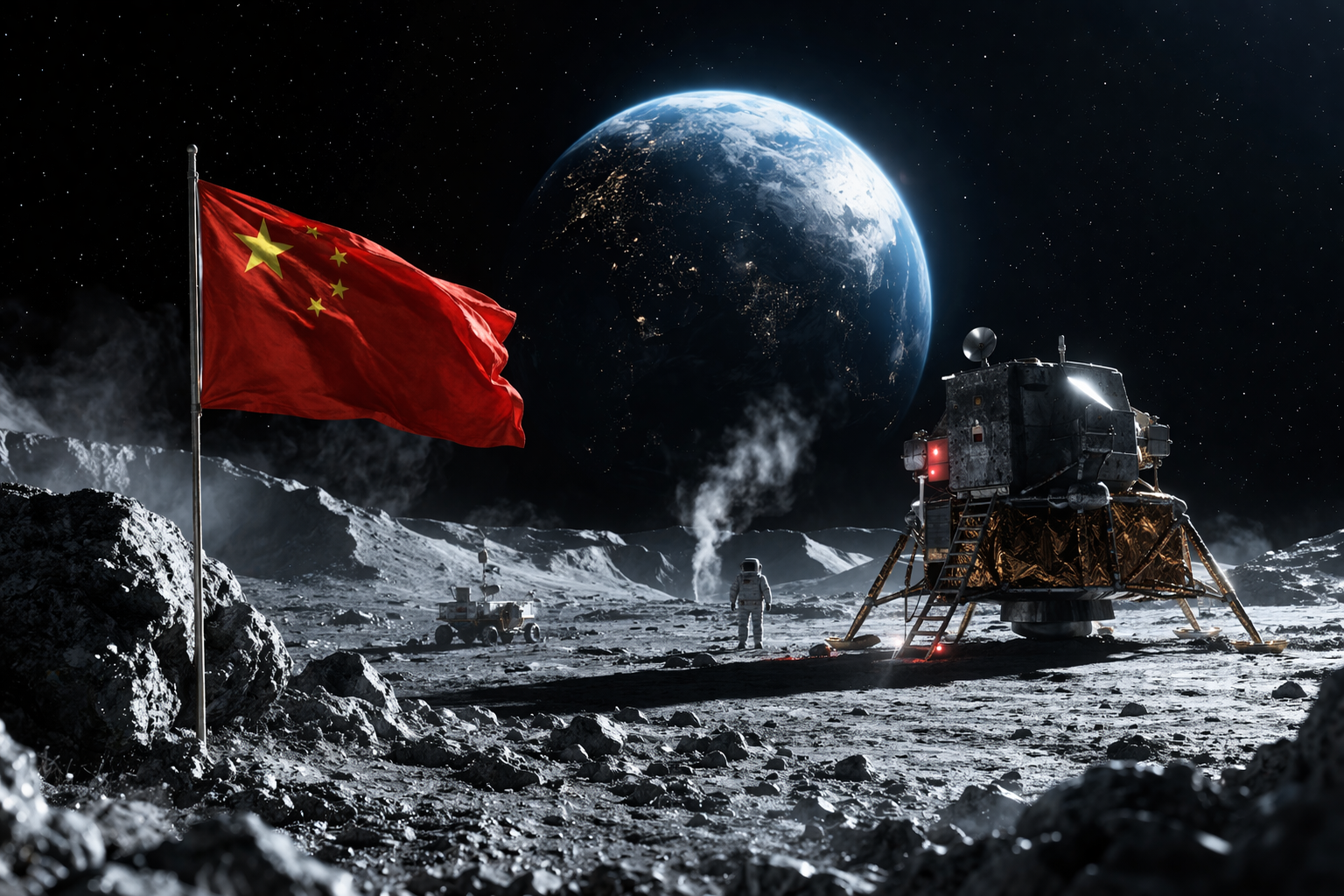
The New Space Race Has Begun — And China Is Moving Fast
China’s 2030 Moon Landing Plan Is Real—And It’s Forcing a New Space
China is now explicitly targeting a crewed Moon landing by 2030, and the timeline is no longer theoretical—it is backed by active hardware development, mission sequencing, and a long-term base strategy.
The shift is clear: the mission is not just a symbolic goal. It is a structured program with rockets, spacecraft, and landing systems already in testing or late development.
The timing matters because it collides directly with renewed US ambitions. NASA has just launched a crewed lunar mission for the first time in over 50 years, marking the beginning of its own return effort.
What emerges is not a replay of the Cold War—but something more complex: a race for presence, infrastructure, and long-term control of the Moon’s most valuable regions.
The story turns on whether China can execute faster and more consistently than the United States.
Key Points
China is targeting a crewed lunar landing by 2030, supported by new rockets, spacecraft, and landers already in development
The mission is part of a broader plan to build a permanent lunar research base by ~2035
The United States has restarted crewed lunar missions through NASA’s Artemis program, intensifying competition
The lunar south pole has become the central strategic target due to potential water ice and resources
China’s program benefits from long-term continuity, while US timelines have historically shifted
The outcome will shape who sets the rules, infrastructure, and access for future space activity
The Program Behind the Headline
China’s lunar ambition sits inside a long-running national strategy, not a one-off mission.
The architecture is already taking shape:
Long March 10 rocket for heavy-lift lunar missions
Mengzhou spacecraft to carry astronauts into lunar orbit
Lanyue lander to ferry astronauts to the surface and act as a base module
The mission profile is methodical: dual launches, orbital docking, surface descent, and return. It mirrors—but does not copy—the Apollo approach.
What matters is sequencing.
China has spent years building capability through robotic missions. Its Chang’e program has already delivered major milestones, including retrieving samples from the Moon’s far side, something no other country has done.
Upcoming missions are focused on exploration, mapping, and resource detection—especially near the lunar south pole.
This is not exploration for its own sake.
It is preparation.
Why the South Pole Changes Everything
The lunar south pole is now the focal point of the global space race—and for good reason.
Unlike most of the Moon, parts of this region contain:
Permanently shadowed craters
Potential water ice deposits
Near-continuous sunlight on nearby ridges
That combination is rare—and powerful.
Water ice can be converted into oxygen and hydrogen. That means breathable air and rocket fuel. It turns the Moon from a destination into a staging ground.
Scientific missions have already confirmed that these cold traps likely contain ice delivered by comets and preserved for billions of years.
Whoever establishes early access here gains more than prestige.
They gain leverage.
The United States Is Back—But On a Different Timeline
The US response is real—but uneven.
NASA’s Artemis II mission, launched in April 2026, marks the return of humans to deep lunar space.
But it does not land.
Actual surface missions are still several steps away, with timelines shifting and missions being restructured.
Recent updates suggest:
First landing attempts are now expected later in the decade
Some mission sequencing has changed, pushing key milestones further out
This creates a narrow but meaningful window.
China does not need to beat the US by decades.
Even a few years matters.
Because the first sustained presence sets the template for everything that follows.
Consequences: This Is About Control, Not Just Exploration
The new space race is not about flags and footprints.
It is about:
Infrastructure
Standards
Access
Influence
China is already planning an International Lunar Research Station (ILRS), potentially with partners like Russia, targeting completion in the mid-2030s.
That matters because infrastructure becomes governance.
The country—or coalition—that builds the first working lunar ecosystem will shape:
How resources are used
Who gets access
What rules apply
The US is pursuing a different model, emphasizing alliances and commercial partnerships.
Two competing systems are emerging.
What Most Coverage Misses
The key difference is not technology.
It is consistency.
China’s lunar program traces back decades, with long-term political backing and relatively stable objectives.
By contrast, US lunar strategy has repeatedly shifted with political cycles, funding changes, and program resets.
That difference compounds over time.
Space programs are not like software projects. Delays are not linear—they cascade. Hardware dependencies, launch windows, and integration cycles amplify small setbacks.
This creates a structural advantage for any program that avoids resets.
The race may not be won by who is more advanced today—but by who changes direction less.
The Stakes Are Bigger Than the Moon
The Moon is not the endpoint.
It is a gateway.
A sustained lunar presence enables the following:
Deep-space mission staging
Fuel production outside Earth’s gravity well
Long-duration human operations beyond low Earth orbit
China’s long-term roadmap extends beyond landing:
Lunar base by ~2035
Expanded orbital infrastructure by ~2045
Support for future Mars missions
The United States is pursuing similar goals.
But again—the race is about sequencing.
Who builds first gains momentum.
Momentum becomes dominance.
Where This Race Will Be Won or Lost
The next five years are decisive.
Watch for:
Successful testing of China’s Long March 10
Progress on lunar lander integration
Artemis landing schedule stability
Early infrastructure commitments at the lunar south pole
This is not a single finish line.
It is a positioning game.
The first crewed landing matters—but the second, third, and permanent missions matter more.
The real outcome will not be decided in a moment.
It will be decided in who stays.
