Nvidia Just Bought the ‘Control Layer’ of AI—And the Industry Is Starting to Panic
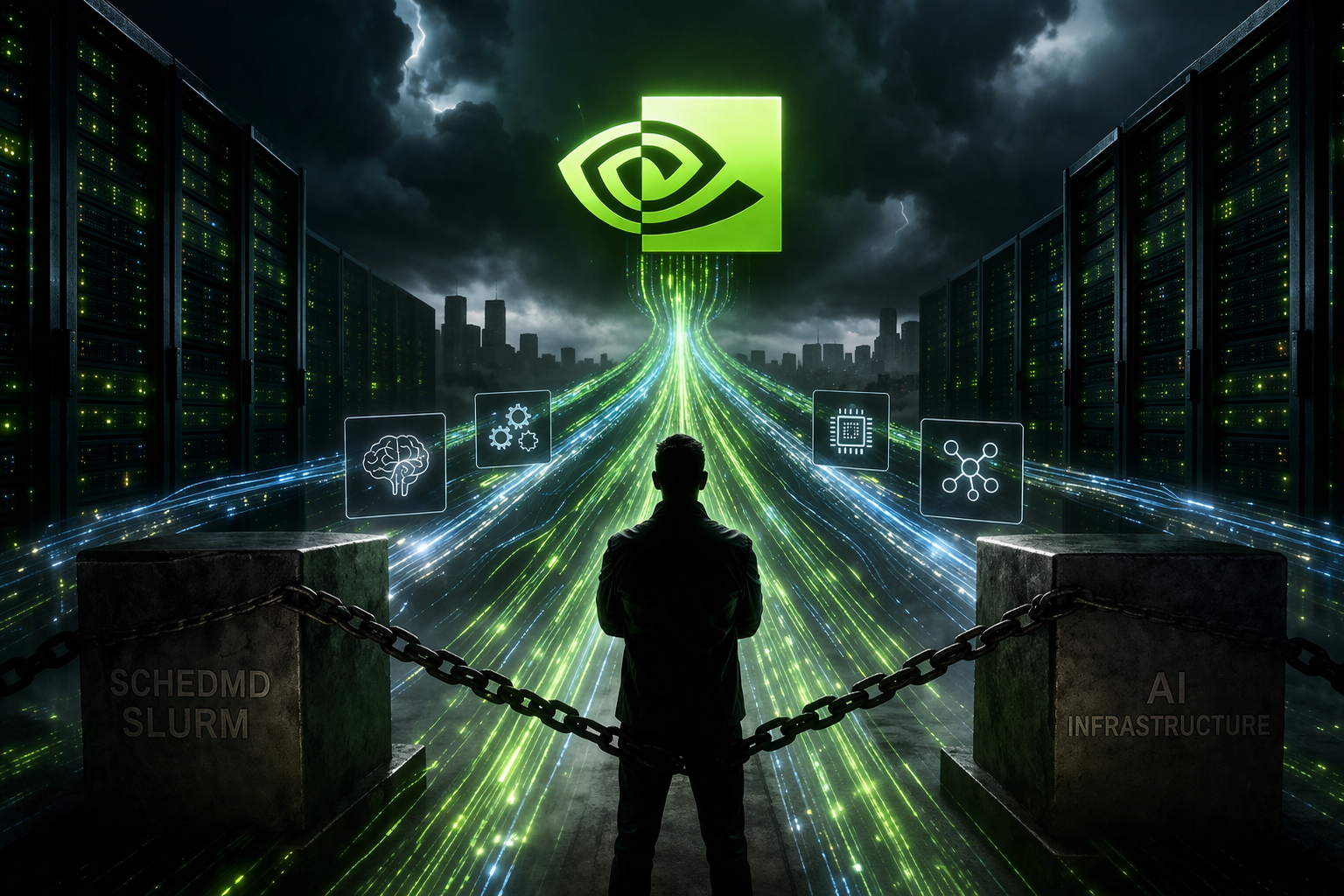
The Hidden Power Move Behind Nvidia’s Latest Acquisition
Nvidia’s SchedMD Deal Could Quietly Reshape Who Wins the AI Race
Nvidia says it’s strengthening open-source AI. Critics perceive a different scenario: Nvidia's control over the system that determines the actual usage of chips and companies.
The battle for AI dominance is shifting from chips to control—and Nvidia just moved upstream
Slurm runs the world’s supercomputers. Now it sits inside Nvidia
Nvidia Just Bought the ‘Control Layer’ of AI—And the Industry Is Starting to Panic
The most important AI war may no longer be about chips. It may be about who controls what runs on them.
Nvidia didn’t just buy software—it bought the traffic system of AI
When Nvidia acquired SchedMD, it didn’t buy a flashy startup or a new model.
Nvidia acquired Slurm, the unseen system that determines the distribution of massive AI workloads across machines.
That sounds technical. It isn’t.
Slurm is the scheduler that determines:
which jobs run
when they run
and crucially, on which hardware they run
And it already powers around 60% of the world’s supercomputers.
This is not a side tool.
This is the operating logic of modern AI infrastructure.
Which means Nvidia didn’t just strengthen its position.
It moved up a layer—into control.
The real shift: from hardware dominance to ecosystem control
Nvidia already dominates AI chips.
Now it is positioning itself to influence the decision-making layer above them.
That matters more than most people realize.
Because in large-scale AI systems:
hardware doesn’t choose workloads
workloads don’t choose hardware
Schedulers do.
By owning Slurm, Nvidia gains leverage over:
optimisation pathways
performance tuning priorities
compatibility timelines
Even subtle differences—like optimizing first for Nvidia GPUs before AMD or Intel—could shape the competitive landscape over time.
Not through bans.
Not through lockouts.
Through defaults.
Nvidia’s promise—and why the industry is sceptical
Nvidia has been clear:
Slurm will remain:
open-source
vendor-neutral
widely supported
On paper, that should calm concerns.
But the AI industry has seen this pattern before.
After Nvidia acquired Bright Computing, some users reported that non-Nvidia hardware became harder to optimize without extra work.
Nothing was “closed.”
But performance realities shifted.
That’s the fear now.
Not that Nvidia will break openness —
but that it will create an uneven advantage within the industry.
Why this matters more than another chip launch
Most AI coverage focuses on:
model releases
GPU benchmarks
funding rounds
But this move sits deeper.
Because AI isn’t just about compute power.
It’s about orchestration.
And whoever controls orchestration:
influences efficiency
shapes developer behaviour
determines ecosystem gravity
Major AI players, including Meta, Anthropic, and Mistral, already use Slurm.
That means Nvidia now sits closer to the following:
how models are trained
how clusters are managed
how scaling decisions are made
This is infrastructure influence, not just product influence.
What media misses
What media misses
This isn’t a story about Nvidia expanding.
It’s a story about Nvidia moving one layer higher in the stack.
The AI race is often framed as the following:
chips → models → applications
But the real leverage sits in between:
the orchestration layer
If you control that layer, you don’t need to block competitors.
You just need to make your own ecosystem:
slightly faster
slightly easier
slightly better integrated
Over time, “slightly” becomes inevitable.
That’s how ecosystems consolidate.
Ecosystems consolidate not through force, but through friction.
A test of Nvidia’s long-term strategy
Even some experts see upside.
With Nvidia’s resources, Slurm could:
evolve faster
adapt better to AI workloads
modernise beyond its supercomputing origins
That’s the optimistic case.
The pessimistic one is simpler:
This becomes the moment Nvidia transitions from
market leader
to
infrastructure gatekeeper
And the industry won’t know which path is real
until subtle decisions start to show up in the code.
What happens next
Three things will be watched closely:
1. Hardware neutrality in practice
How quickly does Slurm support non-Nvidia chips compared to Nvidia’s own?
2. Performance bias
Do Nvidia systems gain quiet efficiency advantages?
3. Developer behaviour
Are teams beginning to prefer Nvidia due to its ease of use?
None of these will be announced.
All of them will be felt.
The deeper shift
The AI industry is entering a new phase.
The first phase was about
building compute
The second was about the following:
building models
This phase is about:
controlling the system that connects everything
Nvidia already won the first phase.
This move suggests it intends to shape the third.
The bottom line
Nvidia didn’t just acquire a company.
It acquired a decision engine at the heart of global AI infrastructure.
And from this point on, the question is no longer
“Who builds the best chips?”
It's
“Who decides how the entire system runs?”
