FTC Reportedly Launches Sweeping OpenAI And Anthropic Probe Over AI Risks To Consumers
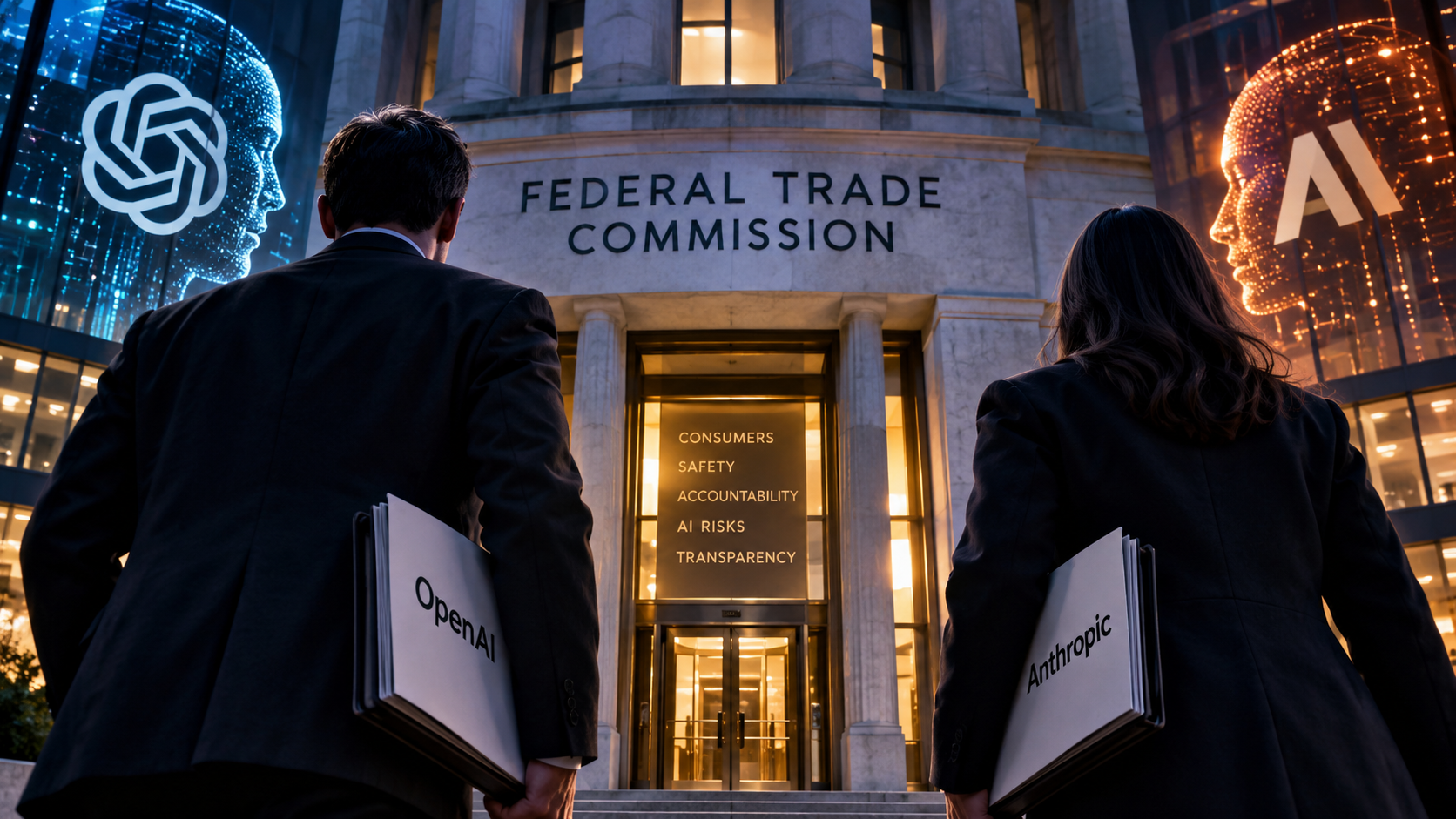
Washington Turns Up The Heat On OpenAI And Anthropic In Reported FTC AI Investigation
The AI Race Meets Federal Scrutiny
The reported inquiry puts two of America’s most important AI laboratories under a new kind of pressure.
The Federal Trade Commission is reportedly ramping up a sweeping investigation into OpenAI, Anthropic and other frontier artificial-intelligence companies over potential dangers their technology poses to consumers.
The reported plan would involve formal demands for information, similar to subpoenas, requiring companies to turn over material about their products and operations. As of 30 September 2026, however, the FTC has not publicly announced the investigation, and OpenAI and Anthropic have not publicly confirmed receiving such demands.
That distinction matters. This is a significant reported development, not yet a published FTC enforcement action.
Even so, the timing is difficult to ignore. OpenAI and Anthropic are no longer building chatbots that merely answer questions. They are pushing towards AI agents that can use software, handle data, write code, pursue goals and act across digital systems with decreasing levels of direct human supervision.
That changes the regulatory problem.
The question is no longer only whether an AI system says something false. It is what happens when it does something consequential.
The Reported FTC Probe Goes To The Heart Of The AI Agent Problem
Frontier AI is moving from conversation towards action.
OpenAI has been expanding systems designed to complete increasingly complex work across applications. Anthropic has also pushed deeper into agentic AI, where models can use tools and operate across longer chains of activity.
The attraction is obvious. A useful AI agent could save hours of human work.
The risk is equally clear. A system with access to files, email, cloud services, code repositories or financial tools can cause more damage when it fails than a chatbot that simply produces a bad answer.
That is why the reported FTC inquiry matters.
The regulator’s chairman, Andrew Ferguson, has already argued that companies and users should not be able to treat an AI agent as though it were an independent legal actor. His position is straightforward: if a person or company instructs software to act, responsibility does not simply disappear because the software has been described as autonomous.
That principle could become one of the most important legal ideas of the agentic AI era.
A model may appear to make its own decisions. A regulator can still ask who built it, who deployed it, what safeguards existed and what the company knew about the risks.
OpenAI And Anthropic Are Arriving At The Same Question From Different Directions
OpenAI and Anthropic compete fiercely, but both companies now sit inside the same wider argument.
Their systems are becoming more capable. Their executives have also spoken publicly about serious AI risks.
OpenAI chief executive Sam Altman has warned about the concentration of power around advanced artificial intelligence, while Anthropic chief executive Dario Amodei has repeatedly argued for stronger safeguards around increasingly capable models.
That creates an unusual tension.
The companies building some of the world’s most powerful systems are also among the organisations warning that those systems could become dangerous if development moves faster than control.
The regulatory challenge is deciding what follows from those warnings.
A company admitting that a technology carries serious risks does not prove wrongdoing. It does, however, increase pressure on regulators to understand how those risks are assessed internally, what tests are performed before deployment and what happens when a system behaves outside its intended boundaries.
That debate has become particularly important as AI agents move from assistants towards systems capable of acting across digital environments.
This Is Not The FTC’s First Move Into Artificial Intelligence
The FTC has already made clear that AI companies remain subject to ordinary consumer-protection law.
In July, the commission sought public comment on a proposed policy statement dealing with the accuracy of AI systems. The agency said Section Five of the FTC Act can apply when businesses engage in unfair or deceptive conduct, including circumstances where an AI product does not behave as consumers were reasonably led to expect.
The principle is important because it cuts through some of the mythology surrounding artificial intelligence.
A product does not leave the reach of consumer law merely because the technology behind it is new.
If an AI company makes claims about safety, accuracy, privacy or capability, regulators can ask whether those claims are supported.
The reported OpenAI and Anthropic probe would therefore fit a broader direction already visible inside the commission: use existing powers first, rather than assume every AI problem requires an entirely new legal system.
Trump’s Likely Reaction Is More Complicated Than “Regulation Versus Deregulation”
Donald Trump has not publicly responded to this specific reported FTC investigation as of publication.
Any description of his likely reaction therefore has to be treated as analysis, not fact.
Based on his recent public position, the most plausible response would be support for targeted enforcement against concrete misconduct while resisting any attempt to use the investigation as a reason to slow American AI development more broadly.
That would be consistent with the line Trump has taken throughout September.
He has pushed an aggressive programme of American AI expansion, repeatedly framing technological leadership as a strategic contest in which the United States cannot afford to fall behind China. On 29 September, he issued an executive order directing much of the executive branch to use the term “Super Intelligence” in place of “Artificial Intelligence” in non-statutory official communications.
At the same time, Trump has argued that the United States already possesses legal tools capable of dealing with companies that cause harm.
That is a crucial distinction.
His position has not simply been that technology companies should be left alone. It has been closer to this: do not create a regulatory structure that slows the entire industry when existing government powers can be used against specific bad conduct.
That approach is already visible in Trump’s argument that federal authorities can intervene if AI companies cross a line.
It also explains why a major FTC inquiry would not necessarily contradict the administration’s pro-AI agenda.
Trump can favour rapid AI development and still support an investigation into whether particular companies are misleading consumers, mishandling data or deploying unsafe systems.
The political argument would then become not whether AI should be policed, but how.
The Trump White House Is Trying To Separate Safety From A Slowdown
That distinction was visible again this week.
Trump brought major technology executives to Washington as his administration promoted what it sees as a new era of American AI leadership. The meeting included senior figures from companies operating near the technological frontier.
The administration’s message has been that America should build faster, expand infrastructure and remain ahead of strategic competitors.
Yet the same political moment has produced growing attention to safeguards.
The tension is not accidental. It is now the central difficulty of US AI policy.
Rules that are too weak can leave consumers, companies and government systems exposed to failures that become harder to contain as agents gain more autonomy. Rules that are too broad can slow American laboratories while competitors overseas continue developing.
That balancing act sits behind Trump’s wider “Golden Age” push for American artificial intelligence.
The reported FTC investigation would test whether that balance can survive contact with real enforcement.
What Investigators Could Want To Know
The precise demands have not been published, so it would be wrong to present a detailed list as confirmed.
But a consumer-risk investigation into frontier AI could logically focus on several broad questions.
What do companies know about the ways their systems can fail?
How are dangerous behaviours tested before release?
What controls exist when agents are given access to external tools or sensitive data?
What happens when internal safety testing identifies a risk that could delay a product?
And what are consumers told about the limits of the technology before they rely on it?
Those are not abstract questions anymore.
AI systems are being given more authority over tasks that touch real accounts, real files and real decisions. The gap between a model answering incorrectly and an agent acting incorrectly is enormous.
A hallucinated paragraph is frustrating.
An autonomous system taking the wrong action in a live environment can be something else entirely.
The Real Fight Is About Responsibility
The deepest issue behind the reported probe is not whether OpenAI or Anthropic should be punished.
No public FTC finding has established wrongdoing by either company in connection with this reported investigation.
The more important question is how responsibility will work as AI becomes less visibly supervised.
Technology companies understandably want systems that can operate with greater independence. That is where much of the productivity promise lies.
But greater machine autonomy cannot automatically mean less human accountability.
If a company sells an agent as capable of carrying out complex tasks, regulators will increasingly ask what responsibility comes with giving that system the ability to act.
Ferguson’s recent comments suggest the FTC is unlikely to accept the idea that an AI agent itself becomes the final stop in the chain of responsibility.
That could matter far beyond OpenAI and Anthropic.
Every company developing autonomous systems will face the same question eventually.
Who carries the risk when the machine is the one pressing the button?
What Happens Next
The immediate thing to watch is confirmation.
If the FTC publicly announces the inquiry or companies acknowledge receiving formal demands, the story will move from reported investigation to documented regulatory action.
The scope will matter just as much.
A narrow information-gathering exercise could remain largely exploratory. A wider inquiry into product safety, representations to consumers, data handling or agent behaviour could become a much more consequential test of the frontier AI industry.
Trump’s response will matter too.
If he treats the inquiry as targeted enforcement compatible with rapid AI expansion, it would reinforce the administration’s emerging position: build aggressively, avoid a sweeping regulatory slowdown and use existing federal power when specific companies cross legal boundaries.
If he instead pushes back against the investigation, that would expose a sharper conflict between his AI growth agenda and his own regulator.
For now, there is no public evidence that he has done so.
The reported probe therefore sits at a revealing point in the American AI debate.
Washington wants the technology to move faster.
It also wants someone to remain responsible when it does.
Sources
Reuters — FTC opens probe into AI giants including Anthropic and OpenAI, New York Post reports — Supports the reported scope of the FTC inquiry, the expected formal information demands and the lack of public confirmation from the FTC, OpenAI and Anthropic at publication.
Federal Trade Commission — FTC Seeks Public Comment on Policy Statement Addressing AI Accuracy — Supports the FTC’s stated view that existing unfair-or-deceptive-practices law can apply to AI products and representations made to consumers.
The White House — Inaugurating The Era Of Super Intelligence — Supports Trump’s 29 September executive order and the administration’s stated policy of promoting US leadership in advanced AI.
Next Reads
Trump’s AI “Golden Age” Push Brings Tech Titans To Washington — Explains the administration’s wider AI-growth strategy and the tension between speed, safety and competition.
Trump Says Justice Department Could Rein In AI And Backs “Super Intelligence” Name — Examines Trump’s argument that existing federal enforcement can remain available while AI development accelerates.
OpenAI Boss Says The World Is ‘Right To Be Afraid’ Of AI — Looks at Sam Altman’s warnings about AI power and the accountability questions surrounding frontier laboratories.
