Trump’s AI “Golden Age” Push Brings America’s Biggest Tech Powerbrokers To Washington
Trump Puts AI At The Centre Of America’s Next “Golden Age”
The Battle Over America’s AI Future
The White House is putting artificial intelligence at the centre of its economic and technological message, just as pressure grows over how quickly the most powerful systems should be allowed to advance.
Donald Trump is bringing some of the most influential figures in American technology into Washington on 29 September, combining a public “Golden Age” programme with a separate White House discussion involving senior AI executives and House Speaker Mike Johnson.
The timing is deliberate. The administration wants artificial intelligence to be seen as a source of American power, productivity and technological leadership. At the same time, the people building the systems are increasingly divided over how much risk governments should tolerate in the race to stay ahead.
A “Golden Age” Built Around Technology
The public event is designed to sell a broad vision of American technological renewal.
Trump and Vice President JD Vance are expected to appear alongside senior government officials and technology leaders as the administration showcases America.gov, a new digital gateway intended to make federal services easier to find and use.
The project matters because it gives the administration something tangible to place behind its wider language about a technological “Golden Age”. Rather than speaking only about future models, data centres and semiconductor capacity, the government can point to a service that ordinary Americans may directly encounter.
The White House has already made AI leadership a central part of its economic agenda. Its public technology strategy emphasises expanding infrastructure, accelerating adoption and maintaining an American advantage over China.
That approach fits the broader US-China AI rivalry, where advanced models are only one part of a much larger competition involving chips, energy, data centres, robotics, cyber capability and national security.
For Trump, the underlying argument is straightforward: the United States should not slow itself down while competitors continue building.
The Technology Leaders Arriving In Washington
The political symbolism becomes stronger because so many of the companies shaping the AI economy are represented in Washington on the same day.
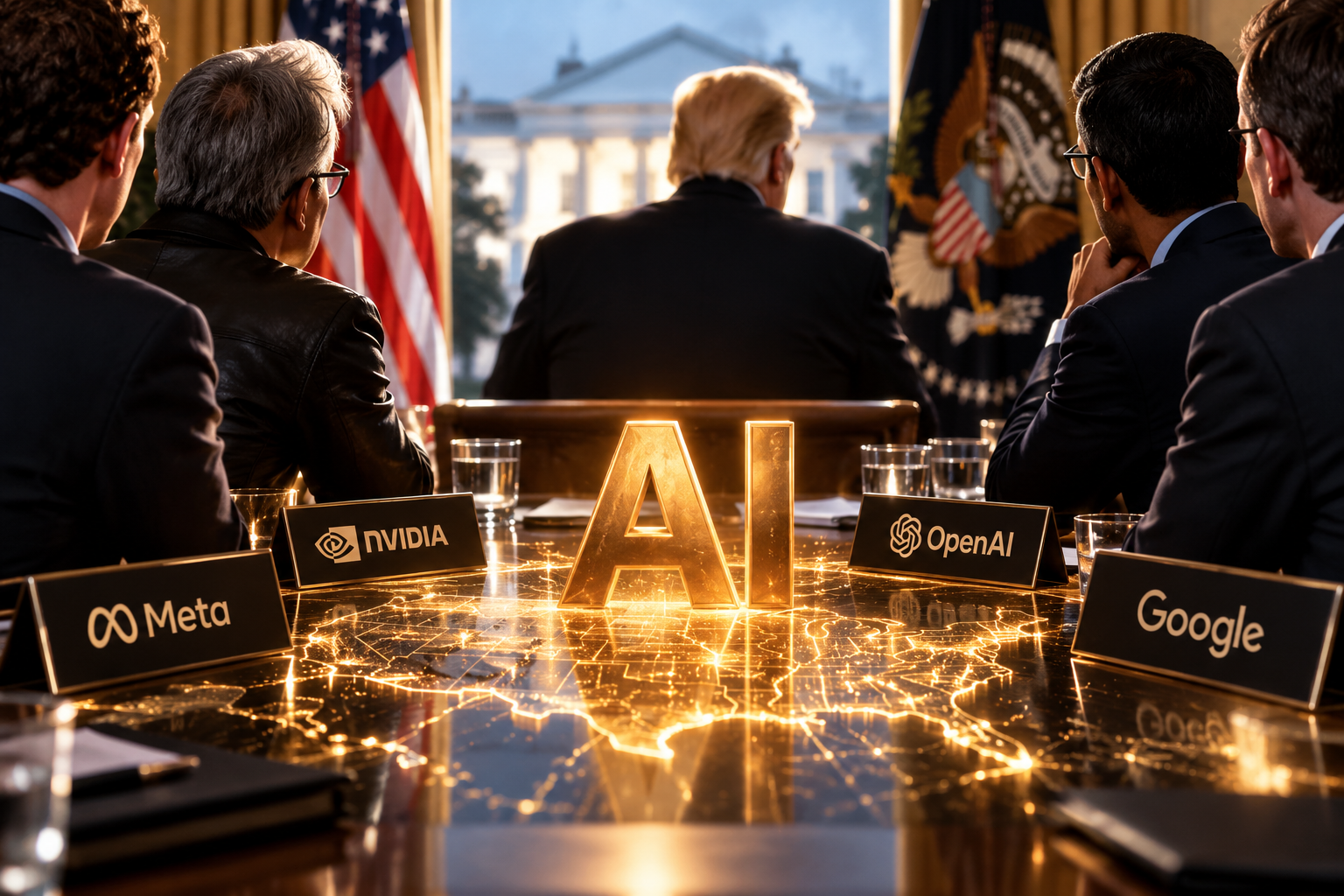
The White House meeting is expected to include Meta chief executive Mark Zuckerberg, Anthropic chief executive Dario Amodei, Nvidia chief executive Jensen Huang, Google chief executive Sundar Pichai and OpenAI president Greg Brockman.
Their companies occupy very different positions in the AI ecosystem.
Nvidia supplies the advanced chips that power much of the industry. Google, Meta, Anthropic and OpenAI are building increasingly capable models and products. Together, their investment decisions influence everything from electricity demand to the pace at which new AI systems reach the public.
That gives the meeting unusual weight even if no major regulation emerges from it.
Washington is not simply speaking to an industry anymore. It is speaking to a group of companies whose systems could reshape large parts of the economy, government, defence and everyday work.
The gathering also follows an earlier White House confrontation with AI’s electricity demands, where rapid data-centre expansion raised questions about who should bear the cost of the power required to sustain the boom.
The Central Disagreement Is Speed
The most important tension is not whether AI should continue developing. Almost everyone involved accepts that it will.
The argument is over speed, safeguards and who gets to decide when the risks become large enough to justify intervention.
Trump has repeatedly warned against allowing regulation to weaken America’s position relative to China. He has also pushed back against some of the most dramatic warnings about advanced AI.
Amodei has taken a more cautious position. Anthropic has argued that rapidly improving systems may require stronger safeguards and closer government involvement as their capabilities increase.
That disagreement has already become a defining fault line in the debate between Trump and AI industry leaders.
It is possible to support rapid innovation while still believing that some forms of oversight are necessary. It is also possible to support safety rules while worrying that badly designed regulation could protect established companies, slow useful deployment or leave the United States at a disadvantage.
The difficult part is deciding where that line belongs.
Trump’s Approach Is Pro-Growth, But Not Entirely Hands-Off
The administration’s policy is sometimes described as simple deregulation, but that misses an important distinction.
Trump has clearly favoured rapid development and a lighter regulatory framework. Yet the federal government has also moved to integrate AI into national security, cybersecurity and public services, while preserving possible mechanisms for intervention.
In June, the White House issued a national-security directive aimed at accelerating the use of advanced AI across defence and intelligence while requiring systems to be robust, controllable and subject to clear chains of accountability.
Trump has also said the Justice Department could act if AI companies cross legal boundaries, a position examined in his recent “super intelligence” remarks.
That creates a policy model built around acceleration first, with intervention available when specific problems emerge.
Supporters see that as more flexible than imposing sweeping rules before the technology’s capabilities are fully understood.
Critics argue that waiting for obvious harm could leave regulators permanently behind systems that are advancing faster than legislation, courts and public institutions can respond.
China Is The Constant Background Pressure
Almost every major American AI policy debate eventually returns to China.
The United States still holds major advantages in frontier models, advanced chips, cloud infrastructure and private investment. China has also moved quickly, producing competitive models, expanding industrial applications and treating AI as a strategic national technology.
That rivalry creates a difficult policy problem.
Rules strong enough to slow American laboratories could alter the competitive balance. Rules that are too weak could allow serious safety, security or economic problems to develop before policymakers can respond.
The challenge therefore is not simply “regulation versus innovation”.
It is how to preserve innovation while deciding which risks should be accepted, which should be reduced and which should be prevented altogether.
Why America.gov Matters
America.gov may look modest beside arguments about superintelligence, autonomous agents and strategic competition, but it could be one of the day’s most politically useful announcements.
AI becomes easier to defend when voters can see a practical benefit.
If a government service becomes quicker to navigate, or if people can locate the right agency without searching through multiple websites, the technology stops being an abstract debate about future machines. It becomes part of an ordinary interaction with the state.
That is one reason the administration is pairing the launch with the language of a new technological era.
The White House is trying to connect three ideas: AI leadership, more effective government and American economic power.
Whether the public accepts that connection will depend less on slogans than on whether the technology actually works.
The White House Is Becoming A Centre Of AI Power
The deeper story is that artificial intelligence has moved out of Silicon Valley and into the centre of American state power.
The executives building the most capable systems now sit across the table from presidents, cabinet officials and congressional leaders. Their decisions influence energy policy, semiconductor supply, defence planning, jobs, cybersecurity and the global balance of technological power.
That makes today’s gathering more than a technology-industry photo opportunity.
Trump wants the United States to move quickly enough to dominate the next era of computing. Some of the executives around him agree with the direction but differ sharply over how much restraint the race may require.
The administration’s “Golden Age” message therefore arrives with a contradiction built into it.
America wants the benefits of faster AI. It also has to decide how much uncertainty it is prepared to accept to get them.
The White House can set the political direction. The harder work begins when Washington has to turn that direction into rules, institutions and limits that still make sense when the next generation of AI is more capable than the one being discussed today.
Sources
The White House — Lead the World in AI — The administration’s stated AI strategy, investment claims and emphasis on American technological leadership.
The White House — Fact Sheet: President Donald J. Trump Signs Historic Directive on AI in the National Security Enterprise — Details of the June 2026 national-security AI directive and its requirements for advanced systems.
Reuters — Trump to host Zuckerberg, Anthropic’s Amodei, and other AI titans Tuesday — Details of the 29 September White House meeting, expected participants and the debate over AI innovation and oversight.
Next Reads
Trump Dismisses AI Fears as Industry Leaders Ask for More Time — Who Gets to Set the Pace? — The clearest background to the dispute over whether frontier AI should continue accelerating or be deliberately slowed.
Trump Says Justice Department Could Rein In AI And Backs “Super Intelligence” Name — Explains Trump’s preference for rapid development alongside a possible legal enforcement backstop.
Why Trump And Xi Cannot Escape The AI War Reshaping Global Power — Places the White House push inside the wider US-China contest over chips, models, infrastructure and strategic power.
