Can AI Save as Much Electricity as It Uses?
Could Nine Gigawatt Power Stations Keep These Data Centres Running?
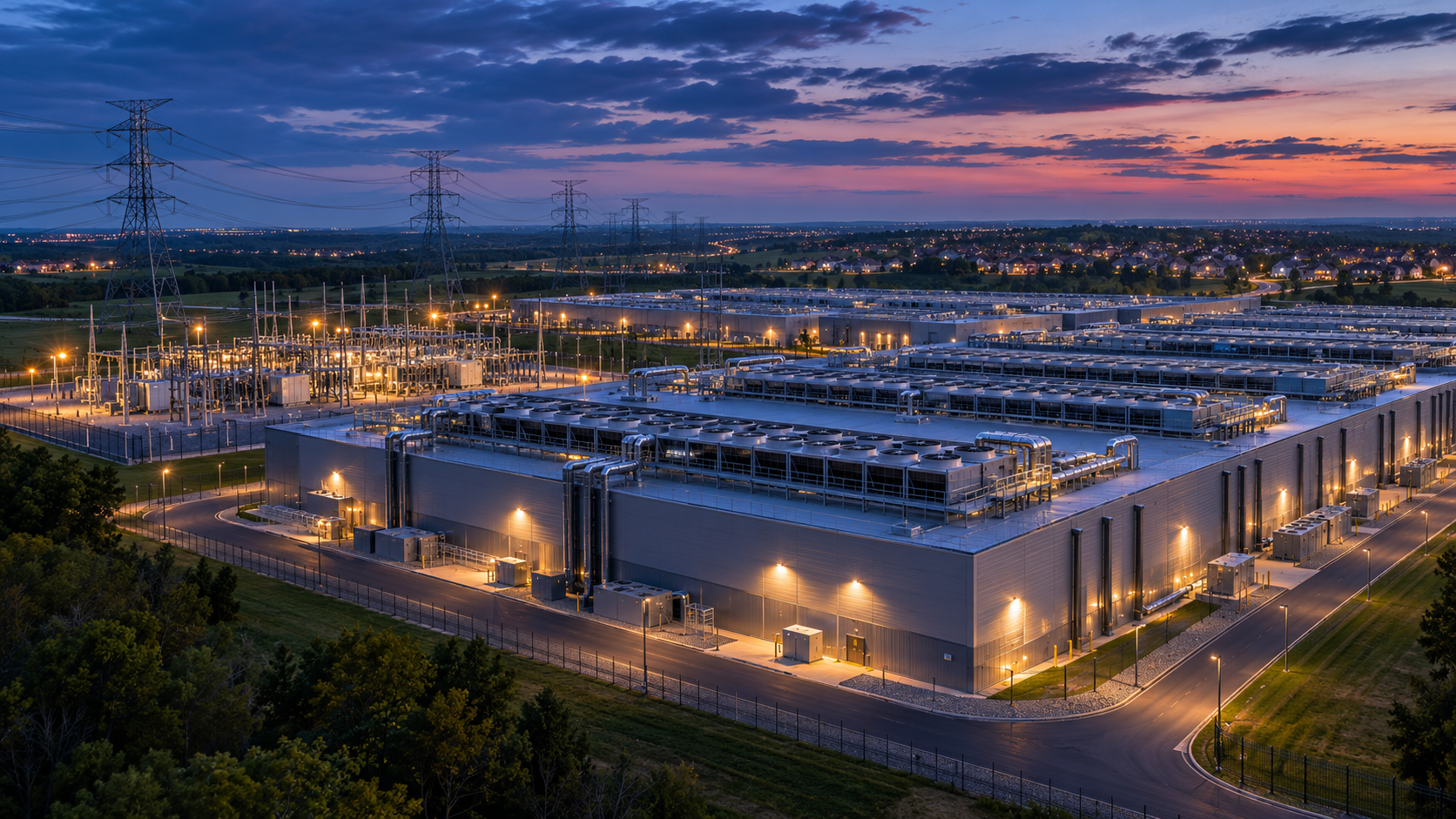
Imagine a power station delivering one gigawatt of electricity around the clock. Give it eight identical neighbours, each running flat out for a year. Even together, the nine would fall a little short of the electricity that a Harvard-led study estimates 403 large American data centres used between May 2024 and April 2025.
The central estimate was about 82 terawatt-hours in one year, roughly 1.8% of US electricity consumption. That is equivalent to the annual electricity purchases of about 7.6 million American residential customers. At the upper end of the researchers’ range, the sites approached the annual electricity use of Michigan.
Some of that electricity trained AI models and answered people’s questions. Some kept ordinary cloud services running. The researchers could estimate what it took to power the facilities, but the available data couldn’t separate those two uses. That distinction matters when considering one of the industry’s most interesting claims. Could AI eventually save as much electricity as it consumes?
Why the Researchers Gave a Range
A satellite image can show where a data centre stands. It cannot tell you whether the servers inside spent Tuesday afternoon running at half capacity. That gap matters when the aim is to reconstruct an entire year of electricity use across hundreds of sites.
For the study, published in Nature Sustainability on 16 November 2026, Gianluca Guidi and colleagues used satellite imagery to help identify operating hyperscale facilities. These are large installations built to provide computing services at enormous scale. The team estimated each site’s electricity use under different assumptions about how hard its equipment was working.
Across the 403 sites, the resulting totals ran from 68 to 99 terawatt-hours. The lower and upper figures describe different operating scenarios for the same twelve months. That 31-terawatt-hour gap gives a sense of how much uncertainty remains even after researchers know where the buildings are.
Smaller server rooms sit outside the study. The team also lacked sufficient information to include every American hyperscale facility. And although the findings appeared in November 2026, the study period ended in April 2025. A campus that opened the following summer contributes nothing to these figures.
What 82 Terawatt-Hours Looks Like on a Household Bill
One terawatt-hour is a billion kilowatt-hours, the units on a domestic electricity bill. In 2022, an average US residential utility customer bought 10,791 kilowatt-hours over the year. Divide 82 billion by that figure and you get the equivalent of roughly 7.6 million residential customers.
On the study’s central estimate, the 403 sites accounted for roughly one in every 56 kilowatt-hours consumed in the United States during those twelve months. Together, they used about 225 million kilowatt-hours a day. Spread evenly across all 8,760 hours of the year, that works out to a continuous draw of around 9.4 gigawatts. Dividing that total equally among the 403 facilities gives an average of about 23 megawatts per site.
The household comparison changes strikingly depending on where you live. Apply the same calculation to average 2022 residential purchases in Louisiana and 82 terawatt-hours covers around 5.6 million customers. Use Hawaii’s much lower average purchases and it covers about 13.3 million. Rooftop solar can reduce how much electricity a household buys from its utility, too. The difference between those answers comes entirely from the household bill used as the yardstick.
For someone planning a substation, the more useful figure is power. A connection must cope with what customers draw at the same moment. The 23-megawatt average tells us little about the highest draw on a particular power line on a hot afternoon. Equally, a proposed campus advertised at 100 megawatts need not draw that much every hour from the day it opens. One figure describes average use across existing sites. The other describes how much power a new site is being designed to handle.
Four States Accounted for More Than Half
Virginia, Oregon, Ohio and Iowa together accounted for more than half of the electricity used by the facilities studied. A demand that looks modest as a share of the national total can therefore loom large for the utilities serving a handful of communities.
Location also changes the emissions attached to a kilowatt-hour. The researchers used US Environmental Protection Agency data on regional generating mixes to estimate the carbon dioxide associated with the sites’ power. They attributed roughly 54% of the electricity to fossil fuels, including about 38% to natural gas and 15% to coal. Their estimate for the associated emissions was 25.7 million metric tonnes of carbon dioxide over the year.
A server hall can have no chimney in sight while drawing power from a grid that burns coal or gas. Change the generators supplying that grid and the same computing workload can leave a different carbon footprint. This helps explain technology companies’ interest in buying electricity from nuclear plants. A cleaner supply can cut emissions even when the electricity meter keeps turning at the same speed.
The Cooling Experiment That Saved Electricity
One of the clearest examples of AI saving energy began with a practical question. If several combinations of pump speeds, temperatures and cooling settings will keep servers running safely, which combination uses the least electricity?
Nearly all the electricity going into a server eventually emerges as heat. Carrying that heat out takes more electricity. The way a facility moves heat away from its chips determines which settings an operator can change. The weather outside changes which combination works best.
In 2018, Google DeepMind described a system that took readings from thousands of sensors every five minutes. It predicted how different adjustments would affect energy use, selected settings within safety limits and passed them to a local controller for another check. One discovery was that the system could exploit winter conditions to produce colder water, reducing the work needed to cool the building.
The team reported an average improvement of about 30% in the electricity needed to deliver a given amount of cooling, measured against historical performance. What would that mean at the building’s meter? Suppose cooling accounts for ten units of every hundred a particular facility uses. Cut those ten units by 30% and the building now uses 97. That is a 3% saving on total electricity at the same workload.
The ten-unit cooling share is illustrative. It shows why applying a 30% improvement directly to the entire 82-terawatt-hour estimate would produce an enormous error. To calculate the real saving, you would first need to know how much electricity each site spends on cooling and how well its existing controls already perform.
The AI Breakthrough That Found Room on Existing Servers
A second Google project tackled a problem familiar to anyone who has packed a removal van. There can be plenty of space left in total and nowhere to fit the next large item. Computing jobs have a similar problem. Each needs a particular combination of processor capacity and memory. Poorly chosen assignments can leave spare resources scattered across machines, with no single machine able to accept the next job.
Google DeepMind’s AlphaEvolve helped devise a better rule for assigning those jobs. In 2025, the team reported that deploying the rule recovered an average of 0.7% of Google’s fleet-wide computing resources that would otherwise have been stranded. Engineers could put additional work through machines they already owned.
What happens next determines the electricity saving. An operator that finishes the same work and takes surplus machines offline can register a reduction at the meter. An operator with a queue of waiting jobs can fill the space immediately. In the second case, customers get more computing from the equipment, even if the local utility sees little change in demand.
Could AI Cover Its Own Electricity Demand?
AI can help the people supplying the grid as well as those drawing from it. In a wind-power project, DeepMind used weather forecasts and historical turbine data to predict output 36 hours ahead. Operators could then make better commitments about how much electricity they would supply the following day. Google reported roughly 20% more value from its wind energy than under a baseline with no time-based commitments. That was an economic gain from knowing when power would arrive. The experiment made no claim that the turbines generated 20% more electricity.
Could the electricity savings from AI applications eventually exceed the power AI consumes? Yes, in principle. The published results do not establish that it has happened at national scale. A system that consumes one megawatt-hour and demonstrably saves two elsewhere leaves a net gain of one. To establish that across an economy, researchers would need to know how much electricity went specifically to AI, how much its applications saved beyond what conventional tools would have achieved, and how much of the freed capacity customers immediately put to another use.
Growth can change the answer even when the technology improves dramatically. Halve the electricity needed for each task, then triple the number of tasks, and total electricity use rises by 50%. In its 2025 Energy and AI report, the International Energy Agency modelled a high-efficiency scenario in which global data centres use about 20% less electricity in 2035 than in its base case. Electricity consumption can still rise in both futures.
The most revealing experiment would publish two readings side by side. Take a facility with AI cooling and show how much electricity it saved while delivering the same computing work through comparable weather. Then publish its full annual meter reading after customers made use of the spare capacity. The first figure tells us whether the invention worked. The second tells the local utility how much electricity it still has to supply.
Sources
Guidi and colleagues — Assessing the carbon emissions and energy consumption of US hyperscale data centres — The 403-site study, operating scenarios and regional emissions estimates.
US Energy Information Administration — How much electricity does an American home use? — National, Louisiana and Hawaii residential electricity purchases used in the comparisons.
Google DeepMind — Safety-first AI for autonomous data centre cooling and industrial control — How the cooling controls worked and what the 30% improvement measured.
Google DeepMind — AlphaEvolve: A Gemini-powered coding agent for designing advanced algorithms — The scheduling improvement and the capacity it recovered.
Google DeepMind — Machine learning can boost the value of wind energy — The forecast horizon and the economic value of advance commitments.
International Energy Agency — Energy and AI — The 2035 high-efficiency scenario and its comparison with the base case.
Next Reads
Why Do AI Data Centres Use Water, and Where Does It Actually Go? — Follow the heat from a processor to the point where the cooling system releases it.
The AI Boom Is Bringing Nuclear Power Back — And Investors Are Betting Billions on It — Why technology companies are looking to reactors for round-the-clock power.
OpenAI’s A$7 Billion Sydney AI Campus: Why the NEXTDC Deal Matters Far Beyond Australia — What a proposed 550-megawatt campus looks like at the planning stage.
