SpaceX’s First Starship Catch Explained, From Re-entry to the Tower
The Spacecraft That Delivered 26 Satellites Came Back To The Tower That Launched It.
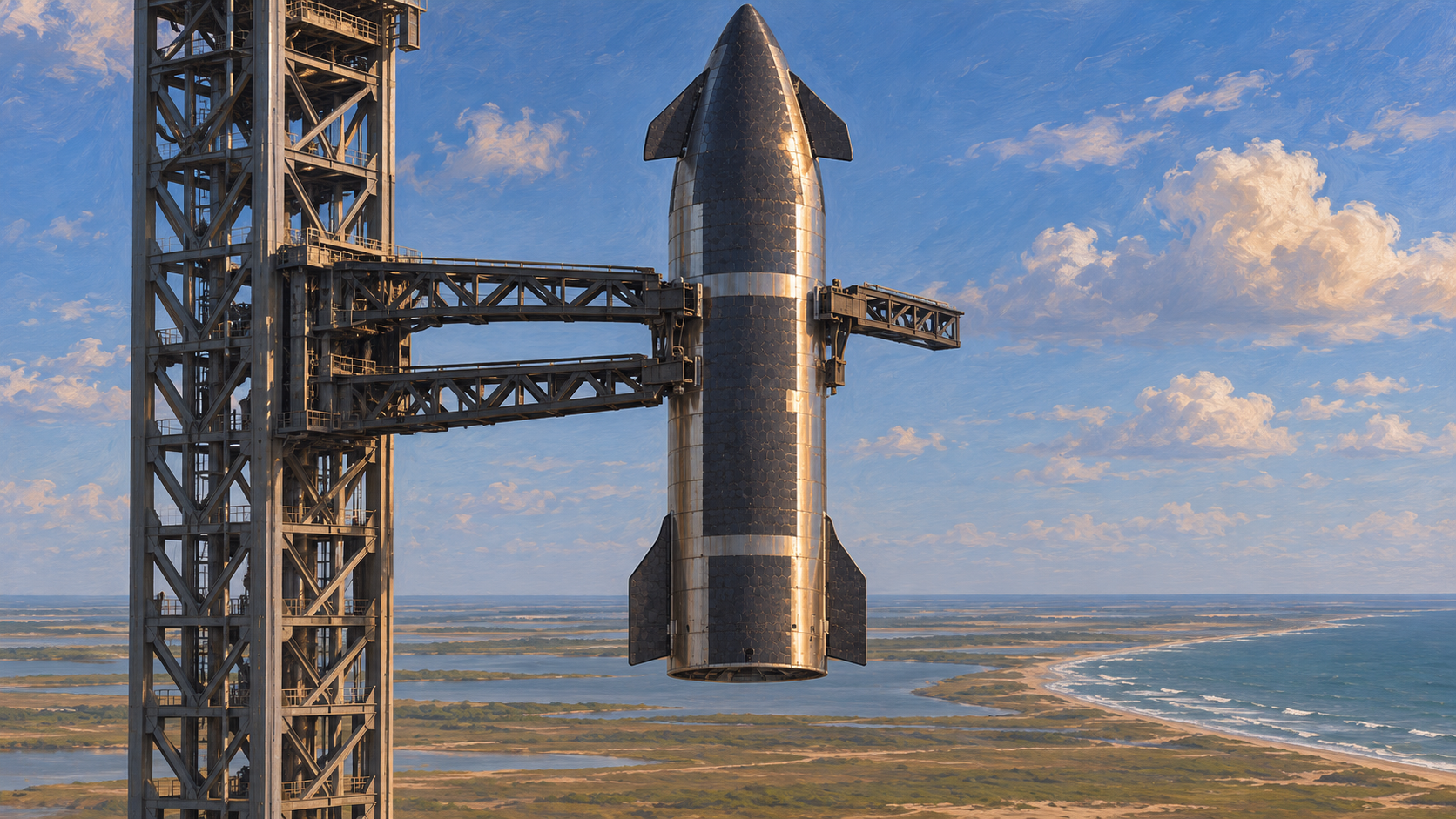
On Saturday 14 November 2026, a stainless-steel spacecraft descended over the Texas coast with its belly facing the ground. Close to the launch site, it fired its engines, swung upright and eased between two mechanical arms. When the engines shut down, the tower held the ship above the pad. Just over 22 hours earlier, it had left the same site carrying satellites.
This was the first time SpaceX had caught a Starship upper stage returning from orbit. The distinction matters. Anyone who remembers a remarkably similar scene in 2024 saw the recovery of Super Heavy, the booster that supplies the first push off the ground. The vehicle caught on Saturday was the part that continued into orbit, opened its payload bay and delivered 26 Starlink satellites. It had a much harder journey home.
Flight 15 also produced a result that the photographs of the catch can easily obscure. SpaceX had hoped to bring both halves of the rocket back to Starbase. The booster was lost at sea. To understand how close SpaceX is to a fully reusable rocket, both outcomes count.
What Happened On Starship Flight 15?
Starship lifted off from Starbase in South Texas on Friday 13 November. Super Heavy rose under the power of 33 Raptor engines. Roughly two minutes into the flight, the upper stage separated and continued towards orbit under its own power. From then on, the two vehicles had separate jobs and very different fortunes.
Super Heavy turned back towards Texas. During the engine firing intended to put it on a return course, the booster detected low fuel mass and ended the burn early. Its guidance system abandoned the tower approach and diverted offshore. The booster fired its engines once more over the Gulf before its flight termination system activated. As of 15 November, SpaceX was still investigating what caused the fuel condition.
The upper stage continued its mission. It deployed 26 third-generation Starlink satellites and circled Earth 14 times, flying about 265 kilometres above the surface. On Saturday, it restarted one of its six engines for a burn lasting about ten seconds. That short firing began the return to Texas.
How Do You Catch A Spacecraft Moving At Orbital Speed?
The tower only enters the story in the final seconds. Most of the work involves giving up the enormous speed that keeps a spacecraft in orbit. An object circling Earth at Starship’s altitude travels roughly 7.8 kilometres every second. Its sideways motion carries it around the curvature of the planet as gravity pulls it down.
That explains how a ten-second engine firing could bring Starship home. The engine only had to slow the ship enough to lower part of its orbit into thicker air. From there, the atmosphere could do most of the braking. The price of using air as a brake is heat. As Starship drove into denser air, the gas compressed and heated in front of it. The orange glow visible during re-entry marked the part of the journey that a returning Super Heavy booster never experiences at orbital speed.
Starship presented its tiled underside to the airflow. Its broad body created drag, while movable flaps helped control its attitude. Its path took it across Baja California and northern Mexico before it approached Starbase from over the Gulf. A spacecraft that had spent the previous day circling the world was now descending almost horizontally, broadside to the air, towards one particular structure on the Texas coast.
Then came the change of posture visible from the ground. Starship fired its engines, rotated upright and slowed its descent so the tower arms could take its weight. The word catch makes the arms sound as though they arrested a fast-moving object. In practice, the ship had to arrive moving slowly enough for the transfer of weight to work. The tower could support it. Only the spacecraft could perform the braking and put itself within reach.
Why Use A Tower Instead Of Landing Legs?
Landing legs would have made the return easier to recognise. They would also have travelled all the way to orbit, occupied space on the ship and come back through the atmosphere. A tower leaves much of the equipment needed to support the landed vehicle on the ground, where its weight costs nothing to launch. It also returns the spacecraft directly to a site equipped to handle it.
The bargain is demanding. A vehicle with legs can use a suitable patch of reinforced ground. Starship has to reach the arms at the right height, with the right orientation and very little sideways motion. The target is also valuable. An unsuccessful approach could damage the infrastructure needed for the next launch. Friday’s booster diversion showed why the ability to abandon a catch matters as much as the ability to complete one.
How Long Did It Take SpaceX To Get Here?
About ten years elapsed between the public unveiling of Starship’s ancestor and the first orbital ship catch. The full-size rocket spent roughly three and a half years in integrated flight testing before the catch succeeded. Those figures measure different things. SpaceX changed the vehicle substantially along the way, even switching from a proposed carbon-fibre structure to stainless steel. There is no single public start date for the design of Saturday’s precise manoeuvre.
In 2016, Elon Musk presented the original interplanetary transport concept in Guadalajara, Mexico. By 2019, SpaceX was flying short prototype hops in Texas. In May 2021, a prototype called SN15 completed a high-altitude flight, turned upright and landed on legs. That test addressed a question anyone watching Saturday’s footage might reasonably ask. Could a vehicle of this shape fall belly-first, swing its engines underneath itself and settle upright before it reached the ground?
The complete Starship and Super Heavy combination first flew in April 2023. In June 2024, an upper stage survived re-entry and reached a controlled splashdown in the Indian Ocean. That October, the tower caught a returning booster for the first time. One test had taken the ship through the atmosphere. The other had brought a large rocket stage into the arms. More than two years passed before an upper stage returning from orbit put those achievements together.
Even orbit itself was a recent milestone. Flight 14 reached it in September 2026. Flight 15 was only Starship’s second orbital mission. The number fifteen can give a misleading impression of how much practice SpaceX had at bringing a satellite-carrying ship home after a day in space.
What Does The Catch Make Possible?
The most immediate gain is that engineers have the spacecraft. They can identify which heat-shield tiles weathered re-entry, inspect the engines that restarted for landing and compare physical wear with the temperatures and loads recorded in flight. A controlled ocean splashdown can tell engineers that a design survived. A ship hanging at Starbase lets them examine precisely how well it survived and decide which parts can fly again.
That distinction determines what recovery is worth commercially. Imagine two ships that look equally impressive in photographs after landing. One needs a few tiles replaced and routine engine checks. The other needs weeks of work before another launch. Both count as successful catches. They imply very different costs per satellite delivered. Flight 15 provided the hardware from which SpaceX can begin to establish the answer.
Starlink offers the clearest near-term use. SpaceX already has satellites to launch, and Flight 15 delivered a working batch before attempting recovery. If one upper stage can make that journey repeatedly, the company could spread the cost of building its engines, tanks and structure across several payloads. The savings depend on how many times it flies, how much servicing each return requires and whether the booster and launch pad can keep pace.
For the Moon, the connection is less obvious but potentially more important. SpaceX’s lunar plans require propellant to be delivered to orbit. A tanker flight earns its place in that system by delivering fuel, returning and becoming available for another delivery. Recovering ships could make a succession of tanker launches more practical. Transferring and storing the propellant in space, docking vehicles and safely landing a crew on the Moon remain separate engineering tasks. A catch in Texas addresses the Earth end of that chain.
What Should We Watch For Next?
Three pieces of evidence would materially change the assessment. The first is an account of what engineers found when they inspected the returned ship, particularly its heat shield. The second is a successful reflight of that same upper stage, with the time and refurbishment it required. The third is a mission that delivers its payload and brings both stages back to the launch site. Friday’s booster loss explains why the third still matters even after SpaceX has caught each kind of vehicle separately.
Flight 15 deserves its place in spaceflight history on the strength of what went up and what came back. A ship carried satellites to orbit, circled Earth 14 times and returned under its own control to the tower it had left the previous afternoon. The next question has a wonderfully ordinary form for such an extraordinary machine. When can this particular ship go back to work?
Sources
SpaceX’s mission account records the satellite deployment, booster diversion and upper-stage recovery. SpaceX — Starship Flight 15. Starship Flight 15
Jon Kelvey gives the flight sequence, including the ten-second deorbit burn, re-entry route and tower approach. Aerospace America — SpaceX achieves first Starship tower catch. Aerospace America
The development history traces the programme from its 2016 unveiling through prototype landings, ocean returns and the first orbital flight. Space.com — SpaceX’s Starship just turned 10 years old. When will it go to Mars?. Space
Next Reads
For the engineering milestones between an Earth-orbit flight and a crewed expedition, read When Will Humans Reach Mars? SpaceX’s Plans And A Realistic Timeline.
For a closer look at why transporting supplies matters so much to lunar exploration, read China Is Hunting For Ice On The Moon — And It Could Decide Who Builds The First Lunar Base.
For the human side of a long expedition, read 378 Days on ‘Mars’: Inside NASA’s Year-Long Experiment on Earth.
