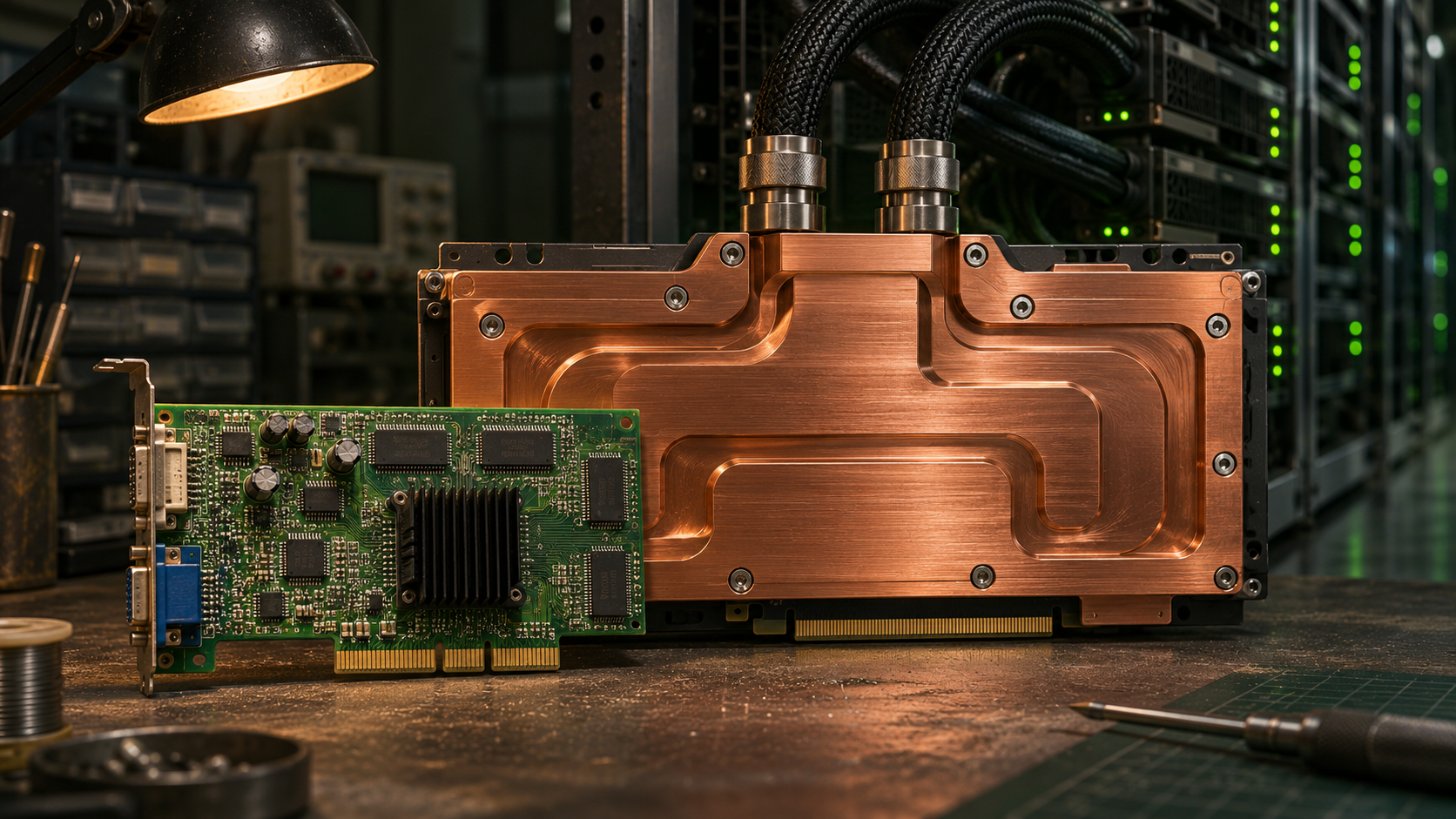
How Nvidia Went From a Failing Graphics Chip to the Heart of the AI Economy
Nvidia Once Asked Sega To Pay For A Chip It Should Never Use.
Jensen Huang had an awkward proposition for one of Nvidia’s most important customers. His engineers had spent a year working on graphics technology for a Sega console. He had concluded that Sega ought to find another partner. There was one further difficulty. If Sega took that advice and stopped paying, Nvidia would probably go out of business.
In Huang’s account, Sega agreed to pay. The reprieve gave Nvidia roughly six months to build something customers wanted. In 1997 it launched the RIVA 128, a graphics processor for personal computers. By the following year, it had shipped its millionth unit.
Three decades later, the company that once needed a customer’s generosity to meet its bills could report $96.2 billion in quarterly revenue. Its equipment helps train artificial intelligence models, run them for paying customers and connect the thousands of processors inside a modern data centre. The US and Chinese governments both influence who can buy its most advanced products. In the week of Huang’s departure in November 2026, its stock market value was around $4 trillion.
There is a thread connecting the Sega contract to that extraordinary valuation. Nvidia nearly failed because it chose a way of building games that developers had little reason to follow. It made its fortune by giving developers so many reasons to choose its technology that switching became a consequential business decision. With Huang gone after 33 years, the durability of those reasons is about to matter more than ever.
Three Engineers Saw an Opening in the Games Business
Jensen Huang, Chris Malachowsky and Curtis Priem founded Nvidia on 5 April 1993. The origin story has acquired a suitably American landmark, a Denny’s restaurant in San Jose where the founders discussed their plans. The more revealing detail is what they chose to work on. They wanted to bring convincing three-dimensional graphics to the personal computer, and video games offered a market where customers could judge the result almost instantly.
Consider what happens when a player turns a corner in a racing game. The road markings change shape, the grandstand moves across the screen and a rival car grows larger as it approaches. The computer must calculate where the objects appear and how their surfaces should look, then do it all again for the next frame. A delay that might pass unnoticed in a spreadsheet can make steering feel sluggish.
A general-purpose processor can perform those calculations. A specialist processor can divide much of the scene into pieces and work on many of them simultaneously. Games gave the founders a commercial reason to pursue that distinction. People who had never heard of parallel processing could see whether a game ran smoothly on the computer in front of them.
Nvidia’s first design, the NV1, demonstrated the danger of being inventive in a market where other people write the software. Its approach to drawing curved surfaces differed from the triangle-based graphics gaining support through Microsoft’s Direct3D. A game studio had to choose where to spend its engineers’ time. Supporting an unusual graphics card was a hard sell when the same effort could help a game run on a much larger pool of Windows computers.
That was the problem behind Huang’s conversation with Sega. Completing the contract would consume the time Nvidia needed to change direction. The RIVA 128 gave developers a fast processor that worked with the emerging standard. Its success bought Nvidia something more valuable than a single product cycle. It gave the company a place in the growing PC games business from which to try again.
How GeForce Helped Turn Graphics Into a Computing Platform
In 1999 Nvidia introduced the GeForce 256 and marketed it as a graphics processing unit, or GPU. Graphics acceleration already had a history. What distinguished this product was the amount of work it could take on, including calculations that positioned objects in a scene and determined how light fell on them.
Imagine a football game in which the camera sweeps from the centre circle towards the goal. The stadium exists as a collection of points in three-dimensional space. As the camera moves, the computer must calculate where those points belong on a flat screen. Handing more of that work to the graphics processor freed the central processor to handle other parts of the game. A developer could spend the extra capacity on a more detailed scene or a steadier frame rate.
There was a business advantage in the division of labour. Game developers could build more ambitious worlds as successive generations of hardware reached players. Those worlds gave players a reason to upgrade. Nvidia could earn money from better graphics while financing research into processors with wider uses. The people buying cards to play games helped pay for a technology that researchers would eventually use to teach computers how to recognise what was in a picture.
The difficult part was giving those researchers access. A physicist might have thousands of calculations a graphics card could perform efficiently, yet little appetite for translating a scientific problem into the language of textures and pixels. The hardware had acquired an ability its original customers had never asked for. Nvidia’s next decision was to make that ability usable.
CUDA Gave Researchers a Reason to Learn Nvidia
Nvidia unveiled its CUDA architecture in 2006 and made its programming tools available the following year. CUDA gave programmers a way to send suitable calculations to an Nvidia GPU. A scientist working with an array of measurements could express the calculation directly, leaving the graphics pipeline out of the conversation.
The distinction matters because buying a processor is usually the easiest part of changing how a research group works. Somebody must rewrite the calculation, check the answers and investigate the cases in which the new version runs slowly or gives an unexpected result. Then a colleague must be able to reproduce it. Every tested library and worked example reduces the amount of that labour the next person has to repeat.
The initial commercial proposition was uncomfortable. Nvidia was spending money on hardware and software features whose eventual customers were difficult to identify. A gamer choosing between two cards could compare how well they ran a favourite title. The value of a programming system depended on what people might create with it years later. Huang was asking the graphics business to fund an experiment with a much less obvious route to a sale.
In 2012, three researchers provided a persuasive answer. Alex Krizhevsky, Ilya Sutskever and Geoffrey Hinton used two Nvidia GeForce GTX 580 graphics cards to train the neural network now known as AlexNet. Their system learnt from labelled photographs and competed in the ImageNet image-recognition challenge. On the competition’s top-five measure, where the correct category had to appear among the system’s five guesses, their entry recorded an error rate of 15.3%. The runner-up recorded 26.2%.
For every hundred images, that gap amounted to roughly eleven more for which the system put the right answer on its shortlist. The research team deserved the credit for the model, the training decisions and the result. What other laboratories could take away was a remarkably practical observation. Two commercially available graphics cards had helped a small team conduct an experiment with consequences for an entire field. A researcher planning the next experiment now had a paper to follow and hardware they could obtain.
From Two Graphics Cards to a Roomful of Computers
Training an AI model means repeatedly adjusting numerical settings so its outputs better match the examples it sees. Much of the work involves multiplying and adding large arrays of numbers. That suits processors built to perform many similar operations at once. As models grow, however, an inconvenient question emerges. What happens when the model or the work no longer fits comfortably on one processor?
Suppose a team divides a training job across hundreds of GPUs. Each can complete its share quickly, yet at intervals the machines must exchange results before proceeding. A delay at that point leaves expensive processors waiting. Buying faster chips delivers a disappointing return if the time saved in calculation is then lost moving information between them.
Nvidia widened the range of problems it offered to solve. Its DGX systems brought multiple GPUs together in one machine. In 2016 Huang personally delivered an early DGX-1 to OpenAI, then a young research organisation. In 2020 Nvidia completed its acquisition of networking specialist Mellanox for about $7 billion. Networking might have seemed a curious destination for the proceeds of a graphics business. To someone paying for a roomful of processors, the connection between them was already part of the product.
Today a cloud provider choosing an AI system must consider the processors, memory, connections, software, cooling and electrical supply together. A machine that looks excellent in a short demonstration can be expensive to own if it takes months to install or spends too much time idle. Nvidia can sell a customer several of the components and help make them work together. Each additional problem it solves increases the share of the customer’s budget it can plausibly earn.
That is also why the relationship with OpenAI matters beyond the photograph of a founder delivering a computer. OpenAI develops models and services that people use. Nvidia supplies computing technology that organisations can buy directly or access through cloud providers. One company can create demand for the other without every pound spent on an AI subscription flowing to the chipmaker. The amount Nvidia ultimately captures depends on whose equipment runs the work, how efficiently it runs and who pays for the next installation.
Why Is Nvidia Worth Trillions?
The clearest answer begins with what customers have already paid. For the quarter ending 26 July 2026, Nvidia reported revenue of $96.2 billion, up 106% from a year earlier. Its data-centre business accounted for $89 billion, or roughly 93% of the total. The company’s gross margin was 75%. For every dollar of revenue, about 75 cents remained after the costs classified as cost of revenue, before operating expenses, taxes and other items.
Those figures explain why investors take Nvidia’s earning power seriously. They also show how thoroughly the company has changed. A downturn in gaming would hurt the business that built GeForce. A major cut in AI infrastructure spending would strike at almost the entire revenue base Nvidia had assembled by that July quarter.
A stock market valuation adds a further judgement. At around $4 trillion in the week of Huang’s departure, investors were putting a price on years of future profits. They were also judging how much of the wealth created by AI would accrue to the supplier of computing equipment. A popular AI service can attract millions of users while struggling to charge enough to cover its costs. For a time, the company selling the equipment can enjoy better economics than the company operating the service.
Over a longer period, the customer’s economics catch up with the supplier. Consider a cloud provider deciding whether to build another data centre. If its existing systems are busy and clients are willing to pay enough for access, buying the next generation is a straightforward proposition. If machines sit idle or customers insist on much lower prices, the provider can defer the order. Nvidia recognises revenue on a different timetable from the businesses trying to earn a return on that equipment.
There is a further complication. Some of the organisations with the money to buy Nvidia systems also have the money to design alternatives. Google’s tensor processing units and Amazon’s Trainium illustrate the attraction of custom silicon. A company running the same operation at enormous scale can justify considerable engineering effort to shave a little off each calculation. Nvidia has a stronger hand when the workload is changing quickly and customers value the freedom to run many different models.
The argument for a large valuation rests partly on how long that flexibility remains worth paying for. A competitor can produce a good chip and still struggle to persuade a customer to move years of tested software. Equally, the larger Nvidia’s profits become, the more a customer can justify spending to reduce its dependence. The same July results that demonstrate Nvidia’s advantage help explain why its customers are funding potential competitors.
What Nvidia Is Changing Beyond the Chatbot
A less visible consequence of GPU computing is the change it makes to the working day of someone running an experiment. A simulation that finishes overnight gives an engineer one result the next morning. A simulation that finishes during a meeting allows the team to alter the design and test it again while everyone who understands the problem is still in the room. A sufficiently large improvement in speed can change the questions people bother to ask.
That opportunity extends to industrial design and robotics. Before a physical robot can pick up an unfamiliar object reliably, its designers need to understand how changes in position, grip and lighting affect the attempt. A simulated environment lets them vary those conditions repeatedly without resetting a real machine each time. The work still has to survive contact with an actual object. A simulation that represents friction badly can teach a robot the wrong lesson with extraordinary efficiency. The commercial opportunity lies in reducing the number of expensive physical trials needed to reach a dependable result.
AI inference offers a different kind of opportunity. Training produces a model. Inference is the work the model performs when someone actually uses it, whether to generate speech, translate a passage or suggest a change to a computer program. A training run has an end. A service answering customers creates a fresh computing bill every day it remains popular.
Here, the important measure might be the price of producing an acceptable answer within two seconds. A faster machine that uses less electricity per answer could make a previously uneconomic service affordable. It could also allow an operator to serve existing customers with fewer machines. The direction of hardware demand depends on how many additional uses emerge as the cost falls. Nvidia’s potential is largest where cheaper computation encourages people to attempt something they previously could not afford.
Why Washington and Beijing Both Have a Say
Nvidia is an American chip designer with a manufacturing network that extends far beyond the United States. Its long relationship with Taiwan Semiconductor Manufacturing Company, or TSMC, reflects a division of expertise. Nvidia designs processors. A foundry develops and operates the exceptionally demanding processes that turn a design into working silicon. Memory suppliers, packaging specialists and systems manufacturers also contribute to the machine that eventually reaches a customer.
That geography complicates the familiar description of an American race against China. Taiwan is central to production. Washington controls exports of certain advanced US technologies. Beijing can restrict what enters its own market. A Chinese company can want an Nvidia processor, have the money to pay for it and still be unable to complete the purchase.
Nvidia’s H200 provides a documented example. In its July-quarter filing, the company said the US government had granted licences for limited shipments to specified Chinese customers. Chinese restrictions prevented it from completing all the sales those licences allowed. Nvidia recorded a $400 million charge associated with excess H200 inventory and purchase obligations in the first half of its 2027 financial year. The licensed shipments accounted for less than 1% of data-centre revenue in its latest reported quarter.
From Washington’s perspective, advanced computing capacity has national-security implications as well as commercial uses. From Nvidia’s perspective, losing access to a market has consequences beyond the immediate order. A developer who spends several years learning to work around unavailable US hardware has a reason to keep using the alternative when restrictions change. Beijing likewise has an incentive to cultivate domestic suppliers, even where an imported product would initially be more convenient.
Nvidia’s August forecast captured the practical result. Management projected $108 billion in revenue for the following quarter, plus or minus 2%, while assuming no data-centre compute revenue from China. That was a forecast issued before Huang left. It shows how much demand management expected elsewhere and how little certainty it was prepared to attach to sales requiring permission from two governments.
What Actually Happened to Jensen Huang?
On 11 November 2026, Nvidia’s board accepted Huang’s resignation as president, chief executive and director, effective immediately. The company announced the change on 12 November. Chief financial officer Colette Kress became interim CEO while retaining her finance role. Harvey C. Jones, a director since 1993, became the board’s first chair. The board said it would consider internal and external candidates for the permanent chief executive position.
The word dismissal captures how abrupt the departure felt. The formal record says Huang resigned. There was real pressure behind the decision. On 8 November Huang acknowledged in a message to employees that he had been unfaithful to his wife. Nvidia’s board opened an independent investigation into national-security concerns following allegations about a relationship with a businesswoman suspected of links to Chinese intelligence. Huang said he would cooperate. His acknowledgement of infidelity established what he admitted. It supplied no evidence that he disclosed company secrets, and the resignation announcement published no finding of espionage.
For the business, the loss is unusually specific. Huang had been present when Nvidia asked Sega for more time, when it funded CUDA and when it began selling complete AI systems. He could ask a customer to believe an expensive new product would arrive and point to earlier occasions when his engineers had delivered. Kress, who joined as CFO in 2013, knows the finances behind much of that expansion. She inherits a different task when a customer wants a commitment involving engineering, supply and pricing all at once. The circumstances of Huang’s resignation make the board’s choice of permanent successor especially consequential.
What Comes Next for Nvidia?
The first public test is unusually close. As of 15 November 2026, Nvidia is due to report its next quarterly results on Tuesday 17 November. The revenue figure will describe orders and deliveries largely made under Huang. Kress’s account of what customers are ordering next, which products they want and what it will cost to supply them will say more about the business she now leads.
One product transition deserves particular attention. In August, Nvidia said its Vera Rubin platform was moving into full production, with racks running at partners including Microsoft Azure, Google Cloud, Oracle Cloud Infrastructure and CoreWeave. Getting a rack running is an engineering milestone. Delivering large numbers across different sites, keeping them busy and earning the expected margin is a commercial one. There is room for a considerable difference between the dates on which those milestones arrive.
Power is another constraint that a chip announcement cannot resolve. A provider can secure the processors it wants and still have to wait for an electricity connection or a suitable cooling installation. Under those conditions, useful work per watt becomes a purchasing criterion as important as outright speed. It also becomes harder to interpret a delayed order. A customer waiting for power and a customer losing faith in AI may both postpone delivery, with very different implications for the following year.
The most revealing question for Nvidia’s next leader is one a buyer could ask. If a rival offers a cheaper processor, what does the customer give up by taking it? In 1990s gaming, the answer went against Nvidia. Developers could reach more players by choosing the graphics standard its early chip had missed. In AI today, the answer often runs in Nvidia’s favour. A buyer leaving its platform may have to replace working software, retrain engineers, redesign connections and spend valuable months getting back to the same result.
Those are substantial advantages for Kress and her eventual permanent successor to inherit. Their value will be decided one installation at a time. Somewhere inside its largest customers, engineers are already doing the arithmetic that once saved Nvidia itself. They are working out whether to stay with the technology they know or build around something else.
Sources
Jensen Huang — National Taiwan University Commencement Address records Huang’s account of the Sega contract, the RIVA 128 and the early ambitions for CUDA. by Kevin Xu
Nvidia — Corporate History dates the founding, the move into GPU computing and the unveiling of CUDA. NVIDIA
Alex Krizhevsky, Ilya Sutskever and Geoffrey Hinton — ImageNet Classification with Deep Convolutional Neural Networks describes the researchers’ hardware, method and competition results. cs.cmu.edu
Nvidia — Completion of the Mellanox Acquisition gives the transaction value and the strategic rationale for buying a networking specialist. NVIDIA Newsroom
Nvidia — Second-Quarter Fiscal 2027 Results gives revenue, gross margin, the Vera Rubin update and the forecast issued in August. investor.nvidia.com
Nvidia — Quarterly Report for the Period Ended 26 July 2026 details the US licences, Chinese restrictions and H200 inventory charge. investor.nvidia.com
Reuters — Nvidia Board Weighs CEO Huang’s Future as Leadership Crisis Deepens provides independent reporting on the pressure preceding Huang’s departure and the company’s approximate market value that week. Reuters
Jensen Huang — A Message to Our Company records his acknowledgement of infidelity and his response to the investigation. NVIDIA Newsroom
US Securities and Exchange Commission — Nvidia Form 8-K records the effective date and terms of Huang’s resignation and the appointments of Kress and Jones. sec.gov
Next Reads
Jensen Huang Resigns as Nvidia CEO. Here’s Why He Left and What Happens Next follows the four days between the board’s public backing and the announcement of a new leader.
OpenAI Is Building An AI That Designs Computer Chips — And The Feedback Loop Could Be Enormous examines what happens when AI begins to help engineers design the hardware on which it runs.
Smugglers of Silicon: Inside the Black Market for AI Chips explores how export restrictions have changed the market for advanced processors.
