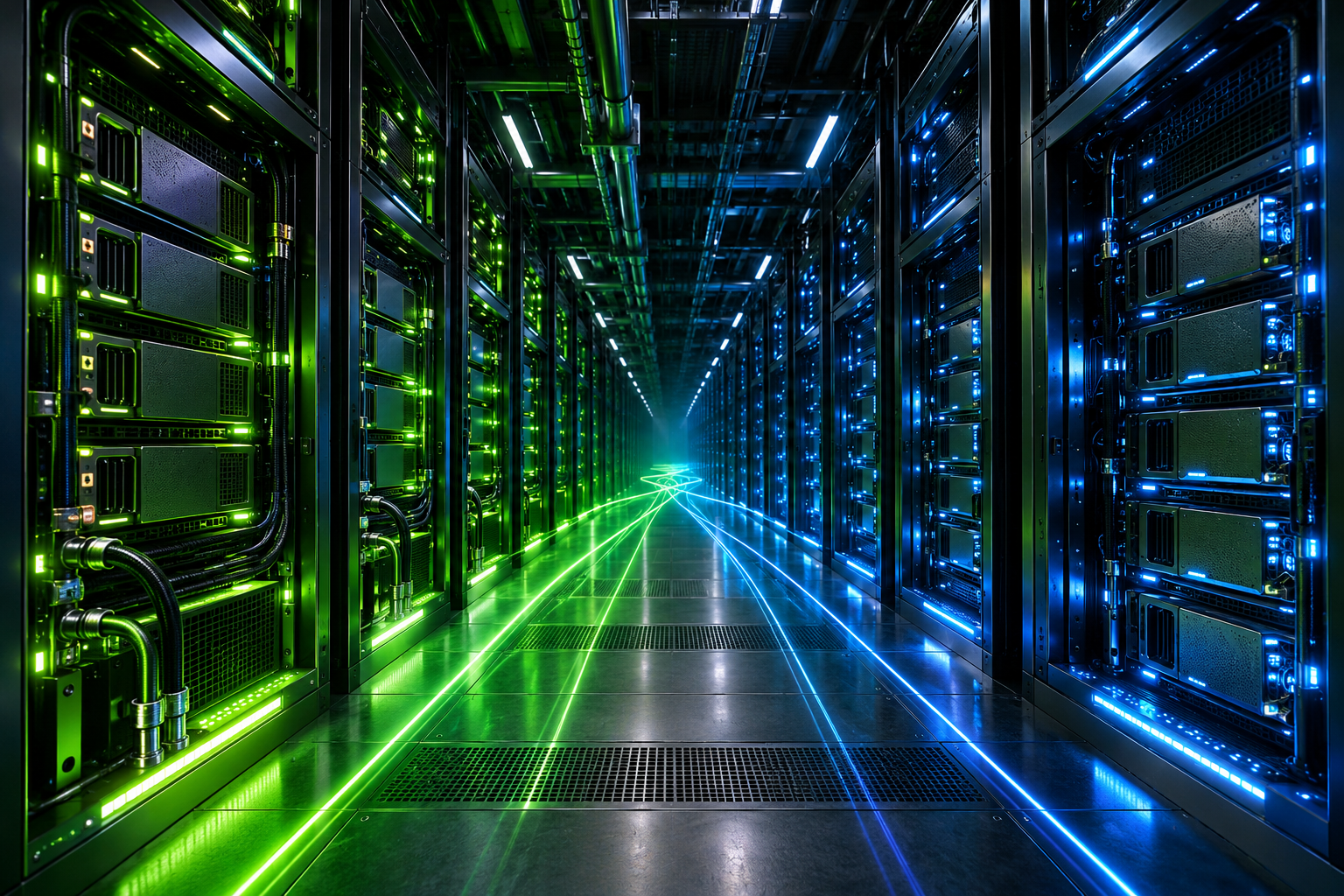
Why NVIDIA's AI Chips Are So Difficult To Replace
How Did A Company That Once Made Gaming Graphics Cards Become The Foundation Of The Artificial Intelligence Revolution?
NVIDIA was once best known for making computer games look better. Today, its technology helps power ChatGPT, trains some of the world's most advanced artificial intelligence models, and forms the backbone of data centres being constructed at extraordinary expense.
The transformation has made NVIDIA one of the most strategically important technology companies in the world.
Microsoft, Amazon, Google, Meta, Oracle and OpenAI are among the organisations building their AI ambitions around its technology. NVIDIA's processors are so valuable that companies are committing billions of dollars to securing computing capacity, while governments increasingly regard advanced AI chips as strategically sensitive technology.
But NVIDIA's dominance raises several important questions.
What exactly does the company manufacture? Why are its processors considered so difficult to replace? How did a business founded in 1993 become indispensable to the modern AI industry? And what is really happening in its increasingly complicated financial relationship with OpenAI?
The answers reveal a business whose greatest achievement may not be inventing a powerful computer chip, but creating an entire technological ecosystem that competitors must now challenge.
What Does NVIDIA Actually Make For Artificial Intelligence?
NVIDIA designs specialised processors and computing systems that perform the enormous mathematical calculations required by artificial intelligence.
Its most important products are graphics processing units, commonly called GPUs.
Originally developed to accelerate computer graphics, GPUs are particularly useful for AI because they can perform vast numbers of calculations simultaneously.
Traditional central processing units, or CPUs, are designed to handle a broad range of computing tasks, including complex sequences of instructions and operating-system workloads.
GPUs take a different approach.
They use large numbers of processing units to perform calculations in parallel. This architecture is particularly effective for the matrix operations used throughout modern neural networks.
When an AI model learns to recognise an image, translate a language, predict the next word in a sentence or generate computer code, it repeatedly performs mathematical operations involving enormous arrays of numbers.
NVIDIA's processors are designed to execute these operations efficiently.
However, selling individual processors is only part of its business.
NVIDIA also designs complete AI computing platforms, including specialised memory systems, networking equipment, central processors, software libraries, developer tools and rack-scale supercomputers.
The company has increasingly moved towards treating an entire data centre as one interconnected computing system.
That distinction explains much of its competitive advantage.
Its customers are not merely purchasing faster chips. They are buying the infrastructure needed to develop, operate and expand industrial-scale artificial intelligence.
Why Are NVIDIA GPUs So Powerful?
The simplest explanation is parallel processing.
Imagine asking one exceptionally capable worker to complete a million similar calculations in sequence.
Now imagine dividing the same workload among thousands of specialised workers who can operate simultaneously.
The second approach can be considerably faster when the work can be divided efficiently.
That is broadly the principle behind GPU acceleration.
Modern AI systems rely heavily on operations that can be distributed across thousands of processing units.
NVIDIA has refined its architecture over several generations to maximise performance on these workloads.
One important innovation is the Tensor Core.
Tensor Cores are specialised processing units designed to accelerate the mathematical operations used in machine learning.
Instead of relying entirely on conventional general-purpose arithmetic, they perform the matrix calculations that dominate many neural-network workloads.
Another advantage is the use of high-bandwidth memory.
Large AI models contain enormous numbers of parameters. Those parameters must be stored and retrieved while calculations take place.
A processor may possess extraordinary computing power, but that power becomes less useful if it spends too much time waiting for data to arrive.
NVIDIA therefore combines its GPUs with sophisticated memory systems designed to move information at extremely high speeds.
The interaction between processing performance, memory capacity and memory bandwidth matters more than any single headline specification.
For an AI developer, the practical question is not simply how fast a chip can perform calculations.
It is how quickly the complete system can train a model, answer requests, process long documents or execute complicated sequences of reasoning.
CUDA: The Software Advantage Competitors Struggle To Overcome
NVIDIA's most important competitive advantage may be software rather than silicon.
In 2006, the company introduced CUDA, a computing platform that allowed programmers to use NVIDIA GPUs for tasks beyond graphics.
At the time, the long-term commercial importance of this decision was far from obvious.
Artificial intelligence had not yet become the dominant technological investment theme it would eventually become.
But CUDA gave researchers and software developers a practical way to run scientific calculations, simulations and machine-learning workloads on NVIDIA hardware.
Over time, a large ecosystem emerged.
Researchers developed GPU-accelerated algorithms. Universities taught students to use CUDA. Companies built applications around NVIDIA's libraries. Popular AI frameworks incorporated support for its processors.
This created an advantage that could not be replicated simply by manufacturing a competitive chip.
A company considering alternative hardware must think about software compatibility, developer expertise, optimisation, testing and operational reliability.
Even if another processor offers attractive theoretical performance, migrating an established AI workload can introduce engineering costs and risks.
For organisations operating data centres with thousands of accelerators, those costs can be substantial.
CUDA also benefits from a reinforcing development cycle.
More customers encourage software developers to optimise for NVIDIA hardware. Better optimisation attracts more customers. Greater adoption gives NVIDIA more information about the workloads its customers need to accelerate.
This is one reason NVIDIA's position resembles that of a major computing platform rather than a conventional semiconductor supplier.
It is not impossible to compete with CUDA.
AMD's ROCm software platform, open-source development and the growing use of hardware-independent programming tools provide alternatives.
But NVIDIA's long-established software ecosystem gives it an important advantage wherever performance, compatibility and deployment speed matter.
Why NVIDIA Needs Thousands Of GPUs To Work Together
A single advanced GPU can perform an extraordinary number of calculations.
But the largest AI models require far more computing power than one processor can provide.
Training frontier models involves distributing enormous workloads across large groups of accelerators.
Those processors must exchange information continuously.
If communication is slow, expensive hardware can spend valuable time waiting for other parts of the system.
NVIDIA has addressed this problem by developing technologies such as NVLink, NVSwitch and high-performance networking systems.
NVLink provides high-speed communication between GPUs.
NVSwitch allows groups of GPUs to exchange information through a sophisticated switching fabric.
InfiniBand and Spectrum-X networking technologies help connect larger collections of servers across data centres.
Together, these systems allow NVIDIA to build computing platforms containing dozens, hundreds or thousands of GPUs.
The important concept is scalability.
A company does not simply need a powerful processor. It needs thousands of processors to behave like a coordinated computing resource.
That demands careful integration of hardware, software, memory, networking and system architecture.
The resulting infrastructure is difficult to design, manufacture, deploy and operate efficiently.
NVIDIA has spent years solving these problems.
Competitors must therefore overcome more than the performance of an individual chip. They must demonstrate that entire competing systems can deliver comparable results under real operating conditions.
From Hopper To Blackwell And Vera Rubin
NVIDIA's recent AI processors demonstrate how quickly the industry's hardware requirements are evolving.
The Hopper architecture, including the H100 accelerator, became central to the development of large generative AI models.
Hopper was particularly valuable during the rapid expansion of transformer-based artificial intelligence following ChatGPT's public launch in November 2022.
NVIDIA subsequently introduced Blackwell.
Blackwell brought architectural improvements designed to accelerate AI training and inference, with a particular emphasis on efficiently processing enormous models.
Inference is the process of running an already trained model to produce an output.
When someone asks ChatGPT a question, the system performs inference to generate its response.
This is different from training, where the model's parameters are adjusted using large quantities of data and considerable computing power.
Both processes require substantial resources, but their economics differ.
Training involves large computational projects that may run for extended periods.
Inference becomes a recurring operational expense whenever users interact with a model.
As AI applications become more popular, the cost of inference becomes increasingly important.
NVIDIA's next major platform, Vera Rubin, has been designed around these changing requirements.
The architecture combines advanced GPUs with specialised CPUs, high-speed memory, networking and other system components.
NVIDIA says Rubin can deliver major improvements in inference efficiency compared with Blackwell, including substantial reductions in the computing cost of producing AI tokens under specified workloads.
These are company performance claims, and actual customer savings depend on the model, system configuration and application.
Nevertheless, the direction of development is significant.
NVIDIA increasingly competes on the economics of an entire AI service rather than simply the speed of an individual processor.
For a business generating billions of AI responses, even a modest improvement in cost per response can become extremely valuable.
Who Are NVIDIA's Biggest AI Customers?
NVIDIA's customer base includes several of the world's largest technology companies.
However, it is important to distinguish direct customers, cloud infrastructure providers and organisations that ultimately use NVIDIA-powered systems.
A company developing an AI model may depend heavily on NVIDIA hardware without purchasing every processor directly from NVIDIA.
It might instead rent computing capacity from Microsoft Azure, Amazon Web Services, Oracle Cloud or CoreWeave.
Similarly, a cloud provider may acquire servers through manufacturers and system integrators.
Consequently, NVIDIA's public financial disclosures do not provide a complete named ranking of its largest ultimate AI customers.
Nevertheless, several relationships are particularly important.
Microsoft: AI Computing At Enormous Scale
Microsoft is a major NVIDIA infrastructure partner through Azure.
Its cloud platform provides AI computing capacity to businesses, researchers and software developers.
Microsoft's relationship with OpenAI has also helped make Azure a significant platform for advanced AI workloads.
Microsoft has committed to using NVIDIA's newer computing architectures as it expands its AI data centres.
For NVIDIA, the attraction of Microsoft extends beyond one AI laboratory.
Azure serves a much wider range of customers, including enterprises deploying machine-learning systems, AI assistants and increasingly autonomous software applications.
Amazon: Selling AI Computing Capacity Through AWS
Amazon Web Services is another major participant in NVIDIA's ecosystem.
AWS operates cloud infrastructure used by businesses around the world.
NVIDIA-powered instances allow customers to rent advanced computing resources without constructing their own data centres.
Amazon also develops its own AI processors, including Trainium.
That makes Amazon both a major commercial partner and a potential competitor.
The relationship illustrates a central tension in NVIDIA's business.
Its largest customers have powerful incentives to reduce their reliance on NVIDIA's most expensive products.
Yet they must also offer NVIDIA technology because many of their own customers specifically want it.
Google: Customer And Chipmaking Rival
Google is particularly interesting because it has developed its own Tensor Processing Units, or TPUs.
These specialised accelerators are designed for machine-learning workloads.
Google uses TPUs extensively within its AI infrastructure and offers them through Google Cloud.
At the same time, Google Cloud supports NVIDIA GPUs and is among the providers adopting newer NVIDIA computing platforms.
This gives customers a choice between different hardware architectures.
Google's position demonstrates that NVIDIA's dominance does not mean all successful AI systems must run on its processors.
Some companies have the engineering expertise, financial resources and workloads needed to develop effective alternatives.
Meta: Training Models And Operating Recommendation Systems
Meta uses AI across Facebook, Instagram, advertising, recommendation engines and its Llama model family.
Its workloads require enormous computational resources.
In February 2026, NVIDIA announced a multiyear partnership with Meta covering the deployment of millions of Blackwell and Rubin GPUs, alongside networking and other infrastructure.
Meta's interest in AI computing is not limited to conversational assistants.
Better recommendation systems can influence advertising performance, user engagement and the commercial efficiency of its existing platforms.
This means Meta can potentially justify substantial AI expenditure through improvements to businesses that already generate large revenues.
Oracle And CoreWeave: The Infrastructure Specialists
Oracle has expanded its cloud infrastructure ambitions around demanding AI workloads.
CoreWeave has built a business focused on supplying GPU-intensive computing capacity to AI developers and other customers.
These companies are important because they help turn NVIDIA's technology into computing capacity that can be rented.
A frontier AI company may therefore have a commercial relationship with NVIDIA through several layers of infrastructure providers.
Understanding this distinction matters when evaluating NVIDIA's true exposure to individual AI developers.
An end customer can be strategically essential without appearing as the largest named direct purchaser in NVIDIA's accounts.
How Much Money Is NVIDIA Actually Making From AI?
NVIDIA's financial results demonstrate the extraordinary commercial demand for its technology.
For the quarter ended 26 July 2026, the company reported revenue of approximately $96.2 billion.
That represented an increase of 106 per cent compared with the same quarter a year earlier.
Its data-centre business generated approximately $89 billion.
In other words, data-centre products accounted for roughly 92.5 per cent of NVIDIA's total quarterly revenue.
That is an extraordinary transformation for a business historically associated with gaming graphics cards.
The company also reported a gross margin of 75 per cent.
Gross margin measures the proportion of revenue remaining after the cost of goods and services sold, before expenses such as research, administration and taxation.
Such a high figure demonstrates NVIDIA's ability to command substantial value for its products.
However, it should not be confused with net profit margin.
NVIDIA still incurs major costs associated with engineering, software development, employees and other corporate operations.
The company's financial position also reflects the fact that it primarily designs advanced processors rather than manufacturing all of them itself.
Specialist semiconductor manufacturers, particularly TSMC, perform crucial fabrication work.
NVIDIA's commercial strength therefore depends on an international supply chain involving advanced manufacturing, packaging, memory and data-centre infrastructure.
That supply chain creates both enormous capability and important vulnerabilities.
How Did NVIDIA Become So Important To OpenAI?
NVIDIA and OpenAI have collaborated since the early years of OpenAI's existence.
NVIDIA provided an early DGX supercomputer to OpenAI, establishing a relationship that became increasingly significant as neural networks grew more computationally demanding.
OpenAI subsequently developed major language models that required immense computing resources.
The arrival of ChatGPT in November 2022 transformed public interest in generative artificial intelligence.
Suddenly, the question was no longer only whether researchers could develop impressive models.
It was whether companies could provide those models reliably to millions of users.
That created demand for two different types of computing.
First, OpenAI needed powerful infrastructure to train increasingly sophisticated systems.
Second, it needed enough inference capacity to respond to large numbers of simultaneous user requests.
NVIDIA technology has played a foundational role in both activities.
The relationship has frequently operated through infrastructure partners such as Microsoft, Oracle and CoreWeave.
This is why the commercial connection between OpenAI and NVIDIA cannot be understood simply as one company purchasing processors from another.
Their activities sit within a much larger network of cloud providers, financing arrangements and data-centre construction projects.
The $100 Billion NVIDIA And OpenAI Announcement Explained
On 22 September 2025, NVIDIA and OpenAI announced an ambitious strategic partnership.
The companies proposed deploying at least 10 gigawatts of NVIDIA-powered AI infrastructure for OpenAI.
The proposal also envisaged NVIDIA investing up to $100 billion in OpenAI progressively as computing capacity was deployed.
The scale attracted enormous attention.
Ten gigawatts is a vast power requirement, equivalent to the nominal generating capacity of several large power stations.
However, power capacity should not be confused with continuous electricity consumption or an already operational computing network.
The September 2025 announcement was a letter of intent.
It established a major strategic ambition, but it did not mean that NVIDIA had immediately transferred $100 billion to OpenAI.
Nor did it establish that 10 gigawatts of infrastructure had already been constructed.
These distinctions are essential when interpreting the extraordinary financial figures surrounding modern AI.
Announced investment ceilings, proposed construction capacity, signed contracts and completed expenditure are different things.
Treating them as interchangeable produces an exaggerated picture of how much capital has actually changed hands.
The Relationship Changed In February 2026
On 27 February 2026, OpenAI announced $110 billion in new investment commitments at a pre-money valuation of $730 billion.
The announcement identified $30 billion from NVIDIA, $30 billion from SoftBank and $50 billion from Amazon.
It also described an expanded infrastructure relationship with NVIDIA.
That arrangement included plans for three gigawatts of dedicated inference capacity and two gigawatts of training capacity using Vera Rubin systems.
The distinction between inference and training is important.
Dedicated inference capacity supports the ongoing delivery of AI products.
Training capacity supports the development of future models.
OpenAI needs both, but the balance between them may change as its customer base and range of applications expand.
In March 2026, OpenAI subsequently announced that its latest funding round had closed with $122 billion in committed capital.
The updated funding announcement provides evidence of the scale of financial support available to the company, although the earlier $100 billion infrastructure proposal should not be treated as an additional completed investment.
The two companies now have overlapping strategic interests.
NVIDIA wants demand for advanced computing infrastructure to keep growing.
OpenAI wants access to the computing capacity needed to build and operate competitive AI systems.
Each can help the other achieve those objectives.
But their interests are not identical.
Why Is NVIDIA Investing In A Company That Uses Its Chips?
This is one of the most interesting financial questions in the AI industry.
NVIDIA is a supplier of AI infrastructure.
OpenAI is a major developer and consumer of AI computing.
When NVIDIA invests in OpenAI, it potentially strengthens the financial resources available to an organisation that needs access to large amounts of computing capacity.
OpenAI can then use capital to support the construction or rental of infrastructure containing NVIDIA products.
This creates a commercial relationship in which investment capital and supplier revenues can reinforce one another.
The arrangement is sometimes described as circular financing.
There are legitimate reasons for such relationships.
Building large AI data centres requires substantial upfront investment. Projects depend on financing, specialised equipment, electricity supplies, construction and long-term customer commitments.
A technology supplier may choose to support these developments because they expand the market for its products.
Similar forms of strategic financing have appeared in other capital-intensive industries.
The concern is whether this arrangement makes demand appear stronger or more independent than it actually is.
For example, infrastructure spending financed partly by a supplier may generate revenue for that supplier before the ultimate AI services produce enough cash to support the investment independently.
This does not mean the demand is fictitious.
The computing infrastructure may be real, useful and commercially productive.
But assessing the long-term economics requires understanding where the money originates, who carries the financial risk and whether end users ultimately generate sufficient revenue.
The distinction becomes more important as investment commitments grow.
A business can report strong product demand while still participating in an ecosystem that depends heavily on continued outside financing.
OpenAI Is Already Developing Ways To Reduce Its Dependence On NVIDIA
Despite its close relationship with NVIDIA, OpenAI is not committing its entire future to one hardware supplier.
The company is expanding its infrastructure strategy across multiple cloud providers and processor architectures.
Its partnerships include AMD, Amazon, Broadcom and Cerebras.
One particularly important development involves OpenAI's custom inference chip, known as Jalapeño.
In August 2026, OpenAI announced initial benchmark results for this custom processor.
The company reported promising results in throughput per unit of power and token-generation latency under specified testing conditions.
These results do not establish that Jalapeño is universally superior to NVIDIA hardware.
Different processors perform differently depending on the model, software, workload and system configuration.
But the development demonstrates something strategically important.
OpenAI wants greater control over the economics of operating its models.
A company that processes enormous numbers of AI requests can benefit significantly from reducing the cost of each response.
Custom silicon may also allow it to optimise hardware specifically for its own models and software.
The same logic helps explain why Google has developed TPUs and Amazon has invested in Trainium.
NVIDIA remains a powerful supplier, but its largest customers increasingly want alternatives.
Could OpenAI Eventually Stop Using NVIDIA?
A complete break appears much less plausible than gradual diversification.
NVIDIA provides a sophisticated combination of processors, networking, software and engineering support.
Replacing all of that infrastructure would be a substantial undertaking.
Furthermore, OpenAI's workloads are not identical.
Training a frontier model places different demands on hardware from serving a short conversational response or operating a long-running autonomous agent.
Some workloads may justify paying a premium for NVIDIA's most capable systems.
Others may be better suited to specialised processors with lower operating costs.
The most plausible direction is a mixed computing environment.
OpenAI could continue using NVIDIA hardware for demanding workloads while increasingly deploying alternative accelerators wherever they offer better economics.
This would reduce NVIDIA's ability to dictate prices, without necessarily eliminating NVIDIA from OpenAI's infrastructure.
Indeed, the overall AI computing market could continue growing even if NVIDIA's share declined.
That distinction is crucial for investors.
A company can remain highly successful while losing market share if the market expands sufficiently quickly.
However, falling market share and increasing price competition can also put pressure on profitability.
What Are NVIDIA's Biggest Competitive Threats?
NVIDIA faces several serious challenges.
The first is competition from AMD.
AMD produces advanced data-centre accelerators and is investing heavily in software and system-level AI infrastructure.
Its opportunity is to offer customers credible alternatives with attractive performance and pricing.
The second challenge comes from custom processors.
Google, Amazon and other large technology companies have the resources to design chips optimised for their own computing requirements.
These products do not necessarily need to beat NVIDIA across every possible workload.
They only need to deliver compelling results for the particular jobs their owners want them to perform.
A third challenge concerns software compatibility.
If developers can move AI applications more easily between different types of hardware, NVIDIA's software advantage becomes less restrictive.
Open-source tools and improvements in model-serving frameworks could gradually make hardware substitution easier.
A fourth risk is energy consumption.
Advanced AI data centres require enormous electrical infrastructure.
Electricity availability, cooling capacity, planning permissions and construction delays can limit how rapidly computing systems are deployed.
Finally, there is the question of economic returns.
NVIDIA's customers are spending extraordinary sums on AI infrastructure.
If those investments fail to generate sustainable commercial returns, future spending could slow.
NVIDIA's products can remain technologically excellent even if customers eventually decide they have purchased more capacity than they need.
Why NVIDIA's Advantage Is Different From An Ordinary Chipmaker
The most useful way to understand NVIDIA is to compare it with the wider history of computing platforms.
Microsoft established a powerful position through Windows because software developers, businesses and consumers became familiar with its operating system.
Apple developed an ecosystem connecting devices, operating systems, applications and services.
NVIDIA has created something comparable within high-performance computing.
CUDA connects developers to GPU hardware.
Networking technologies connect large numbers of processors.
Its software libraries support the development and deployment of AI applications.
System architectures allow customers to construct increasingly complex computing installations.
Each component contributes to the value of the others.
This makes NVIDIA difficult to displace.
A competing chipmaker must provide more than a processor with impressive benchmark results.
It must offer a convincing answer to questions about software compatibility, system reliability, networking, support, deployment speed and long-term cost.
Even a technically impressive competitor can struggle if its customers must redesign substantial parts of their infrastructure.
But platform dominance is not permanent.
Technology markets contain numerous examples of once-dominant systems losing ground as computing architectures and customer requirements changed.
NVIDIA's challenge is to keep improving its platform quickly enough that customers continue choosing it voluntarily, rather than merely remaining because switching is difficult.
Will AI Inference Become Bigger Than Training?
One of the most consequential questions for NVIDIA's future concerns the balance between training and inference.
Training a frontier AI model can demand tremendous computing resources.
But training is not the same economic activity as serving millions of people every day.
Inference creates recurring demand.
Every chatbot response, generated image, software-development task or AI-powered business process requires computation.
As AI becomes embedded in more applications, inference could represent an increasingly large proportion of the industry's total computing expenditure.
However, there is an important complication.
AI systems are also becoming more efficient.
Smaller models can perform tasks that once required larger ones. Software optimisations can reduce computing requirements. Specialised chips can execute particular workloads more economically.
The relationship between AI usage and hardware demand is therefore not straightforward.
If the cost of generating a response falls, companies may provide more responses at the same expenditure.
Alternatively, cheaper AI may encourage entirely new applications, expanding overall demand.
This is an example of a broader economic question: does improving efficiency reduce total resource consumption, or does it make a technology attractive enough that consumption increases?
For NVIDIA, the answer will help determine how valuable future generations of AI hardware become.
Why Investors Are Watching NVIDIA So Closely
NVIDIA has become one of the clearest financial indicators of the AI infrastructure boom.
Its revenue reveals how aggressively technology companies are purchasing computing equipment.
Its margins provide evidence of pricing power.
Its relationships with cloud providers show where the industry expects future demand to emerge.
But the company is not a perfect measure of whether the AI economy is profitable.
Selling infrastructure is different from operating a profitable AI service.
NVIDIA can earn substantial revenue from systems that its customers may take years to monetise.
A strong quarter for NVIDIA does not necessarily establish that every company buying its technology is earning an adequate return.
Investors therefore need to consider several questions beyond quarterly revenue.
Are data-centre utilisation rates remaining high? Are AI applications generating recurring revenues? Are cheaper competitors winning meaningful workloads? Can power and construction projects keep pace with demand? And are large infrastructure commitments being supported by sustainable operating cash flows?
These questions are closely connected.
If AI services become more commercially valuable, infrastructure investment may continue expanding.
If operating economics disappoint, suppliers could face changes in customer purchasing behaviour.
The debate is not simply whether artificial intelligence will matter.
It is whether the eventual financial returns justify the scale and timing of the infrastructure being constructed.
What Happens If OpenAI Becomes The Dominant AI Company?
If OpenAI becomes a dominant provider of consumer and enterprise AI, NVIDIA could benefit substantially from the associated computing demand.
More users and more intensive applications generally require more inference capacity, even as efficiency improves.
However, OpenAI's success would not automatically guarantee that NVIDIA captures a fixed share of that spending.
OpenAI could use its scale to negotiate more aggressively with hardware suppliers.
It could direct particular workloads towards its own processors.
It could distribute computing demand among several cloud providers and hardware architectures.
Ironically, the more commercially successful OpenAI becomes, the greater its ability to invest in alternatives to NVIDIA.
NVIDIA's position is therefore strongest when it remains the most attractive platform across many AI companies, not when its fortunes depend on the success of one customer.
That broader position is a major advantage.
NVIDIA can supply competing AI laboratories, cloud providers, enterprise software businesses and research organisations.
A future in which several major AI developers succeed could be highly favourable for the company.
Competition between those developers may encourage continued investment in computing infrastructure.
For NVIDIA, the most attractive scenario is not necessarily one dominant AI model.
It may be an intensely competitive industry in which multiple organisations continually need more capable computing systems.
The Future Of NVIDIA And The AI Industry
NVIDIA's transformation from gaming-chip designer to AI infrastructure giant is one of the defining business developments of the modern technology industry.
Its success rests on a combination of decisions made long before generative AI became commercially fashionable.
Parallel computing made its GPUs suitable for neural networks.
CUDA encouraged developers to build around its hardware.
High-speed networking enabled enormous computing clusters.
Integrated systems allowed NVIDIA to sell increasingly comprehensive infrastructure.
And the rapid expansion of generative AI transformed those technical advantages into extraordinary commercial demand.
Its relationship with OpenAI captures both the opportunity and the uncertainty.
The two companies need each other's capabilities today. NVIDIA supplies technology central to advanced AI development, while OpenAI represents a major source of demand for increasingly sophisticated computing.
Their financial and infrastructure arrangements reflect the extraordinary capital requirements of modern artificial intelligence.
Yet OpenAI is also developing alternatives, expanding its supplier relationships and attempting to improve the economics of its own products.
That is the challenge NVIDIA must navigate.
It has helped create a computing platform powerful enough to transform an industry, but its most important customers are increasingly capable of designing competing technology.
The next phase of the AI revolution will therefore be decided by more than raw processing power.
It will depend on software, energy efficiency, networking, economics and the ability to deliver useful intelligence at a sustainable cost.
NVIDIA's greatest achievement is that so much of the industry currently depends on its answers to those problems.
Its greatest long-term test is whether that dependence continues to make commercial sense as the alternatives improve.
Sources
NVIDIA Investor Relations — Second Quarter Fiscal 2027 Financial Results — Quarterly revenue, data-centre performance, gross margins and business developments.
OpenAI — Scaling AI For Everyone — February 2026 investment announcement and plans for NVIDIA inference and training infrastructure.
OpenAI — The Full Stack Behind Abundant Intelligence — OpenAI's multi-supplier computing strategy and initial custom inference chip results.
OpenAI — OpenAI And NVIDIA Announce Strategic Partnership — September 2025 proposal involving 10 gigawatts of infrastructure and potential investment of up to $100 billion.
NVIDIA — Vera Rubin Opens Agentic AI Frontier — New computing architecture, technical capabilities and adoption plans.
Next Reads
The AI Oligarchs: How Five Tech Giants Are Quietly Taking Control Of The Future — How major technology companies dominate computing infrastructure, platforms and AI development.
Nvidia Is Becoming A Referendum On Whether The Entire AI Boom Can Keep Going — The financial risks underlying extraordinary AI infrastructure spending.
Nvidia Spy Scandal: The Worst-Case Scenario Explained — The potential national-security consequences of an intelligence breach involving a critical AI supplier.
