Tether’s $120m Bitcoin-Mining Gamble in Uruguay Unravelled — And Exposed a Bigger Problem
Inside Tether’s $120m Uruguay Bitcoin-Mining Gamble That Fell Apart
The Mining Farm That Went Dark
Tether arrived in Uruguay with an unusually ambitious proposition: use the country's renewable electricity to mine Bitcoin, build energy infrastructure and turn a small South American nation into a proving ground for a much larger regional expansion. Three years later, the experiment has become a warning about what happens when the economics of Bitcoin mining collide with the realities of a national electricity grid.
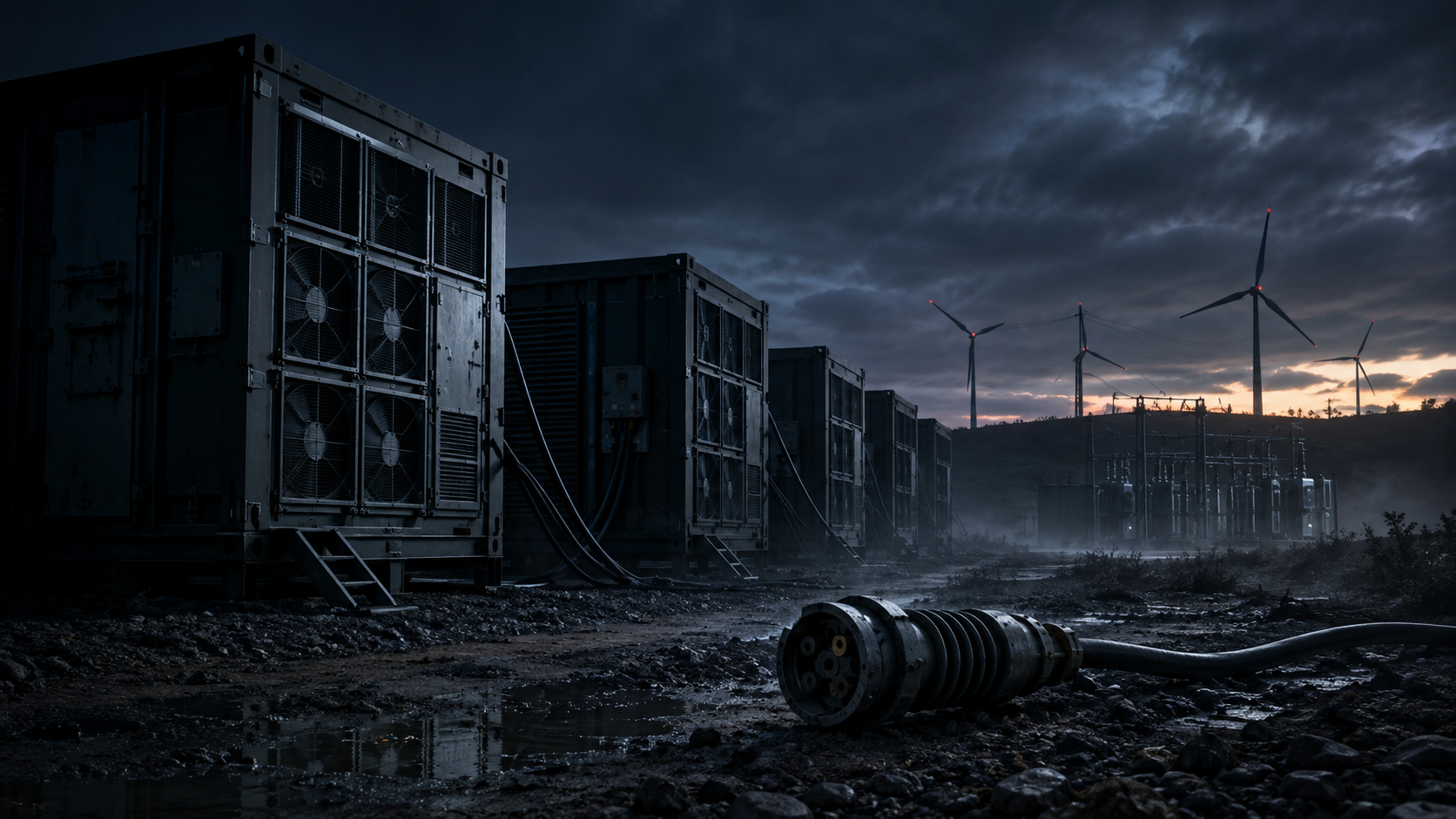
Two mining sites built in Uruguay's rural Florida department have been abandoned after a dispute over electricity supply ultimately resulted in the state utility cutting their power. A former Tether contractor estimated that roughly $60 million had been invested in each location, putting the combined cost at around $120 million, although Tether never publicly disclosed that figure and it should therefore be treated as an informed estimate rather than a confirmed corporate loss.
Uruguay Looked Almost Perfect
When Tether announced its entry into Uruguay in May 2023, the logic appeared compelling. The company highlighted the country's political stability, established electricity network and extraordinarily high share of renewable generation, presenting Uruguay as an ideal location for what it described as sustainable Bitcoin mining.
Tether's argument went further than simply finding electricity for computers. It said Bitcoin mining could act as an immediate buyer of excess electricity, making new renewable-energy projects commercially viable while allowing miners to reduce consumption when the wider grid needed power. The company argued that mining and new energy infrastructure could therefore develop together rather than compete with households and businesses.
Uruguay was also intended to be more than an isolated experiment. According to a former contractor familiar with the operation, it was envisaged as a first step towards a much wider South American mining strategy, potentially providing a template for expansion into larger markets including Brazil, Paraguay and Argentina.
For Tether, that mattered because the company behind USDT has been trying to transform itself from a stablecoin issuer into a much broader technology and infrastructure group. Bitcoin mining became important enough to receive its own Tether Power division, alongside investments spanning artificial intelligence, data centres, communications technology and other industries.
Then Came the Electricity Dispute
The sites initially operated and generated revenue, according to people who worked with the project. The fundamental problem emerged over something much less glamorous than cryptocurrency: the interpretation of an electricity contract.
Tether understood the contracted electricity allocation to represent a minimum supply that could subsequently be expanded as its mining operation grew. Uruguay's state electricity company UTE viewed the allocation differently, treating the contracted amount as a maximum that could not simply be increased. That disagreement became critical because a mining farm's expensive hardware produces revenue only when enough electricity is available to keep it running.
By November 2024, the dispute was already under way. As demand from the mining operation increased, insufficient supply reportedly left equipment without enough electricity for periods lasting days, undermining the utilisation rates on which mining economics depend.
The political environment then changed. Uruguay's new government took office in March 2025 and new directors were appointed at UTE. A former contractor claimed the utility subsequently took a harder position towards renegotiating Tether's electricity arrangements, although the change of government alone does not establish that politics caused the project's failure.
By May 2025, Tether's local entity Microfin had stopped paying electricity bills. It told UTE the following month that it intended to terminate its contracts. Attempts were made to rescue the relationship through revised agreements, but the new arrangement was never completed.
UTE cut electricity to the sites on July 25, 2025. Tether later told Uruguay's labour authorities that it would cease operations and dismiss most of the remaining workforce, while Microfin subsequently settled its outstanding electricity debts in December.
Why Electricity Makes or Breaks Bitcoin Mining
The Uruguay failure exposes the brutal simplicity underneath industrial Bitcoin mining. Mining machines perform enormous quantities of calculations while competing for Bitcoin rewards, which means electricity is not merely another operating expense. It is one of the central determinants of whether the entire business works.
That became even more important after Bitcoin's fourth halving in April 2024. The protocol automatically reduced the block subsidy from 6.25 Bitcoin to 3.125 Bitcoin, effectively cutting this component of mining revenue in half overnight for the same successful block.
Miners can compensate through a higher Bitcoin price, lower electricity bills, transaction fees or more efficient equipment. But operations with relatively expensive power face a structural disadvantage against competitors able to locate beside extremely cheap hydroelectricity, stranded energy, curtailed renewables or other low-cost generation.
Uruguay demonstrates why being rich in renewable electricity is not necessarily the same thing as being an ideal Bitcoin-mining jurisdiction. A clean and reliable grid may be attractive environmentally, but mining economics still demand a sufficiently cheap and scalable supply. Once electricity becomes too expensive or constrained, the environmental credentials of that electricity do little to rescue the financial model.
The $120m Figure Needs an Important Qualification
The most dramatic number attached to the story is also the one requiring the most care. Tether did not announce that it spent $120 million in Uruguay.
That estimate comes from a former contractor who assessed approximately $60 million of investment at each of the two sites. It provides a credible indication of the possible scale of the project, but without detailed accounts from Tether it cannot be treated as a verified $120 million write-off.
There could also be recoverable value in mining machines, containers, electrical equipment and other infrastructure. Bitcoin-mining hardware is inherently movable, meaning the failure of a particular location does not necessarily mean every dollar invested there disappears.
That mobility, however, creates another problem for governments trying to attract miners. A factory is deeply tied to supply chains, employees and a physical market. A mining operation can be considerably easier to dismantle and relocate when electricity economics change.
Uruguay therefore received investment and employment while the project operated, but the collapse raises questions about how much permanent economic value countries receive from exceptionally mobile mining businesses once the machines move somewhere else.
Tether Has Not Abandoned Bitcoin Mining
The Uruguay episode should not be confused with Tether withdrawing from mining altogether. Its actions during 2026 point in precisely the opposite direction.
In February, Tether announced that it was open-sourcing Mining OS, software intended to coordinate mining machines, power systems and infrastructure across large operations. In April it followed with a Mining Development Kit and announced new modular mining systems designed to give operators more control over hardware, cooling, energy use and upgrade costs.
Tether's own current material continues to describe renewable Bitcoin mining as part of its strategy and says its mining technology has been deployed in Uruguay and El Salvador. The strategic lesson therefore appears less likely to be that Tether has lost faith in mining than that future sites will require much tighter control over electricity economics and infrastructure.
For a company with ambitions to operate mining infrastructure at global scale, Uruguay may become an expensive case study in precisely what has to be controlled before machines arrive.
AI Is Becoming the Alternative
There is another reason the Uruguay story matters. The same industrial ingredients that power Bitcoin mines — electricity, land, cooling systems, high-capacity connections and data-centre infrastructure — are increasingly valuable to the artificial-intelligence industry.
That gives infrastructure owners another possible customer for enormous quantities of computing capacity. Instead of dedicating power exclusively to machines performing Bitcoin's proof-of-work calculations, some operators can pursue high-performance computing and AI workloads where the commercial economics may be more attractive.
Uruguay itself has characteristics that could favour conventional data-centre investment: political stability, strong connectivity and a reliable electricity system. Those strengths are not necessarily enough to overcome relatively expensive electricity for Bitcoin mining, where the commodity being consumed is power and competition is global.
Tether already has significant ambitions in AI and data infrastructure alongside its mining business. That means the wider contest may eventually become less about whether large computing sites are built and more about which workload earns the best return from each megawatt of electricity.
The Bigger Warning for Bitcoin Mining
Bitcoin mining has always been geographically restless. Machines follow favourable regulation, available infrastructure and, above all, cheap power. When one jurisdiction stops making economic sense, capital can move.
Uruguay appeared to offer almost everything a large miner could want: institutional stability, renewable electricity, technological infrastructure and a government accustomed to international investment. Yet those advantages could not compensate once the parties failed to agree on the quantity and economics of the electricity needed to scale the operation.
That is the real significance of Tether's experience. The company remains committed to Bitcoin infrastructure and has enough financial power to absorb unsuccessful experiments, but smaller miners have far less room for error.
The next phase of the mining industry is therefore likely to reward operators that control not merely powerful machines but the energy beneath them. Tether entered Uruguay believing renewable electricity could make the country a launchpad for a South American Bitcoin-mining expansion. Instead, two darkened mining sites have produced a different lesson: in Bitcoin mining, access to electricity is not part of the business model. It is the business model.
