AI’s Next Data Centre May Orbit Earth — Space Startup Starcloud Is Now Worth $2.3 Billion
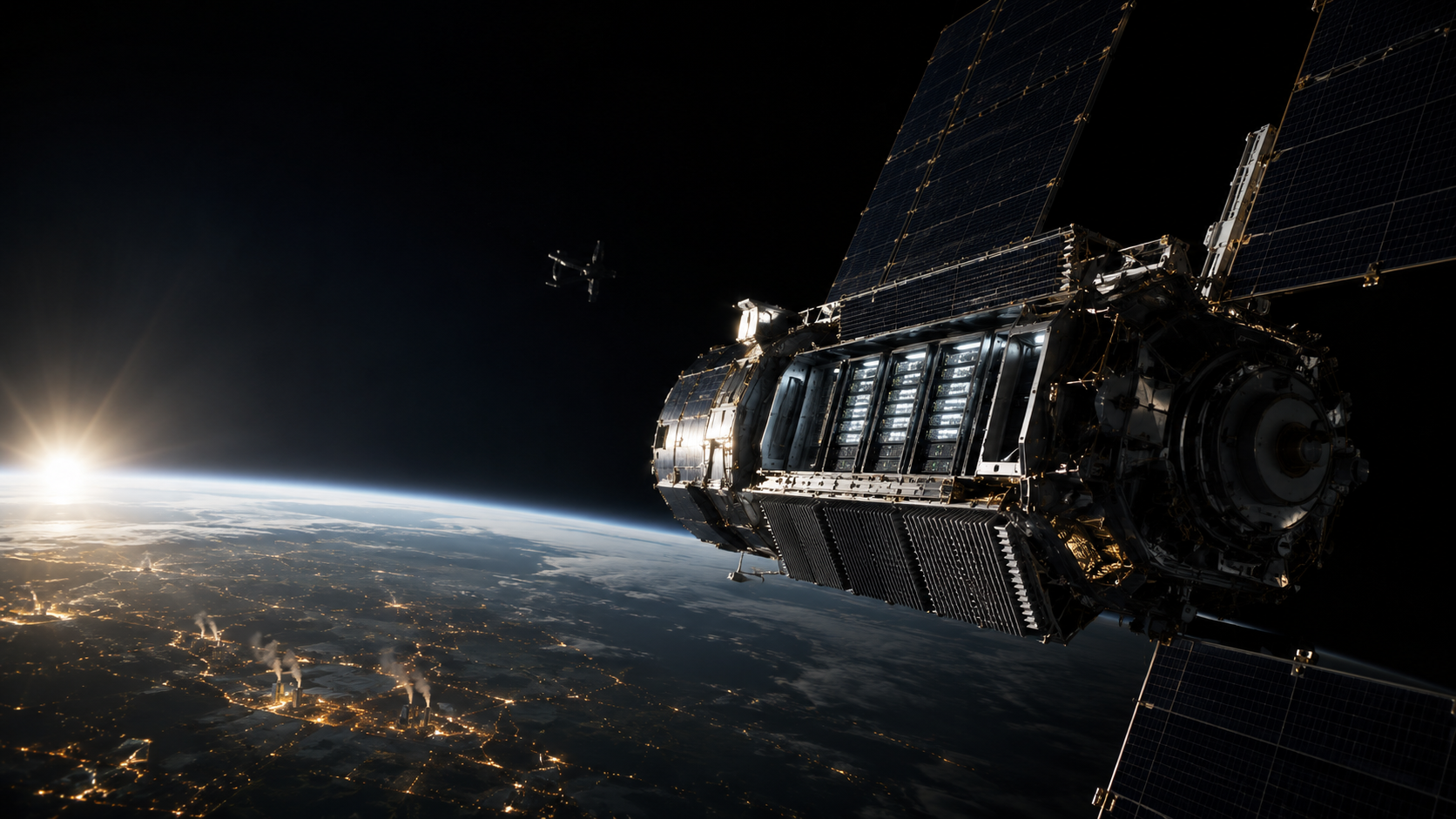
Can AI data centres actually operate in space?
The Data Centre Leaving Earth
The artificial intelligence boom is beginning to collide with the physical limits of Earth. AI needs enormous quantities of electricity, cooling infrastructure, land, advanced chips and increasingly expensive data centres — and one startup believes the answer is to move part of that infrastructure off the planet entirely.
Starcloud has now raised another $250 million at a $2.3 billion post-money valuation, more than doubling the $1.1 billion valuation attached to its funding round less than five months ago. The new investment takes the company’s total capital raised since its founding in 2024 to approximately $450 million and brings Nvidia and Cisco Investments into a group of backers betting that orbital computing could become a genuine extension of the global cloud.
Starcloud Is No Longer Being Treated Like A Science-Fiction Experiment
The speed of the valuation increase is striking. Starcloud raised $170 million in March at a $1.1 billion valuation, becoming one of the fastest startups emerging from Y Combinator to reach unicorn status. Its latest financing effectively doubles that valuation again while the company remains at the beginning of its commercial deployment.
The new round was led by Manhattan West, with participation from existing investors including Benchmark, EQT, Soma, NFX and 776. New investors include Nvidia, Cisco Investments, Cedar Capital, Goanna Capital and Standard Capital.
That investor list matters. Nvidia is not merely financing another artificial intelligence software company. It is developing computing hardware specifically intended to operate in space and has identified Starcloud as one of the businesses using its accelerated computing technology for orbital applications.
The valuation therefore represents a much bigger wager than whether one startup can successfully launch servers on satellites. Investors are effectively betting that the constraints beginning to surround terrestrial AI infrastructure will become serious enough to create an entirely new market above Earth.
The First AI Computer Is Already Up There
Starcloud has moved beyond PowerPoint presentations.
Its Starcloud-1 satellite launched in November 2025 carrying an Nvidia H100 GPU, putting data-centre-class AI hardware into orbit. The approximately 60-kilogram spacecraft was designed as an engineering demonstration rather than a conventional hyperscale data centre, but it allowed Starcloud to begin testing whether powerful commercial AI chips could operate in the radiation, temperature cycles and power constraints of low Earth orbit.
Starcloud says the satellite subsequently became the first spacecraft to train a large language model in orbit, using nanoGPT, while also operating a Google AI model in space. That matters because an orbital data centre only becomes valuable if computation can actually happen in orbit rather than the spacecraft simply acting as another communications relay.
The company’s next step is considerably more ambitious.
Starcloud-2 is being designed as its first commercial mission. The spacecraft is expected to contain a GPU cluster, persistent storage, 24-hour access and dedicated thermal and power systems. Starcloud says it is intended to become fully operational in sun-synchronous orbit during 2027.
That would begin moving the idea from demonstration toward something recognisable as cloud infrastructure.
Nvidia Is Building Hardware For The Orbital AI Era
One of the strongest signs that orbital computing is becoming a serious technology category is Nvidia’s involvement.
The chip giant has unveiled its Space-1 Vera Rubin Module, designed to bring high-performance AI computing into environments where weight, physical size and electricity consumption are heavily constrained. Nvidia says the Rubin GPU used in the system can deliver up to 25 times the AI inference performance of an H100 GPU for space applications.
Starcloud and Nvidia are collaborating around the technology, placing the startup inside an emerging ecosystem rather than leaving it dependent on completely bespoke computing hardware.
This has significant consequences.
The extraordinary expansion of artificial intelligence has gradually transformed the industry from a software race into an infrastructure race. Building the best model matters, but companies increasingly need access to GPUs, electricity, cooling systems, networking, land and capital before they can deploy that intelligence at enormous scale.
AI is already hitting terrestrial limits around power and cooling. Moving compute into space is an attempt to rewrite that physical equation rather than merely building another data centre somewhere else.
Why Put A Data Centre In Space?
The central attraction is energy.
In suitable orbits, enormous solar arrays could receive extremely consistent sunlight without competing with homes, factories or terrestrial electricity grids. An orbital facility would not require thousands of acres of valuable land, lengthy grid-connection negotiations or conventional freshwater cooling systems.
Starcloud has argued that sufficiently large orbital systems could eventually make energy substantially cheaper than operating comparable computing infrastructure on Earth. Its long-term vision stretches towards gigawatt-scale computing platforms rather than individual experimental satellites.
There is another potential advantage.
Satellites already produce huge quantities of information from cameras, radar, weather instruments and other sensors. Today much of that data must be transmitted back to Earth before powerful computers can analyse it.
Put substantial AI processing beside the sensor and the satellite could instead analyse the information immediately, transmitting the useful result rather than every byte of raw data.
That could make orbital computing particularly attractive for Earth observation, disaster monitoring, defence, weather forecasting and other applications where getting an answer quickly is more important than transmitting enormous datasets back to the ground.
Starcloud-2 is explicitly being designed around this model, while also offering terrestrial customers storage and computing capacity positioned away from conventional Earth-based infrastructure.
Space Does Not Magically Solve Cooling
There is, however, an important misconception hidden inside the idea that space provides easy cooling.
Space is cold, but it is also a vacuum.
A terrestrial server can transfer heat into surrounding air or cooling liquid. In orbit there is effectively no surrounding atmosphere capable of carrying that heat away through convection.
Instead, waste heat ultimately has to be radiated into space.
That means extremely powerful orbital data centres could require enormous radiator structures, adding mass and engineering complexity. Research into the economics of orbital computing has identified thermal management as one of the largest technical obstacles: lower water use and potentially cheaper operating energy are exchanged for much more demanding spacecraft architecture and upfront capital costs.
Radiation creates another problem.
Modern AI chips were designed for highly controlled terrestrial data centres, not years of exposure to energetic particles in orbit. Hardware must either be sufficiently protected, tolerate failures or be replaced frequently enough that radiation damage does not destroy the economics.
And maintenance becomes radically harder.
When a GPU fails in Virginia, a technician can replace it. When one fails hundreds of kilometres above Earth, sending somebody with a screwdriver is not an economically sensible solution.
Everything Eventually Comes Back To Launch Cost
That makes the cost of reaching orbit critical.
An Earth-based data centre does not have to survive a rocket launch. Every solar array, radiator, GPU, power system and networking component sent into orbit carries an additional transportation cost before it performs a single computation.
Starcloud’s economics therefore depend partly on another technological revolution succeeding: dramatically cheaper reusable launch systems.
That creates an interesting dependency between orbital AI companies and the companies capable of getting their hardware into space.
SpaceX is already pursuing its own enormous orbital AI ambitions, potentially turning one of the most important launch providers into a future competitor.
The strategic contradiction is obvious.
Orbital AI startups may depend on cheaper rockets to make their business models work. Yet the companies producing those cheaper rockets could eventually build competing computing infrastructure themselves.
The Space AI Race Is Getting Crowded
Starcloud is not alone.
SpaceX has proposed extraordinarily large constellations of AI-compute satellites. China has outlined plans for gigawatt-class space computing infrastructure. Other private companies are pursuing orbital processing architectures, while Google has explored putting AI accelerators into space.
This increasingly resembles the opening stage of a new infrastructure race.
The first phase of the cloud transformed computing by moving servers out of individual company buildings and into enormous centralised facilities.
The next phase could distribute some of those computers again — this time across Earth orbit.
Yet it would be premature to assume that conventional data centres are about to disappear.
Terrestrial facilities have gigantic advantages. Engineers can access them. Chips can be replaced. Fibre connections are extraordinarily fast. Electricity infrastructure already exists. Hardware does not need to survive launch or radiation, and cooling systems operate within well-understood engineering constraints.
Orbital computing therefore does not need to replace every terrestrial data centre to become important.
It only needs to become economically superior for particular workloads.
The $2.3 Billion Valuation Is A Bet On What Comes After The AI Boom
The most interesting part of Starcloud’s valuation may ultimately have little to do with satellites themselves.
AI is becoming one of the largest infrastructure-building programmes in modern economic history. Companies are spending extraordinary sums on processors, electricity generation, data centres, optical networking and cooling equipment.
The cost of financing the AI boom is already becoming one of the industry's central questions.
If computing demand continues expanding rapidly, the economic value of finding new sources of electricity and new locations for infrastructure could become enormous.
That is the opportunity Starcloud is selling.
Its $2.3 billion valuation does not prove orbital data centres will work economically. Nor does putting an H100 into orbit prove that gigawatt computing clusters can operate profitably above Earth.
What it does show is that serious capital is beginning to believe the bottlenecks surrounding AI could become severe enough to justify solutions that would have sounded absurd only a few years ago.
What Happens Next
Starcloud now has to make an enormous transition.
Launching one powerful GPU demonstrated that modern AI hardware can operate in space. Building a commercially useful computing cluster is harder. Scaling that into infrastructure capable of competing with terrestrial data centres is harder again.
Starcloud-2 will therefore be far more important than the valuation attached to the latest financing.
Investors will want to see reliable power, thermal management, communications, radiation tolerance and sustained customer workloads. They will also need evidence that the economics improve as launch costs decline rather than merely producing an extraordinary engineering achievement with an extraordinary price tag.
If those milestones arrive, the implications stretch well beyond one startup.
Data centres have traditionally been buildings.
The extraordinary possibility now attracting billions of dollars is that, in the AI era, some of the most valuable computers humanity builds may no longer be buildings at all.
They may be satellites.
