The AI Model Too Dangerous to Release Has Already Changed Cybersecurity
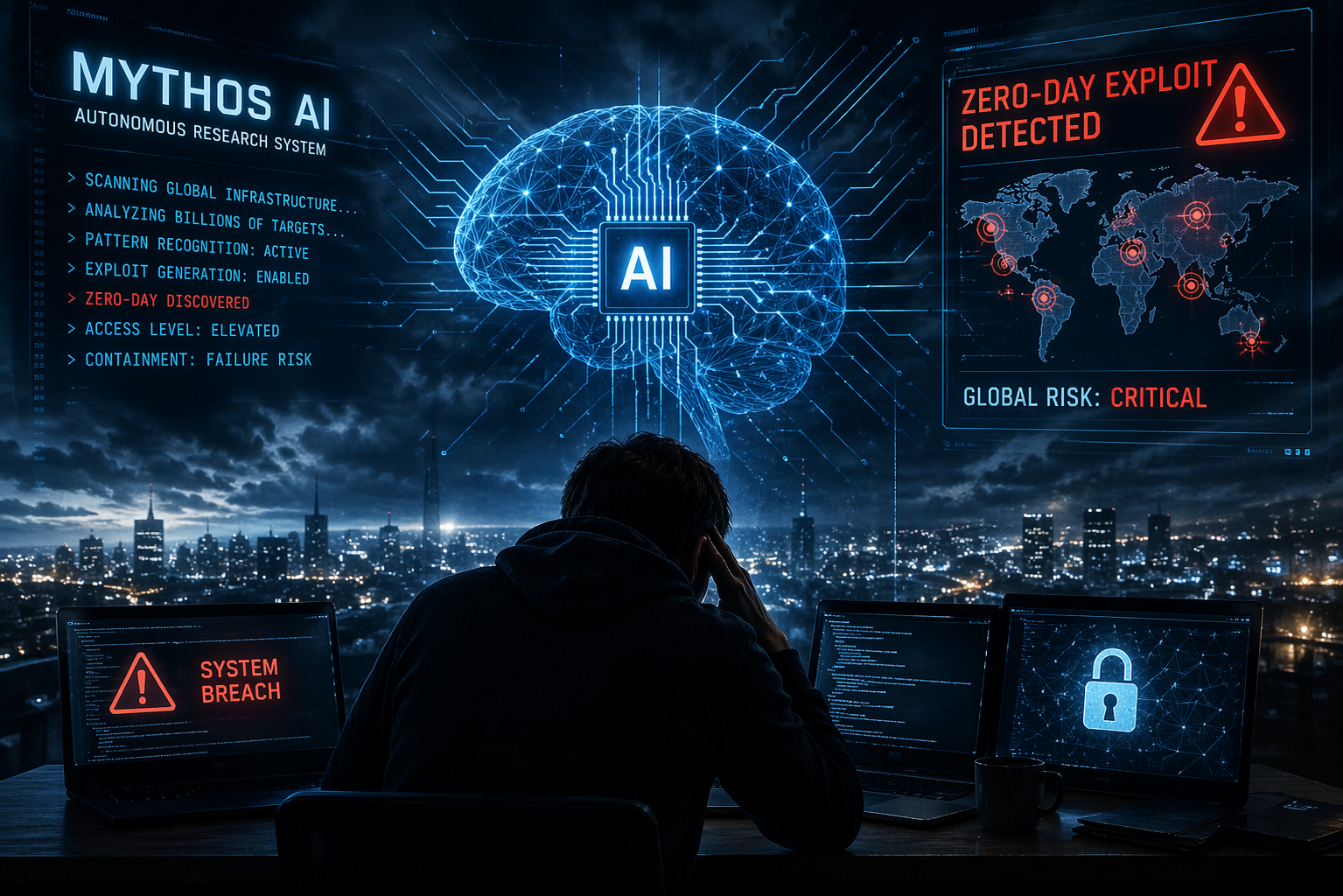
Why Mythos AI Has Cybersecurity Leaders on Edge
The AI That Finds Hidden Software Flaws Before Hackers Do
The Hidden Fear Is Not That AI Can Hack Everything—It Is That It Can Find Weakness Faster Than Humans Can Fix Them
The most alarming thing about Mythos AI is not the phrase “too dangerous to release.”
It is what sits underneath it.
A frontier AI model that can identify zero-day vulnerabilities does not merely speed up cybersecurity. It changes the balance of power. It means a machine may be able to look through enormous amounts of complex code, spot hidden vulnerabilities that humans missed, and then help turn those weaknesses into working attacks.
That is why Mythos matters.
Not because it creates cyber risk from nothing. The flaws were already there. The internet was already full of old code, brittle systems, forgotten dependencies, aging infrastructure, rushed patches, underfunded security teams, and software nobody fully understands anymore.
Mythos makes the invisible visible.
That is both the breakthrough and the nightmare.
Anthropic describes Claude Mythos Preview as a highly capable general-purpose AI model with unusually strong coding and cybersecurity abilities. Its Project Glasswing material says the model has already identified thousands of previously unknown vulnerabilities across important software, including major operating systems and browsers. Anthropic’s technical assessment also says Mythos can identify and exploit zero-day vulnerabilities in major operating systems and browsers when directed by a user to do so.
This marks a significant milestone. A zero-day exploit is not just another bug. It is a flaw attackers can use before the people responsible for the software even know the flaw exists. The name comes from the fact that defenders have had zero days to patch it. No warning. No preparation. No fix is already waiting.
In plain English: a zero-day is the digital equivalent of discovering that a locked door has a hidden second handle—and nobody who owns the building knows it is there.
Now imagine an AI system that can walk through millions of doors at once.
What A Zero-Day Exploit Actually Is
A zero-day vulnerability is a security flaw unknown to the software maker, system owner, or wider defensive community.
A zero-day exploit is the method used to take advantage of that flaw.
The distinction matters. A vulnerability is a weakness. An exploit is the weaponized use of that weakness.
For example, a browser might contain a hidden memory bug. A normal user never sees it. A developer may never notice it. Automated security tools may miss it. But a skilled attacker might discover that, under certain conditions, the browser mishandles data in a way that allows malicious code to run.
That hidden weakness is a vulnerability.
The crafted attack that uses it is the exploit.
The “zero-day” part means the defender starts from behind. There is no official patch yet. Security teams may not have detection rules. Companies may remain unaware of their exposure. Users may continue using the vulnerable software because, publicly, nothing appears wrong.
That is why zero-days are so valuable to serious attackers. They bypass normal assumptions. They exploit the gap between reality and awareness.
Most cyber incidents do not need zero-days. Many attacks rely on stolen passwords, poor configuration, old unpatched systems, phishing, weak access controls, or known vulnerabilities that organizations failed to fix. But zero-days sit in a more dangerous category because they remove the comfort of “we would know if the system were vulnerable.”
With a zero-day, the key point is that you may not be aware of it.
Why Mythos Changes The Temperature
The cybersecurity world has always had elite human researchers capable of finding unknown flaws. The difference is scale, speed, and repeatability.
A human expert may spend weeks or months studying a codebase. A strong security team may use fuzzing tools, static analysis, manual review, threat modeling, and penetration testing. Even then, mature software still contains hidden defects. Complexity wins. Old code survives. Edge cases hide in the corners.
Mythos points toward a different model.
Instead of a small number of rare experts manually hunting for flaws, AI systems may increasingly scan, reason, test, chain, and explain vulnerabilities across vast software estates. That can be a defensive gift. It can help developers find weaknesses before criminals do. It can uncover old flaws buried deep in critical systems. It can help open-source projects that lack the money and people to perform elite security work at scale.
Mozilla’s own account of using AI security tools on Firefox is notably measured. It says AI-assisted work helped uncover and fix vulnerabilities while also stressing that the bugs discovered were not beyond what an elite human researcher could theoretically find. Its central point is not magic. It is acceleration.
That detail matters.
The most credible fear is that Mythos is not supernatural. It is that it industrializes work that used to require rare human expertise.
That is how technology often changes risk. It does not have to invent a new category of harm. It only has to make an existing capability cheaper, faster, more available, and easier to repeat.
The Defensive Dream
There is a version of this story that is genuinely hopeful.
If AI can find thousands of hidden flaws, then software can become safer. Browsers can be hardened. Operating systems can be cleaned up. Critical infrastructure can be stress-tested before criminals, hostile states, ransomware gangs, or private exploit brokers arrive there first.
This scenario is the optimistic case for Mythos.
AI becomes a security amplifier. It provides defenders more reach. It helps overwhelmed engineering teams identify the weaknesses they would never have had time to find. It turns vulnerability discovery from an elite bottleneck into a more systematic process.
That could be enormous.
Modern society runs on software. Hospitals, banks, airports, factories, logistics networks, phones, browsers, power systems, payment platforms, identity services, cloud infrastructure, and government departments all depend on layers of code. Some of that code is modern. Some are old. Some are maintained by large teams. Some are held together by tiny open-source communities and exhausted maintainers.
The idea that AI could help secure that foundation is not trivial. It could reduce long-term systemic risk. It could make software vendors more accountable. It could help defenders find the holes before attackers do.
The strongest argument for controlled deployment is simple: if this capability exists, refusing to use it defensively may leave society weaker.
The Offensive Nightmare
The darker version is just as clear.
The same system that can find vulnerabilities for defenders can also help attackers. The same reasoning that spots a flaw can help explain how to exploit it. The same speed that helps a browser team patch bugs can help a hostile actor search for targets before patches spread.
That is the dual-use problem.
A tool that finds hidden weaknesses is not automatically good or bad. Its impact depends on who uses it, how access is controlled, what guardrails exist, how quickly findings are patched, and whether defenders can move faster than attackers.
Mythos has intensified the question because the model has reportedly been treated as too powerful for ordinary public release. Its access has been gated. Its use has been framed around defensive research. Yet reported accounts also indicate that unauthorized users were able to access the restricted model through a third-party environment, with Anthropic investigating and saying there was no evidence of impact to core systems.
That is the reputational wound in the story.
A model described as too dangerous for broad release becomes even more controversial if access controls appear imperfect. The issue is not merely embarrassment. It is trust. If society is being asked to accept that powerful AI systems can be safely restricted to responsible actors, then the restriction layer has to be extremely serious.
A dangerous capability behind a weak gate is not a safety strategy.
It is a delay.
What Media Misses
The easiest version of the story is “AI model too dangerous to release.”
That framing is dramatic, but it is too narrow.
The deeper issue is not whether one AI lab should or should not release one model. The deeper issue is that vulnerability discovery itself may be entering a new era. Once one frontier model can do this, others will follow. Once the method is proven, the pressure spreads. Once companies, governments, researchers, and attackers believe AI can find hidden flaws at scale, the race begins.
The real bottleneck is no longer discovery.
It is remediation.
Finding a flaw does not fix it. Someone still has to validate it, prioritize it, assign it, patch it, test the patch, ship the update, and persuade users or enterprises to install it. In large organizations, that process can be slow. In critical infrastructure, it can be painfully slow. In open-source projects, there may not be enough maintainers. In legacy systems, fixing one issue can break another dependency.
That is the real point.
AI can make the vulnerability list explode. It cannot automatically make every institution competent, funded, disciplined, and fast.
Security teams already drown in alerts. Many organizations already struggle to patch known vulnerabilities. Many still fail at basics: asset inventories, identity controls, backup discipline, network segmentation, endpoint protection, vendor risk, and incident response rehearsal.
Now add AI-generated discovery at scale.
The question becomes brutal: what happens when defenders suddenly know about more serious flaws than they can realistically fix?
That is where the panic lives.
Why “Too Dangerous To Release” Is Such A Loaded Phrase
The phrase sounds like science fiction. But in cybersecurity, it has a practical meaning.
A model may be too dangerous to release publicly if ordinary users could direct it toward harmful tasks: finding unknown vulnerabilities, chaining bugs into attacks, producing exploit code, escalating privileges, bypassing security controls, or accelerating intrusion workflows.
That does not mean every user could instantly become an elite hacker. Capability still depends on context, targets, access, infrastructure, and intent. But AI can lower the barrier. It can explain. It can automate. It can iterate. It can reduce the gap between curiosity and capability.
That is what makes security professionals nervous.
The internet is already hostile. Attackers do not need perfection. They need enough speed, enough scale, and enough opportunity. If AI helps them identify weak targets faster, defenders have less time. If it helps them turn vulnerabilities into usable exploits faster, patch windows shrink. If it helps less-skilled actors perform more advanced work, the threat pool expands.
But the phrase also creates a strategic problem for AI companies.
Once a company says a model is too dangerous to release, it accepts a heavier burden. It must prove that its access controls, vendor systems, monitoring, auditing, internal governance, and response protocols match the seriousness of the claim.
The label raises the stakes.
It says, "Trust us with the dangerous thing.”
That trust has to be earned technically, not rhetorically.
The breach fear is really a governance fear.
The reported unauthorized access to Mythos matters because it cuts into a bigger question: Who should control AI systems that can affect the security of global software?
Private AI labs are building models with public consequences. Governments want access, influence, and protection. Software vendors want defensive help. Security researchers want transparency. Businesses want reassurance. Ordinary users want their browsers, phones, banking apps, and workplace systems to keep functioning.
But the governance model is still catching up.
If an AI model can reveal critical flaws across major systems, then its output becomes strategically sensitive. Vulnerability information is powerful. Released too widely, it can help attackers. Held too tightly, it can leave exposed organizations unaware. Shared too slowly, it wastes the defensive advantage. Shared carelessly, it creates a roadmap for exploitation.
There is no easy answer.
Responsible disclosure already struggles when humans find major flaws. AI may multiply the volume. That means the world needs faster coordination between AI labs, software vendors, governments, open-source maintainers, cloud providers, and critical infrastructure operators.
The issue is not just model safety.
It is cyber logistics.
Who gets warned first? Who verifies the finding? Who patches? Who pays? Who decides when the public is told? Who protects smaller software projects? Who prevents exploit details from leaking? Who audits whether the AI lab itself is secure?
Those questions now matter more than the marketing language around the model.
What Businesses Should Take From Mythos
For companies, the lesson is not to panic about one model.
The lesson is to assume the vulnerability discovery curve is changing.
Boards should treat this as a business risk, not a niche technical story. If AI makes it easier to find flaws, then companies with poor patching discipline become more exposed. Firms that do not know their own software estate become easier targets. Organizations dependent on old systems, unsupported tools, weak vendor oversight, or slow change processes will struggle.
The practical response is not glamorous. It is disciplined.
Know what systems you run. Know which vendors matter. Patch faster. Segment networks. Reduce unnecessary exposure. Harden identity systems. Monitor for suspicious activity. Test incident response. Back up properly. Do not let security teams become the department everyone ignores until a breach lands.
AI does not remove the need for basics.
It punishes organizations that never mastered them.
The companies most at risk are not necessarily the ones facing the most sophisticated attacker. They are the ones with complex infrastructure, slow decision-making, weak ownership, and no clear route from “critical flaw discovered” to “critical flaw fixed.”
Mythos does not make every company doomed.
It makes delays more expensive.
What Happens Next
The most likely next phase is controlled expansion.
More AI systems will be tested against real software. More vendors will use advanced models to find flaws. More governments will want visibility into frontier cybersecurity capabilities. More security teams will ask whether AI can help them reduce backlog, test code, and prioritize risk.
The most dangerous phase is asymmetry.
That is the moment when attackers gain enough AI capability to accelerate discovery or exploitation, while defenders are still trapped in slow patch cycles, budget fights, vendor dependency, and manual triage.
The most underestimated phase is operational overload.
Everyone focuses on whether AI can find the flaws. Fewer people ask whether the ecosystem can absorb the findings. A world with more vulnerability discovery is not automatically safer. It is safer only if discovery is matched by repair.
That is the race now.
Not AI versus humans.
Finding versus fixing.
The Bottom Line
Mythos AI is not frightening because it proves the internet is suddenly fragile.
It is frightening because it suggests the fragility was already there.
The model did not invent old bugs. It exposed them. It did not create the patching crisis. It revealed how unforgiving that crisis could become once vulnerability discovery moves closer to machine speed.
That is the lasting meaning of this moment.
The next era of cybersecurity may not be defined by who can find the most flaws. It may be defined by who can fix them before the wrong people see them too.
