

The AI That Beats Doctors In The ER — And What That Really Means For Your Future
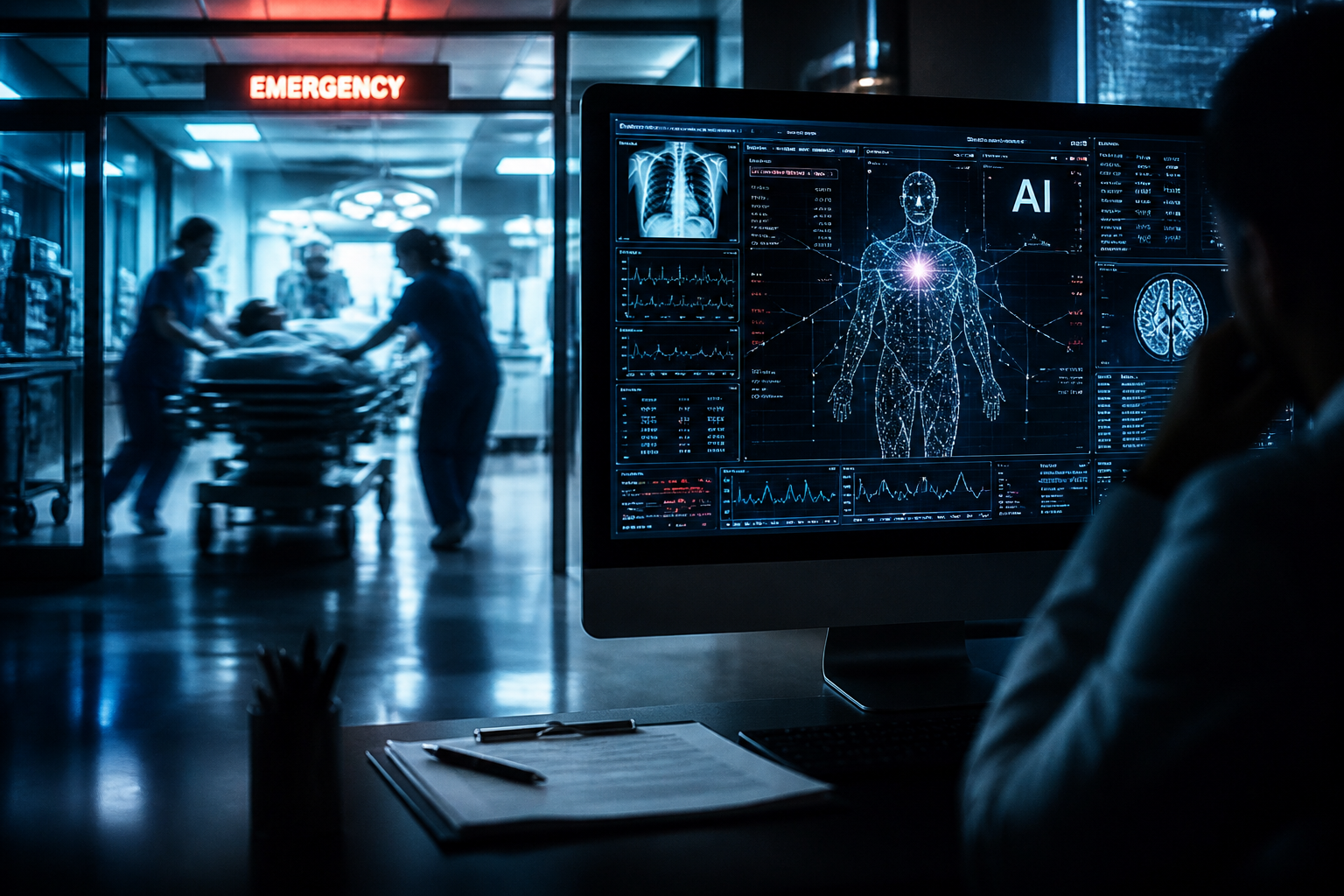
The Moment AI Started Outperforming Doctors In Emergency Rooms
Harvard Study Finds AI Outperforming Doctors — But The Real Story Is More Complicated
In one of the most high-stakes environments in modern life—the emergency room—a machine just beat the people we trust most to save us.
A new Harvard-led study has found that an advanced artificial intelligence system outperformed human doctors when diagnosing patients at triage, the moment where speed, uncertainty, and accuracy collide. The result is not just a technical milestone. It is signals that something deeper is shifting in how people make decisionsen lives are on the line.
The headline is simple: AI did better. The implications are far from clear.
What Actually Happened In The Study
The research tested an advanced reasoning AI model against trained physicians using real emergency department cases. In one core experiment involving 76 patients, both the AI and doctors were given the same electronic health records—basic but realistic information including symptoms, vital signs, and short clinical notes.
The outcome was stark. The AI identified the correct or near-correct diagnosis in around 67% of cases, compared with roughly 50–55% for the doctors.
When more detailed information was added, the AI’s performance improved further, reaching around 82% accuracy — slightly ahead of human clinicians.
It didn’t stop there. When asked to propose longer-term treatment plans, the gap widened significantly. The AI produced higher-quality plans than doctors using conventional tools, scoring far above human benchmarks in structured evaluations.
This was not a toy test or a medical exam simulation. Researchers deliberately used messy, real-world data — the kind doctors actually see under pressure.
That detail matters.
Why AI Won — And Why It’s Not Obvious
The instinctive reaction is to assume AI is simply “smarter.” That is not what’s happening.
The advantage comes from how AI processes information under pressure. In emergency triage, doctors must rapidly filter incomplete data, manage cognitive load, and avoid missing rare but critical diagnoses. That’s a fragile system — even for experienced clinicians.
AI, by contrast, does three things differently:
It considers a wider range of possibilities simultaneously
It does not fatigue, rush or emotionally anchor to early assumptions
It can systematically weigh probabilities without bias
This makes it particularly strong in scenarios where the risk is not just getting the answer wrong but failing to consider the right answer at all.
In other words, AI is not just answering better. It is missing less.
The Catch Most People Will Miss
This study did not prove that AI is better than doctors in real hospitals.
It proved that AI is better at a specific type of reasoning task: text-based clinical diagnosis using structured data. The system did not see the patient. It did not interpret body language, tone of voice, pain behavior, or subtle visual cues.
That limitation is critical.
Emergency medicine is not just pattern recognition. It is also human judgment—recognizing distress, uncertainty, and context that may never appear in a dataset. Experts involved in the research emphasize that AI has not been tested in live clinical environments and is not ready to operate independently.
So the headline is true — but incomplete.
The Real Shift: From Decision-Maker To Decision-System
The deeper story is not about AI replacing doctors. It is about changing what a “decision” in medicine actually looks like.
Traditionally, diagnosis is a human process supported by tools. This study points toward something else: a system where diagnosis becomes a collaboration between human and machine.
Researchers are already describing a future “triadic” model of care—patient, doctor, and AI working together.
In that model:
AI expands the range of possibilities
Doctors interpret, prioritize, and contextualise
Patients still rely on human trust and communication
The balance shifts from individual expertise to combined intelligence.
That is a structural change, not a technological one.
The Future Of Work — And The Hidden Risk
The immediate reaction to studies like these is fear: are doctors about to be replaced?
The data says no — at least not in the near term. But that does not mean everything stays the same.
What is more likely is a shift in what makes a doctor valuable.
If AI becomes better at raw diagnostic reasoning, the human edge moves elsewhere:
Interpreting uncertainty
Making ethical decisions
Communicating complex outcomes
Managing emotional reality
But there is a second, more subtle risk. As AI becomes more accurate, humans may begin to defer to it—even when it is wrong. Early research already suggests clinicians can unconsciously lean on AI outputs rather than challenge them.
That is where the danger lies.
A system that improves accuracy overall can still fail catastrophically if trust becomes automatic instead of critical.
What This Means For Patients
For patients, the shift is both reassuring and unsettling.
On one hand, the potential upside is significant. Better diagnosis at triage could mean:
Fewer missed conditions
Faster treatment decisions
Reduced diagnostic errors
On the other hand, accountability becomes more complex. If an AI suggests a diagnosis and a doctor follows it, who is responsible if something goes wrong?
Currently, there is no clear global framework for that.
And when decisions involve life-or-death outcomes, that gap matters.
What Most People Get Wrong About This Moment
The easy narrative is that AI is “taking over medicine.” The more accurate one is that medicine is becoming a system problem rather than a human problem.
This study indicates that machines are beginning to outperform humans in narrow but critical domains. That does not eliminate the need for doctors. It redefines where their value sits.
The biggest change is not that AI can diagnose.
It is that the benchmark for human performance just moved.
Doctors are no longer competing with other doctors alone. They are now measured against systems that do not forget, tire, or overlook.
The Bottom Line
A machine outperforming doctors in emergency diagnosis sounds like a headline from the future. It is already here — but only under controlled conditions, and only for part of the job.
The real transformation is quieter and more powerful. Diagnosis is becoming a shared process between human judgment and machine reasoning.
That does not make doctors obsolete.
It makes the system around them far more demanding.
