Could Modern Life Survive 24 Hours Without the Internet?
The World Offline
The greatest disruption would come from losing the ability to coordinate a world whose machines were still running.
A supermarket can have electricity, stocked shelves and staff ready to work, yet struggle to sell a loaf of bread. A hospital can have doctors and functioning equipment, yet lose the information needed to move patients safely through treatment. These are the kinds of problems a worldwide internet outage would create before anything resembling social collapse.
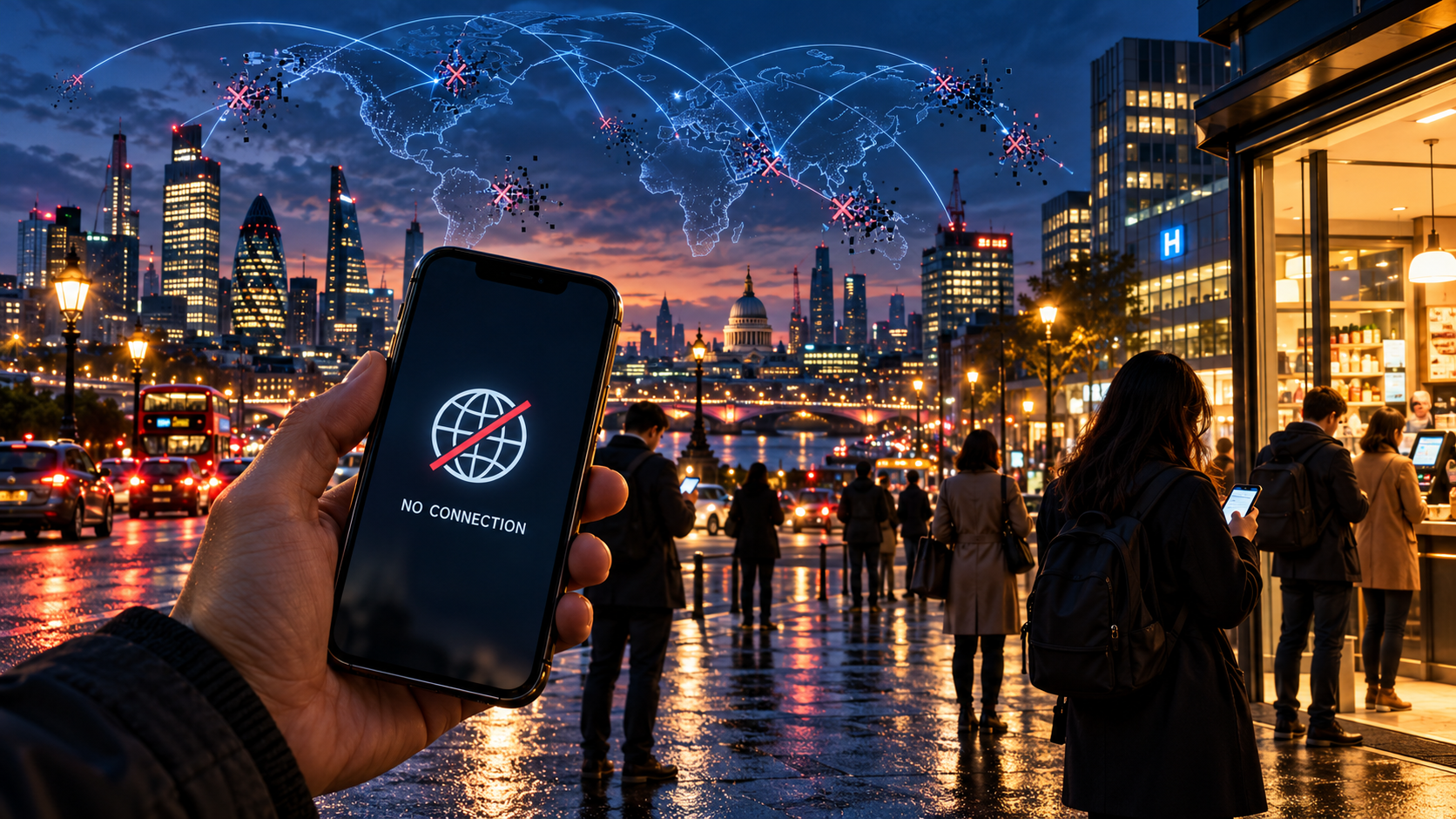
If the entire public internet disappeared for 24 hours, communications, payments, transport administration and business operations would suffer severe disruption. Some essential services would continue through private networks and offline procedures. Others would slow sharply or suspend activities. The damage would depend less on whether a computer remained switched on than on what it needed to contact before somebody could act.
There is no evidence-based timetable in which every bank, hospital and aircraft fails at a particular hour. A useful answer starts by separating the internet from everything people casually associate with it.
What Exactly Has Gone Down?
For this scenario, assume that the public internet becomes unavailable worldwide without warning, remains unavailable for one day, and then returns. Electricity continues to flow. Equipment has not been physically destroyed. Locally stored data remains intact. Private communications networks survive wherever they do not depend on the affected infrastructure or internet services.
Those assumptions matter. If a solar storm also damages electrical equipment, or an attack destroys data, the result is a different emergency. Adding every possible failure to an internet outage produces a dramatic story but prevents us from understanding which consequences belong to which cause.
The internet is a collection of interconnected networks operated by many organisations. It has no single master switch. A failure affecting every public route simultaneously would therefore be an extraordinary hypothetical, rather than the natural result of one broken cable or an ordinary company outage.
The Internet Society documents how shutdowns can nevertheless spill across borders and interrupt unrelated services. Dependence on shared routes, hosting and infrastructure allows a local restriction to have wider effects. This demonstrates interconnectedness; it does not establish that one government can switch off the entire planet.
Even the word “offline” needs care. Two computers inside a building might still communicate through their local network. A factory controller might keep operating its machinery. A downloaded document might remain readable while a document accessible only through a cloud account becomes unreachable.
The scenario would reveal a map of dependencies that most customers, and some organisations, have never needed to see.
The First Minutes: People Would Misdiagnose the Problem
At first, many people would treat the failure as personal. They would restart routers, switch between Wi-Fi and mobile data, close applications and try another device. Businesses would contact their technology teams. Those teams would attempt to check service-status pages that might themselves be inaccessible.
Trying another connection only helps when it avoids the failed component. A phone hotspot is an effective backup for a broken home broadband line. It cannot restore access when the destination and the public network connecting to it are unavailable everywhere.
Repeated attempts would also consume attention. Staff might spend the opening phase troubleshooting individual devices before recognising that the problem exceeded their organisation. A continuity plan that begins with checking an online dashboard could be unusually unhelpful at exactly the moment it is needed.
The October 2021 Facebook outage offers a limited technical comparison. Cloudflare observed the withdrawal of network routes and the resulting inability to resolve Facebook services through the Domain Name System, which translates names into addresses. Requests surged as applications and users retried. The wider internet remained available, so this was nothing like a global shutdown. It showed how a service can become unreachable even while its underlying equipment still exists.
In the imagined worldwide event, the first valuable resource would be a shared explanation: what is unavailable, what still works, and which instructions people should follow. Without that, organisations could waste scarce time applying fixes to the wrong problem.
Your Money Would Still Exist, but Access Could Become Difficult
A failed banking application would not erase your account balance. Banks maintain records beyond the screen displayed on your phone. An inability to retrieve those records is different from their destruction, and neither automatically means the bank has become insolvent.
The practical problem would be making and confirming payments. Many card terminals communicate through broadband or mobile data. Some payment arrangements support limited offline transactions, but acceptance depends on the terminal, card, merchant settings and risk rules. No responsible scenario can assume that every card becomes useless or that every merchant can continue accepting it.
Cash would help where a shop could operate its till, make change and record sales. It would help less if the shop closed because its inventory system, pricing service or security arrangements required remote access. Cash machines also need functioning communications and replenishment; an internet outage would not turn them into unlimited sources of notes.
Wholesale payment infrastructure deserves a separate distinction. The Bank of England describes CHAPS as operating through its real-time gross settlement infrastructure and the Swift messaging network. These are specialised systems, not simply a banking website. Their survival would depend on the precise communications failure and supporting dependencies, rather than follow automatically from a failed consumer app.
Even where settlement continued, customers and businesses could struggle to submit instructions, receive confirmations or reconcile transactions. A house purchase might be delayed because the participants could not complete the surrounding checks. A company might have funds but lack a working route to release payroll.
This creates a particular form of stress: people can be solvent yet temporarily unable to prove it or use their money when a payment is due. The distinction between solvency and access to cash also matters when examining how financial crises spread, although a short connectivity failure need not become a banking crisis.
Hospitals Would Lose Capacity Before They Lost Every Machine
An internet outage would not make all medical equipment stop. Devices with local controls and independent power could continue performing their functions. Hospital networks, digital records and laboratory systems have different architectures, so the consequences would vary between facilities and even departments.
The difficult cases would arise at the joins. A clinician might need a result from an external laboratory, an image from another hospital, a medication history or access to a remotely hosted record. When that information cannot be obtained promptly, staff must decide what can safely proceed and what should wait.
Paper procedures can preserve care, but they impose work. People have to identify patients correctly, record changes, deliver information and later reconcile handwritten records with digital systems. A fallback that works for a few patients may struggle when an entire institution needs it simultaneously.
The 2024 ransomware attack on pathology provider Synnovis illustrates the importance of information flows without serving as a direct model of this scenario. NHS England described reduced testing capacity and postponed appointments and procedures, while urgent and emergency services remained available. That incident involved compromised systems, not just missing internet access, and its disruption lasted much longer than a day.
Its relevance is narrower: healthcare can suffer serious losses of capacity without every hospital closing. Delays in one shared service can affect decisions across multiple clinical teams.
In a global outage, facilities might prioritise time-critical care and postpone work that required unavailable records or coordination. The danger would be uneven. Someone attending a routine appointment could face inconvenience, while a patient whose treatment depended on rapid information exchange might face a much more consequential delay.
Planes Would Not Simply Fall Out of the Sky
Aircraft do not remain airborne because passengers can reach the internet. Flight controls, navigation and aviation communications have dedicated systems and procedures. Satellite navigation is also distinct from downloading a map through a mobile application.
That does not make aviation immune. Airlines and airports coordinate bookings, check-in, baggage, crew assignments, maintenance information and departure planning through complex digital services. The availability of each depends on its design and connections. An airport might retain essential operational systems while losing the ability to process passengers at anything close to its usual rate.
The likely response to uncertainty would include delays, restrictions and cancellations. Preventing a departure can be the safe outcome of missing information. Describing every cancellation as a technical failure overlooks the possibility that operators are deliberately reducing activity to preserve safety.
Railways would face a similar distinction between controlling trains and administering the passenger service. Dedicated signalling need not stop merely because a public website fails. Ticketing, staffing information, customer updates and some operational applications could still be affected, with local consequences depending on the network.
Road vehicles would generally retain their basic ability to move. However, drivers could lose live navigation, ride-hailing dispatch and delivery instructions. Downloaded maps could remain useful, while live congestion information disappeared. Traffic might increase around transport hubs as people tried alternative arrangements.
The wider transport problem would therefore concern throughput. Vehicles could exist, fuel could be available and staff could be present, but the systems matching all three to a safe journey could operate much more slowly.
Shops and Warehouses Would Discover What They Had Outsourced
Consider an illustrative warehouse whose scanners contact a cloud service to identify the next item to pick. The shelves and products remain where they were. Yet workers may not know which order has priority, whether a payment cleared or where the next parcel should go.
A manager could introduce a manual process. That would require accessible order records, staff who understood the workflow and a way to avoid duplicate shipments. If the only copy of the order book were remote, printing blank forms would not recreate it.
Businesses with local stock records and practised procedures would have an advantage. Those that had optimised away every offline option could face an abrupt choice between stopping work and accepting uncertainty about what they were doing.
Fresh food would not automatically spoil in this scenario because refrigeration still has electricity. However, missed collections, delayed deliveries and an inability to redirect stock could create waste. A restaurant might have ingredients but lose incoming orders. A delivery company might have vehicles but lose dispatch visibility.
The same applies to industrial production. A machine can continue its current task while its next instruction, replacement part or quality approval becomes unavailable. Some factories would run for hours from existing schedules. Others might pause quickly because continuing without traceability would create costly mistakes.
The decisive question would be how much useful work an organisation could complete from the information already inside its buildings. That is a more revealing measure than the number of computers it owns.
Emergency Communication Would Become Uneven
Internet messaging would fail wherever it depended on inaccessible servers. That includes the familiar channels many families use to check that somebody has arrived safely. The resulting silence would not itself establish that the person was in danger, but people would understandably find it difficult to interpret.
Ordinary mobile calls and text messages are not identical to public internet applications. Some could continue if the operators' core networks and interconnections remained functional. Others might be disrupted by shared dependencies or congestion. Modern telephone services vary too much to promise universal survival.
Dedicated emergency radio systems could provide important continuity. Broadcast radio and television might also carry information where transmission facilities and programme distribution remained operational. Their usefulness would depend on audiences having suitable receivers and knowing which services to consult.
Emergency call-taking would have its own dependencies. A working call does not guarantee that every digital dispatch tool, map or hospital-status feed is available. Conversely, a failed public website does not prove that emergency numbers have stopped working.
Authorities would need to communicate through several surviving channels and give concrete instructions. Telling people to check a website would clearly be inadequate. Equally, encouraging everyone to telephone for routine updates could place avoidable pressure on the networks that remained available.
Families with an agreed meeting place, an offline contact list or a simple arrangement for checking on vulnerable relatives would face less uncertainty. These preparations do not restore technology. They reduce the amount of technology required to make one important decision.
The Working Day Would Split into Different Economies
Some workers would lose nearly their entire working environment: cloud applications, shared documents, remote desktops, messaging and customer systems. Others could continue much of their day using local tools or physical materials. The dividing line would not be as simple as office work versus manual work.
A tradesperson might still repair a door but struggle to obtain the customer's address or process payment. An office worker might complete a substantial analysis from downloaded data. A teacher could teach in person while losing attendance systems and online resources. An interpreter working remotely might lose the whole appointment.
The outage would also distribute losses unequally. A salaried employee sent home might still be paid. A self-employed worker unable to complete bookings could lose income immediately. An online publisher could lose advertising impressions that would never be recovered, even if some readers returned the following day.
It would be misleading to multiply daily global economic output by one and call the result the cost. Some activity would continue, some would be postponed, and some would disappear permanently. Businesses would also incur recovery costs that outlasted the outage.
A more useful distinction is between work that can move in time and work whose value depends on a particular moment. A delayed report may remain valuable. An unsold restaurant meal, an interrupted live event or a missed departure may not.
That difference explains why a single day could be financially modest for one household and destabilising for another, even if both regained access at exactly the same time.
A Global Outage Would Remove the Usual Escape Route
When one company fails, customers can sometimes choose a competitor. When one region loses connectivity, staff elsewhere may take over. When an office loses broadband, employees may work from home. These are useful responses because the disruption is limited.
The worldwide premise removes many of those options at once. Moving a workload between cloud providers does little if neither can be reached. A geographically distant support team cannot help through the same unavailable communications channel. Backup suppliers may depend on the same ordering or authentication service.
This is where apparent redundancy can disappoint. Two subscriptions do not necessarily provide two independent routes. Separate applications may share an identity provider. Different telecommunications brands may use common physical infrastructure. A company can buy considerable backup capacity while retaining an overlooked common dependency.
The lesson is not that redundancy is pointless. It is that a backup needs to be assessed against the failure it is supposed to survive. An alternative designed for a faulty device is not automatically an alternative for a missing global service.
For an essential organisation, that implies testing a reduced but useful operating mode. Can staff locate the plan without signing in? Can they contact one another without the normal messaging platform? Can they record urgent decisions while preserving a reliable sequence of events?
The aim would not be to reproduce the whole digital business on paper. It would be to preserve the small set of functions whose interruption creates the greatest harm.
Would People Panic or Enjoy the Break?
Both reactions are possible, but neither deserves to become a universal prediction. Someone with food, company and no urgent obligations might experience an unexpectedly quiet day. Someone awaiting a medical update, separated from a child or relying on that day's earnings could experience something very different.
Uncertainty would shape behaviour. If people trusted that service would return within a few hours, many might postpone decisions. If nobody knew the cause or duration, they could seek cash, fuel or information at the same time. Queues can grow from sensible individual choices without requiring mass irrationality.
Neighbourhood relationships would become practically useful. People could share information obtained from a working broadcast, check on someone who relied on remote contact or help a business communicate locally. Such cooperation would be a plausible response, not evidence that all communities would behave identically.
An outage would also reduce some activities that depend on connectivity, including parts of online fraud and harassment. That would not cancel the wider harms. It would simply underline how mixed the internet's functions are: the same infrastructure carries care, commerce, distraction and abuse.
The appealing image of humanity putting down its phones overlooks the many people for whom a phone is an accessibility tool, a workplace or their main connection to support. The dependence imagined in The Machine Stops provides a fictional comparison, though an actual internet outage would leave far more independent systems intact. A voluntary break and an involuntary loss of essential access are different experiences.
Hour Twenty-Five Would Bring a Second Problem
Restoring connectivity would begin recovery rather than finish it. Applications would reconnect, queued messages would arrive and businesses would try to establish which transactions had completed. Customers who repeatedly submitted an order might not know whether they had purchased nothing, one item or several.
Well-designed systems can prevent duplicates and preserve transaction records. Others would require manual checks. Staff would need to reconcile temporary records, update appointments and determine whether instructions issued during the outage remained valid.
The return of access could also create a burst of demand. Devices may seek updates and applications may synchronise large amounts of work. Services would need to accommodate that recovery load while operators investigated the original failure.
Security decisions would matter too. A restored connection would not, by itself, prove that every system was trustworthy if the cause remained unknown. Organisations would need to distinguish a connectivity fault from compromise before restoring sensitive operations indiscriminately.
For the public, the visible sign of recovery would be a working screen. For institutions, recovery would mean knowing what happened while the screen was blank. Those are different milestones.
The Question Businesses Would Ask Afterwards
The strongest argument against maintaining offline capacity is cost. Local copies, training, spare communication methods and occasional exercises consume money that could otherwise improve normal operations. A hypothetical worldwide outage is too extreme to justify preserving every old process indefinitely.
That objection is reasonable. Resilience should be proportionate to the importance of the service and the range of failures it might face. A small entertainment website and an emergency department do not need identical arrangements.
However, the same preparations can help during much more ordinary incidents: a supplier failure, damaged connection, inaccessible account or local cyber disruption. Their value need not depend on the whole internet disappearing.
After a 24-hour global outage, the most revealing question would be which organisations continued making safe, useful decisions with incomplete information. Some would discover that their staff had effective discretion. Others would find that every exception required approval from an unavailable system.
The internet would return to a world still containing its roads, hospitals, shops and skilled people. What the missing day would expose is how much of their practical usefulness depends on being able to establish, in seconds, who someone is, what has already happened and what should happen next.
Sources
Internet Society — Policy Brief: Internet Shutdowns — Network interdependence, cross-border effects and disruption to services.
Cloudflare — Understanding How Facebook Disappeared From the Internet — The observed routing and DNS failure in October 2021, used as a limited comparison.
Bank of England — CHAPS — The distinction between customer-facing access and specialised payment infrastructure.
NHS England — Synnovis Cyber Incident — Documented pathology disruption and its consequences for care; a comparison, not an internet-outage simulation.
Next Reads
The Machine Stops: Did a 1909 Story Imagine Life Through a Screen? — A fictional examination of dependence on a technological network.
What Causes A Financial Crisis? Banks, Debt And Contagion Explained — How interruptions to payment and funding can spread through an economy.
The Circle Explained: What Happens When Privacy Becomes Suspicious? — How digital services become embedded in everyday institutions and relationships.
