

When Will Humans Reach Mars? SpaceX’s Plans And A Realistic Timeline
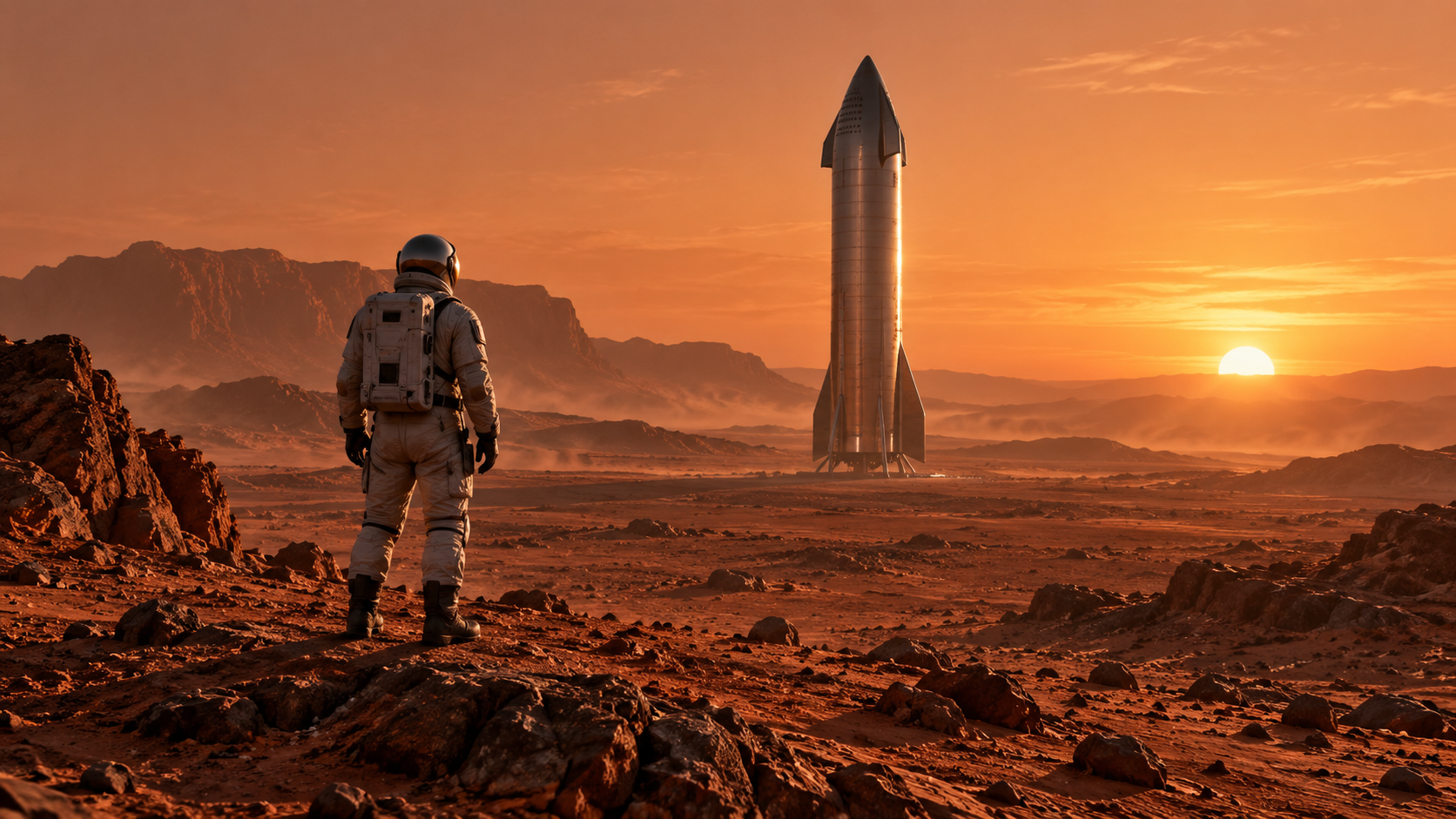
SpaceX’s Mars Plan: From Cargo Landings To The First Crew
The First Human Footprint On Mars Depends On Far More Than A Rocket Powerful Enough To Reach It.
There is no confirmed date for a human landing on Mars. A prudent working expectation is sometime in the 2030s or later, with the mid-to-late 2030s a more defensible planning scenario than treating the earliest advertised dates as commitments. That is an editorial judgement about the work required, not a SpaceX schedule, NASA promise or statistical forecast.
The answer changes depending on what “reach Mars” means. Sending an uncrewed spacecraft, landing cargo, landing astronauts and establishing a settlement capable of surviving without Earth are four very different achievements. They should never be collapsed into a single countdown.
SpaceX’s central idea is to use Starship as the transport system for a much larger off-world presence. The challenge is turning that ambition into a sequence in which each mission establishes something the next mission can safely depend upon.
What SpaceX Is Trying To Build
SpaceX’s Mars concept combines a large transport vehicle with repeated launches and the eventual delivery of substantial cargo and people. Its published material describes launch opportunities recurring approximately every 26 months. The operating ambition is therefore a transport network assembled over successive opportunities, rather than one isolated expedition.
A published destination and an operational mission are different things. To judge readiness, look for the hardware, the supporting operations and a defined mission that those systems can actually carry out. An ambitious transport concept does not establish a flight-ready human expedition.
Earlier targets have been more aggressive. In May 2025, Reuters reported Elon Musk’s aim to send an uncrewed Starship towards Mars by the end of 2026. In February 2026, TIME described a stronger near-term emphasis on lunar development. Those changes illustrate why an old quotation should not be presented as a current delivery promise.
A sensible reader can support the ambition while asking for a dated baseline. Which mission is being discussed? Is the date for departure or arrival? Does the plan concern hardware, people or a settlement? Answers to those questions often explain apparent contradictions between competing Mars headlines.
The Moon Can Help, But Cannot Reproduce Mars
Lunar activity can provide experience of operating beyond Earth, managing supplies and maintaining surface equipment. NASA describes its wider exploration approach through the development of capabilities for human Mars missions. The Moon also offers a closer environment in which to learn lessons before attempting a much more distant expedition.
That makes lunar progress relevant without making it sufficient. A mission to Mars must address its own destination, duration and return requirements. A system that works during one kind of mission cannot simply inherit approval for every other mission because the hardware looks similar.
There is also an opportunity-cost question. Lunar work could develop useful capabilities and revenue, but it also demands engineering effort and programme attention. Whether it accelerates Mars depends on what is transferable and what additional work it creates. It would be premature to assume either that the Moon is a distraction or that every lunar milestone automatically brings a Mars landing closer.
Why The Calendar Comes In Windows
Earth and Mars move around the Sun at different rates. Favourable launch opportunities recur roughly every 26 months, rather than whenever engineers finish assembling a spacecraft. Mission designers also have to account for the trajectory, available propulsion and the arrival conditions they need.
This creates an unusually harsh penalty for missing a deadline. A delay of several months in readiness can mean losing a favourable departure opportunity and waiting around another two years. More energetic alternatives may exist, but they alter the mission’s trade-offs rather than abolishing orbital mechanics.
It also limits the pace of learning. If a cargo mission must travel to Mars, attempt a landing and operate on the surface before engineers can judge it, the feedback does not arrive immediately after launch. A later crew mission needs time to incorporate what that experience reveals.
Any timeline should therefore separate launch windows from arrival years. “A 2033 mission” is incomplete information unless the speaker says which event belongs in 2033. A calendar that hides those distinctions can make a programme look more mature than it is.
Orbital Refuelling Is A Programme Of Its Own
Starship’s deep-space concept depends on adding propellant in orbit. NASA’s work on cryogenic fluid management addresses the broader challenge: very cold propellants must be stored, controlled and transferred in conditions where ordinary terrestrial assumptions about settling liquids do not apply.
The practical implication is that a Mars departure depends on more than the spacecraft carrying the crew. Supporting launches, rendezvous, transfer operations and readiness checks must work together. A delay elsewhere in that chain could affect the departure even if the main vehicle were ready.
A single transfer demonstration would be useful evidence. An operational campaign would require evidence about repeatability, quantities, timing and losses. The difference is similar to proving that a machine works once and proving that an entire factory can deliver on schedule.
Landing Cargo Must Teach More Than Landing
Mars has a thin atmosphere. It can help slow an arriving spacecraft, but a large landed payload presents a very different problem from touching down on Earth. NASA’s Mars information also describes a cold, dusty environment with conditions that equipment must survive after arrival.
For a cargo-first strategy, the useful test would continue after touchdown. Can equipment be unloaded? Can the power system start? Can instruments communicate and keep working? Can the mission identify conditions that would force changes before people arrive?
Those are proposed assessment questions, not a claim that SpaceX has published a final checklist. Their value is that they measure what later crews would actually need. A successful landing that leaves essential supplies inaccessible would provide very different reassurance from a landing followed by sustained useful operations.
Making Oxygen Is A Start, Not A Return Ticket
NASA’s MOXIE experiment aboard Perseverance demonstrated the production of oxygen from the Martian atmosphere. NASA reported that the instrument produced 122 grams in total across its operations. This was a significant demonstration of a process that could contribute to future exploration.
It was not an industrial propellant plant. A crewed return strategy relying on local resources would need the relevant production, power, storage and handling systems to work at the required scale. Oxygen production alone does not establish that a vehicle has everything it needs to launch from Mars.
The sensible inference is to require evidence of the complete return arrangement before treating a human arrival date as dependable. A system can be promising at laboratory or demonstration scale while still needing substantial development before lives depend on it. That difference should be visible in every discussion of “living off the land”.
Keeping People Alive Changes The Standard Of Proof
NASA groups human-spaceflight hazards into radiation, isolation and confinement, distance from Earth, changes in gravity, and hostile or closed environments. These challenges interact: a technical fault can increase stress, consume spare parts and disrupt daily routines at the same time.
Life support includes far more than a supply of oxygen. NASA’s environmental-control systems work covers water recovery, atmosphere management and the removal of contaminants. An expedition needs equipment that can be maintained as well as equipment that functions under ideal conditions.
Radiation protection is another design constraint. NASA identifies exposure beyond Earth’s protective environment as a major human-spaceflight concern. Protective measures have to fit within the spacecraft’s mass, layout and operational plan; calling the vehicle large does not settle the exposure question.
Gravity also creates a sequence of adjustments. Travellers would experience conditions during transit that differ from those on Mars and from those awaiting them back on Earth. NASA’s research addresses consequences for the body, including muscles and bones. A crew must be able to perform essential tasks, not merely survive the journey as passengers.
Distance changes medical and engineering support. Communications take time, supplies cannot be delivered on demand, and an immediate return is not a normal fallback. NASA’s distance research emphasises autonomy and self-sufficiency. A mission must plan for people on board to recognise problems and act before Earth can solve every detail.
A Realistic Timeline Has Conditions Attached
Late 2020s: preparation and possible early cargo attempts. This is the stage to watch for a convincing sequence of orbital operations, propellant-handling progress and uncrewed interplanetary readiness. It should not be advertised as an established human-landing timetable.
Early 2030s: an aggressive crew scenario. A human mission this early would require rapid success across several linked systems, useful cargo results and an acceptable return plan. It remains a possibility to test against evidence, rather than a sensible date on which to make an unconditional promise.
Mid-to-late 2030s: a more cautious planning scenario. Allowing additional time for development and lessons from earlier missions makes this a more defensible working range. This article does not assign it a probability: there is no transparent statistical model here that would justify one.
2040s or later: a credible delay scenario. Repeated missed windows, a major redesign, funding changes or unresolved human-safety requirements could push the first landing further out. There is no known engineering rule that guarantees success by the end of any particular decade.
These are conditional editorial scenarios. Their purpose is to show what must happen for a date to become believable, and what new evidence would change the assessment. They should be updated as capabilities are demonstrated.
A Landing And A Self-Sustaining Settlement Are Different Goals
An expedition can rely on equipment, food and spare parts prepared on Earth. A genuinely self-sustaining settlement would have to withstand the loss of that dependency across a much wider range of essential needs. A habitat full of people is not automatically an independent civilisation.
That distinction follows directly from the meaning of self-sufficiency. If a settlement cannot replace a critical component without an Earth shipment, that shipment remains part of its survival system. Growth in population does not, by itself, remove the dependency.
There is no defensible firm date for a self-sustaining Martian city. Even a successful first human landing would leave that question open. Taylor Tailored’s exploration of risks to civilisation on Earth provides context for the resilience argument, but resilience claims still need practical evidence.
The Milestone That Should Change Your Mind
The strongest signal will be a chain of demonstrated capabilities: dependable transport, useful cargo on the surface, sustained operations and a credible way home. Progress across that chain would justify bringing a human-landing expectation forward. Repeated breaks in it would justify moving the expectation back.
For now, humans on Mars in the 2030s is an ambition worth taking seriously, not a booking that can be made with confidence. The date becomes more credible when the equipment, supplies and return arrangements stop being promises and start becoming things a crew can rely upon.
