Where Does It Actually Go?
A Cooling Loop Can Reuse Its Water While The Building Still Needs More.
A pipe carries warm water away from a bank of computers. Another pipe brings cooler water back. If the two form a loop, why does the operator keep buying water? The apparent contradiction comes from treating the equipment that picks up heat and the equipment that disposes of it as one thing. The water beside the chips can circulate repeatedly while a separate system outside loses water through evaporation.
AI data centres use water in several places. Some use it directly to move or reject heat. Their electricity can require water at generating stations, and the factories making their chips use highly purified water. The quantity depends on the workload, building, weather, electricity supply and accounting boundary. A figure for one facility cannot establish how much water disappears each time somebody sends a message to a chatbot.
Follow The Heat Before Following The Pipe
A processor takes electrical energy and performs calculations. Within a data centre nearly all the electricity consumed eventually becomes heat that has to leave. A useful way to picture the scale is to imagine a steady one-megawatt computing load. Over an hour it consumes one megawatt-hour of energy. Keeping the machines at a safe temperature means carrying a comparable quantity of heat out of that equipment during continued operation.
Cooling starts very close to the source. In an air-cooled rack, heat moves into a heatsink and then to passing air. Fans push that air through the machinery. The warm air can give its heat to another circuit at a heat exchanger. In a direct-to-chip system, liquid inside a cold plate picks up heat near the processor. Moving that heat with liquid can be attractive where a great deal of power is concentrated in a small physical area.
At this stage the heat has merely changed vehicles. A pipe of warm liquid is excellent news for the chip and unfinished business for the building. The operator needs somewhere for the energy to go before the liquid returns for another pass. The next choice, how to give that heat to the outside world, explains much of the variation between water-use claims.
Why Evaporation Works So Well
Water requires energy to change from liquid to vapour. A wet shirt feels cool as it dries because evaporating water draws heat from its surroundings. A cooling tower makes industrial use of the same principle. Air meets water, a fraction evaporates and the water left in the system can emerge cooler. Fans and pumps help maintain the process; the atmosphere receives both heat and moisture.
Evaporated water is the largest intuitive answer to where it went. It has not ceased to exist. It has left the water supply available for immediate use in that locality and entered the atmosphere. It might eventually fall as rain far away or at a later time. A water company facing a dry afternoon cannot use that future rain to fill today's service reservoir. That is why local accounting can properly call the water consumed.
There is another loss a tidy sketch of a loop can conceal. As water evaporates, minerals dissolved in it tend to remain. Run the same reservoir indefinitely and the concentration rises, increasing problems with scale, corrosion or biological growth. Operators remove a fraction of the circulating water and replace it with fresh supply. This discharge is often called blowdown. It leaves the cooling circuit in liquid form and may go for treatment.
The plume visible above a tower on a cool day is a poor measuring instrument. Water vapour itself is invisible; a visible plume includes tiny droplets formed as moist air cools. Its appearance changes with atmospheric conditions. Two photographs taken on different days cannot establish which day consumed more water, any more than visible breath on a frosty morning proves the speaker was breathing harder than in July.
Why A Closed Loop Can Still Have A Water Bill
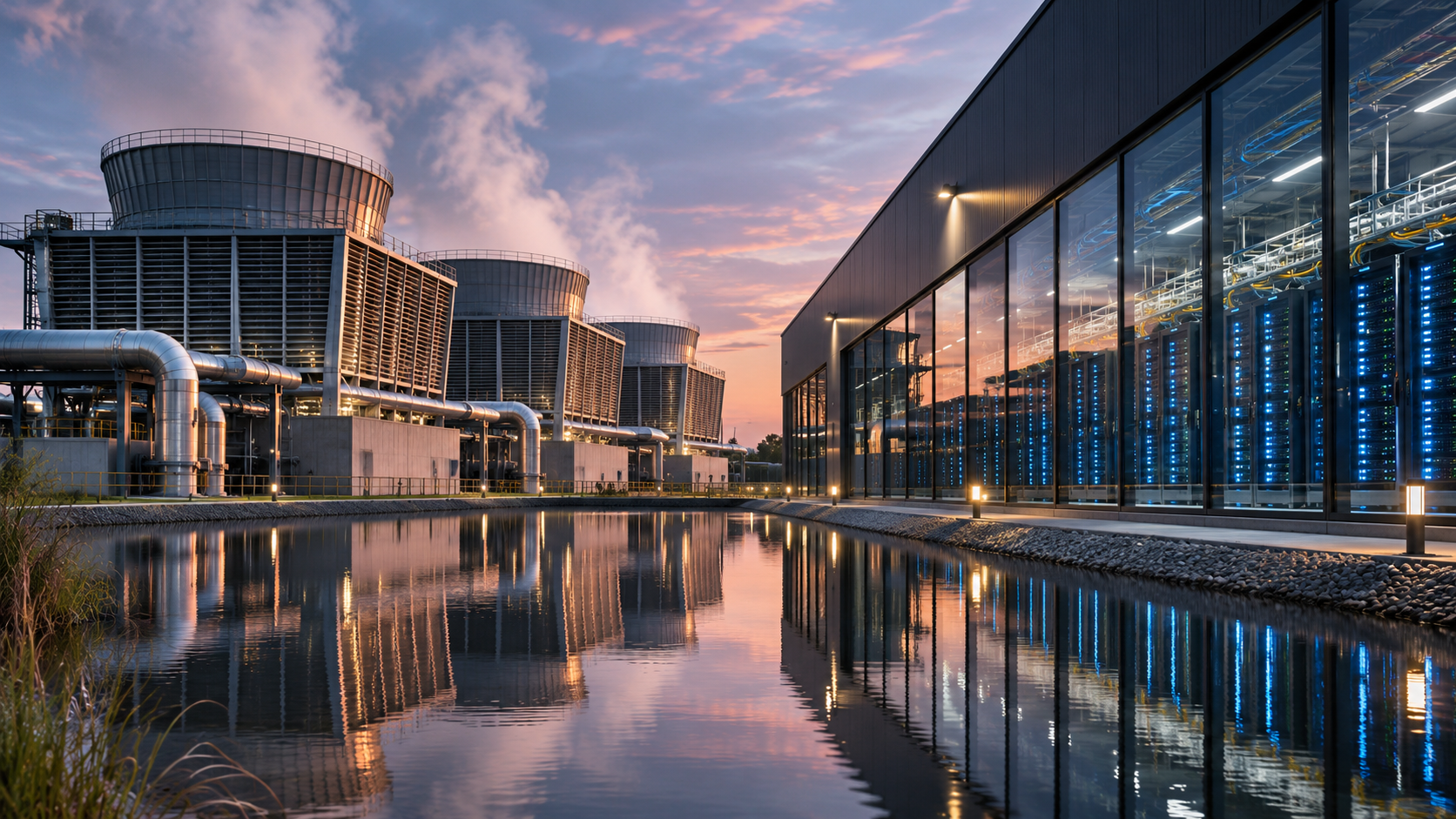
Consider two circuits separated by a heat exchanger. The indoor circuit carries heat from the computers to a metal surface. On the other side, a second fluid picks up the heat without the liquids mixing. Outside, that second circuit uses an evaporative tower. An engineer describing the indoor circuit as closed is making a meaningful statement. A resident asking whether the whole facility uses water is asking about a larger boundary.
An alternative is to reject heat through a dry cooler, moving outdoor air across a heat exchanger. This can reduce direct evaporative losses, though the design still needs space, equipment and power. The available difference between outdoor temperature and the desired fluid temperature matters. On a hot day a method that worked easily on a cold night can require much more airflow or mechanical refrigeration. Some facilities change operating modes with the weather.
Liquid cooling is consequently an incomplete answer to a water question. It tells us something about how heat moves inside the system. It tells us little, by itself, about how the building rejects heat. Conversely, a hall full of air-cooled servers can be attached to plant that uses considerable water outside. The two questions worth putting to an operator are what picks up the heat at the rack and what releases it at the site boundary.
A design can use reclaimed water where local infrastructure and treatment requirements permit. That may reduce demand for drinking-quality supply. It does not abolish the physical water requirement or guarantee that the reclaimed supply had no other potential use. The value of the substitution depends on what would otherwise have happened to that water and which users face scarcity at the time it is needed.
Withdrawal And Consumption Give Different Answers
Water withdrawn is the amount taken from a source. Consumption generally refers to the portion unavailable for prompt reuse within the relevant system or basin, often because it evaporated. Water returned after treatment can reduce the difference between those two figures. Its temperature, quality and destination still matter. Returning water downstream may be of little help to a user immediately upstream.
A simple example illustrates the distinction. Suppose a facility withdraws 100 units and returns 30 to the same basin under the accounting assumptions being used. Its withdrawal is 100 units. A simplified estimate of consumption is 70. Report those two numbers without their labels and one observer may accuse the other of understating demand by thirty per cent when they have measured different properties of the same operation.
Annual totals can hide the feature a local community most needs to understand. A plant able to use dry cooling during winter may rely more heavily on evaporation in hot weather. Its annual consumption could look modest beside another industry while its peak demand coincides with the period when households, farmers and ecosystems are under the greatest pressure. For a planning decision, a hot-week demand profile may be more informative than a global average.
The Water At The Other End Of The Electricity Cable
Power generation can require water to cool equipment or condense steam. Different technologies, cooling systems and locations have very different requirements. A data centre drawing the same number of megawatt-hours in two regions can therefore have different indirect water consequences. It matters whether an estimate uses the regional average generating mix, a particular contracted source or an estimate of the generation responding to additional demand.
The International Energy Agency's illustrative calculation for a 100-megawatt US hyperscale facility puts daily consumption across its accounting boundary at around two million litres, with more than sixty per cent indirect. It is an example, with a location and assumptions attached. Quoting that entire volume as drinking water evaporating from the roof would give a very different impression from the calculation the agency actually presents.
Chip production adds another geographical layer. Semiconductor manufacturing requires water clean enough to wash microscopic structures without leaving contaminants. A chip delivered to one country may have used water during manufacture in another. Allocating part of that impact to each service performed during the chip's useful life requires assumptions about utilisation, lifetime and which services shared the hardware. It is a different calculation from reading a meter at the data-centre fence.
These distinctions can alter the judgement about two competing designs. One building saves direct water by running additional refrigeration. If the electricity supplying that refrigeration is water-intensive, some demand may move to the power system. Another building uses evaporation where suitable reclaimed water is available and needs less electricity. Deciding which performs better requires local evidence about both systems. A global ranking based on a single engineering label cannot do that job.
Can You Price A Prompt In Millilitres?
A useful estimate would need an energy figure for the task, a share of common infrastructure, the facility and season, and an appropriate water intensity for each relevant part of the system. A short answer and a long generated video are plainly different tasks. Even two identical requests can be routed to different hardware or share a batch with different numbers of users. A household measuring jug offers a pleasingly concrete image for a calculation whose boundaries are anything but fixed.
An average can nevertheless be useful if its meaning is clear. Divide a year's measured site consumption by the year's computing energy use and you obtain a site-level intensity for that period. Multiplying it by an estimated task energy gives an allocation of annual consumption. It does not mean the tower drew that precise extra amount of water when the user pressed send. Spare capacity, cooling controls and weather affect the marginal response.
Water and energy reports become much easier to compare when the numerator and denominator are visible. Litres per kilowatt-hour of IT energy and litres per kilowatt-hour of total facility energy are different ratios. A site with the same water consumption and computing load could appear to improve on the second measure by using more electricity elsewhere in the building. The numbers need a boundary and a physical explanation before they deserve a headline.
The useful public question starts with a particular site. What water source supplies it? What leaves as vapour, what is returned, and where? How high does demand rise during a dry summer? Which figures include electricity and chip manufacture? Answers to those questions can tell a town whether a proposed computing facility fits its water system. A precise-sounding figure for a single sentence typed into a chatbot cannot.
