A Lost Ocean Ecosystem: The Moroccan Rocks Rewriting Life’s History
Ancient Life Found Where It Shouldn’t Exist: Morocco Discovery Stuns Scientists
Is there ancient life in places it shouldn't exist? Morocco Discovery Rewrites Deep-Ocean Microbe History
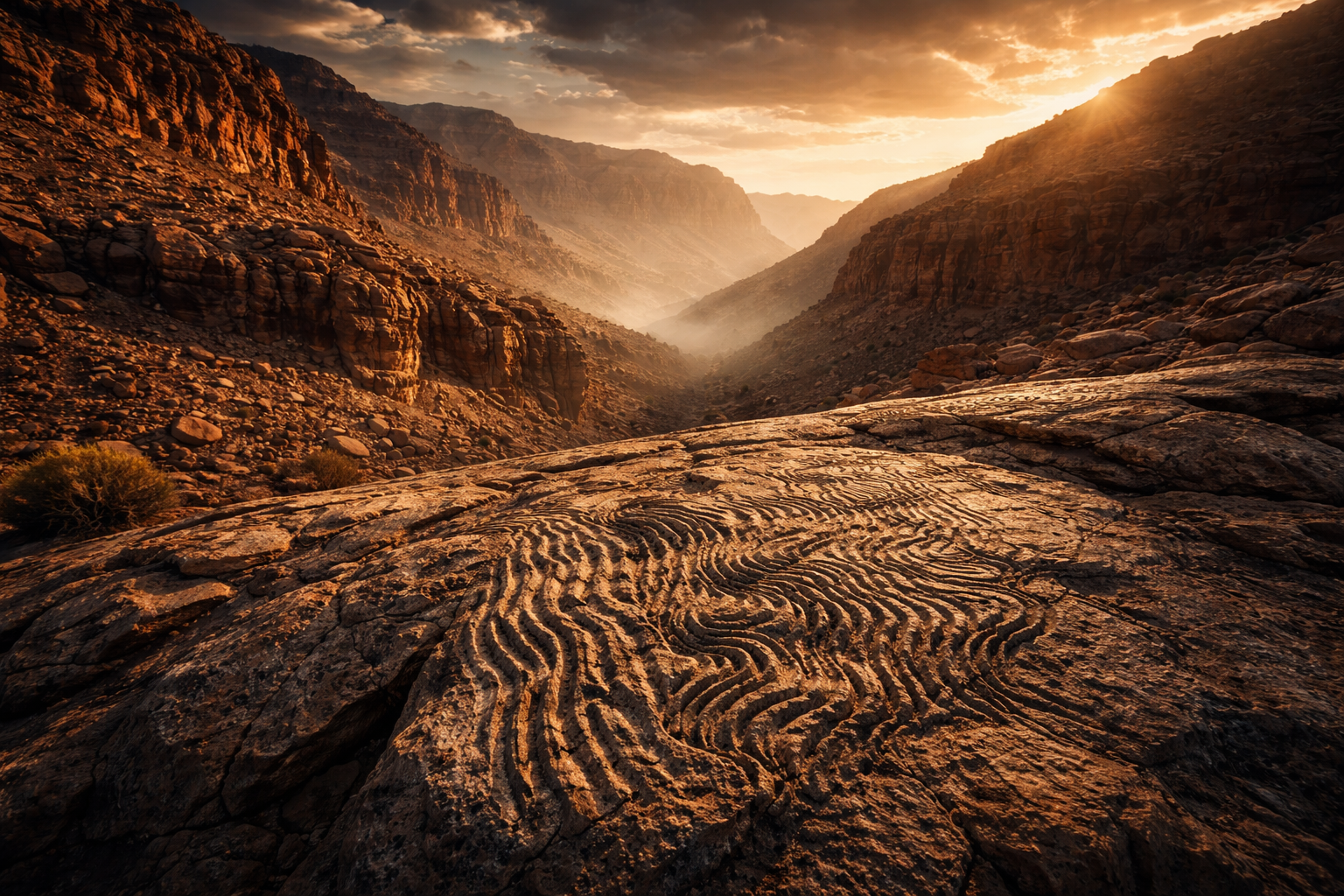
Scientists exploring ancient rock layers in Morocco have uncovered fossilized microbial structures in a place where life was not supposed to thrive. The wrinkle-like patterns—preserved in deep-water sediments dating back roughly 180 million years—suggest microbial ecosystems once existed far below sunlight-lit seas, challenging long-held assumptions about where early life could survive.
The discovery comes from rock layers in the Central High Atlas Mountains that once formed part of the ocean floor. Researchers noticed strange textures resembling the wrinkled surfaces produced by microbial mats—communities of bacteria that grow together and leave distinctive fossil patterns. But these sediments formed hundreds of meters below the surface, in darkness where the usual photosynthetic microbes cannot live.
That contradiction is why the find matters. It suggests that ancient microbes were building complex communities in deep-sea environments powered not by sunlight but by chemical reactions in the sediment.
The story turns on whether deep-ocean ecosystems were far more widespread in Earth’s past than scientists realized.
Key Points
Scientists found fossil “wrinkle structures” in Jurassic-age rocks in Morocco that resemble microbial mats.
These rocks formed in deep-water sediment flows known as turbidites, far below sunlight penetration.
The most likely explanation is chemosynthetic microbes—organisms that gain energy from chemical reactions rather than sunlight.
The structures date to about 180 million years ago, during the Early Jurassic period.
The discovery suggests deep-sea microbial ecosystems were more common in Earth’s past than previously assumed.
It could reshape how scientists search for ancient life in Earth’s geological record—and possibly on other planets.
The Discovery in Morocco’s Ancient Seabed
The discovery began with a simple observation in the field. While studying exposed rock layers in Morocco’s Dadès Valley, geobiologist Rowan Martindale noticed unusual wrinkled textures etched across ancient sedimentary rock surfaces.
Such patterns are familiar to geologists. Known as “wrinkle structures,” they typically form when microbial mats grow across sediment surfaces. The microbes bind grains together and stabilize the sediment, creating textured ripples that can fossilize over time.
But something about these examples was wrong.
The rocks belonged to deep-marine deposits called turbidites—sediments laid down by underwater landslides in the deeper parts of the ocean basin. Geological evidence indicates these layers formed at least about 180 meters below the sea surface, far too deep for sunlight-driven microbes.
That meant the structures should not exist there.
Yet the patterns matched those produced by microbial mats almost exactly.
Life Without Sunlight
The most plausible explanation points to chemosynthesis.
Chemosynthetic microbes obtain energy from chemical reactions rather than light. Instead of photosynthesis, they oxidize chemicals such as sulfur or methane in the surrounding sediment. These processes can power entire ecosystems in dark environments.
Evidence from the Moroccan rocks—including carbon-rich material within the sediments—suggests such chemical energy sources may have supported the ancient microbial communities.
This kind of life is already known in modern deep-sea environments, especially around hydrothermal vents where chemical gradients fuel microbial ecosystems. But finding clear fossil evidence of similar communities in ancient deep-water sediments is rare.
If confirmed, the Moroccan structures show that deep-sea microbial ecosystems existed much earlier and more widely than the fossil record had indicated.
Why the Geological Setting Matters
The rock layers containing the fossils formed in dynamic environments shaped by underwater landslides.
These events created turbidites—rapid flows of sediment cascading down continental slopes into deep ocean basins. When the flows settled, they left layers of fine sediment across the seabed.
Normally, such turbulent environments would destroy delicate microbial structures. Yet the wrinkle patterns appear preserved across the sediment surfaces.
The likely explanation is that microbial mats colonized the seabed between sediment flows. Their sticky biofilms stabilized the surface long enough for their distinctive textures to form and be preserved when new sediment arrived.
In other words, microbial communities may have repeatedly colonized and survived even unstable deep-sea environments.
What Most Coverage Misses
The real significance of the discovery is not simply that microbes lived in the deep ocean. Scientists already know that modern microbes thrive in dark, chemically rich environments.
The deeper insight is about preservation.
Geologists have long assumed that wrinkle structures almost always indicate shallow-water environments, as they commonly observe microbial mats there today. That assumption shaped how scientists interpreted the fossil record.
The Moroccan discovery breaks that shortcut.
If similar structures can form in deep-water turbidites, then many fossil surfaces that were previously thought to be just geological features or overlooked could actually show signs of ancient microbial ecosystems.
This shifts the search strategy for early life. Instead of focusing almost exclusively on shallow ancient coastlines, researchers may need to examine deep-marine sediments as well.
This adjustment could significantly broaden the range of locations where researchers might discover traces of ancient life.
The Stakes for Understanding Life’s History
The implications reach beyond geology.
Microbial mats are among the oldest forms of life known on Earth. Their fossilized textures help scientists reconstruct early ecosystems and the evolution of life before complex animals appeared.
If such communities also thrived in deep-water environments, it suggests early life was more ecologically flexible than previously believed, indicating that similar microbial communities could potentially exist in extraterrestrial subsurface oceans or chemical environments without sunlight.
It also strengthens parallels between Earth’s early oceans and environments elsewhere in the solar system.
Many planetary scientists suspect that extraterrestrial life—if it exists—would likely survive in subsurface oceans or chemical environments without sunlight. Evidence that ancient microbes flourished in similar conditions on Earth strengthens that possibility.
Where the Search Goes Next
The Moroccan discovery opens a new line of investigation for geologists and astrobiologists alike.
Scientists will now look for similar wrinkle structures in other deep-marine sediment layers around the world. To confirm whether these patterns truly formed from microbial activity, scientists will need to conduct detailed chemical analyses and microscopic studies.
Several signposts will determine how transformative this discovery becomes:
Whether additional deep-water microbial structures are found in other geological formations
Whether chemical signatures confirm chemosynthetic microbial activity
Whether similar patterns appear in older rocks closer to the origin of life
If those lines of evidence converge, the discovery could force a quiet rewrite of how scientists interpret the fossil record.
The discovery doesn't prove the existence of new life, but it suggests that scientists may have been searching in the wrong locations.
