Scientists Unveil the Largest Map of the Early Universe Ever Built
A “Sea of Light” From 11 Billion Years Ago Is Now Mapped in 3D
Scientists Create the Largest Map of the Early Universe Ever Made—Revealing a Hidden “Sea of Light” From 11 Billion Years Ago
Astronomers have produced the most detailed three-dimensional map of the early universe ever assembled, offering a new look at how matter was distributed billions of years ago during the peak era of galaxy formation.
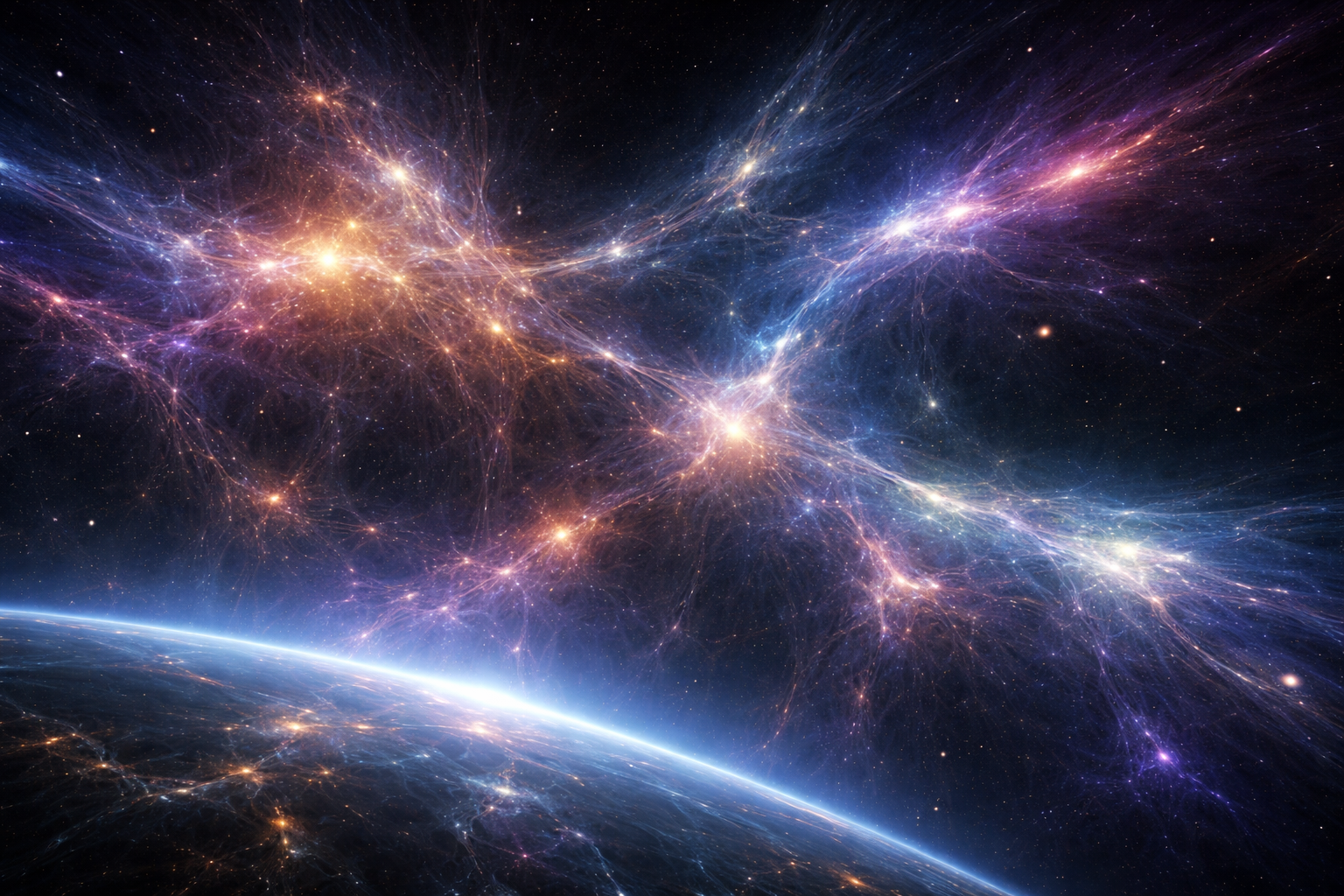
The map reconstructs cosmic structures from roughly 9 to 11 billion years in the past, when galaxies were forming stars at extraordinary rates. Instead of charting individual galaxies one by one, researchers mapped the diffuse glow of hydrogen gas across vast regions of space, exposing structures that had previously been invisible.
It reveals what scientists describe as a cosmic “sea of light”—faint radiation from hydrogen atoms energized by nearby stars, illuminating the scaffolding of the early universe.
And the deeper implication is this: the map doesn’t just show where galaxies were. It shows the cosmic environment that allowed them to exist at all.
The story turns on whether mapping the faint light from hydrogenal the full structure of the cosmic web that shaped galaxy formation.
Key Points
Astronomers have created the largest 3D map of the early universe using observations of hydrogen radiation billions of years old.
The dataset reveals a previously unseen “sea of light” produced by excited hydrogen gas and faint galaxies.
Researchers used a technique called line-intensity mapping, capturing cumulative light from vast regions instead of observing galaxies individually.
The map reconstructs cosmic structures from 9–11 billion years ago, the peak epoch of star formation.
More than 600 million spectra were analyzed to build the map, allowing astronomers to trace matter distribution across enormous volumes of space.
The results could help scientists better understand dark energy, galaxy formation, and the evolution of cosmic structure.
The Survey That Turned Hydrogen Into a Cosmic Map
The breakthrough comes from the Hobby-Eberly Telescope Dark Energy Experiment (HETDEX), a large international effort designed to map distant galaxies and probe the expansion history of the universe.
Instead of counting galaxies individually—the traditional method used in cosmology—the survey measured Lyman-alpha radiation, a specific wavelength emitted when hydrogen atoms are energized by nearby stars.
Hydrogen is the most abundant element in the universe. When astronomers detect its faint glow across large regions of space, they effectively capture a tracer of where matter exists.
Using this approach, scientists can reconstruct the three-dimensional structure of the early cosmos.
The result is a map that shows not just bright galaxies but also:
faint dwarf galaxies
diffuse hydrogen gas
large-scale cosmic filaments
These elements form what astronomers call the cosmic web—the vast network of matter that shapes the large-scale structure of the universe.
Why This Map Shows a Different Universe Than Before
Traditional galaxy surveys operate like a census. Astronomers measure the positions of millions of galaxies and build a map from those points.
However, this approach has a limitation.
Many early galaxies are simply too faint to detect individually.
The new technique—known as line-intensity mapping—captures the combined glow of entire regions of space, allowing researchers to see matter that would otherwise remain invisible.
In effect, astronomers have shifted from mapping individual cosmic “cities” to mapping the entire landscape in which those cities formed.
The difference is profound.
Instead of isolated galaxies floating in darkness, the new map reveals a universe filled with interconnected light and matter.
What the Map Reveals About the Universe’s Most Active Era
The period captured in the new map corresponds to the cosmic noon of the universe—the time when galaxies were producing stars at the fastest rate in cosmic history.
During this era:
Galaxies were rapidly growing.
Black holes were actively feeding.
Massive star formation lit up surrounding hydrogen gas.
The hydrogen radiation recorded in the map effectively acts as a fossil glow from that epoch.
By tracing that light, scientists can study:
how galaxies clustered together
how gravity shaped the cosmic web
how matter evolved into today’s large-scale universe
The map also helps astronomers test models of dark energy, the mysterious force driving the universe’s accelerating expansion.
What Most Coverage Misses
The headline story is the scale of the map. But the real scientific shift lies in how the map was built.
For decades, cosmology relied on galaxy catalogs—counting visible galaxies and measuring their positions.
That method inherently missed most of the universe’s ordinary matter.
The new survey flips the approach. Instead of detecting objects, it detects radiation fields across enormous regions of space.
This matters because galaxies represent only a small fraction of cosmic matter. Vast reservoirs of hydrogen gas exist between them.
By mapping hydrogen light directly, astronomers are effectively mapping the universe’s underlying structure, not just its brightest components.
That approach could become the dominant strategy for future cosmology missions.
Why Cosmic Mapping Is Entering a New Era
The new map is only an early glimpse of what large-scale cosmology will soon achieve.
Multiple upcoming observatories will dramatically expand cosmic mapping:
wide-field space telescopes
next-generation spectroscopic surveys
massive computational simulations
Together they aim to map tens of millions of galaxies and cosmic structures across billions of years of cosmic history.
The ultimate goal is ambitious: to reconstruct the entire evolution of the universe’s structure, from shortly after the Big Bang to the present day.
In other words, astronomers are trying to create something close to a time-lapse map of the cosmos itself.
The Next Clues Hidden in the Cosmic Web
The newly revealed hydrogen map is only the beginning.
Researchers will now analyze the dataset to search for patterns in how matter clustered over time. Those patterns contain critical clues about the forces shaping the universe.
Key signals scientists will watch for include:
subtle shifts in galaxy clustering
distortions caused by dark energy
evidence for new physics beyond the standard cosmological model
If those patterns diverge from theoretical predictions, it could signal that scientists are missing something fundamental about the universe’s expansion.
And that possibility is why maps like this matter.
Maps like this transform the universe from a distant spectacle into a measurable system, where scientists can finally test the deepest mysteries of cosmology against reality.
