A Martian Rock Just Changed the Water Story on Mars
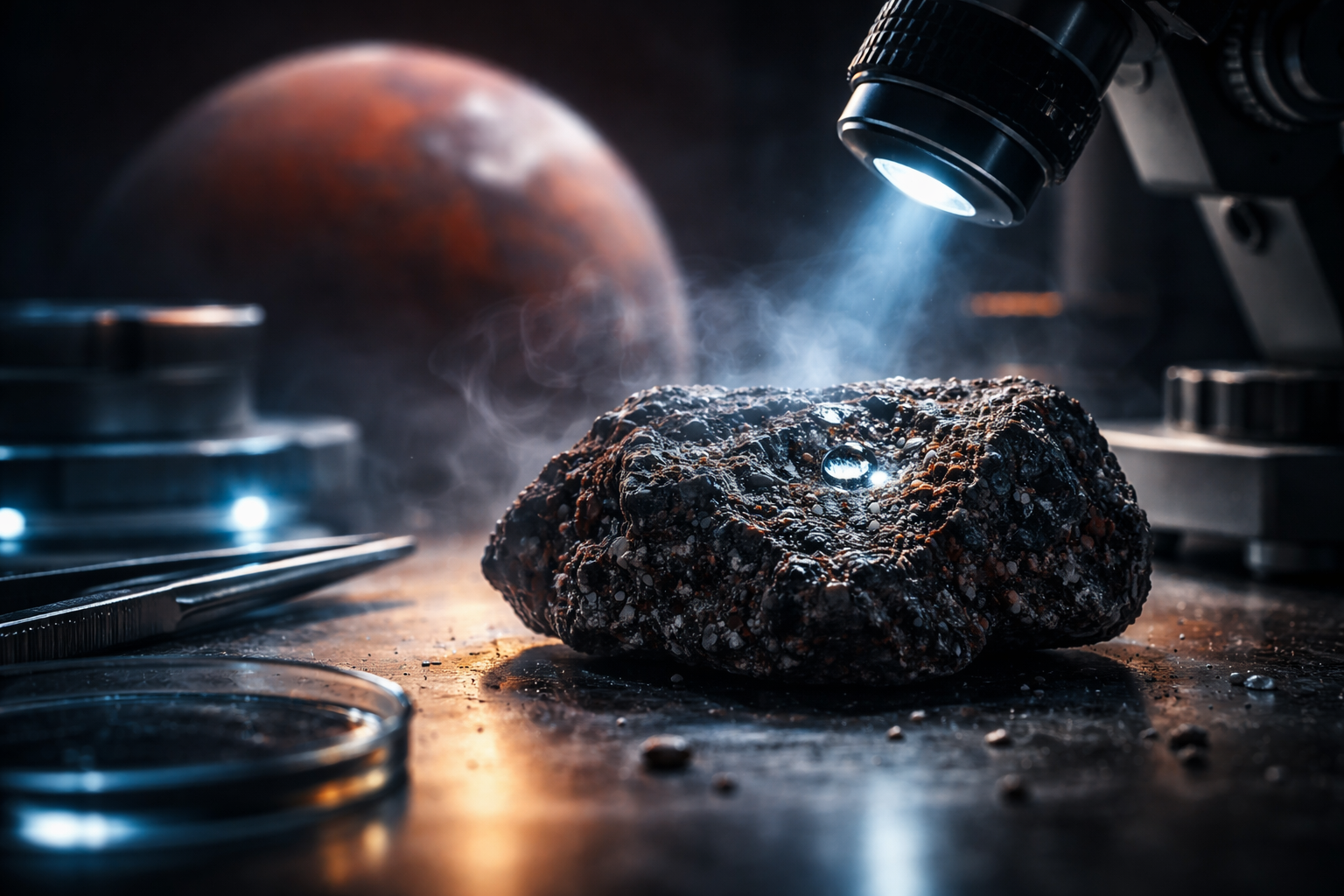
New scans find more hidden water-bearing minerals in the Black Beauty Mars meteorite. Here’s what “more water” really means—and what it changes now.
“Black Beauty” Mars Meteorite Shows More Hidden Water—Here’s What “More Water” Actually Means
The latest confirmed update is that new neutron and X-ray scanning of the famous Martian meteorite NWA 7034 (“Black Beauty”) has mapped hydrogen-bearing material across a larger chunk of the rock than earlier methods could manage. The headline takeaway—“more hidden water”—is accurate but easy to misread.
The real story is not puddles. It’s where the hydrogen sits, what minerals hold it, and what that implies about early Mars—and about how we should hunt for water (and life signals) going forward.
One sentence matters for the big picture: this work reframes “Mars water history” away from only rivers and lakes and toward quiet, widespread near-surface mineral reservoirs that can survive for billions of years.
The story turns on whether this hydrogen-rich mineral “water” is common in the Martian crust—or just unusually well preserved in Black Beauty.
Key Points
New imaging combines neutron computed tomography (good at spotting hydrogen) with X-ray tomography (good at mapping dense mineral structure), allowing nondestructive, 3D mapping of hydrous phases in a larger sample volume than typical lab tests.
The “more water” signal is largely tied to hydrogen-rich iron oxyhydroxides—think rust-like alteration minerals—rather than liquid water trapped in pores.
In the technical framing, much of the hydrogen is interpreted as structural OH (hydroxyl) inside minerals, not free H₂O sloshing around.
The research supports the idea that early Mars might have had water interacting with rocks near the surface, creating minerals that contain water, possibly forming a widespread area instead of just small wet places.
“More water” does not automatically mean “more habitable.” Habitability depends on liquid water availability, chemistry, energy sources, and stability over time, not just total hydrogen content.
Strategically, the result boosts the value of hydrogen-sensitive instruments (orbital mapping + rover/lander payloads) for picking sites where water history is preserved in minerals.
Background
Black Beauty (NWA 7034) is unusual among Martian meteorites because it is a regolith breccia—a mash-up of different rock fragments cemented together—rather than a single, clean igneous chunk. That matters because it can preserve multiple episodes of Martian history in one specimen.
For years, scientists have known this meteorite is relatively water-rich for a Martian rock, but measurements were constrained by a brutal tradeoff: the most direct lab techniques often require grinding, slicing, or chemically processing small pieces. You learn something—but you destroy the context.
The new approach leans on a simple physics advantage: neutrons “see” hydrogen extremely well compared with many traditional methods. Pairing neutron scans with X-ray scans helps researchers say not only how much hydrogen is there, but where it sits inside the rock and what mineral neighborhoods it lives in.
Analysis
The Measurement Trap Behind “More Water”
“More water” in this context usually means one of three things:
The rock genuinely contains more hydrogen-bearing material than earlier estimates.
earlier work sampled the “wrong” micro-areas and missed hydrogen hotspots, or
New methods are measuring a different definition of water (for example, OH in minerals vs. molecular H₂O).
This update leans heavily on (2) and (3). The main improvement is that we can now map the entire sample: rather than guessing the water content from a small, damaged piece, the scans reveal specific areas with a lot of hydrogen within a larger space, keeping the location in That can push estimates upward because you’re no longer averaging away the hotspots.
A realism check: even if the reported water-equivalent fraction sounds attention-grabbing, it is still a small fraction of the rock 's mass. The significance is less “there’s lots of water” and more “there’s a durable record of water–rock chemistry that was easier to miss than we thought.”
What “Water-Bearing Material” Actually Is
Most people hear “water in a rock” and imagine moisture in pores. Planetary geology usually means something else:
Hydrated minerals are those that incorporate water-related components into their structure.
Often that’s not H₂O molecules, but hydroxyl (OH) groups bound into the mineral lattice.
Iron oxyhydroxides are a classic example: they form when iron-bearing phases interact with water and oxygen under certain conditions. On Mars, that often points to alteration, not the storage of liquid.
So the “hidden water” is better understood as hydrogen locked in mineral chemistry—a record that water was present during formation or alteration.
The distinction between Bound Water, Hydrated Minerals, and "Habitability" is crucial.
Headlines tend to blur these terms, so here's a clear distinction:
1) Bound water (structural hydrogen / OH)
Hydrogen is chemically incorporated into a mineral’s structure (commonly as OH).
It is not free to flow. You can release it only by heating or altering the mineral.
It is a strong indicator of past water–rock interaction, and it can preserve that history for immense timescales.
2) Hydrated minerals
A broader category: minerals that contain water-related components (OH or sometimes H₂O) as part of their chemistry.
They can form in many settings: low-temperature alteration, hydrothermal systems, impact-driven processes, and weathering.
They serve as valuable guides for reconstructing ancient environments.
3) Habitability claims
Habitability is about whether an environment could support life, which usually requires:
liquid water availability (not just total hydrogen),
chemical gradients / energy sources (for metabolism),
Key elements include C, H, N, O, P, and S.
Time and stability (or repeated habitable episodes) are important factors to consider.
Hydrated minerals can help support the idea that a place could be habitable, but only if there is also proof of conditions that allow for liquid water and usable energy, such as temperature,
In other words, hydration is a clue, not a verdict.
Why This Travels: Mars + “Water” as Strategy, Not Trivia
Mars water stories spread because “water” is the gateway word for three different audiences at once:
Exploration strategy: where to land, what to drill, and which samples matter.
Human mission planning: water as a consumable resource (even if mineral-bound water is not immediately accessible).
Life-detection narrative: water as a prerequisite, even if not sufficient.
This update plugs directly into the exploration strategy because it reinforces the value of tools that can detect hydrogen in context—on Earth in meteorites and on Mars in rocks and regolith. If hydrated phases can be widespread near the surface, then “water history” may be preserved in more places than classic river-delta imagery alone would suggest.
What Most Coverage Misses
The hinge is that the breakthrough is as much about measurement geometry as it is about Mars.
The mechanism is straightforward: once you can non-destructively map hydrogen in 3D, you stop asking, “Does this tiny chip contain hydration?” and start asking, “How is hydration distributed across the whole rock, and what mineral textures host it?” That shift changes what counts as a meaningful sample and how confidently you can generalize from it.
Two signposts to watch next:
Independent teams should reproduce the hydrogen distribution patterns in other pieces of NWA 7034 and its paired stones, confirming the signal is intrinsic to the material, not an artifact of one sample slice.
Whether the same hydrogen-rich iron changes are found in Mars rover studies (especially where the minerals and textures are similar), supporting the idea that this is a common feature of Mars' crust instead of just a strange meteorite.
Why This Matters
In the short term, this finding sharpens how scientists interpret the phrase “Mars had water” because it emphasizes durable mineral records over dramatic surface scenes. That matters because durable records survive the planet’s later drying and radiation exposure better than many fragile organic clues.
Over the longer term, it influences exploration decisions because hydrogen mapping becomes a site-selection multiplier. If signs of water changes are common and can be identified, mission planners can focus on areas where the chemistry between water and rock is intact, as these areas are more likely to reveal clear environmental histories and possibly conditions that support life.
The main consequence is not that Mars was wetter.” It is that Mars may have stored its water story in minerals that are easy to overlook unless you use the right instruments, because hydrogen can hide in tiny phases and still carry planetary-scale implications.
Real-World Impact
A mission team debates landing sites: one site has photogenic ancient channels, and another has less dramatic terrain but stronger hydrogen/mineral signals. This work nudges the decision toward the quieter site because it could preserve chemistry better.
A lab curates a rare meteorite sample: instead of slicing off more material, researchers prioritize non-destructive scans first, preserving sample integrity while still finding hydrogen hotspots worth targeted follow-up.
A space policy budget meeting asks what “water on Mars” buys us. The answer becomes more concrete: not “maybe lakes,” but mappable mineral reservoirs and testable hypotheses about crustal water storage.
The New Question Black Beauty Forces on Mars Science
The headline is “more hidden water,” but the deeper question is sharper: how much of Mars’ water history is locked in mineral chemistry that doesn’t look like water at all?
If the answer is “a lot,” then exploration logic shifts. The best targets are not only the places that once looked wet from orbit, but also the places where water–rock interaction produced minerals that archive conditions—and can still be read today.
Watch for follow-up work that connects hydrogen maps to specific formation pathways: low-temperature alteration, hydrothermal circulation, or impact-driven processes. That is where “more water” stops being a headline and becomes a timeline—one that could redraw the search strategy for Mars’ most consequential evidence.
