James Webb Space Telescope Just Mapped the Universe’s Invisible Skeleton—and It’s Sharper Than Ever
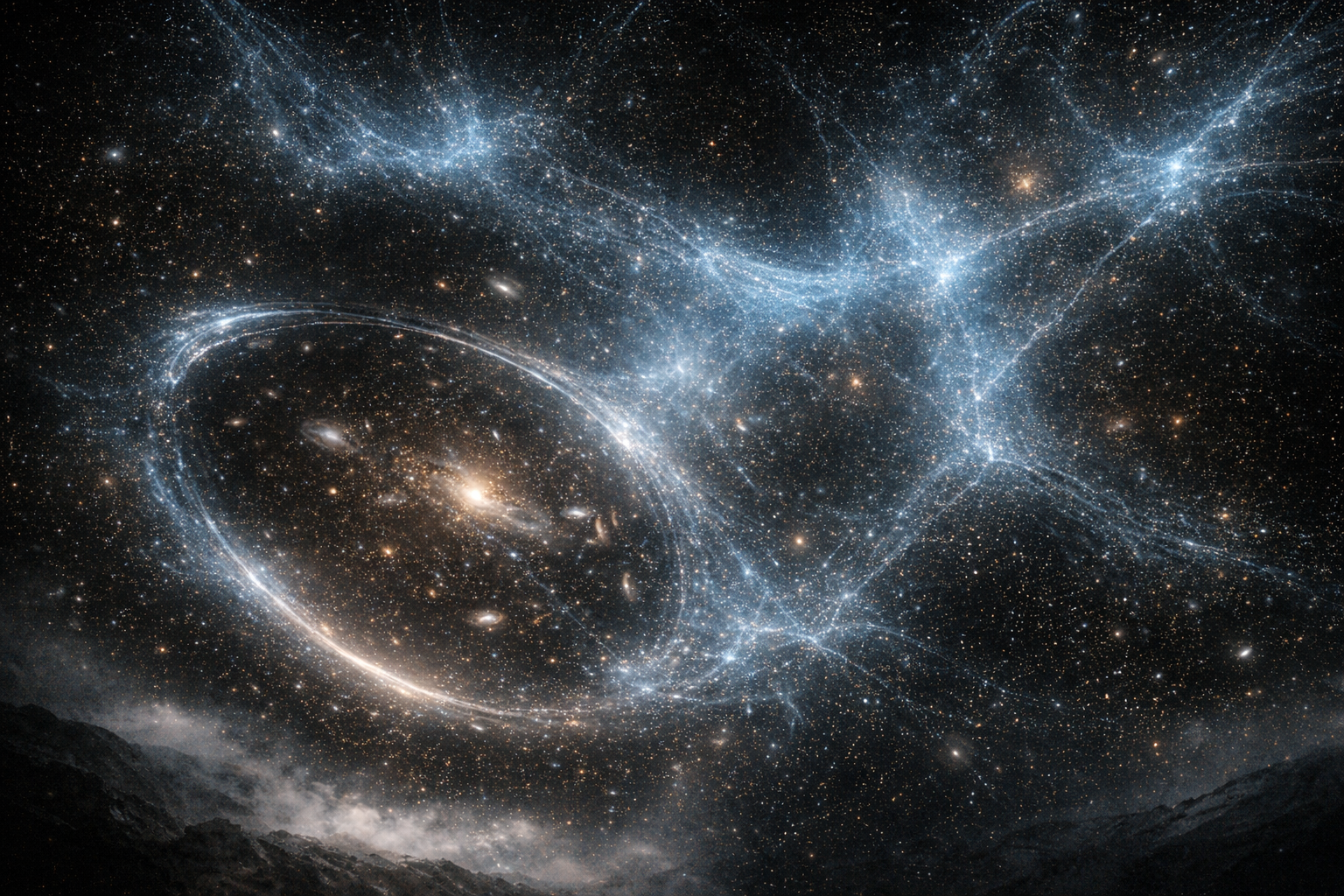
JWST has exposed the universe’s hidden framework.
The most recent update is a new, very detailed dark matter map created from images taken by the James Webb Space Telescope (JWST), which used gravitational lensing to study a large number of distant galaxies in the COSMOS-Web field. It’s a jump in both scale and sharpness: more background galaxies to measure and cleaner images to measure them with.
The headline presents a triumphant "we mapped the invisible." But the real story is more captivating. The map is not a pretty overlay. It’s a measurement tool that turns dark matter from a philosophical problem into a dataset you can stress-test against physics.
The story turns on whether better maps can separate “dark matter physics” from the messy behavior of ordinary matter and measurement noise.
Key Points
JWST data helped create one of the biggest and clearest weak-lensing mass maps so far by analyzing the slight shape changes of hundreds of thousands of galaxies in a well-known area of the sky.
The upgrade comes from source density (more usable background galaxies) and image quality (sharper shapes, more reliable distances), which together boost map resolution.
These maps trace the cosmic web—clusters, filaments, and under-dense regions—showing where mass sits even when light doesn’t.
The result strengthens the standard picture of dark matter as the universe’s gravitational backbone, while tightening the space for alternatives on certain scales.
What it doesn’t do: identify a dark matter particle, or “prove” one model. It refines where theories can hide, not whether the mystery exists.
The next step is comparison at scale: cross-checking with Euclid, Rubin-era surveys, and simulations to see whether small-scale structure matches cold dark matter expectations.
Background
Dark matter is “invisible” in the literal sense: it doesn’t emit, absorb, or reflect light in any detectable way. However, it still possesses gravity, which leaves traces.
One of the cleanest fingerprints is gravitational lensing. When light from distant galaxies passes through the gravity of intervening mass, spacetime bends and the galaxies appear slightly warped. For a single galaxy the effect is tiny—too small to trust. But with enormous samples, the average distortion becomes a reliable signal. That is weak gravitational lensing.
A weak-lensing “dark matter map” is really a mass map: it tracks the total projected matter (dark + ordinary) along the line of sight. In practice, dark matter dominates the budget, so the map is a powerful proxy for the invisible structure shaping galaxy formation.
For years, many telescopes have observed COSMOS, making it a famous deep field. JWST adds a new layer: deep, sharp infrared imaging over a wide patch, revealing faint, distant galaxies that older surveys could not measure well enough for lensing.
Analysis
Gravitational Lensing Basics, Without the Math
Weak lensing works because galaxies are not perfect circles. Their shapes are random. If you average enough of them, the randomness cancels out. What remains is a tiny, coherent “shear” pattern imprinted by intervening mass.
Think of it like reading wind direction by watching a single leaf (useless) versus a whole field of grass (suddenly obvious). Lensing maps turn that “field” into a picture of where gravity is strongest and, therefore, where matter is concentrated.
Two ingredients determine how useful your map can be:
How many usable background galaxies you can measure per patch of sky, and
How accurately you can measure their shapes and distances.
JWST improves both.
What JWST Adds: Source Density, Sharpness, and Distance Leverage
JWST’s infrared sensitivity sees fainter, more distant galaxies, especially at high redshift, where much of the earlier universe’s structure is still assembling. More galaxies per area means more statistical power and finer spatial detail.
Its sharp imaging also matters because weak lensing depends on tiny distortions. Blurry images smear shapes and inflate errors. Sharper imaging gives cleaner shape measurements and lowers the “shape noise” that limits map fidelity.
There’s a quieter upgrade too: distance estimation. To convert distortions into a mass map, you need to know roughly how far away the source galaxies are. JWST’s multi-band infrared data improves redshift estimates for many faint galaxies, which improves the lensing geometry and helps separate structures at different cosmic times.
What This Changes—and What It Doesn’t—About Dark Matter Theories
This new map strengthens a practical point: dark matter behaves like a smooth, dominant gravitational component on large scales, shaping the cosmic web in ways consistent with decades of cosmology. That part is not a surprise.
The real potential is on intermediate and small scales, where different dark matter candidates predict subtly different structures:
Cold dark matter (CDM) tends to form abundant small clumps and sharp density peaks.
Warm dark matter suppresses the smallest structures, smoothing the map at the low-mass end.
Self-interacting dark matter can soften inner density profiles in some environments, changing how mass is distributed in and around halos.
A higher-resolution weak-lensing map does not “pick a winner” by itself. But it tightens the range of structures that must appear if a model is correct.
What it does not do:
It doesn’t directly detect dark matter particles.
It doesn’t eliminate modified-gravity ideas on its own, because lensing responds to the geometry of gravity too.
It doesn’t fully disentangle dark matter from ordinary matter effects, because baryonic physics (gas cooling, star formation, and feedback from supernovae and black holes) can reshape matter distributions in ways that mimic or mask dark matter signatures.
The Measurement Trap: Why “Sharper Maps” Can Still Mislead
Weak lensing measures projected mass along a line of sight. That means two very different three-dimensional realities can look similar once flattened into a two-dimensional map.
There are also known degeneracies and systematics:
Line-of-sight mixing: multiple structures at different distances can stack into one apparent feature.
Calibration and selection effects: faint galaxies are harder to measure; if the usable sample shifts, the inferred mass can shift.
Baryonic contamination: the visible matter you can model is not always the visible matter you can measure perfectly.
So the headline “highest-resolution dark matter map” is true as a statement about data quality. But the physics payoff depends on how well researchers can isolate the lensing signal from these traps.
What Most Coverage Misses
The hinge is that the map’s real power is not the image—it’s the ability to compare the same mass structures against multiple surveys and simulations on the same patch of sky.
Mechanism: COSMOS is a calibration arena. JWST is pushing deeper, allowing different instruments with different biases to remeasure the same region. If they converge, you get a stronger, cleaner lensing-based constraint on structure growth. If they disagree, you learn where your systematics live—and that directly shapes what dark matter theories remain viable.
Signposts to watch:
Monitor whether independent analyses replicate the same small-scale features using different shear pipelines and redshift methods.
Whether combined comparisons with Euclid- and Rubin-era lensing over COSMOS tighten constraints on small-scale clustering beyond what any one survey can do alone.
What Changes Now
In the short term (weeks to months), the change is practical: this becomes a benchmark dataset for weak-lensing method testing and for simulation comparisons. This serves as a practical assessment of the "lumpiness" of the universe across various eras.
In the longer term (years), the stakes are bigger because lensing maps are one of the few ways to test dark matter without guessing its particle identity first. When different surveys find small-scale structures that don't match CDM predictions and baryonic effects can't explain them, we might finally understand dark matter better.
The key consequence is simple: better lensing maps tighten the link between cosmological theory and observed structure because they reduce statistical noise and extend measurements to earlier cosmic times.
Real-World Impact
A simulation team uses the map to validate a galaxy-formation model. Their prescribed feedback results in excessively smooth mass distributions, necessitating a reconsideration of the modeling of energy from stars and black holes.
A cosmology group cross-checks the JWST lensing signal against another survey in the same sky region. Agreement boosts confidence in dark energy constraints derived from structure growth.
An instrumentation pipeline spots a subtle measurement bias only visible at JWST’s depth. Fixing it improves lensing analyses across future missions, not just this one.
A theory group tests a warm dark matter scenario. The map doesn’t “confirm” it, but it narrows the parameters to a smaller, testable corner.
The Next Map Is the Real Story
The JWST result is a milestone, but it also reads like a preview. The coming era is not about one perfect map. It’s about stacking maps, cross-validating them, and forcing theories to survive contact with multiple instruments, multiple pipelines, and multiple cosmic epochs.
If the universe’s invisible scaffolding keeps matching cold dark matter on every scale we can measure, the mystery shifts toward particle detection. If it doesn’t, the maps become the first clear sign that dark matter is not just “missing mass,” but a new physical behavior hiding in the structure of space itself.
The historical significance of this moment is that dark matter is being pushed from inference-by-anecdote toward inference-by-cartography—and that is where physics gets ruthless.
