A Meteor Just Exploded Over Massachusetts With 300 Tons Of TNT Force — And The Real Warning Is Bigger Than The Boom
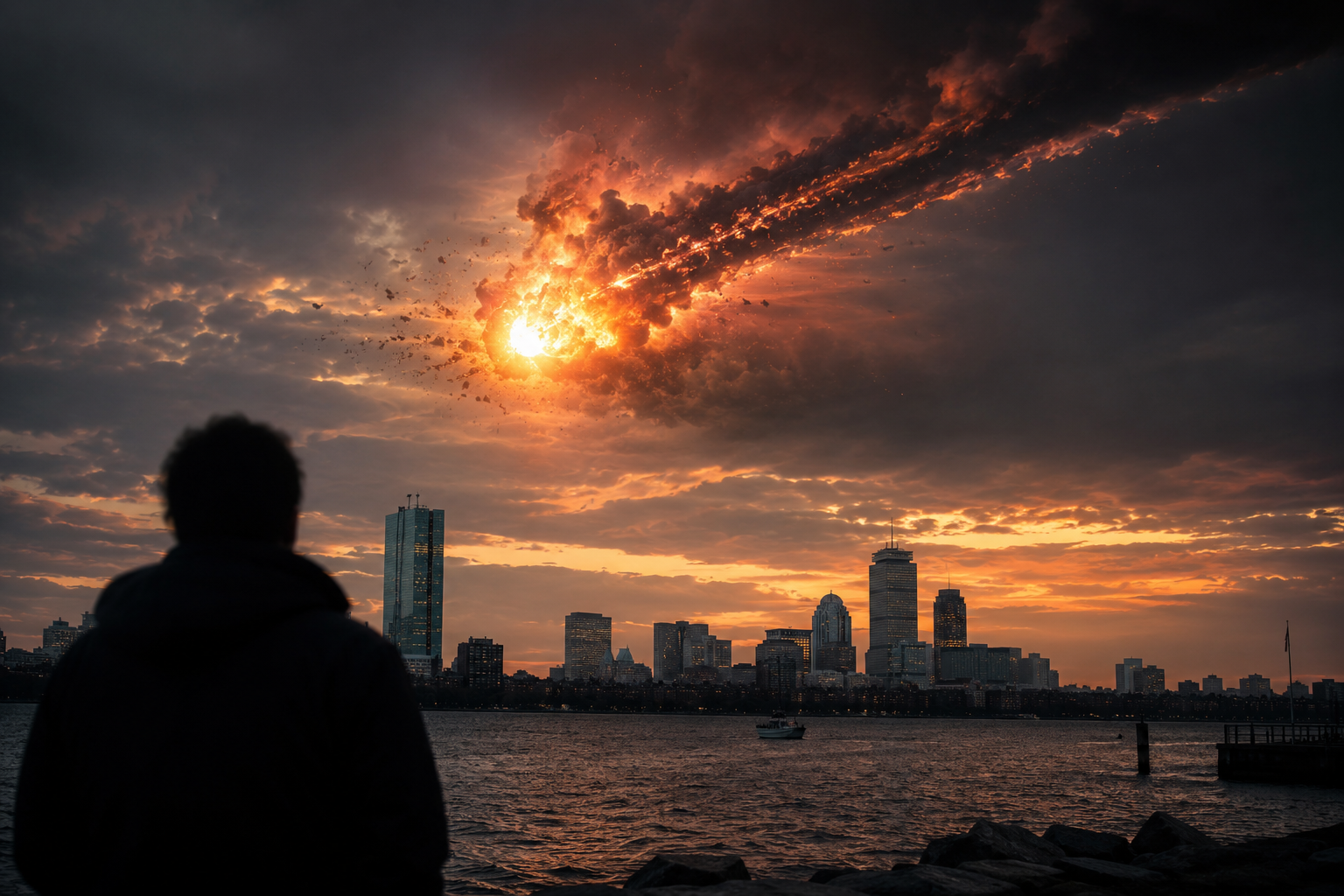
Massachusetts Was Shaken By A Meteor Blast — And It Exposed How Fragile The Sky Above Us Really Is
The Boom Was Not An Earthquake
For a few moments, people across parts of Massachusetts, New Hampshire, Rhode Island, and the wider New England region were left asking the same basic question: what just happened? Homes shook, windows rattled, and reports of a loud boom spread quickly before officials and monitoring systems began pointing toward the real cause: a meteor exploding high in the atmosphere.
The confirmed detail is dramatic enough without exaggeration. A natural space object entered Earth’s atmosphere at roughly 75,000 miles per hour and broke apart around 40 miles above the ground, releasing energy estimated at about 300 tons of TNT. The object was not connected to an active meteor shower, and it was not identified as satellite debris or a human-made re-entry event.
A Small Object Created A Massive Human Reaction
The meteor itself appears to have been small by asteroid standards, with reports placing it around three feet across. That is the unsettling part. Something small enough to sound almost harmless still produced a blast powerful enough to be heard and felt across a populated region.
This is the strange violence of atmospheric entry. Earth’s atmosphere protects life every day by burning up debris before it reaches the ground, but that protection can look and sound like an explosion when speed, pressure, and fragmentation collide. A rock from space does not need to hit a city to make people feel suddenly exposed.
The Real Story Is Earth’s Blind Spot
The Massachusetts meteor matters because it sits in the uncomfortable space between spectacle and warning. It was not a mass-casualty event. It was not a civilization-threatening asteroid. But it was a reminder that Earth is constantly moving through a field of natural debris, and most people only think about that reality when the sky flashes or the ground shakes.
That is why this belongs in the same wider conversation as Taylor Tailored’s analysis of the new space race and geopolitics. Space is no longer just a place for rockets, satellites, billionaires, and national prestige. It is an operating environment that touches communications, defense, science, infrastructure, and public safety.
The Atmosphere Saved The Ground
The most important fact is also the most reassuring. The meteor broke apart high above the surface, and current reporting suggests it likely disintegrated or fell into the ocean rather than striking land. That does not make the event meaningless. It means the planet’s natural shield did its job.
But protection is not the same as control. The atmosphere absorbs, burns, slows, fragments, and deflects countless objects. It does not ask permission, issue alerts to every resident, or remove the psychological shock of hearing a blast with no obvious source. For ordinary people, the event arrived first as confusion, then fear, then explanation.
Science Turns Panic Into Pattern
The reason the story did not remain a mystery is that modern detection systems could piece it together. Eyewitness reports, satellite observations, seismic-style readings, and official monitoring helped turn scattered public alarm into a coherent picture of a bolide: a bright meteor that explodes in the atmosphere.
That is where the story becomes more than a viral sky event. Scientific infrastructure matters most when ordinary senses fail. People heard a boom and felt shaking, but instruments helped distinguish a meteor from an earthquake, explosion, storm, or aircraft event. Taylor Tailored has explored the wider importance of scientific capability in the hidden crisis behind scientific decline, and this incident shows why that capability is not abstract. It is the difference between public confusion and public understanding.
The Chelyabinsk Shadow Still Hangs Over Every Fireball
Every modern meteor airburst carries an unavoidable comparison: Chelyabinsk. In 2013, a much larger fireball exploded over Russia, damaging buildings and injuring more than 1,600 people, mostly through shattered glass. The Massachusetts event was far smaller, but the psychological pattern is similar: a normal day, a sudden flash, a boom, and then the realization that the threat came from above.
That does not mean this event should be treated as a near-disaster. It should be treated as a useful warning. The dangerous objects are not always the giant planet-killers of science fiction. Sometimes the more realistic risk is a smaller airburst over the wrong place, at the wrong height, with enough force to damage windows, trigger panic, or strain emergency systems.
The Future Risk Is Not Just Impact
The real modern challenge is not simply whether a meteor hits the ground. It is whether societies can detect, interpret, communicate, and respond quickly when unusual events happen in the sky. In an age of drones, satellites, military systems, space debris, hypersonic weapons, and natural bolides, the public no longer experiences the sky as a quiet background.
This connects with the broader Taylor Tailored theme of technology moving faster than institutions, explored in AI moving faster than law. Different subject, same pressure: capability, risk, and public understanding are no longer moving at the same speed. When the unknown arrives suddenly, institutions have to close the gap fast.
The Sky Is Not Empty
The Massachusetts meteor was not the end of the world. That is exactly why it is useful. It was dramatic enough to seize attention, but limited enough to study calmly. It gave people the feeling of cosmic vulnerability without the catastrophe.
That is the deeper meaning of the boom. The sky above modern life can look stable, familiar, and safe until one object moving at impossible speed reminds everyone that Earth is not sealed off from the universe. Most days, the atmosphere wins quietly. This time, it won loudly.
