

Ancient Teeth May Reveal Humanity’s Earliest Habitual Drug Use
How Researchers Tested An Ancient Drug-Use
Ancient Teeth, Chemical Traces And An Ice Age Question
Unusual tooth wear and chemical traces from Indonesian remains suggest repeated use of a psychoactive plant long before farming.
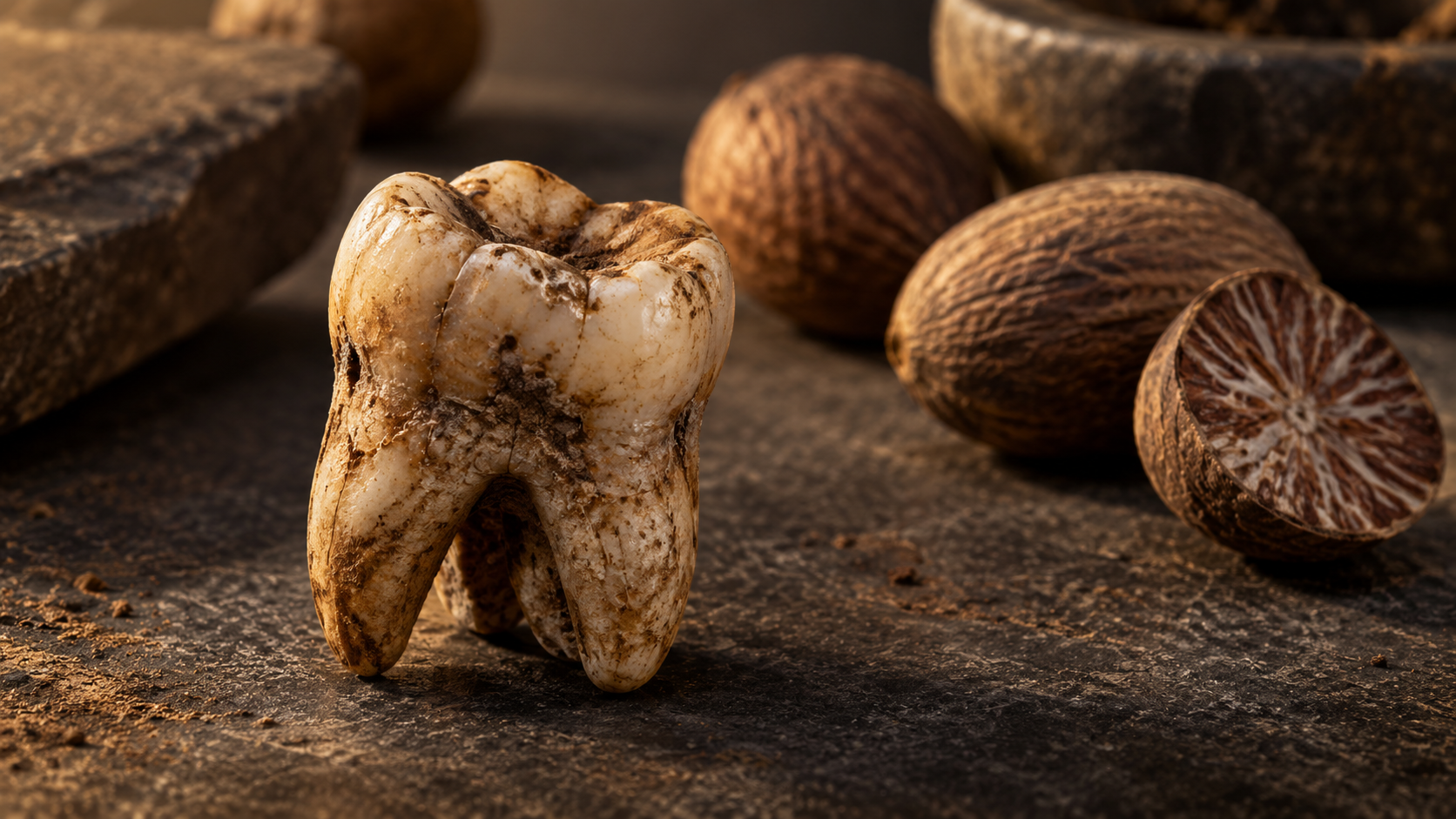
Ancient teeth from the Indonesian island of Sulawesi may preserve evidence of one of humanity’s oldest recurring drug habits. Researchers have linked distinctive dental wear with traces of arecoline, a psychoactive compound associated with betel nut.
The study, published in Science Advances, argues for repeated sucking of the nuts by prehistoric foragers. One individual falls within an estimated range of 25,000 to 16,000 years ago; a second dates to approximately 7,600 to 6,300 years ago, according to Griffith University’s account of the research.
That makes “up to 25,000 years ago” the careful formulation. The older individual has not simply been dated to one exact year, and evidence of a habit does not reveal everything about why it began.
What The Teeth Preserve
The research combines two kinds of evidence: a physical pattern and a chemical signal. Deep, rounded wear suggested repeated contact with a hard object, while biochemical analysis identified arecoline in dental tissues.
The combination matters because neither strand needs to carry the entire interpretation alone. Tooth wear can indicate repeated behaviour, but identifying the object responsible is a further step. A chemical trace can support contact with a substance, but frequency and method require additional reasoning.
The researchers’ argument brings the two together. Their proposed explanation is habitual betel-nut sucking rather than assuming that the prehistoric practice was identical to modern chewing preparations.
This is a useful example of how archaeology reconstructs behaviour indirectly. It asks whether several traces fit one explanation, what alternatives remain possible and how much detail the surviving evidence can support.
Why The Laboratory Work Matters
The study also examined whether whole nuts could release biologically active compounds without the preparation associated with many modern forms of use. Experiments described by the researchers involved artificial saliva and receptor testing.
Those tests support the plausibility of a physiological effect from sucking intact nuts. They do not reproduce an ancient person’s subjective experience or tell us exactly how much was consumed on a particular day.
That distinction prevents a familiar reporting leap. Establishing a mechanism is not the same as reconstructing every aspect of the behaviour. The experimental result helps explain how the archaeological interpretation could work; it does not turn the remains into a complete diary.
The paper’s strongest contribution is the connection between physical evidence and a testable mechanism. That is more informative than simply announcing that prehistoric people were “getting high”.
Habitual Use Does Not Tell Us The Whole Motive
The research team proposes that relief from tooth pain may have been part of the explanation. It also describes how repeated contact with hard seeds could worsen dental damage, creating the possibility of a harmful cycle.
Pain relief remains an interpretation rather than a recorded statement from the individuals. Other motivations cannot be reconstructed with confidence from a small number of remains.
It would therefore be misleading to label the people recreational users, patients or addicts as though those modern categories had been directly established. Repetition is evidence about behaviour. A diagnosis, social role or private intention requires more.
The distinction makes the discovery more human, not less interesting. People in the deep past had bodies, discomforts and practical knowledge, but the available evidence gives only a partial view of how those experiences shaped their choices.
Earliest Evidence Is Not The First Time It Happened
A claim about the earliest surviving evidence is a claim about the archaeological record. It cannot establish that nobody elsewhere used a psychoactive substance at an earlier date.
Preservation is selective. Practices involving materials that disappear easily can be much harder to identify than activities leaving durable objects or distinctive traces. Discovery also depends on where researchers look and which methods are available.
This is why an apparently dramatic change in the timeline should not be read as a sudden invention by one known person or community. The study can push back the documented evidence without locating the original beginning.
The same principle applies across archaeology: the oldest identified example gives us a boundary in current knowledge, not necessarily the first occurrence in human life.
What A Small Sample Can And Cannot Change
Two individuals cannot establish how common the behaviour was across an island, a period or humanity as a whole. They can nevertheless provide evidence that a behaviour existed earlier than previously documented.
Those are different kinds of claim. A small sample may support an important historical finding while remaining inadequate for estimates of prevalence, social meaning or regional spread.
Further remains, independent replication and comparable analyses from other sites would help test the interpretation and reveal how widely the pattern occurred. An absence of matching evidence elsewhere would also need to be considered alongside differences in preservation and sampling.
The discovery’s appeal is that teeth can retain a trace of repeated action long after the surrounding life has disappeared. Its scientific importance lies in how carefully that trace is connected to a substance, a mechanism and a date range. The evidence may extend the history of habitual drug use deep into the Ice Age, while leaving the people’s motives partly beyond reach.
