

Sleep Paralysis: Why You Wake Up Unable To Move
Between Sleep And Waking
Awake But Unable To Move: The Science Of Sleep Paralysis
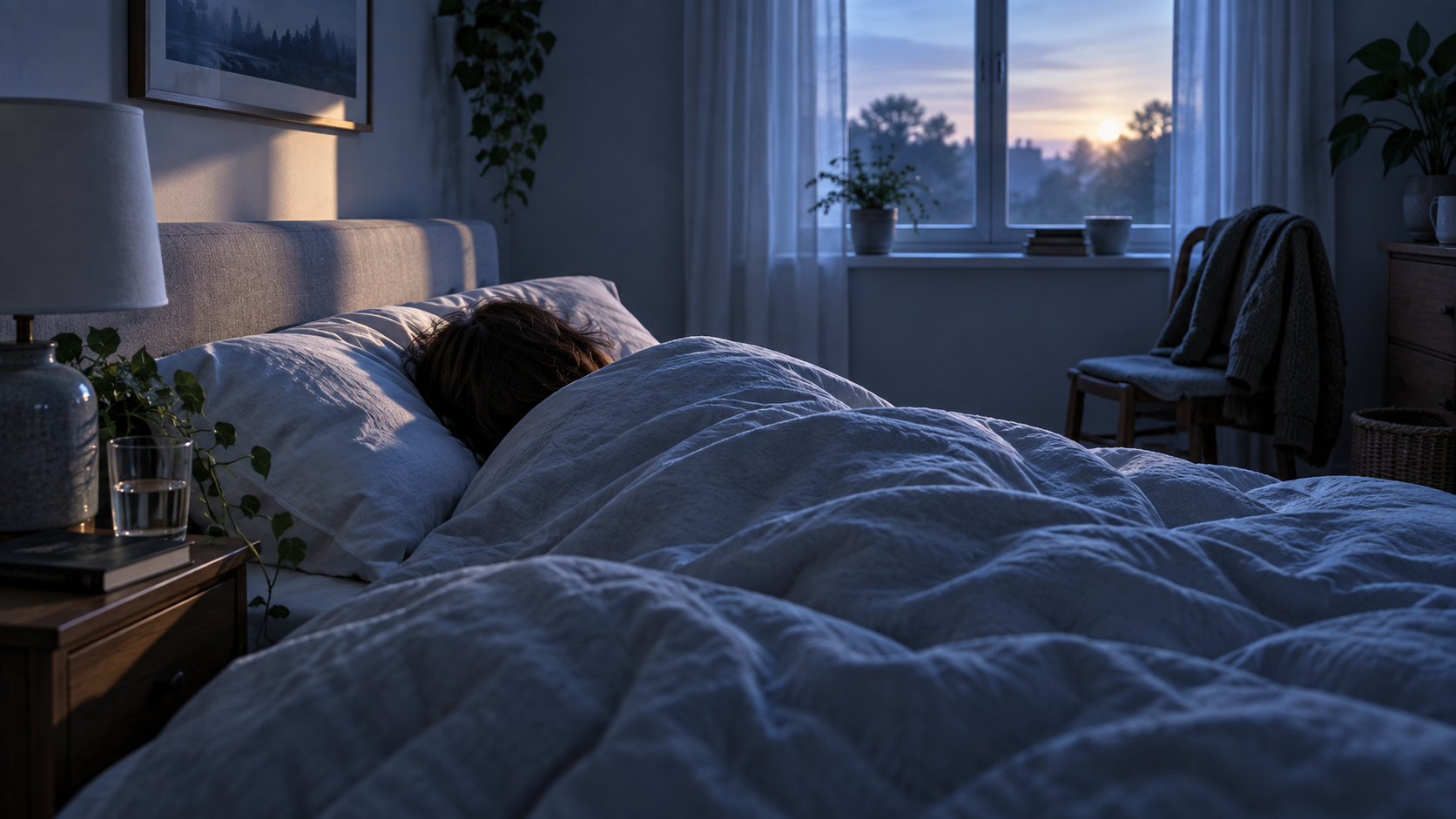
Sleep paralysis can leave you aware of your bedroom while movement remains temporarily unavailable, making an ordinary sleep transition feel extraordinary.
You recognise the room. You want to turn over or call out, but your body does not respond. Sometimes there is another sensation: someone seems to be nearby, although nobody is there.
Sleep paralysis describes temporary difficulty moving or speaking as you fall asleep or wake. It is associated with features of rapid eye movement sleep, or REM, persisting alongside awareness. The experience can be frightening, but an episode does not establish that an intruder was present or that you have a serious neurological illness.
The useful question is how awareness, movement and perception can briefly get out of step. That question leads to a more interesting explanation than a supernatural visitor: waking up is a transition involving several processes, rather than a single switch that changes everything at once.
What Is Happening When You Cannot Move?
During REM sleep, the nervous system strongly suppresses much skeletal-muscle activity. This reduction in muscle tone is called atonia. In sleep paralysis, awareness can return or persist while this restriction on voluntary movement remains.
The person therefore encounters an unusual combination: enough awareness to recognise the situation, but insufficient control to make the expected response. Researchers describe this as a dissociation between aspects of REM sleep and waking. That wording does not mean the mind has left the body; it describes normally coordinated features appearing together in an unusual way.
Dream-like perceptions may accompany the episode. Some people report a figure, sound, touch or overwhelming sense of presence. Others experience immobility without an elaborate hallucination. A dramatic account is one possible presentation, not a compulsory script that every episode follows.
Research on dreams, sleep and memory raises a related distinction: what a person experiences and what a physiological measurement records are connected, but they are different kinds of evidence.
Why Does It Feel As Though Someone Is There?
The sensed intruder is especially unsettling because the room appears familiar. A strange experience taking place in an obviously fantastical dream can be dismissed on waking. A threatening presence apparently occupying your actual bedroom is harder to place.
Baland Jalal’s theoretical work proposes that threat interpretation, bodily sensations and attempts to move can contribute to an escalating cycle of fear. This is a proposed explanation of how distress develops, not a complete experimental account of every hallucination.
Consider the distinction between two statements: “I experienced a presence” and “someone entered the room”. The first reports an experience. The second identifies an external cause. A powerful experience can support the first statement without independently establishing the second.
That distinction allows a respectful response. Telling someone that nothing happened can sound as though their fear is being denied. Something did happen: they experienced immobility, awareness and perhaps a vivid perception. The uncertainty concerns what produced the perception, not whether the person was frightened.
What The Timing Can Tell You
Sleep paralysis occurs around falling asleep or waking. Clinicians sometimes use “hypnagogic” for experiences at sleep onset and “hypnopompic” for those associated with awakening. The terminology describes timing rather than severity.
Cleveland Clinic explains that breathing continues during sleep paralysis, even when a person feels pressure or suffocation. Episodes are generally brief, although subjective duration can vary. An experience that feels prolonged should be described honestly without assuming that fear provides a reliable stopwatch.
The timing also helps distinguish this phenomenon from an ordinary nightmare. A nightmare is a frightening dream; sleep paralysis includes the characteristic inability to move around the transition into or out of sleep. Having one does not mean every disturbing night-time experience belongs to the same category.
For a useful account afterwards, start with the sequence. Were you falling asleep or waking? What could you perceive? When did movement return? These questions describe the episode more precisely than immediately deciding what the figure or sensation “meant”.
Sleep Paralysis Does Not Automatically Mean Narcolepsy
The NHS lists sleep paralysis among experiences that can occur in narcolepsy, a condition involving difficulty regulating sleep and wakefulness. Narcolepsy can include excessive daytime sleepiness and, in some people, cataplexy: sudden muscle weakness associated with emotions.
But a symptom can occur in a condition without being sufficient to identify that condition. Sleep paralysis also occurs outside narcolepsy. The inference cannot be reversed simply because an online list places the two terms beside each other.
A clinician considers the wider pattern. Someone describing a single episode after a disrupted night presents a different history from someone describing repeated episodes alongside persistent daytime sleepiness. That does not settle either person’s diagnosis; it explains why the context matters.
Searching a symptom can make a rare explanation feel disproportionately prominent because search results organise information around conditions. A more useful question is which additional observations would distinguish the possibilities, rather than which diagnosis has the most memorable description.
Why Frequency Estimates Differ
You may encounter different figures for how many people experience sleep paralysis. Before choosing a number, ask what was counted: any lifetime episode, episodes during a recent period, or recurrent episodes that cause distress.
The populations matter too. Research involving a sleep clinic cannot automatically represent everyone. A volunteer survey about unusual experiences may recruit differently from a general-population sample. A narrow definition can also produce a different estimate from a broad question about waking without movement.
This article therefore does not turn one headline percentage into your personal likelihood of experiencing another episode. Differences in measurement can explain some disagreement without making every study useless.
The same principle applies when reading comments beneath a video. A thread can reveal experiences worth investigating, but the people motivated to comment do not form a random sample. Hundreds of striking accounts demonstrate that people are discussing the experience; they do not establish how common each symptom is.
Sleep Disruption Is A Clue, Not A Complete Explanation
The NHS associates sleep paralysis with disrupted sleeping patterns and several sleep or mental-health conditions. Its practical guidance includes maintaining regular sleep times and an adequate opportunity for sleep. It also notes that sleeping on the back can make episodes more likely.
These are useful starting points, not a guarantee that changing one habit will prevent every episode. Shift work, caring responsibilities and illness can make a stable routine difficult. An explanation should not quietly become an accusation that a person caused their own symptoms.
Taylor Tailored’s guide to sleep debt and recovery explains why hours in bed, actual sleep and feeling recovered are different measures. That distinction is useful when describing disrupted nights.
A short record can separate observations from impressions: approximate sleep times, whether an episode occurred, its timing and any daytime impact. It need not contain a minute-by-minute reconstruction. Its value is in identifying a pattern that is difficult to recall accurately across several weeks.
What The Small Treatment Study Actually Found
A 2020 pilot study by Jalal and colleagues enrolled ten patients with narcolepsy and sleep paralysis. Six received meditation-relaxation therapy and four received a breathing-based comparison intervention. Participants recorded episodes before and during treatment.
The therapy group reported fewer episodes in the final month than at baseline. However, the study was small and open-label, and the groups differed in episode frequency before treatment. It provided preliminary evidence, rather than proof of a reliable cure for everyone who experiences isolated sleep paralysis.
The distinction matters when a treatment becomes a social-media headline. A promising observation justifies better testing. It does not identify which individual will benefit, establish the size of a lasting effect or show that the same result will occur outside the studied population.
Useful follow-up research would need larger samples, appropriate comparison groups and outcomes that include distress as well as frequency. Having fewer episodes and feeling less frightened by them are both meaningful possibilities, but they answer different questions.
What Is Worth Doing After An Episode?
Allow time to recognise that the episode has passed. A frightening perception does not require an immediate elaborate interpretation. Separating “what I felt” from “what I think caused it” can make the account clearer without diminishing its emotional force.
The NHS recommends speaking to a GP if episodes happen often and leave you anxious about sleeping or persistently tired from insufficient sleep. That is a proportionate reason to seek help: the repeated disruption and distress deserve attention even when an individual episode is harmless.
There is no reason to change prescribed medication on the basis of a general explainer. If medication, another sleep condition or a recurring pattern seems relevant, that belongs in a clinical conversation. A symptom diary can support that conversation; it cannot replace it.
Most of all, the experience does not oblige you to adopt the most frightening explanation available. Sleep paralysis shows that awareness, movement and perception can briefly form an unfamiliar combination. Understanding that combination gives the event a name without pretending that every detail of sleep has been solved.
