Time In Bed Is Not The Same As Sleep
Can A Weekend Lie-In Repay Your Sleep Debt?
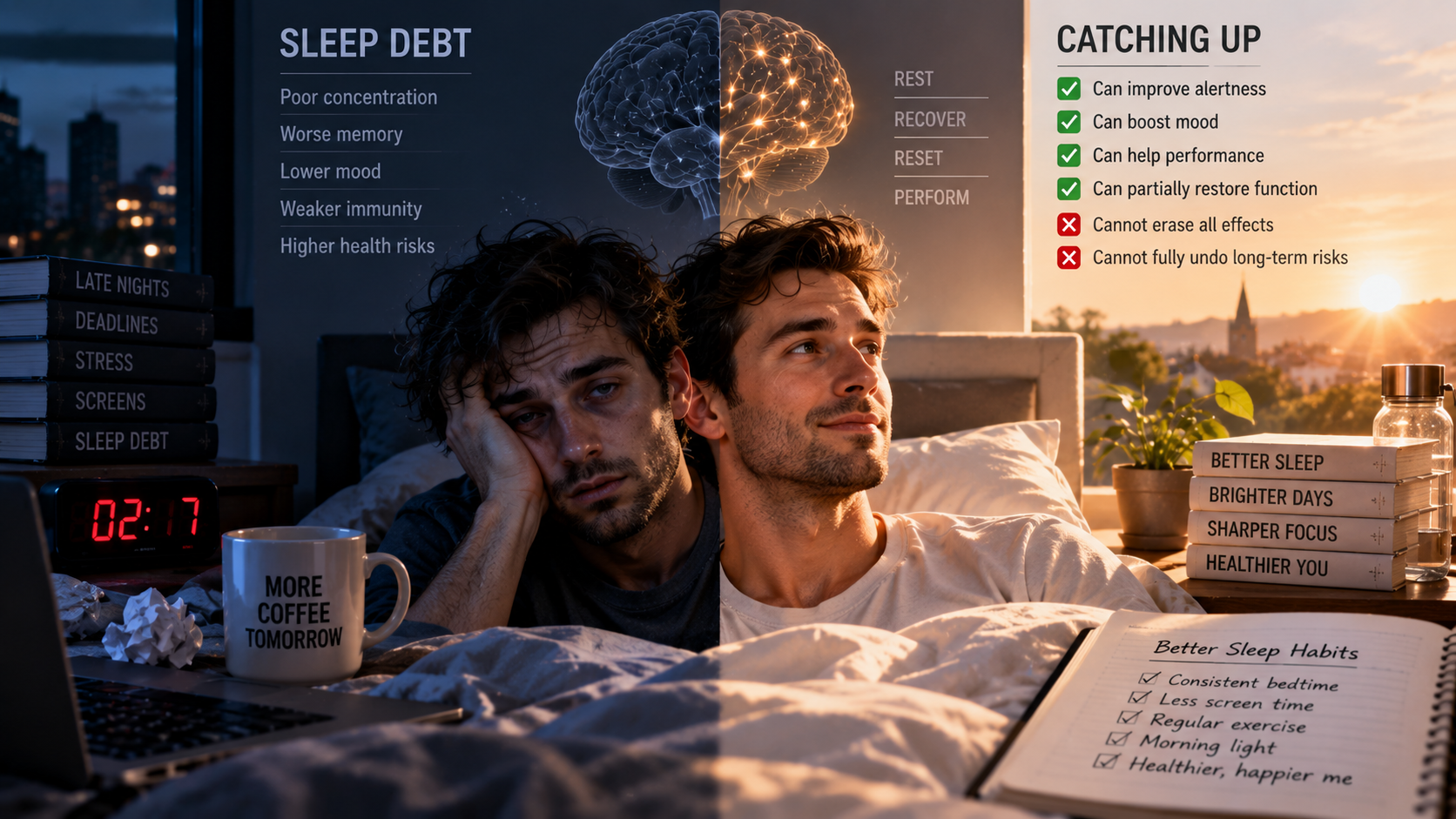
Extra sleep can help after lost sleep, but a weekend lie-in should not be treated as a guaranteed reset for repeated restriction.
Sleep debt describes accumulated sleep loss relative to what a person needs. Extra sleep can help recovery, but there is no reliable universal rule that every lost hour is repaid by one extra hour later.
Different outcomes can recover at different rates. Feeling less sleepy, performing normally on a task and reversing a measured physiological change are not the same endpoint.
The practical conclusion is to protect adequate sleep regularly where possible, while recognising that recovery sleep is worthwhile without treating it as permission to repeat a harmful pattern.
What The Debt Metaphor Explains
The National Heart, Lung, and Blood Institute describes sleep debt as sleep loss that accumulates when someone repeatedly sleeps less than needed. The metaphor communicates an important idea: one short night and a recurring pattern are different situations.
It becomes less useful when treated as a bank account with an exact balance. Most people do not know their individual requirement to the minute, and sleep quality and timing also matter.
An arithmetic estimate can reveal that a schedule leaves too little opportunity for sleep. It cannot diagnose the cause of tiredness or prescribe an exact repayment plan.
Use the number as a prompt to examine the pattern, not as a precise biological measurement.
Time In Bed Is Not The Same As Sleep
A person can spend eight hours in bed while sleeping substantially less. Awakenings, difficulty falling asleep and disrupted breathing can affect the night.
Equally, a consumer device’s estimate is not identical to a clinical sleep assessment. It may be useful for noticing patterns, but its output needs appropriate interpretation.
Before calculating a deficit, distinguish bedtime, estimated sleep time, waking time and how rested you feel. Those observations can help explain the problem more clearly.
They do not establish a diagnosis on their own. Persistent problems may require assessment beyond changing a schedule.
Can You Catch Up After A Short Night?
Additional sleep can help after sleep loss. The misleading leap is to assume that feeling better establishes complete recovery in every respect.
The effect depends on how much sleep was lost, how long the restriction continued and what outcome is measured. A study of attention after one short night cannot automatically settle recovery from weeks of restricted sleep.
Avoid absolute headlines in either direction. “You can never catch up” is too broad; “a weekend reverses sleep deprivation” is also too broad.
The evidence is more useful when the conditions and measured outcomes are stated.
What The Weekend-Recovery Study Found
A 2019 laboratory study discussed by the US National Institutes of Health examined a repeating pattern of insufficient sleep and weekend recovery opportunities. Weekend recovery did not prevent the measured metabolic disruption when restricted sleep resumed.
That finding is relevant to the idea of repeatedly borrowing sleep during the week and cancelling the effects at weekends. It is not evidence that extra sleep has no benefits or that the study measured every possible long-term health outcome.
Laboratory designs control conditions but simplify everyday life. Observational studies can examine longer periods, yet face confounding because people with different sleep patterns may differ in many other ways.
The strongest conclusion stays close to the design: the tested recovery pattern did not provide a complete metabolic reset under those conditions.
Why Feeling Better Is Not The Whole Test
Subjective sleepiness is important, but it is not the only outcome. Research can also examine sustained attention, response speed, memory or physiological measures.
A person may notice improvement in one area before another has fully recovered. That is one reason an exact personal recovery deadline cannot be inferred from a general article.
It also means that confidence in being alert should not be the sole basis for a safety-sensitive decision. If you are sleepy, avoid driving or operating dangerous equipment until it is safe.
This is a practical consequence of impairment, not a reason to become anxious about every imperfect night.
Timing Can Complicate Catch-Up Sleep
Sleeping much later on days off can alter the relationship between sleep and the body’s daily rhythm. The NHLBI notes that extra sleep may help someone feel better while a shifted schedule can also disrupt the sleep–wake pattern.
That creates a practical tension for people whose weekday schedule leaves too little sleep. The longer-term solution may involve increasing sleep opportunity, not merely moving the deficit between different days.
For shift workers and caregivers, control can be limited. Advice should acknowledge those constraints rather than assume everyone can choose an ideal timetable.
A workable change may be gradual and depend on support, work arrangements or assessment of an underlying problem.
What Naps Can And Cannot Do
Naps can provide a short-term improvement in alertness. They do not automatically supply every benefit associated with adequate night-time sleep.
Their usefulness also depends on timing, length and the person’s circumstances. A generic article should not prescribe one schedule for every reader.
If napping regularly reflects overwhelming daytime sleepiness, consider the wider pattern instead of treating the nap as the complete solution.
The question is why sleepiness is occurring and whether there is enough good-quality sleep overall.
A Simple Schedule Example
Suppose someone estimates they need eight hours but usually obtains six and a half on five work nights. The arithmetic shortfall is seven and a half hours over those nights.
That calculation is illustrative. It does not establish that sleeping seven and a half extra hours at the weekend would restore every affected function, nor that eight hours is this person’s exact requirement.
Its practical value is showing that the schedule creates a repeated mismatch. Adding a realistic amount of sleep opportunity on work nights may address the pattern more directly than relying only on a large weekend correction.
Whether that change is feasible depends on the cause: workload, habits, caring, insomnia or another factor.
When More Time In Bed Is Not Enough
If someone regularly has adequate opportunity for sleep but remains unrefreshed, the explanation may not simply be an unpaid sleep debt. Sleep disorders, health conditions and medicines can contribute to sleep problems.
Persistent daytime sleepiness, loud snoring with breathing interruptions, or ongoing difficulty sleeping are reasons to discuss the pattern with a clinician. This article cannot determine the cause.
Do not change prescribed medication or abandon treatment for a sleep disorder on the basis of a recovery-sleep headline.
Taylor Tailored’s overview of ways to improve sleep provides general background, while individual problems require attention to their own circumstances.
Reading Sleep Research Carefully
Sleep restriction
Question To Ask: How much, and for how long?
Recovery opportunity
Question To Ask: How many nights and under what conditions?
Participants
Question To Ask: How similar are they to the intended audience?
Outcome
Question To Ask: Sleepiness, performance or a health marker?
Design
Question To Ask: Controlled experiment or observational association?
These details explain why studies that sound contradictory may actually be answering different questions.
Recovery Headlines Often Measure Different Things
One study may report an association between weekend sleep and a health outcome over years. Another may measure a laboratory marker after a controlled period of restricted sleep. Their conclusions cannot be compared by the word recovery alone.
The observational study may capture ordinary behaviour but be affected by differences in work, health or other habits. The laboratory study can control more conditions but may involve a narrower group and a shorter period.
Ask whether the article describes the actual outcome or substitutes a broader claim such as reversing harm. A change in one marker is not automatically a measurement of overall health.
This is why a balanced explainer can recognise benefits from additional sleep while rejecting a claim that one pattern eliminates every consequence of repeated restriction.
A Useful Record For A Consultation
If sleep problems persist, a brief record of bedtimes, estimated sleep, awakenings and daytime sleepiness can help describe the pattern. Include work schedules and other relevant circumstances without assuming they establish the cause.
The purpose is communication, not self-diagnosis. A record can reveal that adequate time is available but sleep remains disrupted, or that the schedule regularly leaves too little opportunity.
That distinction affects what needs assessment. Simply extending time in bed may not address an underlying sleep disorder, while a schedule problem may require practical changes beyond a sleep-tip list.
Avoid turning the record into a demand for perfect numbers. Estimates can be useful when clearly labelled. The aim is to understand a recurring difficulty and its effect on daily life.
Sleep research offers useful general principles, but an individual’s recovery depends on circumstances that a general article cannot measure. That is a reason for appropriate assessment when needed, not for assuming that every bad night requires intervention.
A More Useful Recovery Goal
Aim to improve the ongoing pattern rather than calculate a perfect repayment date. Notice whether sleep opportunity, timing and daytime functioning are improving, and seek assessment when problems persist.
One poor night does not establish lasting harm. Repeated restriction should not be dismissed because a weekend feels restorative.
Recovery is possible, but the evidence does not support treating sleep as an account that can be overdrawn indefinitely and settled in one lie-in.
