

Dreams, Sleep And Memory: What Is Known And What Is Still Debated
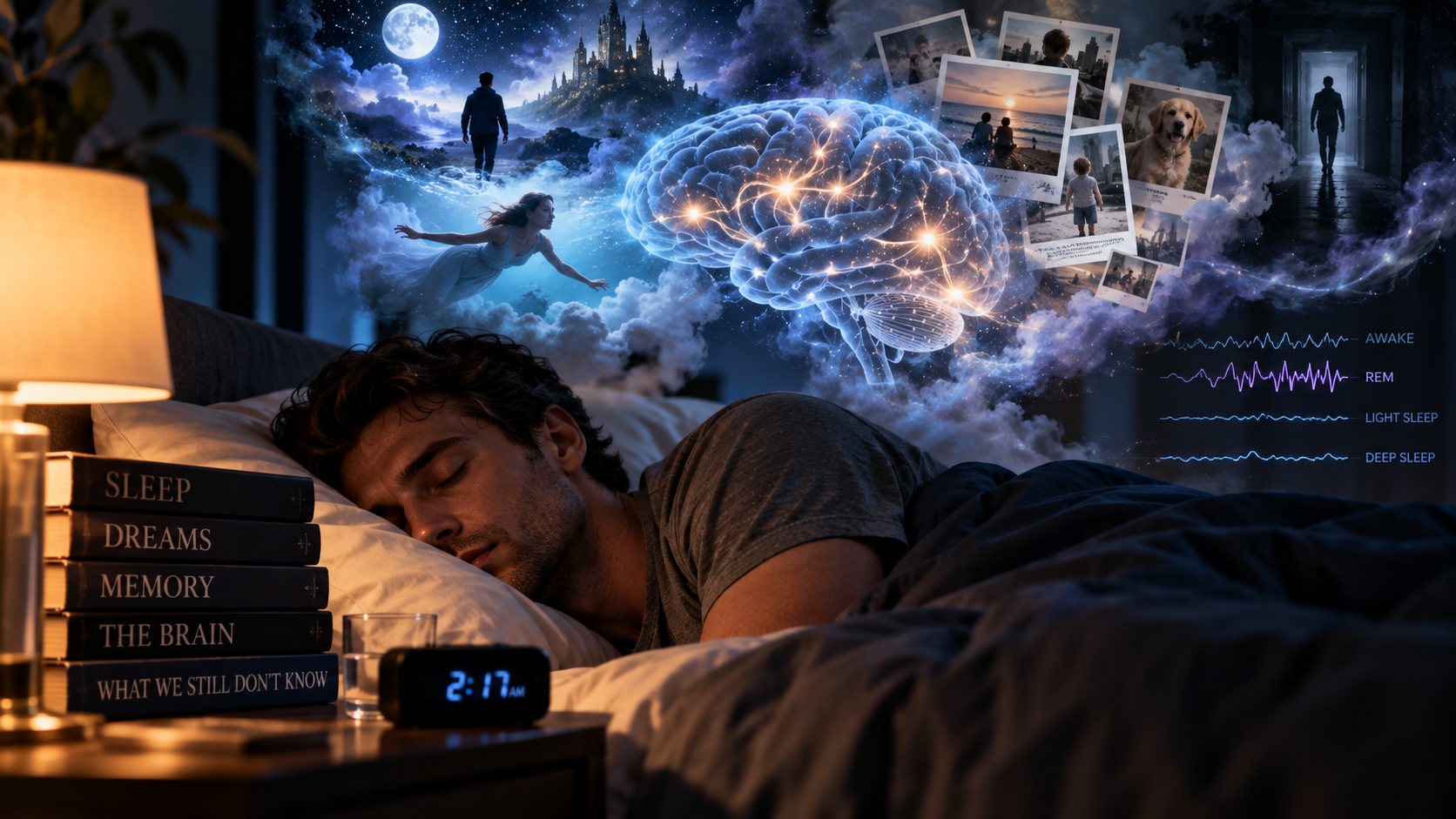
The Dreaming Brain: What The Maze Studies Can Tell Us
Do Dreams Improve Memory—or Reflect Its Processing?
Sleep supports memory, but that does not establish that consciously experiencing a dream is what produces the benefit.
Sleep and memory are closely connected. Dreams can contain fragments of recent experiences. The difficult question is whether dreaming itself helps memory, reflects underlying processing or sometimes does both.
Those possibilities are easy to blur. A study finding that people who dreamed about a task later performed better does not, by itself, prove that the dream caused the improvement.
To understand the evidence, separate sleep, brain activity during sleep, remembered dream reports and later performance. They are related measurements, not interchangeable descriptions of one thing.
Sleep Is Not An Empty Interval
Research has linked sleep with the stabilisation and reorganisation of memories. The details depend on the task, sleep conditions and the kind of memory being studied.
“Memory consolidation” describes processes through which memories become more stable or are integrated with other knowledge. It does not mean every experience is perfectly stored or that sleep turns the brain into a filing cabinet.
An experiment might measure performance on a learned task before and after a sleep opportunity. That provides a defined outcome. It does not automatically explain the purpose of every dream someone has during the night.
The first discipline is to keep the experimental question narrower than the grand theory it may inspire.
Dream Reports Are Indirect Evidence
Researchers usually learn about dream experience by asking people to report it after awakening. The report depends on what the person remembers and how they describe it.
Not reporting a dream does not necessarily mean no experience occurred. A vivid report also does not provide a direct recording of the sleeping brain’s activity.
This creates a measurement challenge. Scientists can compare reports, sleep stages, physiological measures and later performance, but each contributes a different part of the picture.
A compelling description of a dream is therefore valuable subjective evidence. It is not an unfiltered transcript of a neural process.
The Maze Studies
Research by Erin Wamsley and colleagues examined dreaming about a recently learned spatial task and subsequent memory performance. Their work reported an association between task-related dreaming and improved performance, with later research exploring the relationship further.
The interesting possibility is that dream content gives a subjective indication of memory processing. The crucial limitation is that an association does not establish that consciously experiencing the dream is necessary for the improvement.
People who find a task difficult may process it differently, and the processes influencing dream content may also influence later performance. These are questions for study design, not details that can be resolved by an attractive headline.
The evidence supports investigating a link. It does not support a promise that deliberately dreaming about an exam topic will reliably improve a result.
Why Dreams Do Not Replay Life Exactly
Dreams often combine people, places and concerns in ways that do not correspond to a single waking event. That observation fits the idea that remembered material can be recombined rather than replayed as a recording.
But a plausible interpretation is not a complete causal explanation. One dream might resemble a recent conversation; another may be difficult to connect to anything identifiable.
Consider a hypothetical dream involving a childhood school, a current colleague and a missed train. It may draw on several familiar elements. Assigning one definitive hidden message would require assumptions that the dream itself cannot verify.
Personal reflection can still be meaningful. It should not be presented as a scientifically validated decoding method.
REM Sleep Is Not The Whole Story
Dreaming is strongly associated in popular culture with rapid eye movement sleep, or REM. Dream reports can also follow awakenings from non-REM sleep.
This matters because a claim about a sleep stage is not automatically a claim about the conscious experience of dreaming. A physiological process may occur whether or not a person later remembers a dream.
Likewise, a study measuring time in a stage does not necessarily establish what the participant experienced. Headlines should preserve that distinction.
The more precise question is what was measured: sleep stage, neural activity, reported content or behaviour afterwards?
What About Emotional Memories?
Researchers also investigate how sleep relates to emotional memories and responses. The evidence varies across tasks and designs, and broad claims about dreams “healing” emotional experiences can outrun it.
A dream about a difficult event may reflect its importance without resolving its emotional effect. A distressing dream is not proof that a useful therapeutic process is occurring.
Equally, a comforting dream can have personal value without establishing a general mechanism. The distinction is between what an experience means to a person and what a study can demonstrate across participants.
Both can be discussed respectfully without collapsing one into the other.
Are Dreams A Survival Simulator?
Threat-simulation and related theories propose that dreams may rehearse situations relevant to coping or social life. They are interesting explanatory frameworks, but establishing an evolved function requires more than finding threatening or social content.
The content could reflect waking concerns without demonstrating that rehearsal improves real-world performance. Different predictions need different tests.
Ask what result would count against a theory. If every possible dream can be explained after the event, the account may be difficult to evaluate scientifically.
A useful theory generates specific expectations that can be compared with evidence, rather than merely giving an evocative interpretation to familiar experiences.
A Research Map For Readers
Sleep benefits a learned task
What Would Support It?: Appropriate sleep–wake comparison
Dream content reflects recent learning
What Would Support It?: Systematic content assessment
Dreaming causes better memory
What Would Support It?: Evidence separating dreaming from shared causes
A dream symbol has a universal meaning
What Would Support It?: Reliable cross-person predictive evidence
A finding applies to everyday life
What Would Support It?: Replication and relevant real-world testing
The comparison shows why several statements that sound similar require different evidence. Strong support for one does not automatically establish the others.
What A Dream Diary Can And Cannot Do
A diary can help someone notice recurring themes and preserve reports before they fade. It is a personal observation tool, not a diagnostic instrument or a controlled experiment.
If you use one, record the dream before interpreting it. Note relevant waking events separately, so the interpretation does not silently replace the original account.
Avoid drawing major conclusions about another person’s intentions, hidden memories or future events from dream content. A dream is an experience, not independent evidence that an external event occurred.
Persistent distressing sleep problems deserve assessment on their own terms rather than being explained away by an online symbol dictionary.
A Stronger Experiment Would Separate The Possibilities
Imagine that people who report dreaming about a task later improve more than people who do not. One explanation is that the dream contributes to improvement. Another is that a shared memory process influences both the dream and performance.
A stronger causal test would need to distinguish those pathways without introducing another difference that explains the outcome. That is difficult because changing sleep or awakening people can affect more than dream content.
This hypothetical explains why an interesting association can persist without settling the mechanism. The obstacle is not necessarily a lack of imagination; it is the need to isolate variables that are closely connected.
Readers should therefore look for the authors’ actual conclusion rather than assume a causal verb in a headline reflects the study design. “Associated with” can be the most accurate and informative wording.
Replication Does Not Mean Every Detail Must Match
A later study can investigate the same relationship using a different task, sleep interval or participant group. Similar findings can strengthen confidence, while differences may reveal conditions under which the relationship changes.
The useful comparison identifies what was held constant and what changed. A result in a nap study and one after overnight sleep may address related but not identical conditions.
Neither a single success nor a single failure should automatically settle an entire theory of dreaming. The accumulated pattern, quality of methods and plausibility of alternative explanations all matter.
This is why a research map can be more useful than a ranked list of dream functions. It shows where evidence is relatively strong, where findings remain tentative and what a future study would need to establish. Curiosity is preserved without converting uncertainty into a claim of scientific discovery.
A dream’s personal significance does not need scientific validation to be worth reflecting on. The boundary concerns claims about external facts or general mechanisms. Someone can find an experience moving while acknowledging that it does not prove a theory of memory, predict an event or establish another person’s intentions. Keeping those categories separate protects both personal reflection and scientific accuracy.
The Most Defensible Conclusion
Sleep contributes to memory processing, and dreams can reflect material connected to waking life. How the conscious experience of dreaming relates causally to those processes remains an active question.
That answer is more useful than either “dreams are meaningless” or “every dream is your brain solving a problem”. Both slogans erase distinctions the research is trying to understand.
The evidence is strongest when we keep the question specific: what did researchers measure, what changed and what alternative explanation remains? Dreams are fascinating partly because those questions are still open.
