

Are Humanzees Possible? The Dark Science Behind The Claim
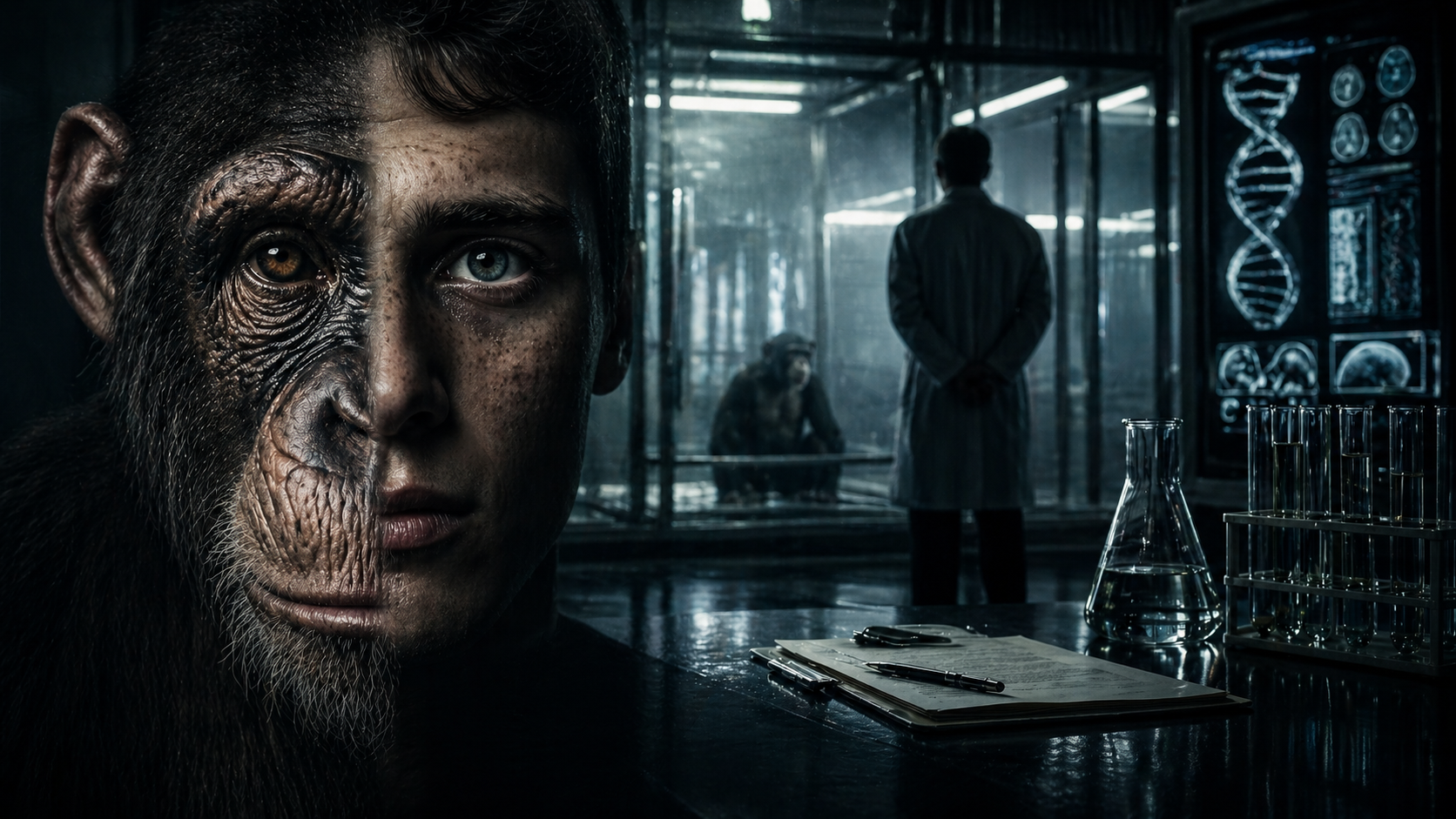
Humanzee Explained: The Science, The Rumours And The Ethical Nightmare
Why The Humanzee Myth Still Disturbs Science
The most uncomfortable part of the humanzee question is not whether one has ever existed.
It is what would happen if one did so.
A human-chimp hybrid would not be a neat fifty-fifty creature from science fiction. Biology does not work like costume design. It would not simply have a human mind inside a chimpanzee body or a chimpanzee mind inside a human-shaped frame. If viable at all, it would be the result of two closely related but deeply divergent developmental programs trying to run inside one organism.
That matters because human and chimpanzee differences are not limited to visible anatomy. The two species differ in chromosome number, gene regulation, brain development, growth timing, immune function, reproduction, and behavior. Humans normally have 46 chromosomes; chimpanzees have 48. Comparative genome work has also found tens of millions of single-letter DNA differences, millions of insertions and deletions, and chromosomal rearrangements between the two lineages.
So if a humanzee embryo were ever created, the most likely outcomes would be lack of dramatic success. They would be failures.
The Most Likely Biological Outcomes
The first likely outcome would be failed fertilization. Human sperm and chimpanzee eggs, or the reverse, might not successfully combine in a way that begins viable development.
The second likely outcome would be early embryonic arrest. Even if fertilization occurred, the embryo could stop developing very early because the genetic instructions were incompatible.
The third possible outcome would be miscarriage or non-viable pregnancy. Development might begin but fail during implantation, organ formation, placental growth, or later gestation.
The fourth, most disturbing possibility would be a severely abnormal live birth. That would raise immediate welfare concerns: pain, disability, neurological impairment, immune dysfunction, breathing problems, skeletal problems, feeding problems, developmental instability, and profound suffering.
The least likely outcome would be a healthy, viable hybrid with stable development.
That is the version people imagine. It is also the version least supported by what we know.
Would It Be Intelligent?
This is where the speculation becomes especially dangerous.
A humanzee, if viable, would not automatically have human-level intelligence. Intelligence is not loaded into a single gene. Human cognition depends on brain size, cortical development, gene regulation, childhood length, social learning, language pathways, motor control, culture, and environment.
Chimpanzees are already highly intelligent animals. They use tools, recognize social hierarchy, show emotional complexity, remember individuals, solve problems, and display forms of self-awareness. But human cognition is not simply “chimpanzee plus extra DNA.” It is an entire developmental system.
A hybrid could theoretically fall anywhere across a wide range:
It might be closer to chimpanzee cognition.
It might have unusual learning capacities.
It might have impaired neurological development.
It might show human-like traits in some areas and chimpanzee-like traits in others.
It might suffer from severe cognitive or behavioral dysfunction.
The terrifying ethical problem is that nobody could know in advance.
If the being had even partial human-like cognition, then creating it for research would be morally indefensible. If it did not, the experiment would still have deliberately created a highly sentient primate in extreme biological uncertainty.
Either way, the outcome would not be a breakthrough.
It would be a moral emergency.
What Would It Look Like?
No one can honestly say.
A humanzee would not necessarily look like a perfect midpoint between a human and a chimpanzee. Hybrid traits do not average out cleanly. Some traits could follow one parent species more strongly. Others could develop abnormally. Growth proportions could be unpredictable.
Possible visible outcomes might include:
Chimpanzee-like facial structure.
Unusual skull proportions.
Different limb lengths.
Mixed hand, foot, or posture traits.
Abnormal dental development.
Growth problems.
Muscular or skeletal instability.
A body plan closer to one species than the other.
The idea of a human-looking ape or ape-looking human is compelling because it is visually simple. Real developmental biology would probably be messier, harsher, and less cinematic.
The more likely result would not be a mysterious new species.
It would be a vulnerable individual whose body may not work properly.
Would It Be A Person?
This would be the central ethical question.
If a humanzee had human ancestry, human-like cognition, self-awareness, language potential, emotional depth, or complex social understanding, the scientific community could not treat it as a normal laboratory animal.
But even if it had mostly chimpanzee-like cognition, that would not make the experiment acceptable. Chimpanzees are already morally significant. They are not disposable biological tools. Their cognitive and emotional complexity is precisely why great ape research is so ethically restricted.
Modern stem-cell and chimera guidelines treat human-nonhuman primate research as a special concern. The International Society for Stem Cell Research says non-human primates should only be used when more evolutionarily distant animals are inadequate, and it highlights special concern around chimeras with widespread human cell contribution, central nervous system contribution, or germline contribution. It also excludes apes from common laboratory species for this kind of work.
That matters because a humanzee would sit far beyond ordinary animal research. It would force questions no ethics committee could comfortably answer:
Does it have human rights?
Could it consent?
Could it be confined?
Could it be studied?
Could it be displayed?
Could it reproduce?
Could it suffer in ways neither humans nor chimpanzees fully do?
Would destroying the embryo be destruction of human-like life?
Would allowing it to live be an act of care or cruelty?
The rights question would not be theoretical. It would be immediate.
How Would the Scientific Community Respond?
If a credible claim emerged that someone had created a humanzee, the response would be explosive.
The first reaction would be skepticism. Scientists would demand evidence: genetic sequencing, chain of custody, medical records, reproductive records, developmental data, independent verification, and ethical approvals.
If the evidence were weak, the claim would be dismissed as another myth.
If the evidence were strong, the response would likely be condemnation rather than celebration.
There would be:
Emergency institutional investigations.
Ethics committee scrutiny.
Possible criminal or regulatory inquiries.
Public outrage.
Demands for international bans or tighter controls.
Questions about the welfare and legal status of the being.
Severe reputational damage to any institution involved.
A scientist who created a humanzee would not be treated like someone who cured cancer. They would likely be treated as someone who crossed one of biology’s most forbidden lines without a defensible reason.
Even human-animal chimera research, which is much more limited and not the same as creating a humanzee, already generates intense ethical debate. Published human-monkey chimera embryo research has been framed around early development, disease modeling, and biomedical possibility, but it remains controversial because of concerns about moral status, brain contribution, and germline involvement.
A born human-chimp hybrid would be far beyond that controversy.
It would be a global scientific scandal.
Is There Any Means Possible?
At a very high level, there are three categories people imagine.
The first is direct reproductive hybridization: human sperm with a chimpanzee egg, or chimpanzee sperm with a human egg. This is the classic “humanzee” idea. It is the route associated with historical claims and alleged experiments. It is also the route with enormous biological barriers and no verified success.
The second is embryo manipulation or assisted reproduction technology. In theory, modern reproductive tools could let scientists attempt things that earlier researchers could not. But technical ability does not erase biological incompatibility, and it certainly does not erase ethics.
The third is chimera research, where human cells are introduced into animal embryos. This is real science, but it is not the same as making a human-chimp hybrid. Human-monkey chimeric embryos have been created in laboratory conditions for early developmental research, but they are not humanzee babies and should not be described that way.
So is there “any means possible”?
In the broadest theoretical sense, future biotechnology could make increasingly extreme human-animal experiments more technically imaginable. But a viable, born human-chimp hybrid remains unproven, biologically doubtful, and ethically beyond the line of acceptable research.
The important distinction is this:
Possible to imagine is not the same as possible to justify.
Science may one day be able to push closer to that boundary. But the closer it gets, the stronger the reason not to cross it.
The Final Ethical Verdict
The humanzee question is often asked as a biological puzzle.
Could it work?
Could one be born?
Would it be intelligent?
Would it look human?
But the deeper answer is that the experiment itself would create a being trapped inside our uncertainty. It would be made not for its own life, but to answer our question.
That is the ethical failure.
A humanzee, if created, would not settle a debate. It would create a new moral subject whose body, mind, rights, and suffering would be impossible to categorize cleanly.
The scientific community would not see that as a triumph.
It would see it as a warning that technical ambition had outrun moral judgment.
