Artemis II Isn’t Just a Moon Mission — I’s the First Viral Space Event of the Internet Age
NASA’s Artemis II Has Hijacked the Global Attention Economy
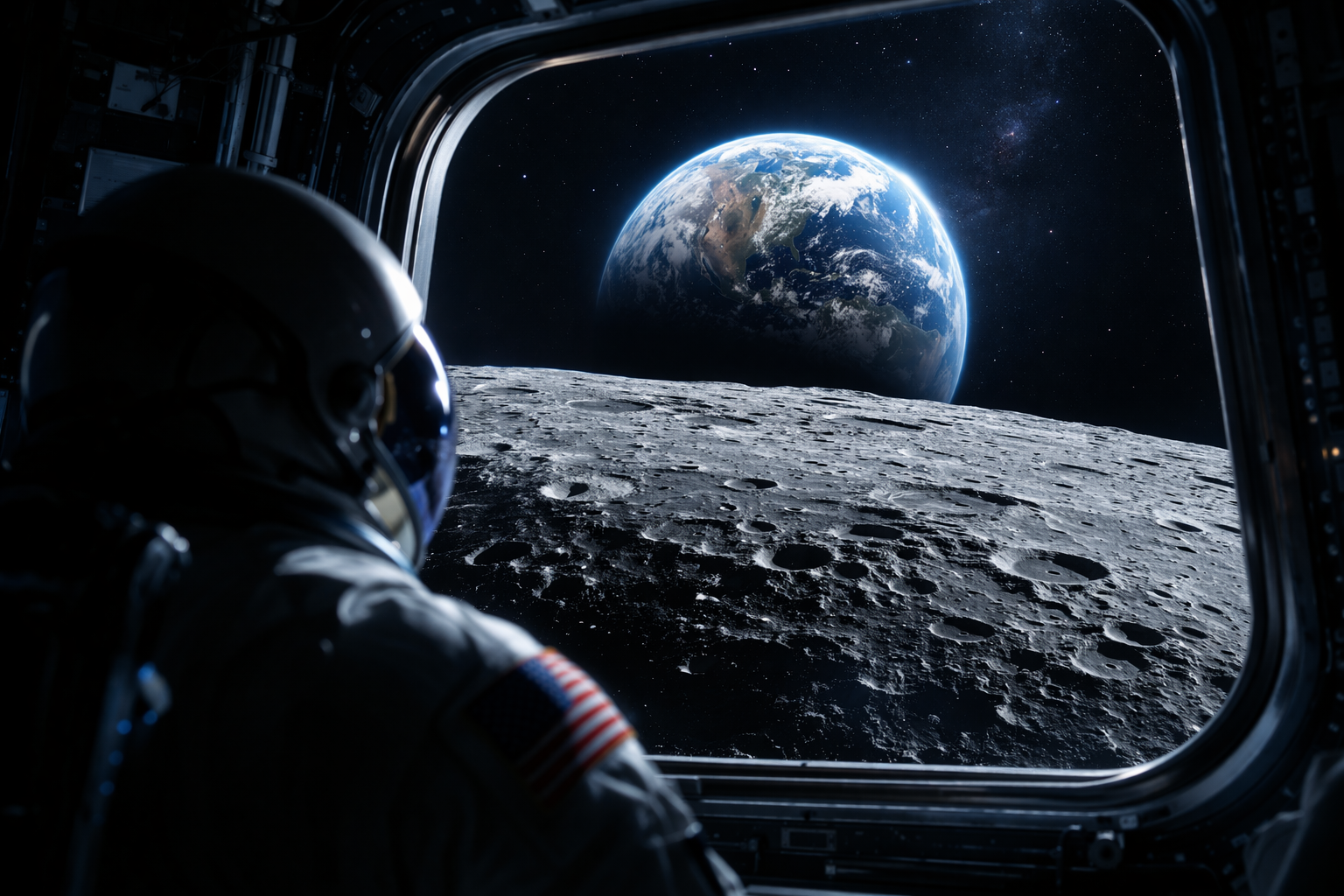
Artemis II astronauts looking back at Earth during historic lunar flyby
This Is Not Just A Mission — ’s A Media Event
Something unusual is happening.
NASA sent four astronauts around the Moon for the first time in over 50 years—and instead of feeling distant, historic, or abstract, it feels immediate. Personal. Everywhere.
Artemis II has broken physical records—humans traveling over 252,000 miles from Earth, farther than ever before
But more importantly, it has broken something else:
The barrier between space and everyday attention.
This is the first deep-space mission fully embedded inside the modern content ecosystem—and that changes everything.
The Mission Is Built For Narrative — And It Shows
Strip away the technology, and Artemis II is almost perfectly designed for storytelling.
A crew of four, each representing a different “first”
A journey beyond anything humans have done in decades
A literal blackout behind the moon—40 minutes of silence
The emotional image of Earth rising over a dead lunar horizon
A return home at 25,000 mph through fire and atmosphere
The story is not dry science.
This is tension, isolation, risk, and scale— all compressed into a 10-day arc.
And unlike Apollo, it’s not filtered through nightly news bulletins.
It’s live, fragmented, replayed, clipped, and redistributed in real time.
The feed has replaced the broadcast.
During Apollo, the world gathered around televisions.
Now, the experience is atomized.
Clips of astronauts floating.
Short-form videos explaining gravity slingshots.
Close-ups of lunar craters.
Threads analyzing trajectory physics.
Emotional reactions to Earthrise.
The mission doesn’t arrive as a single story.
It arrives as thousands of micro-moments competing for attention—and winning.
Artemis II isn’t just being watched.
It’s being consumed, remixed, and emotionally processed at scale.
What Makes Artemis II So Shareable
Not all space missions trend like this.
This one does because it hits three psychological triggers perfectly:
Human Stakes
People don’t share rockets. They share people.
The crew—Reid Wiseman, Victor Glover, Christina Koch, and Jeremy Hansen—are not abstract figures. They are visible, emotional, and relatable.
When they describe seeing Earth from deep space, it lands.
Visual Extremes
The Moon’s far side. Total darkness. Earth hangs in black space.
These are not just images — they are contrast machines.
They stop the scroll.
Structured Tension
There is a clear arc:
Launch → Deep space → Lunar flyby → Blackout → Return
It behaves like a story, not a dataset.
And stories travel.
What Media Misses
Most coverage treats Artemis II as a milestone.
It is— but that’s not the most important thing happening.
The real shift is structural:
Space exploration is no longer a rare, distant spectacle.
It is now integrated into the global attention system.
That means:
Missions are judged not just by success, but by visibility
Public engagement becomes a strategic asset, not a side effect
Narrative becomes part of the mission architecture
NASA hasn’t just sent humans to the Moon.
It has re-entered the cultural bloodstream.
The Strategic Layer Beneath The Hype
This mission matters beyond content.
Artemis II is a rehearsal mission—testing systems for future landings and long-term lunar presence
But it’s also something else:
A signal.
To competitors like China that the US is back in deep space
To the public that space exploration is active, not historical
To policymakers that this programme has momentum
Attention is not accidental here.
It’s leverage.
What Happens Next
Three trajectories now matter:
The Physical Trajectory
The crew returns to Earth, completing a ~700,000-mile journey
The Program Trajectory
Artemis III and beyond aim to land humans on the Moon again and build infrastructure there.
The Attention Trajectory
This trajectory is the one most people underestimate.
If Artemis II proves that space can dominate modern feeds, future missions will be designed—consciously or not— with that in mind.
More access.
More visuals.
More narrative.
More immediacy.
The Deeper Meaning
For decades, space has felt like something humanity used to do.
Artemis II changes that.
It's not simply a matter of us returning to space.
But because we experienced it differently.
Not as a distant achievement—but as a continuous, shared, real-time presence.
The Moon didn’t just come closer physically.
It came closer psychologically.
And once that happens, you don’t go back.
