The Science of Human Difference: What Genetics Says About Populations
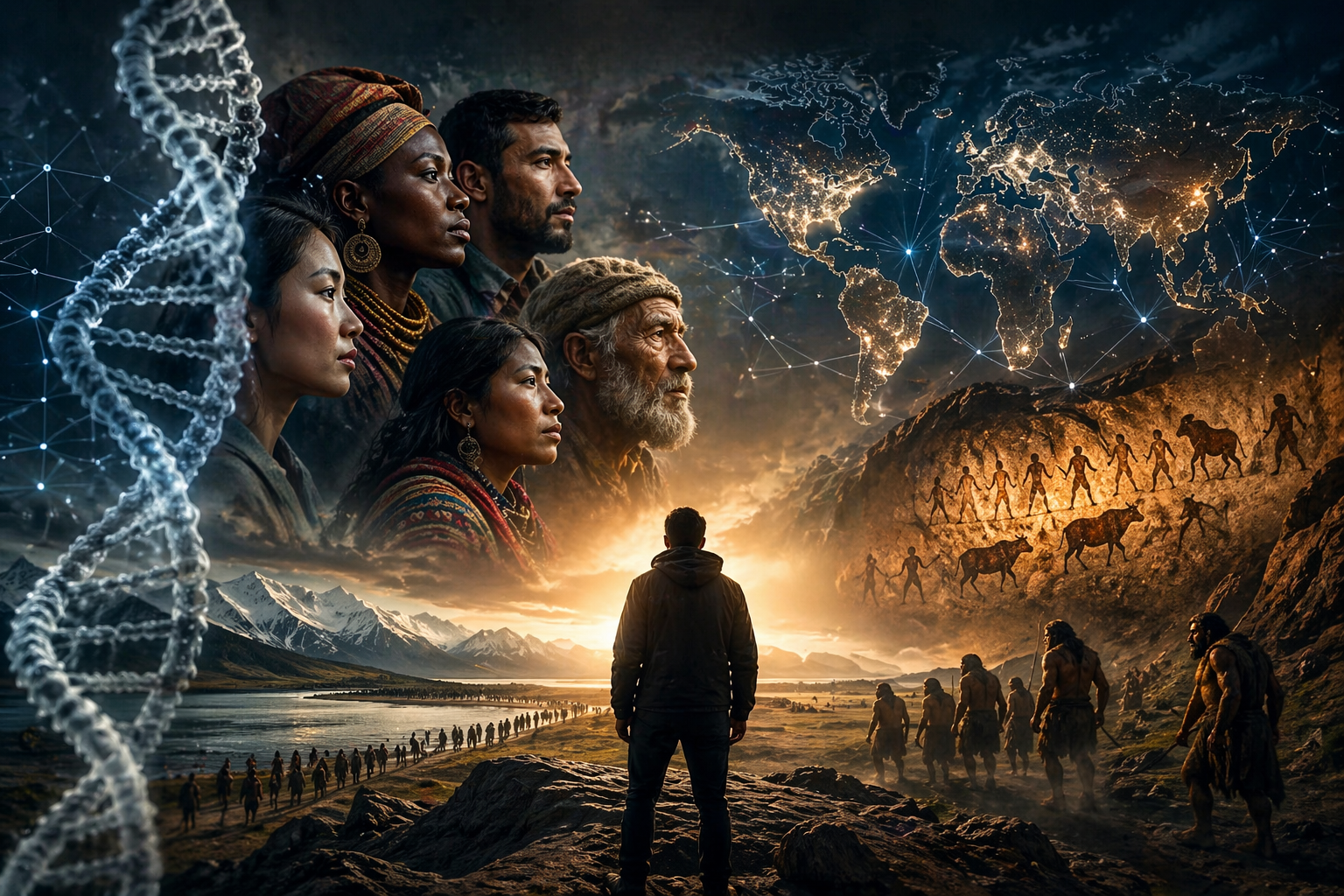
One Species, Many Adaptations: The Science of Human Population Differences
What Evolution Really Changed in Different Human Populations
The strongest evidence for human difference is not a hierarchy of races but a record of ancestry, migration, and local adaptation written into living populations.
The most intriguing differences between human populations are real, measurable, and scientifically rich. They are about ancestry, migration, adaptation, and ecology—not a ladder of human worth.
That matters because this subject is often ruined in one of two ways. One camp pretends human biological differences are too dangerous to discuss at all. The other treats visible difference as proof of deep, fixed racial destiny. Both approaches flatten the science. Modern genetics has done something far more interesting. It has shown that human populations carry traces of ancient movement, ancient mixture, and local adaptation—but those patterns do not sort neatly into old racial boxes, and they do not add up to a biologically ordained hierarchy.
That is the right starting point for a serious article on human difference. Human populations do differ in some patterns of ancestry, in the frequency of certain variants, and in how natural selection responded to local conditions over time. But the language that best captures those differences is not “race as essence.” It is population, ancestry, admixture, ecology, and adaptation. That shift is not ideological softening. It is a better map of reality.
Once you make that shift, the subject becomes more fascinating, not less. Modern humans mixed with archaic humans. Different populations inherited different fragments of that ancient contact. Some populations adapted to altitude, some to dairying, some to malaria, some to ultraviolet radiation, some to diving, some to starch-heavy diets, and some to alcohol metabolism or sweat chemistry. Sometimes different populations solved the same problem in different ways. Sometimes one selected variant altered several traits at once. The real story is not simple. That is precisely why it is worth telling.
Why race is the wrong map
The first thing a scientifically honest article has to do is clear away the oldest confusion. Human biological variation is real. But race, as commonly used in public debate, is too coarse, too historical, and too socially loaded to work as a precise biological category. Current expert guidance in biological anthropology states plainly that socially recognized races are not discrete biological groups or evolutionarily independent lineages.
That does not mean genes are not relevant. They do. It means old racial categories do a poor job of tracking how human variation is actually distributed. Human populations have moved, mixed, split, and remixed repeatedly. Boundaries blur. Traits do not all travel together. A visible characteristic can be evolutionarily important while saying very little about the rest of the genome. Two people placed in the same race category can be genetically quite distant in ancestry terms, while two people placed in different categories can share overlapping population history.
This is why scientifically careful writing prefers more exact language. Populations can be described by shared ancestry, geography, ecological history, admixture, or local selective pressures. Countries are political units. Races are social categories. Populations are what evolutionary biology can actually work with.
Archaic ancestry is real—and far more interesting than race myth
One of the most dramatic findings in modern genetics is that Homo sapiens did not move across the world in total isolation from other human groups. There was interbreeding. Most present-day people with primarily non-African ancestry carry some Neanderthal DNA, and some populations in Oceania and parts of Island Southeast Asia carry substantially higher Denisovan ancestry than most other living populations.
That alone makes the human story more tangled than older schoolbook versions suggested. But the details are even more striking. A major study reported that the Ayta Magbukon of the Philippines possess the highest level of Denisovan ancestry yet identified, roughly 30 to 40 percent greater than that found in Australians and Papuans in that analysis.
This is precisely the kind of difference that belongs in a serious science article. It is real, measurable, and historically rich. It tells us that different populations encountered different archaic humans in different places and at different times. It also tells us that human prehistory was not a clean relay race from one species to the next. It was a web of branching, migration, and contact.
But the guardrails matter. Archaic ancestry is not a permission slip for modern race essentialism. These fragments of Neanderthal or Denisovan ancestry do not make any living population less modern, more primitive, or morally different. They show admixture, not separate ladders of civilization.
Population history beats national borders
A better article does not treat biology through the lens of modern countries. Countries are recent political containers, not evolutionary units. The more scientific frame is to talk about high-altitude populations, pastoralist populations, populations with long exposure to malaria, Arctic populations, equatorial populations, or populations shaped by specific admixture histories.
That sounds like a small wording choice, but it changes everything. Once the frame becomes population history rather than nation or race, the science becomes sharper and the rhetoric becomes safer. You stop asking whether one broad group is “different” in the abstract and start asking how specific environments shaped specific traits.
The adaptations that make human diversity genuinely fascinating
The strongest examples of human difference are not the ones that flatter ideology. They are the ones that show evolution solving concrete problems in different places.
Milk after childhood
Lactase persistence is one of the clearest cases. Most mammals reduce lactase production after weaning. Many humans do too. But in some populations with long histories of dairying, adults retain the ability to digest milk efficiently. What makes this especially important is that it did not emerge through one universal mutation shared by one imagined continental race. Genetic work showed convergent adaptation, with different variants associated with lactase persistence in Europe and in African pastoralist populations.
That is a perfect example of how human evolution really works. Culture altered the environment by making milk a valuable adult food source. Natural selection then favored variants that helped some populations exploit that niche. The result is a real biological difference, but not a tidy racial script.
Skin pigmentation and ultraviolet radiation
Skin pigmentation is another classic example where the science is strong and the popular mythology is weak. Human pigmentation is best understood as an adaptation to varying ultraviolet environments, with darker pigmentation helping protect against intense UV exposure and lighter pigmentation in lower-UV settings linked to pressures around maintaining vitamin D synthesis. The key point is that pigmentation tracks ecological pressures far better than folk ideas about race.
That matters because visible traits are easy for the public to overinterpret. Skin color is highly noticeable. But a visible trait can be evolutionarily important without serving as a summary of intelligence, character, or total biological identity. People see skin. Evolution saw sunlight.
Malaria and the sickle-cell story
The sickle-cell trait is another powerful example of local adaptation. Carrying one copy of the HbS variant can reduce the risk of severe malaria in some settings, helping explain why the allele rose to appreciable frequency in some malaria-endemic regions despite the serious burden of sickle-cell disease in people with two copies.
This is what real selection often looks like: local, brutal, and full of trade-offs. Evolution can preserve a harmful allele if, in one-copy form and in one environment, it improves survival enough to matter.
Diving and the Bajau
One of the most memorable modern cases comes from the Bajau, a population associated with traditional breath-hold diving. Research found that Bajau individuals had larger spleens than a nearby comparison population and identified evidence of selection in genes linked to diving physiology. A larger spleen can function as a reservoir of oxygenated red blood cells, improving tolerance during repeated dives.
The appeal of this example is obvious. It feels almost mythic—a population whose way of life seems to have shaped measurable biology. But again, the lesson is not superiority. The lesson is responsiveness. Human bodies, over enough generations, can be locally shaped by repeated ecological demands.
Same problem, different solutions
This is where the story gets even more interesting. Evolution does not always produce one universal answer. Different populations can face the same broad challenge and solve it through different physiological routes.
High altitude is one of the clearest examples. Tibetan populations are associated with strong signatures of selection at genes including EPAS1 and EGLN1 and often show a pattern that avoids the marked hemoglobin elevation commonly seen in some Andean highland populations. Ethiopian highlanders, meanwhile, appear to show partly different genetic candidates again. In other words, chronic low oxygen did not produce one single “high-altitude gene.” It produced multiple evolutionary responses in different populations.
That is a bigger point than it first appears. It tells us that even when environments are similar, the pathways to adaptation do not have to be identical. Human evolution is not just about difference. It is about repeated problem-solving.
The smaller traits that prove the point
Not every meaningful population difference is dramatic. Some of the best examples are almost mundane. That is part of what makes them useful.
Alcohol metabolism and flushing
Variation around ALDH2 helps explain why alcohol flushing is common in many East Asian populations. When acetaldehyde is broken down less efficiently, people are more likely to experience flushing and other unpleasant reactions after drinking. This is a very good example of a real, familiar, biologically meaningful population difference that has nothing to do with hierarchy or destiny.
Earwax type and underarm odor
The ABCC11 variant associated with dry earwax is more common in East Asian populations and is also linked to reduced production of the usual odor precursors in axillary sweat. It is one of those wonderful examples that sounds almost trivial until you realize what it shows: evolution can shape specific, everyday human traits in ways most people never think about.
Starch digestion
Copy number variation in the salivary amylase gene AMY1 is another striking case. An influential study found that populations with historically high-starch diets tended, on average, to carry more AMY1 copies than populations with lower-starch diets. This fits the broader pattern you also see with lactase persistence: subsistence strategy and diet can shape selection over time.
One variant, several traits
The EDAR V370A variant, which rose to high frequency in East Asian and Native American ancestry populations, has been associated with thicker hair and other ectoderm-related traits. This makes another important point clear: one selected variant can influence several traits at once. Biology is not a clean set of isolated switches.
What the public gets wrong about “lineages”
The phrase “different lineages of genus Homo” sounds dramatic, and that is part of the danger. Yes, modern humans interacted with other Homo groups. Yes, fragments of those encounters remain in living populations. Yes, archaic ancestry varies across populations. But that still does not mean modern human populations are clean descendants of different Homo species in a way that maps onto today’s race categories.
What genetics actually shows is shared Homo sapiens ancestry layered with different episodes of admixture and local selection. That is a population-history story. Once writing slides from “different populations carry different admixture histories” into “different races evolved from different human species,” it begins to sound like old pseudoscience in fresh language. The first statement is defensible. The second is misleading.
Intelligence
This is the section where a writer either keeps control of the science or loses it.
Cognitive traits are influenced by genes. They are also influenced by development, schooling, nutrition, health, stress, and environment. Heritability within a population does not tell you why average differences might appear between populations. That point has been stressed repeatedly in modern genetics and remains widely abused in public argument.
There is also strong evidence that cognitive test performance can shift substantially with environment. Education can raise measured performance. Long-run rises and reversals in scores have occurred far too quickly to be explained by deep genetic change. And polygenic prediction remains much less reliable when scores trained in one ancestry group are applied to people from different ancestry backgrounds. These are not side notes. They are central warnings against lazy genetic determinism.
A disciplined article does not need to deny that genes matter for cognition. It needs to refuse the leap from that fact to racial ranking. The evidence does not justify it.
Why old race science keeps returning
Race science survives because it offers a seductive illusion: one master variable that explains everything. It promises a shortcut through history, institutions, development, and contingency. It claims inequality can be read off biology. That promise was always false, but it remains tempting because it is psychologically tidy.
The real science is less flattering to ideology. Human difference is real, but it is patchy, local, contingent, and historically messy. Traits do not align into one grand ranking system. Adaptations often reflect climate, diet, pathogens, altitude, or lifestyle rather than some total package of group destiny. A population may carry one striking adaptation, and none of that tells you anything sweeping about human worth.
What comes next in this science
The next phase of this field is not a triumphant return of biological race. It is better population sampling, more ancient DNA, more work on underrepresented groups, and more precise language about ancestry and adaptation. As genomics becomes less Eurocentric, the old racial boxes are likely to look even cruder, not more vindicated.
The most underestimated trend is methodological humility. Better researchers are increasingly careful about proxies, increasingly cautious about overclaiming, and increasingly explicit about the limits of cross-ancestry prediction. That is not scientific weakness. It is what a field looks like when it matures after generations of overconfidence.
The most dangerous trend is public misuse. Ancient DNA, admixture findings, and polygenic research all sound dramatic enough to be turned into ideological weapons long before the details are understood. The science is getting richer. That makes precision more important, not less.
The real lesson
Human populations are not identical in every biological respect. They were shaped by different environments, different migrations, different mixtures, and different selective pressures. That part is true.
But the deepest lesson is not separation. It is complexity. The real pattern of human difference is more intricate, more contingent, and less flattering to racial mythology than race science ever wanted. One species. Deeply mixed. Locally shaped. Historically mobile. Biologically adaptable. Too complicated for the old myths, and far more interesting than them.
