

Black Holes Explained: Why The Universe’s Darkest Objects May Reveal Everything
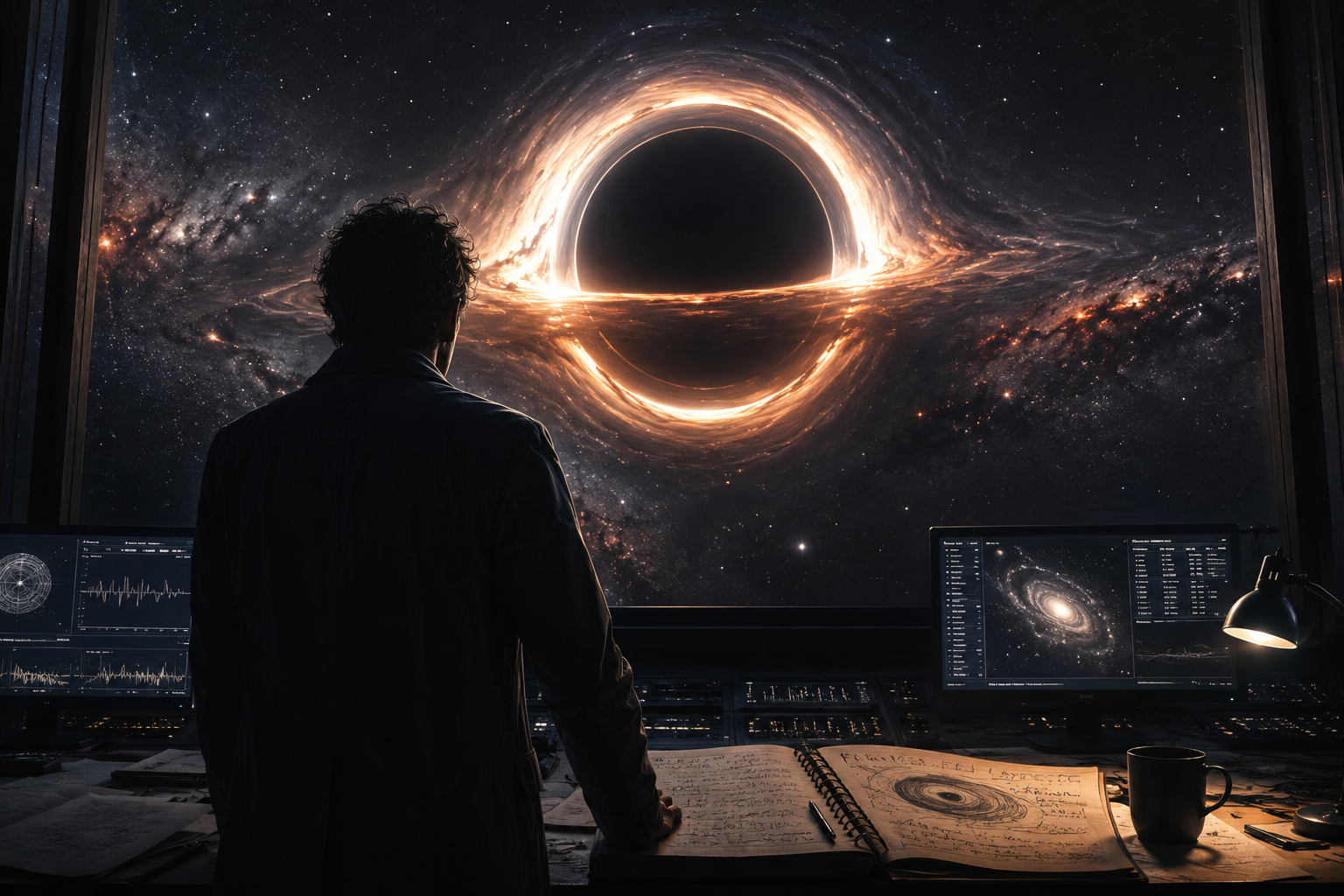
What If Black Holes Are The Key To Everything?
The Darkest Places In Space May Be Where The Universe Explains Itself
Why Black Holes Feel Like The End Of EverythingA black hole sounds like the simplest nightmare in science: something so dense, so heavy, and so extreme that not even light can escape once it crosses the boundary around it. That boundary is called the event horizon. Think of it like the edge of a waterfall. Above the edge, a boat might still fight the current. Past the edge, the direction has already been decided.
That is why black holes feel more like cosmic traps than normal objects. A planet sits in space. A star burns in space. A black hole seems to attack space itself. It bends light, distorts time, tears apart stars, and hides its deepest interior from direct view.
To a non-scientist, that can make black holes sound like science fiction. To physicists, they are something more dangerous: a real place where the rules of the universe are pushed until they almost break.
The Simple Analogy That Makes Black Holes Less Impossible
Imagine space as a huge trampoline. Put a tennis ball on it and the fabric dips a little. Put a bowling ball on it and the dip becomes deeper. Now imagine something so heavy and compressed that the dip becomes less like a dent and more like a bottomless drain.
That is the rough idea behind gravity in Einstein’s theory of general relativity. Massive objects curve space-time, and other objects move through that curve. Gravity is not simply a mysterious invisible pull. It is the shape of the road.
Black holes are what happens when the road curves so violently that every possible path points inward. They are not only objects inside the universe. They are experiments performed by the universe on its own laws.
Where Einstein And Quantum Physics Start Fighting
The biggest problem in modern physics is that the two greatest theories we have do not fit neatly together. General relativity explains gravity, space-time, planets, stars, galaxies, and black holes. Quantum mechanics explains atoms, particles, uncertainty, and the strange behavior of matter at tiny scales.
Both theories work brilliantly in their own territories. The trouble begins when nature asks them to share the same room. A black hole is exactly that room. It is enormously heavy, so gravity matters. But it also compresses matter into an extreme state, so quantum physics should matter too.
The center of a classical black hole is often described as a singularity, a place where density and curvature become infinite. In plain English, that means the mathematics starts screaming. Infinity is not usually a satisfying physical answer. It is often a sign that the theory has been pushed beyond its safe limit.
That is why black holes are so important. They may be where scientists are forced to build a deeper theory that unites gravity and quantum mechanics. That hoped-for theory is often called quantum gravity. Nobody yet has a complete, experimentally confirmed version. But black holes keep pointing at the missing door.
The Information Paradox Is The Real Horror Story
The scariest part of a black hole may not be that it swallows matter. It may be that it appears to threaten information itself. In physics, information means the details that describe a system: what particles went in, what state they were in, how they were arranged.
Quantum mechanics says that information should not simply vanish from the universe. Then Stephen Hawking changed the story. Hawking’s work suggested that black holes are not completely black. They can emit a faint form of radiation, now called Hawking radiation, and over immense timescales may evaporate.
That creates a brutal question: if a black hole forms from detailed matter, then evaporates into apparently featureless heat, where did the information go? This is the black hole information paradox. If black holes destroy information, quantum theory is in danger. If information escapes, then our understanding of black holes must change.
A simple analogy helps. Imagine burning a book. The words seem gone, but in principle the information has been scrambled into smoke, ash, heat, and light. It is practically impossible to reconstruct, but not fundamentally erased. A black hole raises the darker possibility that the book is not merely burned. It may be deleted from reality.
What Current Theories Are Trying To Explain
There are several major ideas about how black holes might preserve information. One is the holographic principle. This suggests that information about everything falling into a black hole could be encoded on its boundary, almost like a 3D movie stored on a 2D screen.
If true, the universe may be far stranger than it appears. What looks like depth may, at some deeper level, be information written on surfaces. That does not mean everyday reality is fake. It means the deeper code behind reality may be nothing like the world our brains evolved to understand.
Another idea involves “quantum hair.” Older black hole theory suggested that black holes were almost featureless, described mainly by mass, spin, and electric charge. The phrase “black holes have no hair” meant they had very few distinguishing features. Quantum hair proposals argue that black holes may carry subtle quantum details after all, allowing information to remain encoded rather than destroyed.
A third route involves wormholes, entanglement, and so-called “islands” in the mathematics of black hole evaporation. These are not simple ideas, but the basic picture is this: the inside and outside of a black hole may be connected in deeper quantum ways than ordinary intuition allows.
Black Holes May Also Explain How The Universe Grew Up
Black holes are not only useful for deep theory. They may also rewrite the story of cosmic history. The early universe appears to contain surprisingly mature galaxies and powerful black holes very far back in time, which puts pressure on simple ideas about slow cosmic growth.
The standard picture says many black holes begin as the remains of collapsed stars, then grow by consuming gas, dust, and other black holes. But some early supermassive black holes appear so large, so soon after the Big Bang, that scientists have to ask whether some were born with a head start.
These are sometimes called heavy seed or direct-collapse scenarios. In simple terms, instead of a small black hole growing slowly from a dead star, a huge cloud of gas may collapse rapidly into a much larger black hole. That would change the story. Black holes would not just be leftovers from cosmic destruction. They could be early engines of cosmic construction.
If that is right, black holes were not late-stage monsters arriving after galaxies had already formed. They may have helped shape galaxies, regulate star formation, and build the large-scale universe from very early times.
Gravitational Waves Turned Black Holes Into Instruments
For a long time, black holes were mostly studied through the light and motion around them. Then gravitational-wave astronomy changed the field. When two black holes collide, they send ripples through space-time itself.
That matters because black holes are otherwise secretive. They do not shine like stars. They reveal themselves through influence: the motion of nearby matter, the distortion of light, jets of energy, X-rays from hot gas, or ripples in space-time. Every new detection method turns the darkness into data.
In a way, black holes are becoming cosmic microphones. They let scientists listen to the universe’s most violent events. They test whether Einstein’s theory still works under extreme pressure. They reveal black holes that ordinary telescopes may never see.
The more sensitive these instruments become, the more black holes may shift from mystery objects to precision tools. They are no longer just things we stare at from a distance. They are becoming instruments for testing reality itself.
Why This Could Be Bigger Than Black Holes
The deepest possibility is that black holes are not just one strange thing in the universe. They may be a clue to how reality stores information. If the holographic principle is right, black holes could hint that space, volume, and even gravity emerge from something more basic.
That is the clickbait-sounding claim that may actually be defensible: black holes could be the key to everything. Not because they are magic portals or cosmic gods, but because they force the biggest questions into one place. What is space? What is time? Can information be destroyed? Is gravity fundamental, or does it emerge from deeper quantum rules?
Black holes do not answer all of that yet. But they ask the questions in a way no laboratory on Earth can. They are nature’s most extreme test chambers, built not by scientists but by collapse, gravity, and time.
The terrifying part is that black holes hide their interiors from us. The hopeful part is that their edges may still speak. Around the event horizon, in gravitational waves, in distorted starlight, in Hawking’s paradox, and in the strange growth of the early universe, black holes keep leaving clues. The universe may not have placed its deepest secrets in the brightest places. It may have hidden them in the dark.
