

The Silence Of Space May Be The Most Terrifying Signal Of All
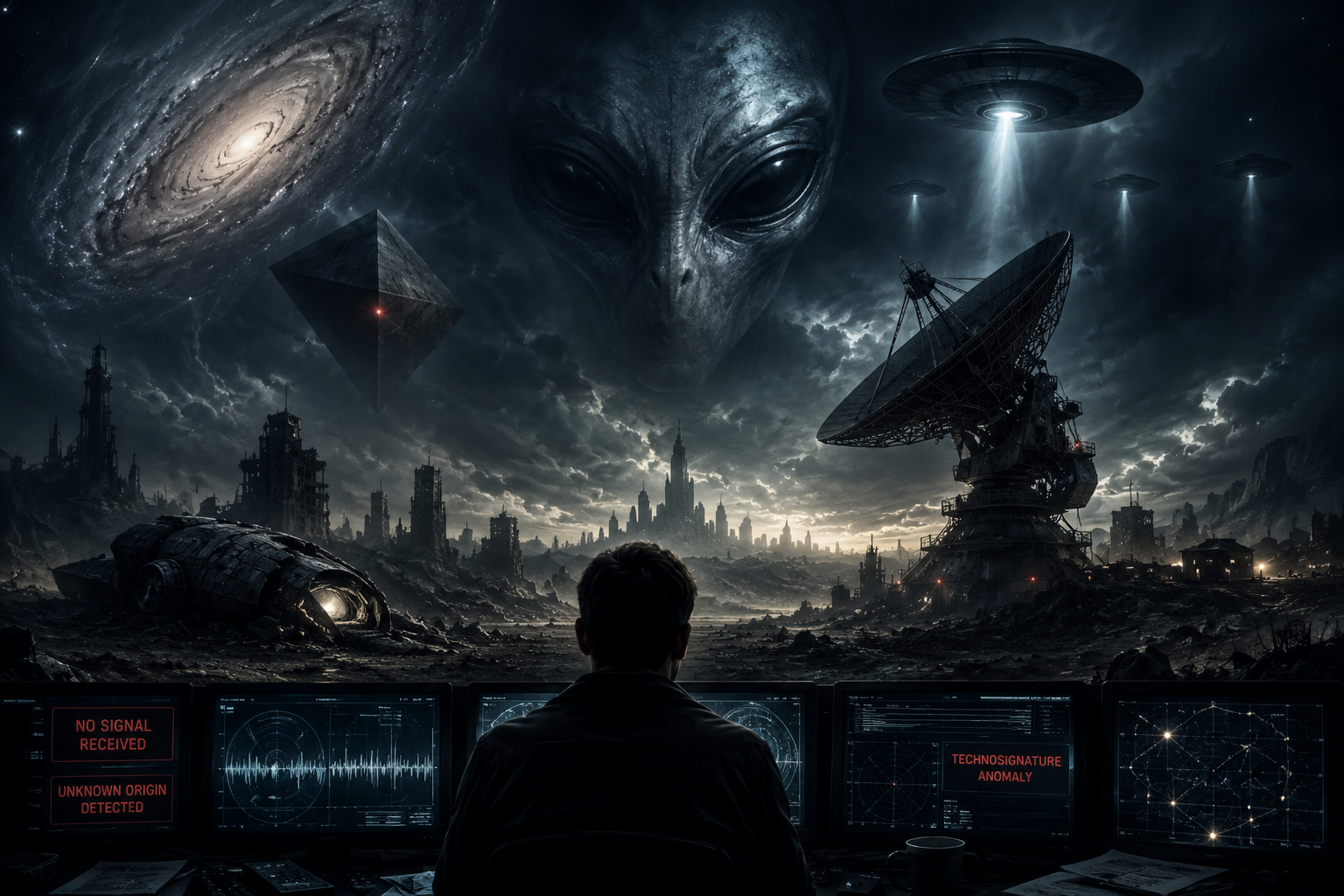
Why The Universe Is Quiet May Be More Disturbing Than Finding Aliens
The Question That Refuses To Go Away: The Fermi Paradox May Have A Darker Answer Than You Think
The Fermi Paradox begins with a simple problem: the universe is enormous, ancient, and full of places where life might exist. NASA says more than 6,000 exoplanets have now been confirmed, and thousands more candidates still await confirmation, which means scientists are no longer guessing whether planets are common. They know planets are everywhere.
That makes the silence harder to explain. If there are so many planets, so many stars, and so much time, why has nobody appeared? Why has no clear alien signal arrived? Why does the sky not look like a busy neighborhood full of ancient civilizations, artificial structures, radio traffic, or obvious signs of intelligence?
The classic version is usually linked to physicist Enrico Fermi’s famous question: “Where is everybody?” NASA describes the issue as the “eerie silence” of the universe: if intelligent life can arise and spread, the billions of years available should have given it time to make itself visible.
The disturbing part is that the paradox is not really about aliens. It is about us. The silence may be telling humanity something about how rare intelligence is, how fragile civilizations are, or how dangerous it may be to announce yourself in a universe you do not understand.
The Easy Answer Is That Space Is Just Too Big
The least frightening explanation is also the simplest: space is huge. Imagine standing in the middle of the Pacific Ocean with a torch and assuming nobody else exists because you cannot see another torch. That might not mean the ocean is empty. It might just mean your light is weak, your view is tiny, and everyone else is too far away.
This is one of the safest ways to understand the Fermi Paradox. We may simply be looking badly, briefly, and with primitive tools. Humanity has only been sending strong technological signals for a very short period compared with the age of the galaxy. On cosmic timescales, we are not an old civilization. We are a baby tapping a spoon on a high chair and asking why the universe has not replied.
Modern search strategies are also changing. NASA’s technosignature work now looks beyond old radio-signal assumptions and includes possible signs of technology such as laser pulses, industrial gases, or other artificial traces. Jill Tarter, a major figure in SETI, has argued for looking across the whole sky and many wavelengths, not just for one narrow kind of alien radio message.
This means one current theory is not dark at all: aliens may exist, but we are using the wrong ears. It is like trying to detect Wi-Fi with a wooden spoon. The signal could be real, but the instrument is laughably inadequate.
The Darker Answer Is The Great Filter
The Great Filter is where the Fermi Paradox becomes more uncomfortable. The idea, developed by Robin Hanson, is that there may be some extremely difficult step between lifeless matter and a long-lasting spacefaring civilization. Somewhere on the road from chemicals to cells, cells to intelligence, intelligence to technology, and technology to cosmic expansion, most worlds may fail.
Think of it like a long obstacle course in the dark. A planet has to clear many hurdles: forming life, keeping stable conditions, developing complex cells, producing intelligence, inventing technology, surviving its own weapons, surviving ecological damage, and perhaps learning how to leave its home world. If almost nobody reaches the end, the universe would look exactly as it does now: full of planets, but almost completely silent.
The terrifying question is whether the biggest obstacle is behind us or ahead of us. If the hardest step was the origin of life itself, humanity may be lucky. It would mean we have already passed the most brutal barrier. But if the hardest step is surviving advanced technology, nuclear weapons, artificial intelligence, ecological collapse, or self-destruction, then the silence becomes a warning.
That is the darkest emotional core of the Great Filter. Empty space may not mean life never begins. It may mean intelligent life repeatedly reaches a dangerous stage, gains extraordinary power, and then destroys itself before it can become visible across the galaxy.
Civilizations May Burn Bright And Vanish Quickly
Another theory is that technological civilizations exist, but their detectable phase is brief. Imagine fireflies flashing in a forest for half a second at random times across thousands of miles. Even if there are many of them, your chance of looking at the right patch of darkness at exactly the right moment is tiny.
This matters because humanity’s own loud technological phase may not last long. We used giant radio broadcasts, then moved into tighter, more efficient communication systems. A more advanced civilization might become harder to detect, not easier. Its technology could become quieter, cleaner, smaller, encrypted, or directed through systems we do not recognise.
SETI researchers already frame the search around “technosignatures,” meaning evidence of technology rather than evidence of biology alone. Recent searches ask how detectable Earth itself would be to another civilization, which is a useful reality check: even we may not be as obvious as we imagine.
In simple terms, aliens may not be missing. They may be whispering. Or they may have stopped shouting millions of years before we started listening.
The Dark Forest Theory Turns Silence Into Strategy
The Dark Forest theory is more cinematic and more frightening. It suggests that the universe may be full of civilizations, but they stay quiet because making noise is dangerous. In this view, space is not an empty desert. It is a dark forest full of hunters who survive by not revealing their position.
The analogy is simple. Imagine walking through a pitch-black forest at night. You hear nothing. That does not prove you are alone. It may mean every other creature has learned that sound attracts predators. The safest move is not to wave a flag. The safest move is to hide.
This idea is speculative, but it speaks to a real strategic fear. If one civilization detects another, it may not know whether the other is peaceful, hostile, desperate, expansionist, or technologically superior. Because communication across interstellar distances is slow, misunderstanding could last centuries. In a universe where survival is uncertain, some civilizations might choose silence as insurance.
The Dark Forest answer is not that nobody exists. It is that the smart ones stay invisible. That is what makes it so unsettling. The silence would not be a natural absence. It would be deliberate behavior.
Machine Civilizations Make The Puzzle Even Stranger
A newer version of the paradox asks what happens when intelligence no longer needs biology. If advanced civilizations create self-replicating probes, autonomous factories, or machine explorers, they might spread without sending fragile bodies across the stars. A recent 2026 paper argues that autonomous AI, robotics, and space-based industry could make expansion cheaper and quieter than old science fiction assumed.
That sharpens the paradox. If machines can travel slowly, replicate locally, and operate for immense periods of time, then the galaxy should contain at least some trace of old technological activity. Not necessarily giant alien cities or dramatic starships, but weak artifacts, strange anomalies, old probes, or patterns that do not look natural.
This is why some researchers argue future searches should include not just radio signals, but also artifacts in the Solar System, unusual debris, atmospheric technosignatures, and evidence of past technological activity. A 2026 paper on future technosignature searches specifically highlights Solar System artifact searches because they can look for evidence accumulated over enormous spans of time, rather than needing two civilizations to be active at the same moment.
The simple analogy is archaeological. If you arrive at an ancient abandoned city, you do not only listen for voices. You look for tools, broken walls, footprints, buried objects, and marks in the ground. The next stage of the alien search may be less like making a phone call and more like investigating a cosmic crime scene.
The Worst Answer Is That We Are Early
There is one answer that sounds hopeful but carries its own fear: maybe humanity is early. Maybe intelligent life is not common yet because the universe is still developing the right conditions. Perhaps we are among the first technological civilizations to appear.
That would make the silence less like a graveyard and more like an empty stage. Nobody has answered because the others have not arrived yet. The galaxy may not be dead. It may be waiting.
But that answer also puts pressure on humanity. If we are early, then we are not just spectators. We may become one of the civilizations that shapes what comes next. Our choices around artificial intelligence, space expansion, environmental survival, weapons, and communication could decide whether the future universe becomes alive, silent, dangerous, or deliberately hidden.
The Fermi Paradox therefore does something rare. It turns a question about aliens into a mirror. We ask why nobody else has crossed the cosmic distance to greet us, but the deeper question is whether any civilization can survive long enough to become the kind of thing others would notice.
The Silence May Be The Signal
The Fermi Paradox remains unsolved because every answer carries a different kind of darkness. Maybe life is rare. Maybe intelligence is rarer. Maybe civilizations destroy themselves. Maybe advanced societies become invisible. Maybe everyone is hiding. Maybe we are simply too young to understand what we are looking at.
The important point is that none of these theories should be treated as proven. There is no confirmed evidence of extraterrestrial intelligence, and a lack of evidence is not the same as evidence that no one exists. But the silence is still meaningful because it forces humanity to confront the size of the unknown.
The universe should be full of possibilities. Instead, it looks quiet from here. That quiet may eventually turn out to be a measurement problem, a timing problem, or a technology problem. But the darker possibility is that the silence is not empty at all. It may be the only warning the universe has ever given us.
