

The Entropy Mystery That May Explain Why Time Exists At All
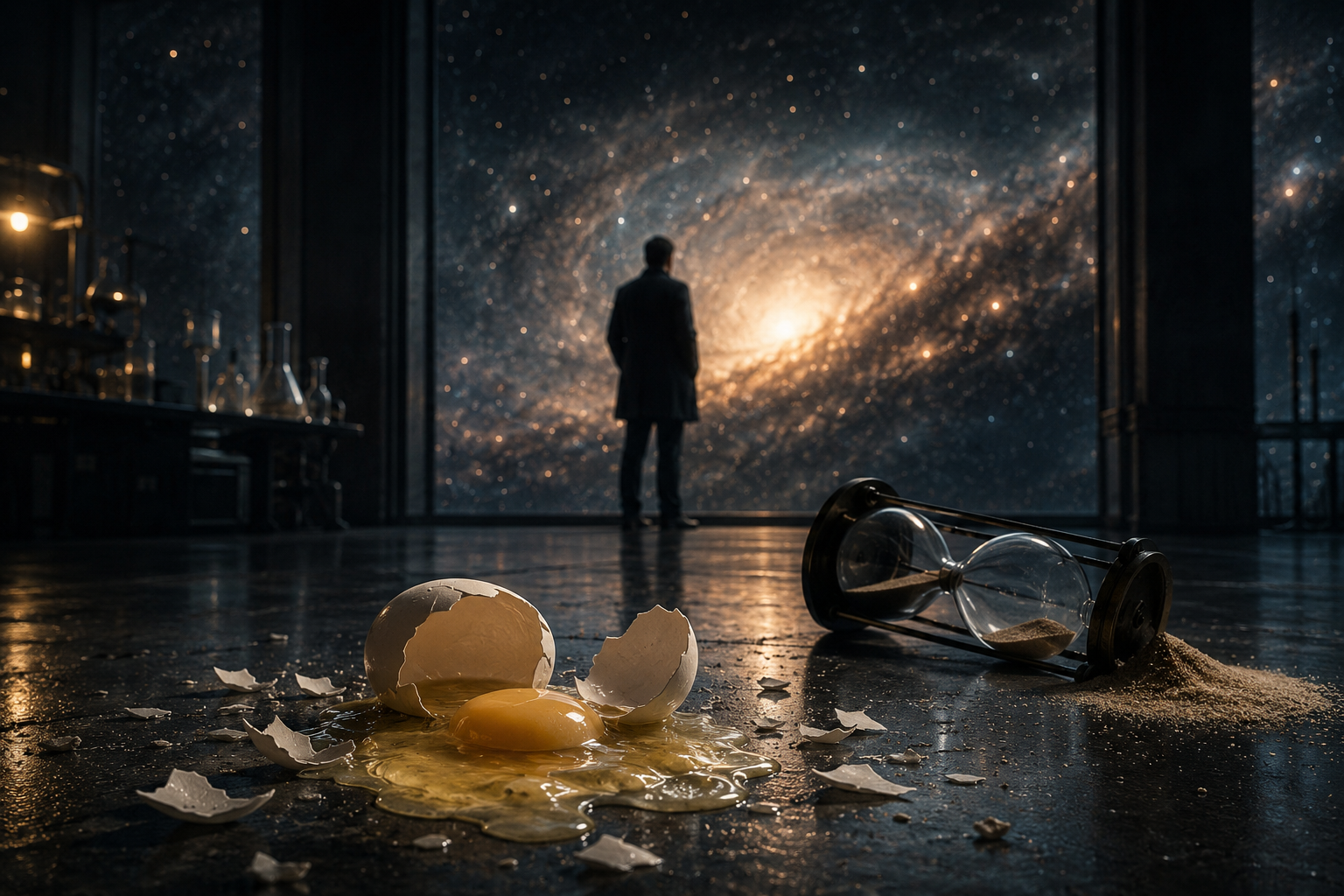
The Hidden Law Of Disorder That Gives The Universe A Past And Future
The Strange Problem Hidden Inside Every Clock
Time feels obvious because life is built around it. Morning becomes afternoon, children become adults, cups fall, glass breaks, people remember yesterday and not tomorrow. The world appears to move in one clean direction, as if reality has a built-in arrow pointing from the past into the future.
The strange part is that many fundamental laws of physics do not strongly prefer one direction of time over the other. A simple collision between two ideal billiard balls can often be described forward or backward without breaking the basic equations. Yet real life does not behave like a reversible video. A smashed glass does not leap back onto the table and rebuild itself.
That gap between reversible physics and irreversible experience is the mystery. The leading clue is entropy: the measure of how spread out, mixed up, or statistically disordered a system has become. The thermodynamic arrow of time is one of the most important asymmetries in the physical universe, because it appears to explain why the future looks different from the past.
Entropy Is Basically The Universe Making A Mess
The easiest analogy is a bedroom. A tidy room has clothes folded, books stacked, and the bed made. There are only a few ways for the room to be perfectly tidy. A messy room, by contrast, can be messy in almost endless ways: socks under the chair, books on the floor, sheets twisted, drawers half open.
That is entropy in simple terms. Low entropy means order: fewer possible arrangements. High entropy means disorder: many possible arrangements. Nature tends to move from the rare, tidy arrangement toward the common, messy arrangement because messy outcomes are statistically far easier to reach.
This does not mean disorder is magic. It means probability is brutal. If you shake a box full of puzzle pieces, they will almost never land as a completed picture. They will land as a pile because there are far more ways to be a pile than a finished puzzle.
Britannica describes entropy as commonly understood as a measure of disorder, with matter moving from more ordered states toward more disordered ones in many thermodynamic processes. That simple idea becomes explosive when applied to time itself.
The Broken Egg Explains The Arrow Of Time
Imagine filming an egg falling from a table. It drops, hits the floor, cracks, and spreads into shell, yolk, and mess. If someone plays that video normally, nobody is confused. If someone plays it backward, everyone instantly knows something is wrong.
Why? Because the backward version shows entropy decreasing. It shows scattered shell pieces finding each other, yolk pulling itself back together, and the whole egg jumping neatly into its original form. Physics does not say every microscopic motion is impossible in reverse, but probability makes the reverse event so unlikely that it might as well never happen in ordinary life.
The egg gives your brain a timeline. Whole egg first, broken egg second. That is the arrow of time in its simplest form: the direction in which entropy increases.
A similar example is perfume in a room. Open a bottle, and the scent spreads out. Nobody expects all the perfume molecules to suddenly gather back into the bottle. The smell spreads because there are vastly more ways for molecules to be scattered through the room than trapped neatly inside one small container.
The Past Looks Ordered Because The Future Looks Messier
This is why photographs can reveal time. Show someone a picture of a clean wine glass and another picture of shattered glass on the floor, and they know the order. The intact glass came before the broken glass. The low-entropy state came before the high-entropy state.
That is the hidden logic behind ordinary memory. We remember the past because the past left records: footprints, scars, photographs, fossils, documents, wrinkles, ruins, smoke, ash. A record is a physical trace, and physical traces are created through irreversible processes.
Think of walking across wet concrete. Before you step, the surface is smooth. After you step, there is a footprint. The footprint is a record of the past because the world changed in a way that is not naturally undone. Time feels real because the universe keeps producing evidence of what has already happened.
This is why entropy is not just a technical physics concept. It may be the reason reality has a story. Without entropy increasing, events would not have the same obvious before-and-after structure.
The Biggest Question Is Why The Universe Started So Tidy
The deepest mystery is not simply that entropy increases. The deeper problem is that entropy had room to increase in the first place. For time to have a strong arrow, the early universe must have begun in a very special, low-entropy state.
That is strange because low-entropy states are rare. A perfectly ordered deck of cards is rare. A shuffled deck is common. A completed puzzle is rare. A scattered pile is common. A pristine egg is rare compared with the many possible ways an egg can be broken.
So the uncomfortable question is this: why did the universe begin like a perfectly ordered deck? Why was the starting condition so special? Why was there so much order available to be spent?
This is sometimes called the “Past Hypothesis”: the idea that the universe began in an unusually low-entropy state. The Stanford Encyclopedia Of Philosophy notes that many explanations of time’s arrow depend on this special initial condition.
Gravity Makes The Mystery Even Stranger
The early universe was hot, dense, and smooth. To everyday intuition, smoothness sounds like disorder. If everything is evenly mixed, that seems like maximum mess. But gravity changes the story.
With gravity, a smooth universe can actually be very low entropy. That is because gravity likes clumping. Over time, matter gathers into stars, galaxies, black holes, and vast cosmic structures. The universe becomes more complex, more clumped, and in a gravitational sense, more entropic.
This is like starting with a perfectly flat field of snow. At first, everything is smooth and untouched. Later, footprints, trenches, melted patches, and piles appear everywhere. The later scene has more structure, but also more ways to be irregular and messy.
That means the early universe was not “tidy” in the same way a bedroom is tidy. It was cosmically special. It had a kind of gravitational order that allowed stars, galaxies, planets, chemistry, life, memory, and history to unfold.
Time May Be Something The Universe Creates
Some physicists now explore an even more radical possibility: time may not be fundamental in the way we instinctively imagine. Instead of time being the stage on which everything happens, time may emerge from physical change, entropy, and information.
A simple analogy is a receipt printer. The machine does not show you a grand invisible timeline. It prints one record after another. The order appears because each new mark comes after the previous mark and cannot be cleanly erased from the chain.
The universe may work something like that. Interactions leave traces. Traces become records. Records create memory. Memory creates the difference between past and future.
Recent work in physics and information theory explores whether time could emerge from the irreversible accumulation of information rather than existing as a basic background ingredient. The idea remains debated, but it sharpens the deeper point: what humans call time may be inseparable from the universe’s ability to keep records of change.
The Simple Version Is Still The Most Powerful
The simplest way to understand the entropy mystery is this: the universe is not like a clock ticking in an empty room. It is more like a sandcastle slowly collapsing, a hot coffee cooling, a room becoming messy, a perfume cloud spreading, or an egg breaking on the floor.
Each example shows the same pattern. Ordered states are rare. Disordered states are common. Once systems move into the common state, they almost never naturally climb back into the rare one.
That statistical imbalance may be what gives time its direction. We call one side “past” because it was more ordered. We call the other side “future” because it is where entropy has increased.
The haunting question is not whether broken eggs stay broken. The haunting question is why the universe began as an egg that could be broken at all. If time exists because entropy rises, then the birth of time may depend on the strangest fact in physics: the universe started with an enormous supply of order, and everything since has been the long, brilliant consequence of spending it.
