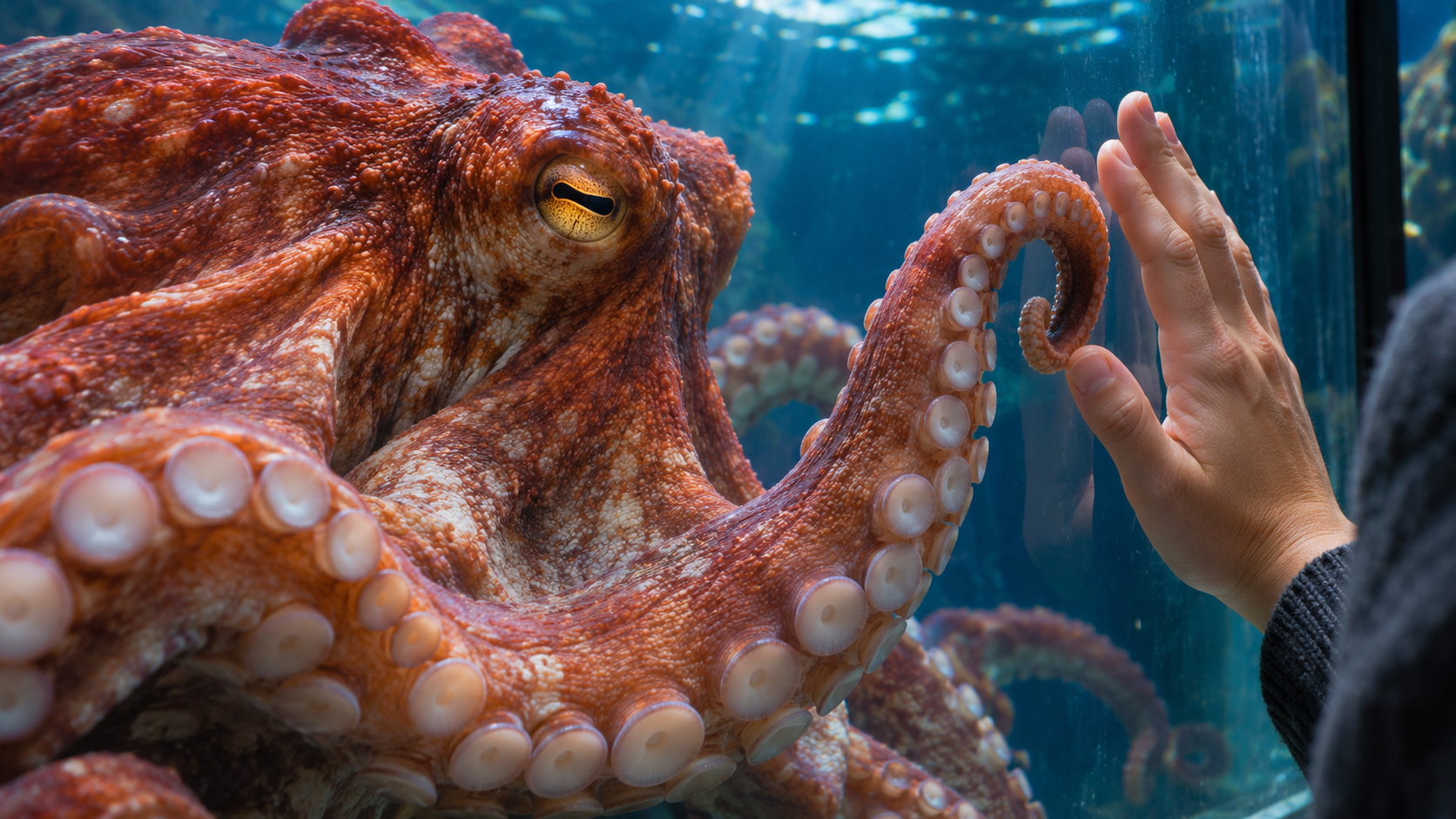
Where Recognition Ends and Friendship Begins
Does It Know Who You Are?
An experiment with human handlers offers a window into octopus learning, while leaving deeper questions about faces, feelings and friendship unresolved.
One person brought food. Another touched the octopus with a bristly stick. Over repeated encounters, the animals responded differently to the two humans. A question that sounds like aquarium folklore had become something scientists could test.
Can octopuses recognise people? Yes: experimental evidence shows that giant Pacific octopuses can distinguish between individual human handlers. That finding does not establish that they recognise our faces as we do, understand our intentions or experience friendship in a human sense.
The interesting question is what recognition involves. When an animal responds to a particular person, it may be identifying a familiar appearance, anticipating an event or combining several clues. Understanding which explanation fits changes what we can reasonably say about the encounter.
The Experiment Behind the Claim
In 2010, Roland Anderson, Jennifer Mather and colleagues studied eight giant Pacific octopuses, Enteroctopus dofleini. Two initially unfamiliar handlers consistently provided different experiences over two weeks: feeding or contact with a bristly stick.
Responses differed significantly in an eye marking, arm movements and funnel direction. Breathing responses differed significantly in the four larger animals, but not the four smaller ones. The authors interpreted the results as individual human recognition. Eight animals from one species cannot establish how widespread the capacity is.
What Does It Mean to Recognise Someone?
Recognition sounds like a single ability because everyday language bundles several achievements together. You might recognise a neighbour by their face, a colleague by their voice or a friend by the way they walk. Each route can identify someone without using exactly the same information.
For an animal experiment, the question must be narrower. Can the subject reliably respond differently to two individuals? Can it do so when both individuals perform the same action? Will that distinction survive a change in setting or appearance? Those are separate tests, and success in one does not guarantee success in the others.
Imagine a hypothetical animal that approaches anyone carrying a particular bucket. Its behaviour is useful and learned, but the bucket may explain the response. Now imagine that the animal chooses the same person when neither person carries anything. The possible explanation has changed. Identity has become more plausible because the obvious object cue has disappeared.
There is also a distinction between recognising someone as familiar and knowing which familiar individual they are. A receptionist may look familiar even when you cannot place where you have met them. Remembering their name, your last conversation and the purpose of your visit adds further layers.
We should not demand all those layers before calling an animal’s performance meaningful. Equally, we should not silently add them when describing the result. The scientific task is to specify the ability demonstrated, then design the next question around what remains uncertain.
Can Octopuses Recognise Human Faces?
Human recognition and human face recognition are different claims. Establishing the second requires an experiment that isolates facial information from the rest of the person and their behaviour. The handler study does not establish that stronger conclusion.
Consider how a face-specific test could work in principle. The body, clothing and movements would need to stop providing the answer. Researchers could compare responses to controlled images or carefully standardised presentations, while checking that the animals actually perceive those displays in a meaningful way.
A photograph creates its own problem. Failure to respond to a flat image would not necessarily mean failure to recognise the person in real life. Perhaps the display removes depth, movement or another relevant feature. A good test must distinguish a missing ability from a poor way of asking the question.
Conversely, success with two photographs would not immediately establish recognition across all views. Identifying the same face from a new angle, under different lighting or among similar unfamiliar faces would make a stronger case. Each additional control removes an alternative explanation.
The wider lesson is that an accurate headline should name the level of evidence. “Can distinguish people” is already interesting. Adding “by their faces” creates a new claim with a new burden of proof.
Why Learning About Food Still Counts
An animal’s interest in a person can feel less impressive once food enters the explanation. Yet dismissing an interaction as merely food-related can obscure the question that matters: what information allows the animal to predict the food?
There is a difference between responding to food already present and responding to something that has previously predicted it. In the first case, the animal may be reacting to an immediate stimulus. In the second, past experience is helping shape behaviour before the expected event occurs.
Neither explanation automatically involves affection. Both can be investigated without treating the animal as a machine or imagining a human relationship where the evidence does not support one.
Suppose, as a thought experiment, two carers deliver identical meals but only one has previously performed an unpleasant procedure. A difference in the animal’s response would raise a question about its history with the people. If the response instead follows the feeding equipment regardless of who carries it, the equipment would deserve closer attention.
This is why “recognition or conditioning?” can be a misleading choice. Learning an association and identifying its predictor can belong to the same process. The important distinction is between a response tied to a replaceable cue and one that remains specific to an individual across changing circumstances.
What an Arm Reaching Towards You Can Tell You
Octopuses investigate their surroundings through a sensory system that differs substantially from ours. Research led by Lena van Giesen and Nicholas Bellono identified receptors in their suckers that detect chemicals through contact, including molecules that dissolve poorly in water. The work helps explain the ability often described as tasting by touch.
Their arms also contain extensive neural machinery and can perform aspects of sensing and movement with considerable local control. This makes a reaching arm a poor equivalent of a human hand extended in greeting. Contact can be part of examining an object or animal, rather than an invitation with an obvious social meaning.
A hypothetical encounter illustrates the interpretive problem. An octopus touches a visitor’s hand and then withdraws. The visitor may describe a greeting, a rejection or a moment of curiosity. The observable event is simpler: contact followed by withdrawal. Choosing among the richer explanations requires information beyond the movement itself.
Context helps. Was the object new? Had food just been offered? Did the same response occur towards an unfamiliar object? Was withdrawal preceded by disturbance? These questions do not remove the wonder of the encounter. They make its description more useful.
The unusual biology explored in octopus RNA editing offers another reason to resist easy human comparisons. Different biological mechanisms need to be explained on their own terms; a striking molecular ability cannot, by itself, establish what a particular interaction means.
Do Octopuses Recognise Other Octopuses?
A separate study published in 2011 investigated recognition between common octopuses, Octopus vulgaris. Elena Tricarico and colleagues studied 24 size-matched pairs, comparing interactions involving familiar and unfamiliar animals.
Familiar pairings showed longer delays before interaction and fewer physical contacts. The researchers concluded that the animals appeared able to recognise previously encountered octopuses and retain that familiarity for at least a day. They also emphasised the need to distinguish full individual recognition from a simpler familiar-versus-unfamiliar classification.
This supports a broader discussion of recognition, but it is not a second test of remembering human handlers. The subjects, relationship and task were different.
That separation is useful whenever several studies appear under one attractive headline. Evidence that an animal distinguishes a familiar neighbour, remembers a place or learns a feeding signal can inform the next experiment. It cannot be substituted for an experiment on a different ability just because all the results involve memory.
How Long Could an Octopus Remember You?
There is no defensible universal number to attach to this question from the studies discussed here. A demonstration across repeated encounters does not establish how long recognition lasts once the encounters stop. Nor does remembering another octopus for a tested interval establish the maximum duration of memory for a person.
To measure retention, researchers would need to introduce a delay after learning and test performance again. A programme might compare different intervals while controlling what happened between encounters. Those are proposed experimental choices, not established limits on octopus memory.
Repeated testing introduces another complication: the test itself can become a reminder. If an animal encounters the familiar person every day, researchers are no longer measuring what happens after an uninterrupted absence. They may be measuring a memory repeatedly refreshed by new experience.
Failure after a delay would also need careful interpretation. An animal may fail to express a learned preference because it is satiated, distracted or responding to changed conditions. A memory test measures behaviour under a particular set of circumstances; it does not open a complete inventory of everything retained.
This distinction between retention and performance also matters when considering how memory is retrieved. Remembering is inferred from what a subject can do, and the design of the task determines how informative that inference will be.
Can an Octopus Have a Favourite Person?
“Favourite” is a convenient everyday description of a preference. As a scientific claim, it needs an observable definition. Does the animal approach one person more often, approach sooner, spend longer nearby or choose between two people presented together?
Those measures would not necessarily produce the same answer. An animal could approach a food-associated person quickly and still spend more time investigating someone unfamiliar. Calling both behaviours affection would erase the distinction between anticipation and novelty.
A useful preference test would give the animal a genuine choice. If only one person is ever present, approaching that person cannot establish that they are preferred over anyone else. If two people occupy fixed positions, a preference for one side of the enclosure might masquerade as a preference for a person.
In a proposed study, alternating positions and standardising what the people do would help. Researchers could also ask whether the preference remains when food is absent and whether it persists after routines change. A consistent response across those conditions would be more informative than one enthusiastic encounter.
Friendship is a further interpretation. The word normally implies a relationship extending beyond a single predictable benefit, and it carries assumptions about emotion and reciprocity. A person can find an encounter deeply meaningful without claiming that the animal experiences the same relationship in the same way.
Does Avoidance Mean an Octopus Holds a Grudge?
“Grudge” adds a story about resentment to an observation of avoidance. If an animal withdraws from a particular person, several explanations could fit: a learned prediction of disturbance, sensitivity to their movements or a response to something happening nearby.
To call it revenge would add even more. Revenge implies that an action is directed at someone because of a remembered wrong, rather than simply because the individual is currently unwanted or associated with something unpleasant. Those interpretations require different evidence.
Imagine a hypothetical observation in which an animal repeatedly retreats when one carer arrives. The useful record would identify the carer, the timing, recent feeding, movements and the animal’s behaviour before arrival. “Still angry” supplies none of those details and makes the explanation sound settled before it has been tested.
Neutral descriptions are not an assertion that animals lack feelings. They keep the observation distinct from the emotional explanation so that both can be examined. That distinction protects against sentimental exaggeration and against dismissing potentially meaningful behaviour too quickly.
Recognition and Sentience Are Different Questions
Sentience means the capacity to have felt experiences. Recognising a person is a cognitive ability; experiencing something as pleasant or unpleasant concerns what the event is like for the animal. The two questions are related, but neither can simply stand in for the other.
Robyn Crook’s 2021 research provides a separate line of evidence. Octopuses avoided a context associated with a harmful stimulus and preferred a context associated with local anaesthetic relief when they had received that stimulus. Animals without the painful treatment did not show the same preference for relief. Behavioural observations and nerve recordings together supported the interpretation of an affective component of pain.
A 2026 review led by Alexandra Schnell assessed cephalopod sentience using eight criteria. It found strong evidence for octopuses and cuttlefish, with high or very high confidence for six criteria in each group. The review also distinguished missing evidence from evidence that a capacity is absent.
Neither finding tells us that an octopus feels affection for a particular person. They do show why its welfare cannot sensibly depend on proving that kind of relationship. An animal need not love a human to have experiences that deserve consideration.
The broader difficulty of understanding subjective experience should encourage precise questions. Recognising, remembering, anticipating and feeling are connected possibilities, each requiring evidence suited to the claim.
The Human Is Part of the Experiment
For researchers and carers, individual recognition has a practical implication: the person interacting with an animal may influence the result. Treating all handlers as interchangeable could hide a source of variation.
The 2015 consensus guidelines for cephalopod research explicitly acknowledge evidence that giant Pacific octopuses may recognise people. They recommend separating staff involved in potentially aversive procedures from routine feeding or inspection, because an animal could develop avoidance associated with a handler.
Consider a proposed puzzle-solving task. If one investigator presents the task and a different investigator repeats it later, a change in performance might be attributed entirely to the puzzle. Yet the animal’s previous experience with each investigator could also matter. This is a possible confound to test, not proof that every inconsistent result is caused by recognition.
Recording who was present, standardising procedures and using video scored by someone unaware of the experimental condition would make the interpretation stronger. The aim is to prevent expectations about the animal from deciding what its behaviour is taken to mean.
There is a broader methodological point here. The observer does not always sit outside the situation being observed. Where a living subject can learn about the observer, their shared history can become part of the conditions of the test.
What Would Make the Evidence Stronger?
The next useful studies would separate the person from the predictable event. One approach would be to establish different histories with several people and then present those people under matched, neutral conditions. Another would examine whether recognition transfers across clothing, location and posture.
No single control settles everything. Matching clothing leaves other visual differences intact. Using screens standardises the image but changes the encounter. Concealing movements may remove the very information the animal normally uses. Researchers need several complementary tests, each with a clear reason for its design.
Larger samples would help reveal variation between animals, while work across species would test how widely the ability occurs. Replication by independent teams would show whether a result depends on one setting, one procedure or a particular pairing of people and animals.
A further improvement would be to decide in advance which behaviours count as evidence. If investigators record ten different movements and later highlight only the one that differs, readers need to know about the other nine. An observation discovered during exploration can be valuable, but a fresh test should establish whether it survives a specific prediction made beforehand.
The identity of the humans deserves attention too. An experiment using only one pair could leave open whether an unusually conspicuous difference makes that pairing easy. Adding people with varied appearances and reversing their roles across independent groups would help distinguish a general learning capacity from an advantage peculiar to the original comparison.
The most revealing result might therefore be less theatrical than a memorable encounter. A modest, repeatable difference under well-controlled conditions could tell us more than a dramatic approach captured once on camera. Reliability makes it possible to ask how an ability works instead of arguing indefinitely about what a single moment meant.
Positive results would gradually support a richer account of recognition. Negative results would be informative too, provided the task was appropriate. They might show that a response depends on context, that an apparent identity cue is replaceable or that an ability is less general than expected.
For anyone watching an octopus, the best question is therefore more specific than whether it likes us. What has this animal learned about this encounter, and what observation would reveal that learning? The answer begins with allowing the animal’s behaviour to challenge the story we arrived wanting to tell.
Sources
Anderson and colleagues — Octopuses (Enteroctopus dofleini) Recognize Individual Humans — The 2010 experiment involving eight giant Pacific octopuses and two human handlers.
Tricarico and colleagues — I Know My Neighbour: Individual Recognition in Octopus vulgaris — Familiarity and recognition between common octopuses, including the distinction between familiarity and full individual recognition.
Harvard University — Touch and Taste? It’s All in the Suckers — The researchers’ account of contact-based chemical sensing and the arm nervous system.
Robyn Crook — Behavioral and Neurophysiological Evidence Suggests Affective Pain Experience in Octopus — Experimental evidence concerning pain, place avoidance and relief.
Schnell and colleagues — Sentience in Cephalopod Molluscs: An Updated Assessment — The 2026 review of evidence for cephalopod sentience.
Fiorito and colleagues — Guidelines for the Care and Welfare of Cephalopods in Research — Guidance on human interactions, learned avoidance and research care.
Next Reads
The Octopus Paradox: Adaptive but Doomed — Explore RNA editing and the relationship between octopus biology and life history.
Consciousness Explained: Why Science Still Cannot Explain Your Inner Experience — Examine the distinction between observable processing and subjective experience.
The Science of Memory: How Memory Works, Changes, and Retrieves Experience — Explore the broader problems of storing, retrieving and interpreting memories.
