How Far Is That From Life?
From Asteroid Dust to DNA
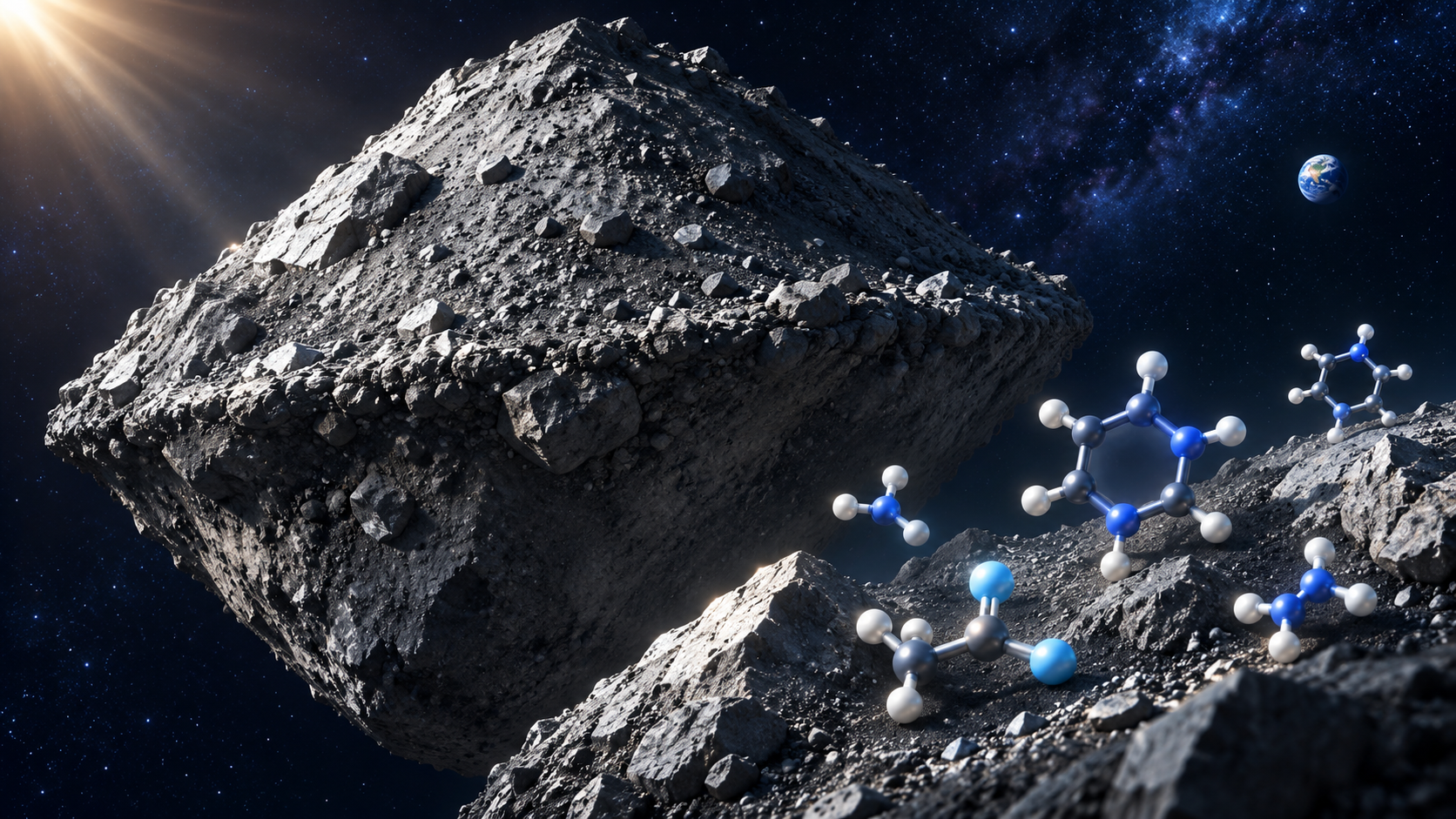
Samples returned by Japan’s Hayabusa2 mission contain all five canonical nucleobases, strengthening the case that asteroids supplied some of the chemistry needed before life began.
The material brought home from Ryugu weighed only about 5.4 grams. Inside that small collection of asteroid grains, researchers have found molecules that connect the chemistry of space with the biology of every living person.
The central discovery is precise: samples from Ryugu contain all five canonical nucleobases used across DNA and RNA. They are adenine, guanine, cytosine, thymine and uracil. The finding was published in March 2026, extending earlier research that identified uracil and other organic compounds in material returned by Japan’s Hayabusa2 spacecraft.
These are ingredients from which biological systems build genetic molecules. Their detection does not mean scientists found DNA, cells or alien organisms on Ryugu.
What it does establish is a more compelling starting point for the origin-of-life debate. Some of the chemistry that biology depends on was available beyond Earth. The difficult question is how that chemistry became part of something capable of living.
What Changed Between the Earlier Discovery and the 2026 Study?
Ryugu’s scientific story has unfolded through successive analyses of the returned material.
In March 2023, a team led by Yasuhiro Oba reported uracil in Ryugu extracts. The research also identified nicotinic acid, a form of vitamin B3, alongside related compounds. Earlier investigations had already revealed a wider assortment of organic substances, including amino acids.
The March 2026 study, led by Toshiki Koga, expanded the nucleobase inventory to the complete canonical set. This is the development that distinguishes the newer finding from the often-repeated story about uracil alone.
Keeping those dates separate matters. A reader encountering the discovery in November 2026 should not be told that it has just happened. Nor should an older description of the samples be treated as the final inventory of their chemistry.
Sample-return missions produce discoveries long after their capsules land because different experiments ask different questions of the material. A spacecraft’s return starts the laboratory investigation; it does not complete it.
What Does “Building Blocks of Life” Actually Mean?
The phrase is useful shorthand, but it can conceal several different levels of organisation.
Nucleobases are components of nucleotides. A nucleotide also contains a sugar and phosphate. Nucleotides can form the chains that make up DNA and RNA, whose sequences have biological functions.
DNA normally uses adenine, guanine, cytosine and thymine. RNA normally uses adenine, guanine, cytosine and uracil. “All five” therefore refers to the combined set across the two molecules. It does not mean that ordinary DNA contains five different canonical bases.
An amino acid belongs to another category: amino acids are the units from which proteins are assembled. Finding both categories is scientifically interesting, but they cannot be treated as interchangeable discoveries.
Most importantly, the presence of components does not demonstrate the presence of the structures made from them. Detecting a base is a chemical identification. Detecting a functioning genetic system would require evidence of organisation and activity far beyond that identification.
This distinction makes the result more useful. It tells researchers which part of the problem the samples address: the availability of precursor chemistry.
Why Bringing the Samples Home Matters
Hayabusa2 collected material during two touchdowns in 2019 and returned its sample capsule to Australia in December 2020. The second collection included material exposed by an artificial impact experiment.
The mission offered something ordinary meteorite finds cannot always provide: a known source and carefully controlled handling from collection onwards. At JAXA’s curation facility, the container was opened in a vacuum environment, with subsequent work also using high-purity nitrogen.
That care is essential when the substances being measured are familiar constituents of terrestrial chemistry. A molecule found in a rock after prolonged exposure to soil, water and living organisms raises an obvious question: was it already there?
Controlled collection greatly strengthens the interpretation of returned samples. It does not remove the need for laboratory checks. It gives those checks a much better starting point.
The achievement is therefore partly chemical and partly evidential. Researchers are examining material whose journey into the laboratory is unusually well documented.
How Scientists Find Molecules in Asteroid Grains
These discoveries do not involve looking through a microscope and recognising tiny pieces of DNA.
In the 2023 investigation, researchers extracted compounds from Ryugu material using hot water, then analysed them with liquid chromatography and high-resolution mass spectrometry. The approach separates substances in a mixture and measures properties that help identify them against reference compounds.
The analytical procedure also affects what a measurement means. The 2023 paper discussed how acid treatment could release or produce uracil from derivatives or precursor substances in an extract. That is a reason to describe the actual experiment carefully, rather than imagining every measured molecule sitting unchanged and freely exposed on the asteroid’s surface.
The broader lesson is that an inventory is built through methods with particular sensitivities and limitations. “Not detected” and “not present” are different claims. A more informative experiment can reveal chemistry that a previous analysis did not resolve.
Bennu Shows Why Comparison Is So Valuable
Ryugu is not the only asteroid whose returned samples contain biologically relevant compounds.
A 2025 study of material from Bennu identified all five canonical nucleobases and 14 of the 20 amino acids used in terrestrial proteins. The samples also contained abundant ammonia and a wide range of nitrogen-bearing organic chemistry.
That comparison shifts the research beyond celebrating one remarkable object. Scientists can ask which ingredients recur and which chemical conditions produce different mixtures.
The Bennu research linked its organic inventory to cold environments and subsequent low-temperature reactions. The 2026 Ryugu study compared nucleobase proportions across asteroid and meteorite materials, identifying an association with ammonia abundance that may help investigate formation pathways.
A correlation does not provide a complete reconstruction of every reaction. It supplies a relationship that further measurements and experiments can test.
The useful next question is therefore more specific than whether space contains complex chemistry. It is which environments favour particular compounds, and how later processing changes what survives.
Does This Mean Life Came From Space?
There are two very different propositions hidden inside that question.
One is that extraterrestrial material supplied some of the molecules involved in life’s emergence on Earth. The other is that living organisms themselves arrived from elsewhere.
The Ryugu findings support the plausibility of the first proposition. They do not establish the second. A chemical precursor can travel without any organism accompanying it.
This distinction is central to the broader discussion of life’s ingredients travelling through space. Evidence about molecular delivery should not quietly become evidence about the transport of life.
There is also no requirement to choose between an entirely terrestrial origin for every relevant compound and an entirely extraterrestrial supply. Both sources could, in principle, contribute to the same environment. Establishing their relative importance would require evidence beyond identifying substances in surviving asteroid material.
Ryugu does not provide a delivery record for the first living system on Earth. It provides a real example of an extraterrestrial chemical inventory that such explanations must take seriously.
The Gap Between Ingredients and an Origin Story
Several steps remain between a molecule in an asteroid sample and a claim about the origin of life.
For a proposed delivery pathway, researchers would need to establish how much relevant material arrived, how much survived the journey and whether it accumulated somewhere useful. For a proposed origin pathway, they would need to explain what happened next.
The distinction between detecting a compound and explaining its role is crucial. A substance might be available yet too dispersed, unstable or chemically inaccessible to contribute to a particular reaction sequence. Conversely, a modest supply could matter if a local environment concentrated it effectively. Those are questions for models and experiments, not conclusions supplied by the headline.
The discovery therefore sharpens the problem without solving it. Researchers now have stronger evidence about possible starting materials. They still need to connect those materials to sustained systems of chemical organisation.
The next decisive advance would do more than extend a list of familiar molecules. It would show how a realistic mixture, under plausible conditions, could take a demonstrable step towards the functions that make life possible.
Sources
Koga and colleagues — A complete set of canonical nucleobases in the carbonaceous asteroid (162173) Ryugu — The 2026 nucleobase study and comparisons with other extraterrestrial materials.
Oba and colleagues — Uracil in the carbonaceous asteroid (162173) Ryugu — The 2023 findings, analytical methods and extraction caveats.
JAMSTEC — Discovery of All Five Nucleobases in Asteroid Ryugu — Research institutions’ explanation of the March 2026 result.
JAXA/ISAS — Ryugu is a primitive asteroid rich in water and organic matter — Collection chronology, returned mass and controlled sample handling.
Glavin and colleagues — Abundant ammonia and nitrogen-rich soluble organic matter in samples from asteroid (101955) Bennu — Bennu’s nucleobases, amino acids and chemical context.
Hokkaido University — Uracil found in Ryugu samples — Background on the earlier discovery and the analytical approach.
Next Reads
Panspermia’s Newest Clues: Fresh Evidence That Life’s Ingredients Travel Through Space — The wider discussion of molecular transport and the separate question of living organisms travelling between worlds.
