Cosmic Gamma Rays Put Einstein’s Light-Speed Rule Through an Even Tougher Test
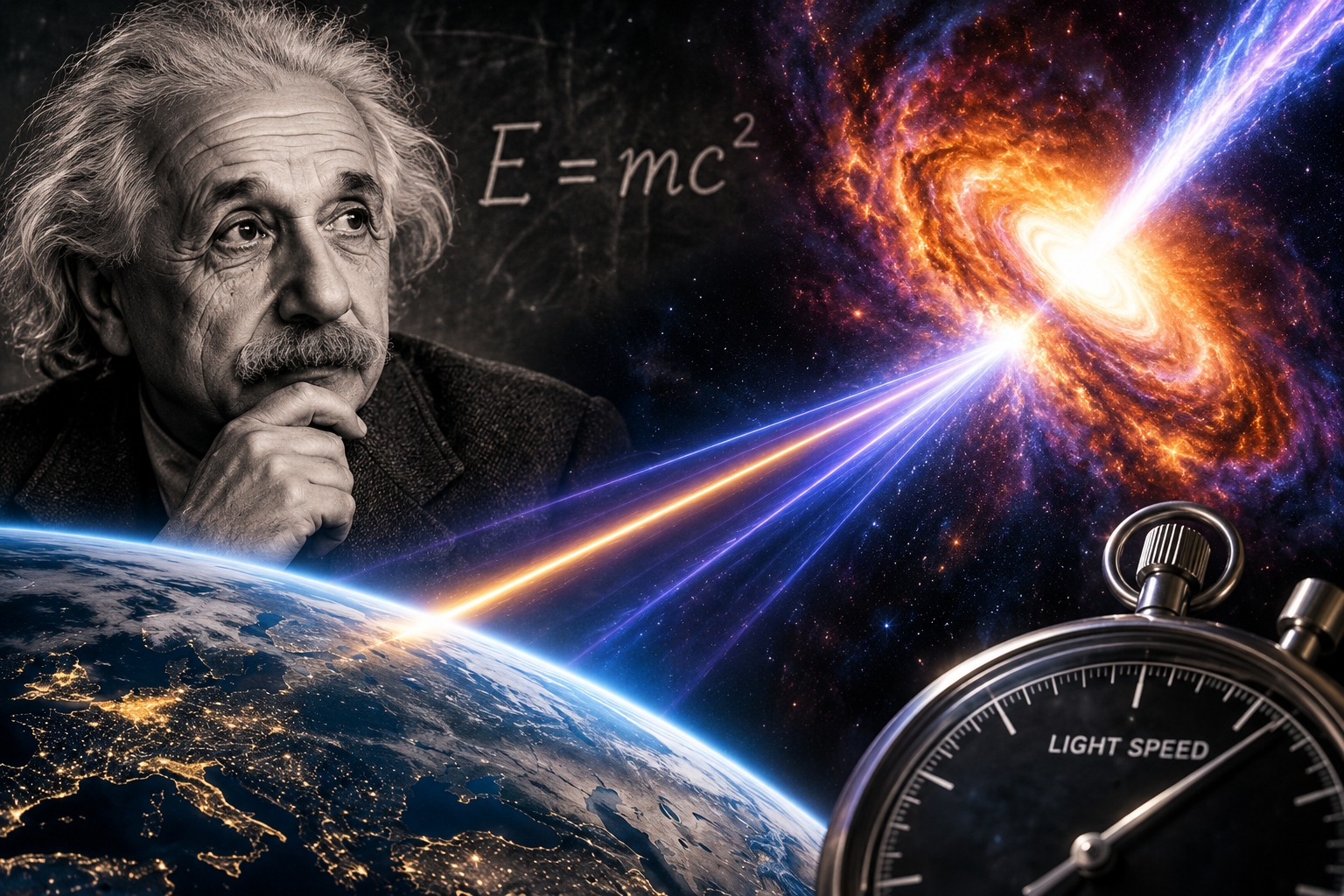
Scientists Use a Record-Bright Cosmic Explosion to Test Whether Light Really Has One Speed
A Billion-Year Test of the Speed of Light
Photons from the extraordinary gamma-ray burst GRB 221009A have been used to search for tiny energy-dependent differences in the speed of light, placing severe limits on some ideas about quantum gravity.
Some of the most energetic light ever measured from a cosmic explosion has put one of modern physics’ central assumptions through another demanding test.
Researchers analysing gamma rays from GRB 221009A have looked for a subtle effect that would have profound consequences if it existed: high-energy photons travelling through empty space at a measurably different speed from lower-energy photons.
They did not find persuasive evidence for such a difference.
Instead, the observations tighten constraints on models in which the structure of spacetime causes the speed of light to depend slightly on photon energy. The effect, if it exists at all in the forms tested, must be extraordinarily small.
That matters because Lorentz invariance sits near the foundations of modern physics. It is built into special relativity and underpins the relativistic framework used by quantum field theory.
The new work therefore does not announce that Einstein was wrong. It does almost the opposite. It shows how difficult it remains to find a measurable departure from one of the rules that made relativity revolutionary.
Why Gamma Rays Can Test the Speed of Light
In ordinary life, the speed of light in vacuum is treated as a universal constant.
Special relativity does not say that every observer agrees about distances, durations or whether two separated events happened at the same time. It says, among other things, that the laws of physics have the same form for inertial observers and that the speed of light in vacuum is invariant.
That principle is part of the wider symmetry known as Lorentz invariance.
The reason physicists keep testing it is not because relativity has performed badly. It has performed exceptionally well. The problem is that general relativity, which describes gravity and spacetime, still does not fit cleanly with quantum mechanics.
A successful theory of quantum gravity would have to describe situations in which both become important. Some candidate ideas allow extremely small departures from Lorentz invariance at enormous energy scales.
One possible consequence would be vacuum dispersion. Instead of every photon travelling through empty space at precisely the same speed regardless of its energy, very energetic photons might move imperceptibly faster or slower.
The difference could be far too small to measure over a laboratory distance.
Across billions of light-years, it could accumulate.
That is why gamma-ray bursts are so useful.
GRB 221009A Was an Exceptional Natural Laboratory
GRB 221009A erupted on 9 October 2022 and rapidly earned a reputation as an extraordinary event.
It was so bright that it became widely known as the “brightest of all time” gamma-ray burst. The Large High Altitude Air Shower Observatory, or LHAASO, detected tens of thousands of very-high-energy photons associated with its afterglow, including photons in the teraelectronvolt range.
That combination is rare and valuable.
Physicists need a source that is distant enough for tiny propagation effects to accumulate, energetic enough to give a wide range of photon energies, and variable enough in time for differences in arrival patterns to be measured.
GRB 221009A supplied all three.
Earlier analyses of the burst had already produced stringent limits on energy-dependent changes in the speed of light. One LHAASO study found no measurable propagation difference and placed especially strong bounds on models in which the effect grows quadratically with photon energy.
More recent work has attacked the problem with a different statistical method.
Researchers Yu Xi and Fu-Wen Shu analysed photon timing data using a technique known as dispersion cancellation, or DisCan. In simplified terms, the method asks whether shifting photon arrival times according to their energy can make the burst’s time structure appear sharper.
If a particular energy-dependent correction consistently restored a cleaner signal, that could point toward dispersion during the photons’ journey.
The analysis instead produced lower limits on the energy scale at which such new physics could become important.
The Numbers Push New Physics to Extreme Scales
For a linear energy dependence, the analysis placed a 95 per cent confidence lower limit of about 5.4 × 10^19 gigaelectronvolts for a subluminal effect, where higher-energy photons would travel slightly more slowly.
For a corresponding superluminal case, the lower limit was about 2.7 × 10^19 gigaelectronvolts.
The quadratic limits were lower in absolute energy because the assumed correction depends differently on photon energy: about 1.0 × 10^13 gigaelectronvolts for the subluminal case and 2.4 × 10^12 gigaelectronvolts for the superluminal case.
These values are not measurements of an actual quantum-gravity energy.
They are exclusions.
The higher the lower limit climbs without a signal appearing, the less room remains for models predicting a comparatively large energy-dependent shift in photon speed.
This distinction is important. Scientists have not measured the scale of quantum gravity with a gamma-ray burst. They have tested specific mathematical forms of Lorentz-invariance violation and found that any such effect must be weaker than the data would otherwise have revealed.
Why This Is Really a Test of Spacetime
The most interesting part of the experiment is not simply whether one photon outruns another.
It is what such a difference would imply.
A genuine energy dependence in the speed of light could indicate that the apparently smooth spacetime described by relativity is only an approximation. At extremely small scales, spacetime might possess structure that changes how particles propagate.
That possibility sits close to one of physics’ hardest unfinished problems: reconciling gravity with quantum theory.
As our guide to what Einstein could not solve explains, the difficulty is not that either quantum mechanics or relativity fails in the regime where it has been tested. It is that the two frameworks are built differently and resist being merged into a single complete description.
The same tension appears in attempts to understand what physics can say about the Universe before the hot Big Bang, where the limits of classical spacetime eventually collide with the need for quantum physics.
Gamma rays offer a different route into the same problem. Instead of recreating the relevant energies directly, astronomers use the Universe as the experiment.
Why Distance Makes Tiny Effects Measurable
Suppose two photons leave a distant event at nearly the same time.
If one travels even fractionally more slowly because of its higher energy, the delay grows with distance. The effect might remain invisible after a kilometre or even across the Solar System, yet become detectable after a journey lasting billions of years.
This gives astrophysics a peculiar advantage.
Human-built accelerators can generate extraordinary particle energies, but they cannot provide a propagation baseline measured across cosmological distances.
Gamma-ray bursts combine both ingredients: energetic photons and an immense journey.
That is also why the source itself creates a major complication.
Researchers do not observe the moment every photon was emitted. A gamma-ray burst is a violent astrophysical engine with its own energy-dependent timing. A high-energy photon arriving later does not automatically mean it travelled more slowly. It may simply have been produced later.
Good analyses therefore have to separate possible propagation effects from the burst’s intrinsic behaviour.
That uncertainty is one reason different methods and different cosmic sources matter.
Einstein Has Not Been Proved Untouchable
It is tempting to describe every successful relativity test as another proof that Einstein was right.
The scientific position is more careful.
No finite series of experiments can prove that Lorentz invariance must remain exact at every conceivable energy. Researchers can only keep testing predictions and pushing the allowed size of deviations downward.
There are also many different ways Lorentz symmetry could hypothetically be modified. A limit on one mathematical form does not automatically eliminate every theory of quantum gravity.
What these gamma-ray results do is make broad classes of simple energy-dependent models harder to sustain.
That is useful even without a discovery.
Physics advances not only by finding new particles or spectacular anomalies, but by closing regions of possibility. A theory that predicts a detectable effect in a region already excluded by observation has a problem.
The surviving theories must predict something subtler, different or harder to reach.
That same divide between what is established and what remains speculative runs through the modern search for a theory of everything. Elegant mathematics is not enough. Eventually, a proposed description of spacetime has to survive contact with measurement.
The Next Test May Be Even More Severe
GRB 221009A is unlikely to be the last cosmic event used this way.
Future gamma-ray observatories will collect larger samples, measure higher energies and capture transient events with greater time resolution. Combining different bursts at different distances can also help separate a genuine propagation effect from quirks of an individual source.
A real violation of Lorentz invariance would rank among the most consequential discoveries in fundamental physics.
For now, however, the message from these photons is more conservative.
Light tr
avelled across an enormous span of the Universe, at wildly different energies, without revealing the kind of energy-dependent speed variation researchers were looking for.
Einstein’s rule has not escaped testing.
The tests are becoming harder.
Sources
Chinese Physics C — “Constraints on Lorentz invariance violation from GRB 221009A using the DisCan method” — Provides the newer DisCan analysis, methodology and reported 95 per cent confidence lower limits on Lorentz-invariance-violation energy scales.
Physical Review Letters — “Stringent Tests of Lorentz Invariance Violation from LHAASO Observations of GRB 221009A” — Provides the LHAASO constraints from the exceptionally bright GRB 221009A and the reported improvement in quadratic limits.
NASA Fermi Gamma-ray Space Telescope — “Lorentz Invariance” — Explains why distant gamma-ray bursts can test whether photons of different energies propagate at the same speed.
Next Reads
What Einstein Couldn’t Solve: Unfinished Physics — Explains the unresolved tension between relativity, quantum theory and a complete description of spacetime.
What Was There Before the Big Bang? The Leading Scientific Theories Explained — Explores where classical descriptions of spacetime meet the unresolved problem of quantum gravity.
Are We Finally Closing In on the Theory of Everything? String Theory Today — Looks at current attempts to build a deeper framework capable of unifying gravity with quantum physics.
