European Glacier Could Vanish Within Days As Scientists Warn The Ice Has Reached Its End
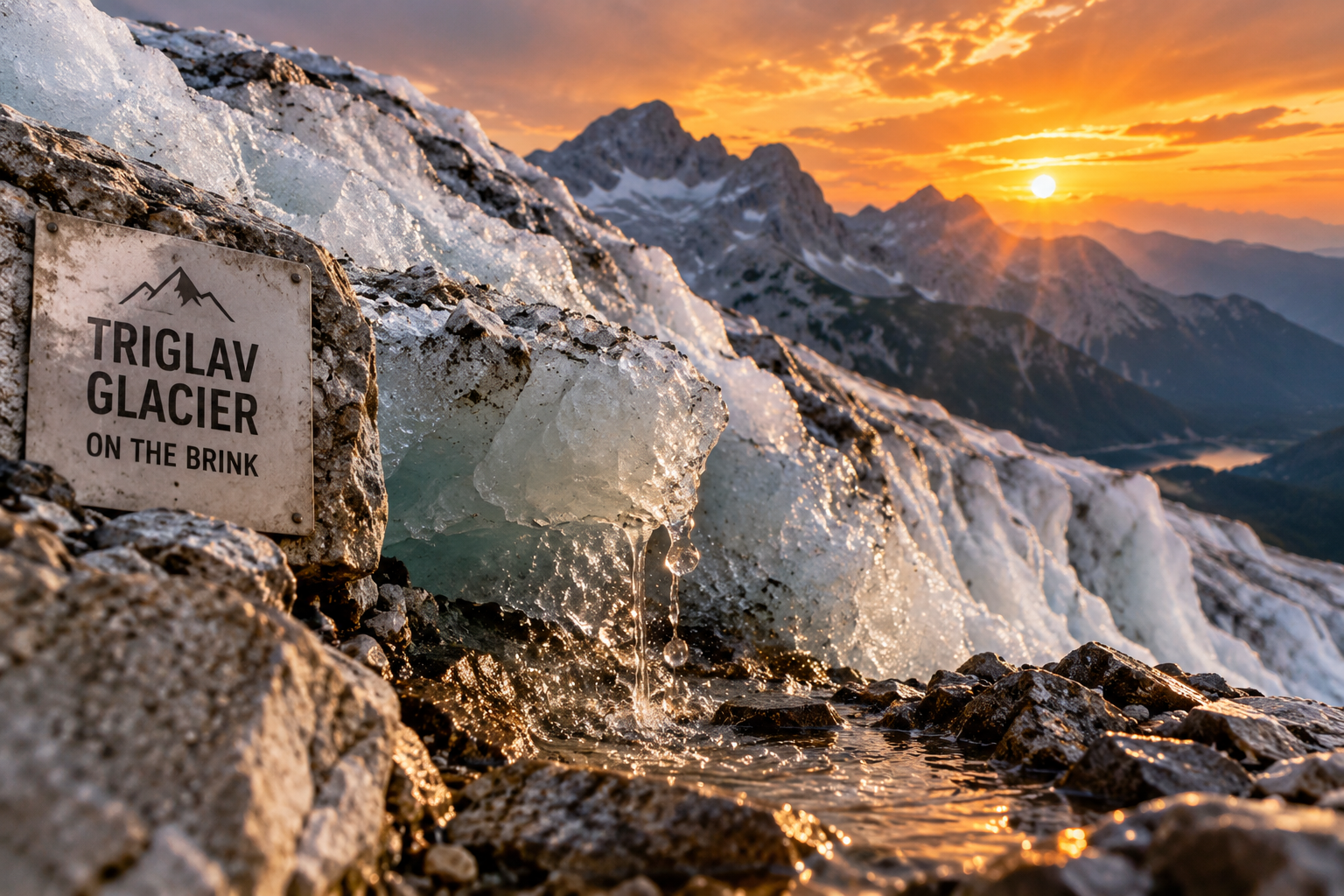
The Last Days Of The Triglav Glacier
The Warning Goes Far Beyond One Mountain
The Triglav Glacier has shrunk from roughly 14 hectares when systematic monitoring began in 1946 to scattered remnants of ice, with researchers warning that the final patches may now disappear altogether.
One of Europe’s most closely watched disappearing glaciers may have only days left.
The Triglav Glacier, high in Slovenia’s Julian Alps beneath the country’s tallest mountain, has been reduced to a few surviving patches of ice after a winter with unusually little snow and a summer that exposed the remaining ice to prolonged heat.
Miha Pavšek, a researcher at the Anton Melik Geographical Institute who has monitored the glacier for around three decades, said the remaining ice could literally disappear within the coming days.
That would bring an extraordinary scientific record to a symbolic endpoint. Researchers have followed the glacier systematically since 1946, when it covered about 14 hectares. What remains now no longer behaves like the flowing Alpine glacier that generations once knew.
Its disappearance will not send a wall of water down the mountain. The surviving ice is far too small for that kind of disaster scenario. The more serious warning lies in what is happening across the Alps as glaciers shrink, fragment and, increasingly, vanish altogether.
Eighty Years Of Ice Loss Are Reaching Their Final Stage
Triglav is not simply experiencing another bad summer.
Its transformation has unfolded across decades.
When systematic measurements began after the Second World War, the glacier occupied roughly 14 hectares beneath Mount Triglav. Over time it thinned, retreated and broke apart. Researchers have said for years that it had lost many of the physical characteristics required to function as a true glacier.
A glacier is more than permanent snow. It is an ice body substantial enough for gravity to drive internal deformation and movement. Once an ice mass becomes too small and fragmented, that dynamic behaviour effectively stops.
That point had already been reached at Triglav before the final ice disappeared.
The remaining question was how long the remnants could survive.
The winter of 2025 to 2026 made the answer more urgent. At the Kredarica weather station below Mount Triglav, maximum snow depth reached only about 220 centimetres, compared with an average of roughly 374 centimetres during the 1991 to 2020 reference period.
Normally, substantial snow can survive well into early summer and shield glacier ice from direct solar radiation. This year the snow cover disappeared exceptionally early. By the end of May, the station was effectively snow-free.
The exposed ice then faced months of summer melting without its normal protective layer.
Why Scientists Think The Glacier Could Disappear Now
The mechanism is brutally simple.
A glacier needs enough winter accumulation to replace at least part of what melts in summer. Triglav has been losing that balance for decades.
Less snow means less new mass. Earlier snowmelt exposes darker ice and rock sooner. Those surfaces absorb more solar energy than bright snow, accelerating local warming and melt. Repeated hot seasons then remove ice that took decades or longer to build.
Researchers studying the surviving Triglav ice have found material more than 70 years old below the surface. That makes the final melt more than a visual change to the landscape. It is the destruction of a small frozen environmental archive.
The wider European heat problem also matters. Europe has been warming faster than the global average, while the Alps experience especially strong warming because of their elevation, snow feedbacks and changing seasonal conditions.
Slovenian researchers say the Alpine region is warming roughly two to three times faster than the global average. At Kredarica, years with median annual temperatures above freezing have become increasingly common. Since 2022, they have occurred continuously.
The Triglav Glacier has therefore reached its apparent final stage through accumulated pressure, not one isolated heatwave.
Could The Glacier’s Disappearance Cause Flooding?
Not in the dramatic sense suggested by images of a glacier suddenly collapsing and releasing a torrent.
The remaining Triglav ice is already extremely small and fragmented. There is no evidence in the current warnings of a large glacial lake sitting behind an unstable ice dam, nor of enough stored meltwater to produce a major sudden flood when the last ice disappears.
The final melt itself should therefore be understood as a loss of ice, not an imminent flood event.
That does not mean glacier retreat is unrelated to flooding elsewhere.
Across mountain regions, retreating glaciers can expose unstable rock, create or enlarge lakes and alter drainage systems. In some locations, water can accumulate behind weak natural barriers and later escape in a glacial lake outburst flood. Melting permafrost can also weaken slopes and increase the risk of rockfalls, debris flows and landslides.
Those are real mountain hazards, but they depend heavily on local geography. They should not be transferred automatically to Triglav simply because its glacier is disappearing.
For this glacier, the more immediate hydrological lesson points in almost the opposite direction: eventually, there is less ice available to melt.
The Bigger Threat Is Losing A Natural Water Reserve
Glaciers act as long-term stores of frozen water.
During hot, dry periods, meltwater can help sustain streams and rivers after seasonal snow has already disappeared. At first, accelerated melting can temporarily increase summer runoff. But once enough ice has been lost, that extra contribution declines.
It is a temporary dividend paid by destroying the asset itself.
Researchers in Slovenia have warned that the retreat of larger glaciers elsewhere in the Alps, particularly in neighbouring Austria, could eventually reduce flows feeding the Drava and Mura river basins. Those waters support agriculture and irrigation across parts of Slovenia.
The same principle can be seen farther west. Swiss glaciers lost more than five per cent of their remaining ice volume during 2026 alone after a snow-poor winter and extreme summer heat. Nearly one fifth of Switzerland’s glacier volume has disappeared in just five years.
During the worst melt periods, that ice releases immense quantities of water. Yet as the glaciers shrink, there is progressively less stored ice left to provide the same buffer in future droughts.
That connects Triglav to a much wider question of how climate change is reshaping water security across Europe.
What Happens After A Glacier Disappears?
The physical landscape does not instantly become stable when the ice is gone.
Freshly exposed rock and sediment begin responding to rain, frost, erosion and gravity. Mountain ecosystems shift. Plants colonise surfaces that may have been ice-covered for centuries. Water pathways change. Scientists also lose access to frozen material that can preserve chemical and environmental information about the past.
For researchers in Slovenia, the work is already moving underground.
The Anton Melik Geographical Institute has begun placing greater attention on high-altitude ice caves, where permanent ice several metres thick can still preserve records of earlier climatic conditions. More than 200 ice caves are known in Slovenia, although their ice is also declining.
Triglav therefore does not mark the end of cryosphere research in the country. It marks a change in what is left to study.
The glacier’s disappearance will also carry a cultural weight difficult to express through surface-area measurements alone. Mount Triglav is the dominant national mountain symbol of Slovenia. The glacier beneath it was once large enough to attract summer skiing. Its retreat has been photographed and measured across several generations.
A natural feature that appeared permanent within a human lifetime has instead been reduced almost to nothing.
Triglav Is Small — The Alpine Warning Is Not
It would be easy to dismiss the disappearance of such a tiny surviving ice body as largely symbolic.
In isolation, its effect on European sea level or global climate is negligible. Losing Triglav will not flood cities, change the planet’s orbit or suddenly transform Europe’s weather.
But that is precisely why the glacier matters as evidence.
Scientists did not discover its decline through a short modern dataset. They have watched the same patch of mountain for eight decades. The trajectory is documented from a functioning glacier covering about 14 hectares to broken remnants that may now be measured in their final days.
The pattern extends far beyond Slovenia. Several small Swiss glaciers have already disappeared permanently, while major Alpine glaciers continue losing metres of thickness in individual years. Research modelling larger glaciers points towards profound losses across the European Alps during this century.
The question of what happens as warming continues is therefore no longer confined to distant projections. In parts of the Alps, the changes predicted for a warmer climate are now physical absences on the map.
For the Triglav Glacier, the process may be almost complete.
After 80 years of systematic observation, scientists are no longer documenting how far the glacier has retreated.
They are watching for the moment when there is no glacier left to measure.
Sources
Government of Slovenia — Triglav Glacier On The Brink Of Extinction — Official September 2026 account of the glacier’s condition, snowfall deficit, long-term monitoring and expected disappearance.
Reuters — Slovenian Glacier Could Disappear In Days, Researchers Say — Current 5 October 2026 reporting and comments from researcher Miha Pavšek on the final remaining ice and regional water implications.
ETH Zurich — Devastating Year For Switzerland’s Glaciers — Evidence on 2026 Alpine glacier losses, snow deficits, meltwater and the disappearance of smaller Swiss glaciers.
Next Reads
The Omega Block Turning Europe Into A Climate Warning — How persistent atmospheric patterns and a warmer climate are intensifying European heat extremes.
Global Warming: Scientific Reality, Political Weapon or Both? What the Evidence Actually Says — A broader evidence-led examination of warming, glaciers, climate predictions and political arguments.
World’s Oceans Absorbed A Record Amount Of Heat — What Happens Next Could Reshape Coastlines — How accumulated planetary heat connects with sea-level rise, land-ice loss and future coastal risk.
