

Einstein’s Gravity Explained: The Invisible Rule That May Decide Why The Universe Exists
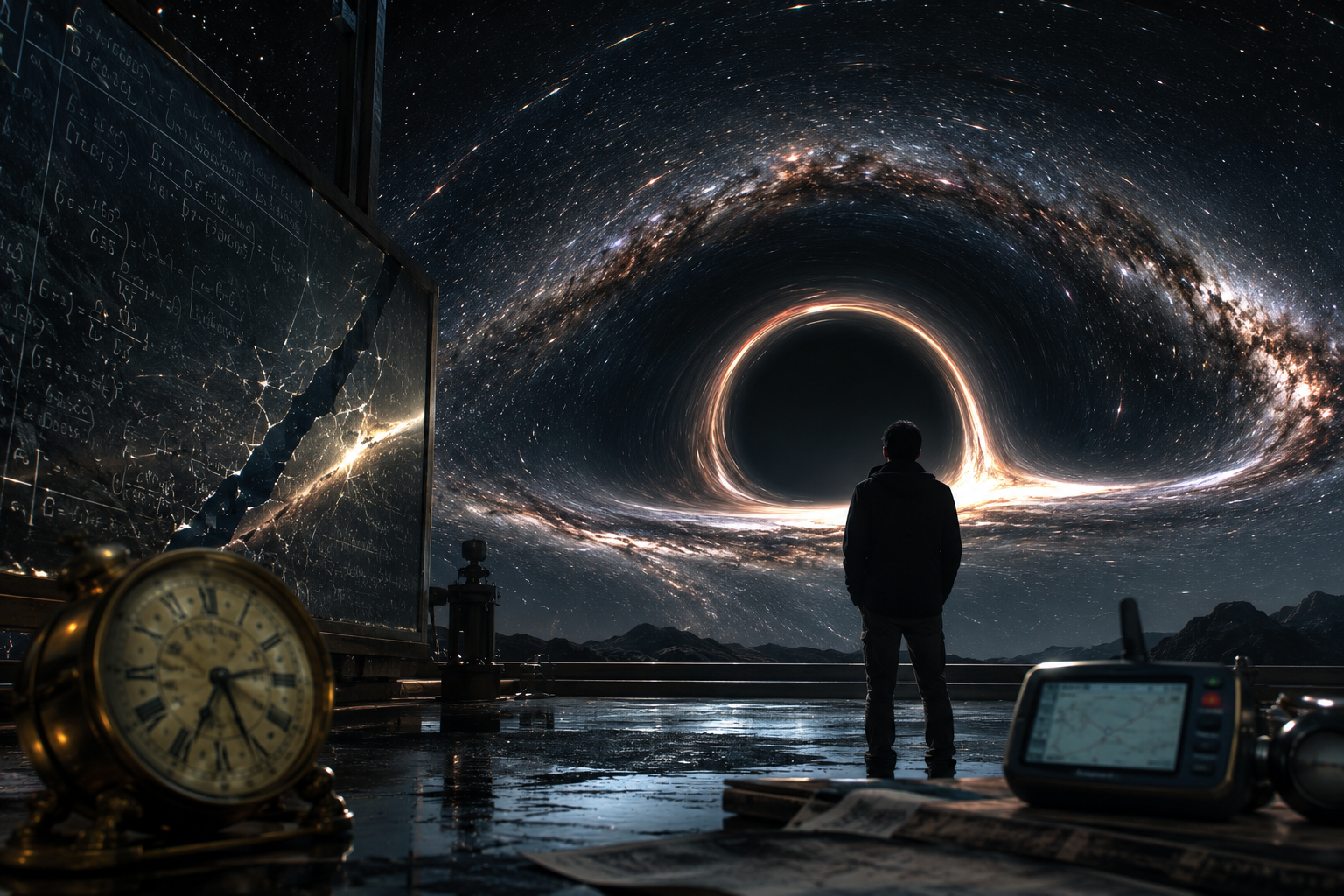
General Relativity Explained: The Theory That Turned Space, Time, And Reality Inside Out
Before Einstein, The Universe Looked Like A Giant Machine
For most of human history, the universe looked like something built around us. Ancient people saw the sky as a dome, the stars as fixed lights, and the Earth as the obvious center of everything. The heavens seemed perfect, distant, and almost untouchable, while Earth was the messy place where things fell, burned, aged, and died.
That picture slowly cracked. Copernicus moved Earth away from the center. Galileo showed that the heavens were not perfect glassy spheres. Newton then gave the world a much more powerful idea: the universe was a machine, and gravity was the invisible force pulling its parts together.
Newton’s universe was brilliant because it worked. Apples fell, planets orbited, cannonballs curved, and tides rose because objects attracted one another. Gravity was like an invisible rope between masses. The Sun pulled on Earth. Earth pulled on the Moon. Everything tugged on everything else.
But Newton’s theory had a strange problem hiding inside it. It described what gravity did with astonishing accuracy, but it did not really explain what gravity was. The force seemed to act instantly across empty space, as if the Sun could somehow reach across 93 million miles and pull Earth without anything in between.
Einstein’s Breakthrough Was To Stop Treating Gravity Like A Pull
Einstein’s great move was not to make gravity more complicated for the sake of it. It was to ask a brutally simple question: what if gravity is not really a force at all? What if objects are not being pulled through space, but are following the shape of space itself?
General relativity, published in 1915, says that space and time are not separate, fixed backgrounds. They are part of one flexible structure called spacetime. Matter and energy bend that structure, and objects move along the curves created by that bending. In Einstein’s picture, mass distorts spacetime, and what we feel as gravity is the result of moving through that distortion.
The classic analogy is a bowling ball placed on a trampoline. The ball makes a dip. If a marble rolls nearby, it curves toward the bowling ball, not because the bowling ball has thrown a rope around it, but because the surface beneath the marble has changed shape.
That analogy is imperfect, but it gets the emotional truth right. Einstein turned gravity from a mysterious invisible pull into geometry. The Sun does not simply yank Earth around. The Sun bends spacetime, and Earth follows the curved path available to it.
The Simple Way To Understand Curved Spacetime
Imagine driving across a flat map. If the road is straight, you move in a straight line. But now imagine driving over a huge landscape of hills, valleys, slopes, and dips. You may still think you are driving straight, but the shape of the ground changes where your path goes.
That is the heart of general relativity. Objects are not always “choosing” to curve. They are moving through a universe whose hidden surface is already curved. A planet orbiting a star is like a car following a road that bends around a mountain.
The stranger part is that time also bends. Near a very massive object, time runs more slowly than it does farther away. This is not poetry or metaphor. It is one of the real predictions of general relativity, and it has been tested repeatedly. GPS and other satellite navigation systems must account for relativistic timing effects because clocks in orbit do not tick exactly like clocks on Earth.
That means Einstein’s theory is not trapped on blackboards. It is inside the phone that tells someone where they are. Every time satellite navigation works properly, it quietly depends on a universe where time itself is flexible.
General Relativity Made Black Holes And Gravitational Waves Possible
Once gravity becomes curved spacetime, the universe becomes far more dramatic. If enough mass is squeezed into a small enough region, spacetime can curve so severely that not even light escapes. That is the basic idea behind a black hole.
Black holes are not cosmic vacuum cleaners in the cartoon sense. They are places where Einstein’s equations reveal something terrifying: spacetime can become so extreme that all normal escape routes vanish. The boundary around that region is called the event horizon. Cross it, and the future points inward.
General relativity also predicted gravitational waves: ripples in spacetime caused by violent cosmic events. The simplest analogy is dropping a stone into a pond, except the “pond” is the fabric of spacetime and the stone is something like two black holes colliding. LIGO describes gravitational waves as ripples in spacetime produced by some of the most violent and energetic processes in the universe.
In 2015, LIGO detected gravitational waves from colliding black holes, opening a new way to observe the universe. That mattered because humanity was no longer only seeing the cosmos with light. It had begun feeling spacetime shake.
How General Relativity Helps Explain The Existence Of The Universe
General relativity does not fully explain why there is something rather than nothing. That question still reaches beyond established physics. But it does give scientists the language needed to describe the universe as a whole.
Before Einstein, space was often imagined as the empty stage where events happened. After Einstein, space and time became actors in the story. The universe was no longer matter moving through a fixed container. The container itself could expand, curve, stretch, and evolve.
That is why general relativity sits at the foundation of modern cosmology. The Big Bang is not best understood as a normal explosion happening at one location in empty space. It is the expansion of space itself from an earlier hot, dense state. NASA’s cosmic history material places the universe’s rapid early expansion around 13.8 billion years ago and notes that scientists still do not know what came before inflation or what powered it.
This is where the theory becomes both powerful and incomplete. General relativity can describe how the universe evolves after extremely early moments. It can help model expansion, cosmic structure, gravitational collapse, black holes, and the large-scale fate of the cosmos. But when the question becomes the absolute origin, the theory begins to strain.
The deepest mystery is not simply “what exploded?” It is whether the concepts of before, space, time, and cause even make sense at the beginning. If time itself is part of the universe, asking what happened before the universe may be like asking what is north of the North Pole.
The Technology Einstein’s Theory Quietly Enables
The most obvious technology linked to general relativity is GPS. Satellite navigation depends on precise timing. If the clocks are wrong, the position is wrong. Relativity matters because satellite clocks experience both speed-related effects from special relativity and gravity-related effects from general relativity.
That turns Einstein’s theory into a working part of modern life. Navigation, aviation, logistics, finance, mapping, military systems, telecoms, and scientific measurement all rely on precision timing. The more exact the system, the less it can ignore relativity.
General relativity also enables gravitational-wave astronomy. Observatories such as LIGO use extremely sensitive laser systems to detect tiny distortions caused by passing gravitational waves. This gives scientists a new way to study black holes, neutron stars, and events too dark or distant to understand through light alone.
The theory also shapes space exploration, astrophysics, satellite engineering, cosmology, and high-precision timekeeping. It informs how scientists understand black holes, lensing, cosmic expansion, and the behavior of light near massive objects. It is not just a theory about distant galaxies. It is a practical framework for operating in a universe where time and space do not behave the way human instinct expects.
Why It Breaks Down With Quantum Physics
The problem is that general relativity and quantum physics are both spectacularly successful, but they describe reality in different languages. General relativity describes gravity as smooth geometry. Quantum physics describes the smallest parts of nature as uncertain, probabilistic, and grainy.
At large scales, general relativity rules. It explains planets, stars, galaxies, black holes, gravitational waves, and the expansion of the universe. At tiny scales, quantum theory rules. It explains atoms, particles, radiation, chemistry, electronics, and much of modern technology.
The crisis appears when both should matter at once. That happens inside black holes and at the earliest moments of the universe. General relativity predicts extreme curvature and singularities, places where the mathematics can blow up. Quantum theory says nature should not behave as a perfectly smooth classical surface at the smallest scales.
Quantum gravity is the attempt to unify those two worlds. Perimeter Institute describes the challenge as unifying quantum theory, which governs atoms and subatomic particles, with relativity, which governs gravity, space, and time.
The simple analogy is this: general relativity treats the universe like a smooth ocean, while quantum physics says that up close, the ocean is made of droplets. Both pictures work in their own domain. The unsolved problem is how the smooth ocean emerges from the droplets, or whether that analogy is still too simple.
Could AI Solve Einstein’s Unfinished Problem?
AI could help, but it is unlikely to solve quantum gravity by simply being clever on command. The problem is not just that humans have failed to find the right equation. It is that the final theory may require new mathematics, new experimental clues, and a better understanding of what space and time really are.
AI is powerful at finding patterns, testing mathematical structures, accelerating simulations, searching huge theory spaces, and identifying hidden relationships in data. In physics, that could matter enormously. It may help compare models of quantum gravity, search for signals in gravitational-wave data, generate candidate equations, or uncover patterns that humans overlook.
But AI still needs grounding. A model can propose an elegant idea that is mathematically interesting and physically meaningless. The universe does not care whether a theory sounds beautiful. It must match reality.
The most realistic path is not AI replacing physicists, but AI becoming a force multiplier for them. It could compress decades of trial-and-error into shorter cycles, expose weak assumptions, and help connect fields that currently speak different mathematical dialects. The breakthrough may come from a human-machine partnership rather than one genius at a desk.
The Final Mystery Is Not Gravity. It Is Reality Itself
General relativity remains one of the most astonishing achievements in human thought because it changed the meaning of common words. Space was no longer empty. Time was no longer universal. Gravity was no longer just a force. The universe was no longer a fixed stage, but a dynamic structure that could bend, ripple, stretch, collapse, and perhaps begin.
That is why the theory still feels dangerous. It works almost too well across the largest scales, yet it points directly toward places where it cannot finish the job. Black holes, the Big Bang, dark energy, and quantum gravity are not side puzzles. They are signs that the deepest layer of reality has not yet been translated.
Einstein gave humanity a universe made of geometry. Quantum physics gave humanity a universe made of uncertainty. Somewhere between those two visions may be the answer to why anything exists at all. Until that missing theory arrives, modern physics stands in a strange position: it can guide satellites, detect colliding black holes, and describe the expansion of space, while still staring at the oldest question like a locked door.
