Oil Emissions Are Set to Drop by 243 Million Tonnes. What Happens When Supplies Recover?
The World Could Burn Less Oil This Year And Still Release More Carbon Dioxide.
Global fossil CO₂ emissions could fall by 0.4% in 2026, the first annual decline since the pandemic year of 2020. The clearest immediate cause is the oil supply shock from the war in Iran. A longer-running change made that shock more consequential. Wind turbines, solar panels and electric vehicles were already limiting how much extra fossil fuel the world needed as energy demand grew.
The Global Carbon Project’s estimate, released on 10 November, puts fossil emissions at 38.2 billion tonnes this year. Its projected range runs from a 1.5% fall to a 0.6% rise, so even the direction could change when the final figures arrive. And across the wider carbon balance, the central estimate points upwards. Once emissions from changes in land use are included, humanity is projected to release 43.3 billion tonnes of CO₂, up from 42.8 billion in 2025.
How The Iran War Changed Global Oil Use
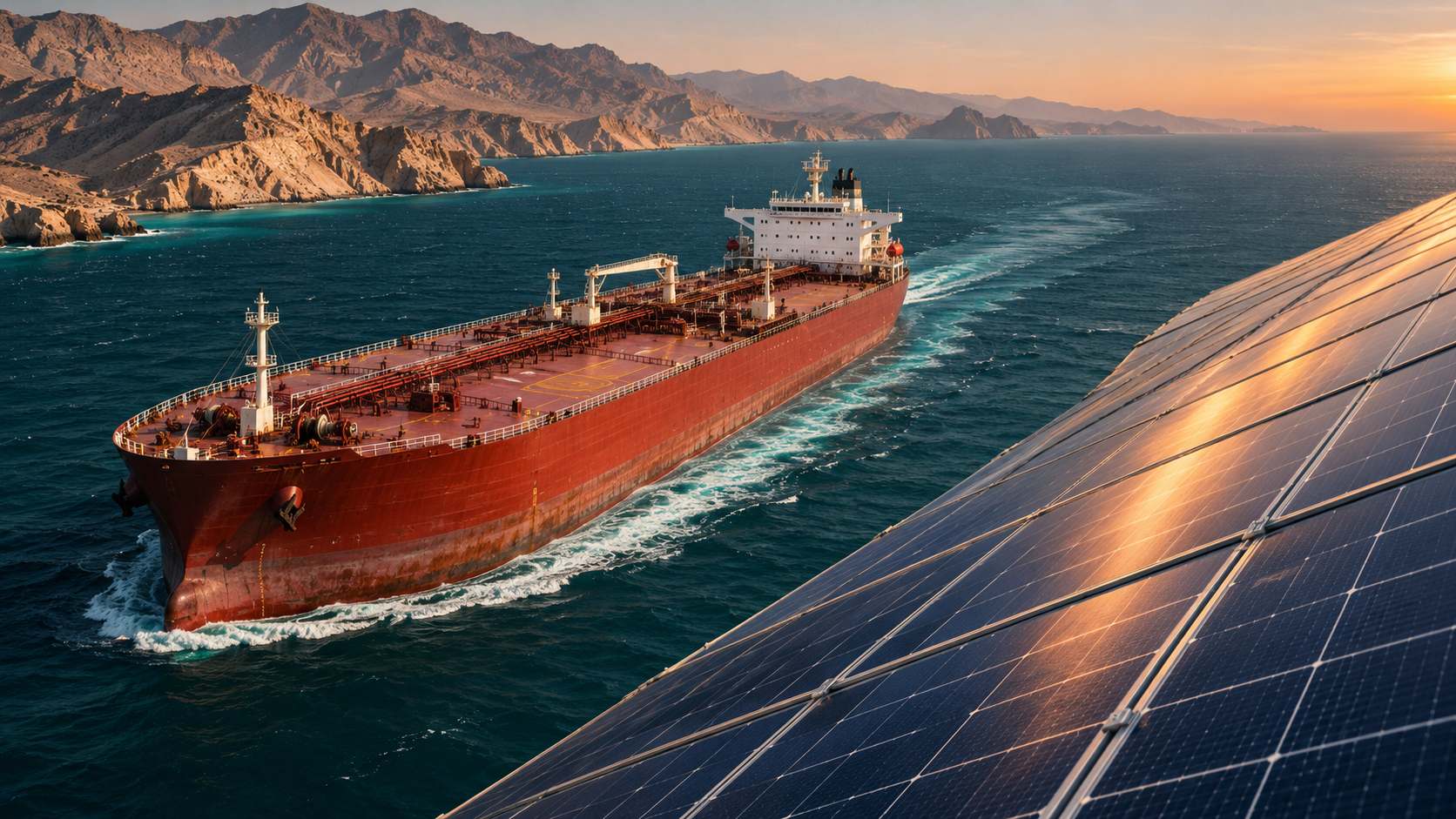
Oil provides the strongest evidence of the war’s effect. Disruption to tanker traffic through the Strait of Hormuz constrained supplies and drove up prices. The consequences travelled well beyond the Gulf. A business buying fuel on the other side of the world could face higher costs even if its own deliveries arrived on time.
The Global Carbon Project expects emissions from oil to fall by 1.9%, or about 243 million tonnes of CO₂. That reduction alone is larger than the projected fall across all fossil sources combined. Natural gas emissions are expected to edge down by 0.3%, while coal emissions are expected to rise by 0.6%. Oil did enough to pull the global figure down despite continued growth in coal.
Aviation offers a concrete example. International aviation emissions are projected to fall by around 1%, partly because of reduced activity in the Middle East. A flight that does not take place uses less fuel that year. If the route reopens and passengers return, so can its emissions. That makes the reason for a fall important when judging whether it will last.
Russia’s war in Ukraine also forms part of the supply picture. Researchers at the CICERO climate institute identify both conflicts as constraints on oil and gas supply. The evidence is more specific for Iran, where researchers can connect disruption at Hormuz to the price shock and the global fall in oil use. The assessment gives no separate percentage for Ukraine’s contribution. Nor is the 0.4% figure an estimate of either war’s overall climate impact. It measures the annual change in worldwide fossil CO₂ from all causes.
What Clean Energy Had Already Changed
Imagine two drivers responding to expensive petrol. One leaves the car at home for a few weeks. The other replaces a petrol car with an electric one. Both buy less petrol this year. Only one still has to visit the petrol station when the price comes down.
That distinction also matters for electricity. A newly installed solar farm can keep generating after an oil shock passes. Its immediate effect depends on what the grid would otherwise have used. If electricity demand is growing quickly, the solar farm may supply new demand while existing coal plants carry on running. It has still avoided emissions that would have occurred if coal had supplied that extra electricity. This is how renewable energy can make a substantial difference even in a year when coal emissions rise.
A companion study in Nature Climate Change estimates that growth in wind, solar and electric vehicles now offsets around two-thirds of the additional emissions that rising energy demand would otherwise produce. That is two-thirds of the increase, a much smaller quantity than two-thirds of the world’s total emissions.
The long-term significance is that demand can now grow considerably before it translates into the same increase in fossil fuel use as before. The remaining challenge is visible in this year’s figures. Clean technology has narrowed the gap enough for an oil shock to tip global fossil emissions into a possible decline. Its expansion has yet to guarantee a decline when fuel supplies are plentiful.
Why Total CO₂ Could Reach A Record Anyway
The fossil figure covers coal, oil, natural gas and industrial processes including cement production. The wider carbon budget also counts the net effect of human changes to the land. Clearing or degrading a forest can release carbon that accumulated over decades. Fires in peatland can also burn through carbon stored beneath the surface.
The researchers project 5.1 billion tonnes of net CO₂ emissions from land-use change this year. They identify peat fires and forest degradation in south-east Asia, linked to developing El Niño conditions, as principal reasons for the increase. Land-use emissions are harder to estimate than fossil emissions, but the projected rise is large enough to outweigh the fossil fuel saving.
What does that mean for the climate? Every tonne of fossil CO₂ avoided reduces cumulative emissions compared with what they would otherwise have been. The climate benefit is real even if another source rises. But the atmosphere responds to the combined balance. The researchers expect atmospheric CO₂ to average 427.7 parts per million in 2026, around 54% above its pre-industrial level.
A 0.4% cut in the annual fossil flow therefore gives no reason to expect the planet to cool. Even if confirmed, it would mean adding fossil carbon slightly more slowly. Halting the warming driven by CO₂ requires global net CO₂ emissions to reach roughly zero. Other greenhouse gases also influence how temperatures develop from there.
Will Emissions Fall Again In 2027?
A second fall is plausible, but the researchers have stronger grounds for explaining 2026 than for predicting 2027. Oil could rebound if supply routes recover and lower prices encourage travel and consumption. A simultaneous fall in coal use, or faster growth in clean electricity, could offset that rebound. The balance depends on how large those changes are.
The comparison with 2020 is instructive. Pandemic restrictions interrupted travel and economic activity. When those restrictions eased, much of the equipment that burned fossil fuel was ready to use again. Today’s energy system contains more renewable generation and more electric vehicles, but much of the world’s dependence on oil also survives an interruption in supply.
The most revealing outcome in 2027 would be a fall in fossil emissions alongside recovering oil supplies and growing energy demand. That would give researchers stronger evidence that changes to vehicles, power stations and the way energy is used can sustain a decline under ordinary economic conditions. A second fall caused mainly by continuing shortages would leave that question open.
How Close Is A Lasting Peak?
Over the decade from 2016 to 2025, total human-caused CO₂ emissions grew by an average of about 0.3% a year, down from 1.7% a year over the preceding decade. A slower rise over ten years tells us more about the changing energy economy than the sign of a single November forecast. Yet the level at which emissions flatten matters enormously. A plateau near today’s record would still add tens of billions of tonnes every year.
The researchers judge that a sustained peak and decline in fossil CO₂ could be only a few years away if clean technology deployment accelerates further. That condition matters. Installing enough clean power to meet most new demand leaves existing fossil generation largely intact. Installing enough to meet new demand and replace the output of existing coal and gas plants changes the direction of annual emissions.
The clearest signal of a lasting turn will come when oil is available, people can afford to travel, electricity demand is rising, and the world still burns less fossil fuel. The 2026 figures show why that outcome is within reach. What happens when the oil shock eases will tell us how close it really is.
Sources
Global Carbon Project — Global Carbon Budget 2026 — The annual assessment and preliminary estimates for fossil emissions, land use and atmospheric CO₂.
Nature Climate Change — A Further Acceleration of Clean Energy Is Needed for Global CO₂ Emissions to Peak and Decline — The research behind the estimate of emissions avoided by clean technologies and the conditions for a lasting peak.
CICERO — Global Fossil CO₂ Emissions Set to Unexpectedly Decrease in 2026 — Researchers’ assessment of the Iran and Ukraine supply shocks and their contribution to the projected decline.
Next Reads
Why The Strait Of Hormuz Matters To The World Economy — Why a disruption between Iran and Oman changes fuel prices even in countries that buy little Gulf oil directly.
The Energy Crisis Behind The Headlines: The Oil Dependence The World Still Hasn’t Escaped — Where oil remains embedded in transport, trade and industry as electricity gets cleaner.
Iran’s Two-Day Hormuz Proposal: The Conditions Behind a Possible Reopening — Why a diplomatic agreement and a return to normal tanker traffic can follow different timetables.
