Meet Meilynodraco, the Oldest Known North American Member of a Lost Reptile Group
The First Bones Looked Like a Backbone. The Answer Was Hidden Near the Ear.
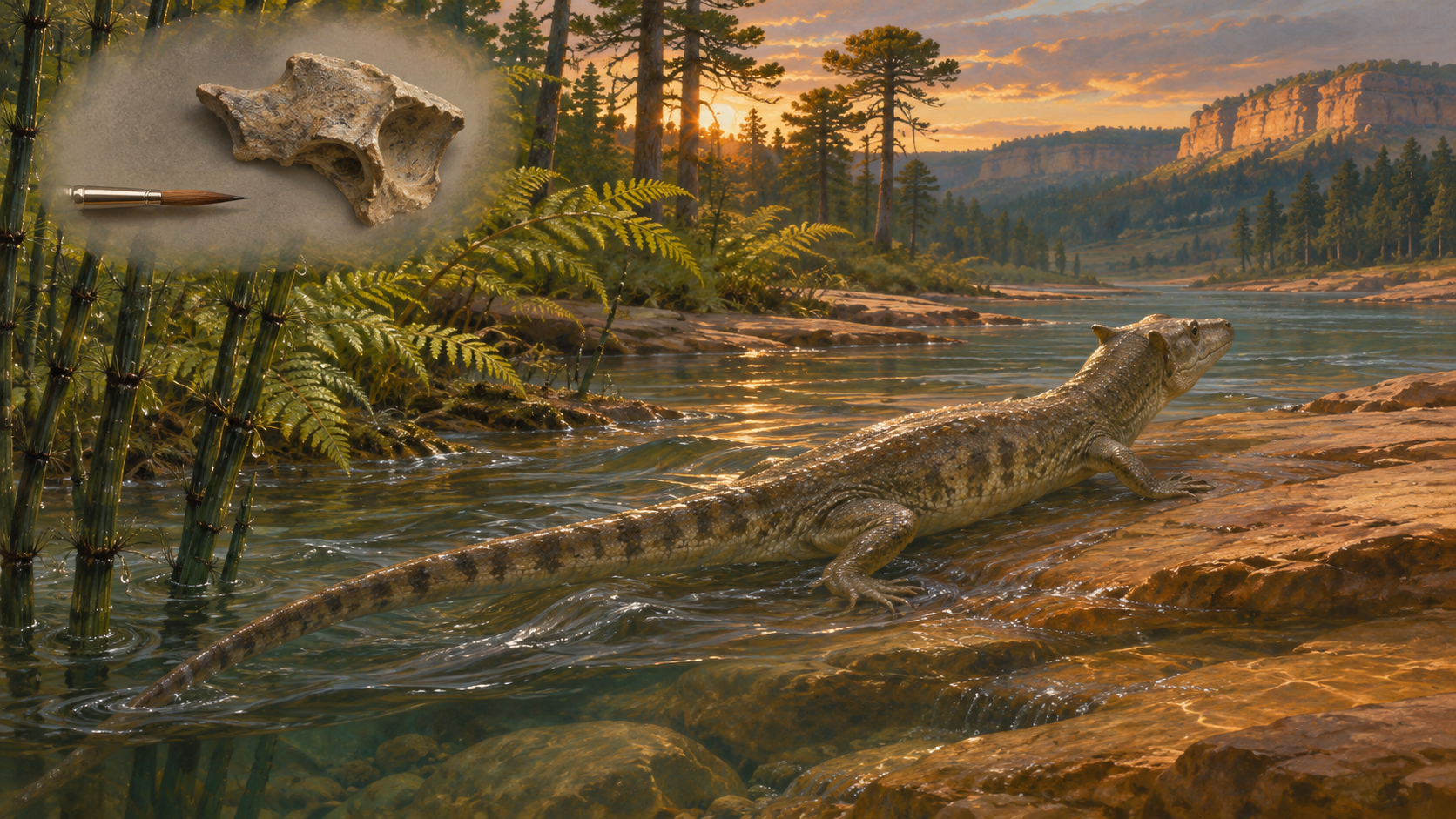
When excavators found a row of tiny vertebrae in Wyoming sandstone in 2022, a baby dinosaur was among the possibilities. The bones that would settle the question were still inside the rock. Among them was an almost complete braincase less than two centimetres across, with a distinctive projection on one of the bones surrounding the inner ear.
Using neutron and X-ray scans, researchers reconstructed enough of the skull and skeleton to identify Meilynodraco amonamarthi, a previously unknown species of freshwater reptile. About 45 centimetres long, it lived roughly 156 million years ago. It belonged to the choristoderes, a group that shared the Jurassic world with dinosaurs and survived long after the last non-avian dinosaurs disappeared.
The Wyoming specimen gives palaeontologists their oldest known North American record of a choristodere. It also gives them something harder to come by than an early date. They can now see how the bones around the ear fitted together in one of the group’s early members.
How Did Scientists See a Skull Inside Sandstone?
At Meilyn Quarry, in the lower Morrison Formation, the exposed vertebrae told the excavation team where to look. They offered few clues to the animal’s identity. The skull had separated from the torso, and several skull bones lay scattered. Fortunately, the delicate bones enclosing the brain had largely stayed together. That distinction would matter once the rock reached Switzerland.
The route to a scanner began with a family outing. In January 2023, materials scientist Pavel Trtik took his three sons to the Aathal Dinosaur Museum. Trtik worked with neutrons at the Paul Scherrer Institute and left his business card in case the museum ever had something worth examining. Ten days later, the museum called about the mystery fossil from Wyoming.
The researchers used two kinds of computed tomography. Each produces a series of virtual slices through an object. X-rays and neutrons interact with matter differently, so a boundary between fossil and sandstone that is difficult to follow in one set of images can be easier to trace in the other. Across tens of thousands of cross-sections, the team followed those boundaries and assembled the bones digitally, without having to pick every sliver of sandstone away from the skull.
The result included a connected backbone, pelvic bones, parts of a hind leg and much of the braincase. Each contributed a different piece of information. The backbone preserved the proportions of the body. The pelvis and hindlimb allowed comparisons with other small, semi-aquatic reptiles. The braincase preserved something a loose collection of bones could easily have lost during burial: the position of one small structure relative to the next.
What Did the Bone Beside the Inner Ear Reveal?
A braincase is the bony enclosure that once surrounded the brain. In Meilynodraco, one particularly informative bone was the prootic, which forms part of the wall around the inner ear. The Wyoming animal had a pronounced extension on the lower front of this bone. Its shape gave the researchers a feature they could compare across reptiles, including species with quite different head shapes.
That comparison helped answer two separate questions. The first concerned the identity of the Wyoming animal. Another choristodere, Cteniogenys antiquus, was already known from the Morrison Formation. The anatomy preserved across the new specimen differed enough for palaeontologist Torsten Scheyer and his colleagues to describe a separate genus and species in their study published on 18 November 2026. The prootic was one part of that case. The identification drew on the skeleton as a whole.
The second question reaches further back. Palaeontologists have struggled to establish exactly where choristoderes belong on the reptile family tree. The shape of the prootic in Meilynodraco resembles a condition found in the reptile crown group, the branch that includes the last common ancestor of all living reptiles and its descendants. That resemblance gives researchers a specific anatomical reason to consider a closer relationship.
There is a limit to what one ear region can settle. A feature shared by two animals can be inherited from a common ancestor, or a similar shape can evolve separately. Finding the same arrangement in another early choristodere, alongside other shared features, would help distinguish those explanations. For the next researcher with a suitable skull, the Wyoming fossil identifies precisely where to look.
Why Does This Wyoming Reptile Matter?
Choristoderes had a remarkably long history. Their known record extends from the age of dinosaurs into the Miocene, and their remains occur across the Northern Hemisphere. Yet the early part of that history rests heavily on fragments. An isolated bone can establish that an animal was present while leaving open what the rest of it looked like, how it moved and which other bones belonged with it.
At Meilyn Quarry, researchers could connect details from the head with the build of the same individual. Its vertebrae, pelvis and limbs resemble those of small choristoderes thought to have divided their time between land and water. Two projections at the back of the head helped inspire the name Meilynodraco, roughly “dragon of Meilyn”. The species name, amonamarthi, honours the Swedish metal band Amon Amarth.
The rock layer supplies a second piece of evidence. Meilynodraco is slightly older than Cteniogenys antiquus. Together, the fossils show that at least two distinct choristoderes occupied what is now the American West during the time represented by the Morrison Formation. They need not have shared the same stretch of river or even been alive at the same time. What has changed is the known diversity of this group in a landscape famous for much larger animals.
Could the Same Approach Reveal More Dinosaurs?
Yes. A scan can reveal diagnostic bones inside a block whose exposed surface shows little of interest. Palaeontologists have already used CT imaging to help identify a predatory dinosaur from an Isle of Wight braincase. That specimen entered a museum collection in 1924. A new dinosaur discovery can begin with a fossil that somebody collected a century ago.
Wyoming has a particularly relevant case of its own. In separate research announced in February 2026, palaeontologists described unusual bones attributed to ornithopods, a group of plant-eating dinosaurs. One braincase bears a backwards-pointing projection. A long, slender foot bone has a distinctive groove. The researchers raised the possibility that the material represents one or more unrecognised dinosaur species.
Their difficulty shows exactly where better imaging helps and where another fossil would help more. A scan can clarify the shape of a projection. It cannot establish that a separately collected foot bone belonged to an animal with that kind of skull. A skeleton preserving both features together would give the researchers a much stronger test. That is part of the good fortune at Meilyn Quarry: enough of one small animal survived for the team to compare the clues against one another.
The most revealing next find for Meilynodraco might be smaller still. A second early choristodere skull preserving the bone beside the inner ear could help determine whether the Wyoming animal carried a feature widespread among its relatives or an unusual variation of its own. Palaeontologists now know what to ask of a piece of fossil small enough to cover with a fingertip.
Sources
Torsten M. Scheyer and colleagues — Neutron and X-ray computed tomography reveals new early-branching choristodere from the lower Morrison Formation of Wyoming, USA — The scientific description of the species, its preserved anatomy, its age relative to Cteniogenys and the evolutionary interpretation of the prootic. JoVE Visualize
Paul Scherrer Institute — Neutrons, death metal and a tiny prehistoric dragon — The research team’s account of the excavation, the braincase measurement, the complementary scans and the origin of the name. PSI
Idaho State University — New Dino? ISU Paleontologists Homing in on Possible New Species in Wyoming — The separate ornithopod investigation and the evidence researchers still need to test their proposed identification. Idaho State University
Next Reads
New Dinosaur Hidden in Museum Collection for a Century Reveals Europe’s First Megaraptoran — How openings and ridges in an Isle of Wight braincase helped identify a long-clawed predator.
What Can Fossil Teeth Tell Us About a Giant Rodent That Lived in Thailand 34 Million Years Ago? — Why the best clue to a giant rodent’s size was knowing which teeth to compare with its molar.
Blood-Cell Evidence Found in a 115-Million-Year-Old Dinosaur: Could We Bring It Back? — What microscopic traces inside a Brazilian dinosaur bone can reveal about the animal that left them.
