How Much Worm Compost Does It Take to Grow a Potato in Simulated Moon Dust?
The Potatoes Had Fertiliser From The Start.
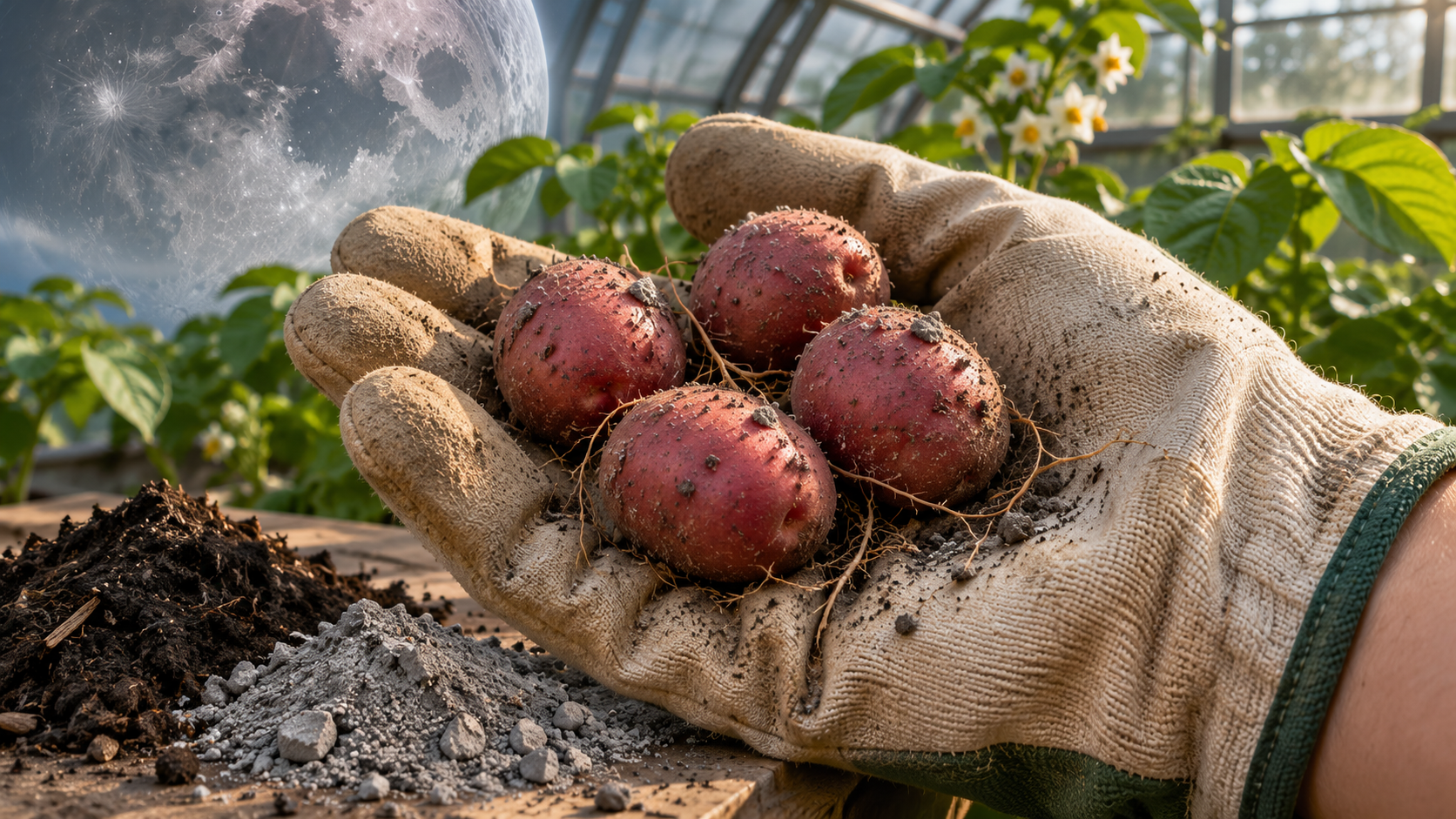
Even with nutrients supplied, potatoes planted in an Earth-made version of lunar dust barely put down roots. Yet in the same Oregon greenhouse, the same red-skinned variety produced a harvest comparable to potatoes grown in agricultural soil. The difference was what the researchers mixed into the pot. In the successful blend, worm compost made up 30 per cent of the growing material by volume.
The experiment, published on 19 November 2026 in npj Microgravity, gives a qualified yes to the question of whether potatoes could grow on the Moon. It shows that material resembling lunar rock and dust can form the bulk of a growing bed and still support a crop. The harvest took place on Earth, under greenhouse conditions. What makes the result interesting is how much the compost changed the outcome even after the researchers had addressed the most obvious problem with farming on the Moon.
Why Plant a Potato in Moon Dust?
A potato earns its greenhouse space through the amount of food it can produce underground. Its leaves capture sunlight, and the plant stores some of that energy as starch in tubers. Those tubers, the potatoes we eat, form at the ends of underground stems. A plant can put up a promising green shoot and still deliver very little at harvest. For a crew counting on dinner, the weight of the tubers matters more than the sight of the first leaf.
The Oregon State University team chose Modoc, an early-maturing potato with red skin and white flesh. For comparison, the researchers grew it in soil from Hermiston, an Oregon potato-growing region. Both sets of plants had the benefit of a greenhouse kept at about 22°C during the day and 18°C at night, with artificial lighting supplementing sunlight.
What changed between pots was the material around the roots. On the Moon, impacts have broken surface rock into a loose layer of fragments and dust called regolith. On Earth, years of growth and decay add organic matter to agricultural soil. A potato planted in lunar material would inherit none of that history. Using simulants made on Earth allowed the team to test different mineral mixtures and quantities of compost against a familiar farming soil.
What Changed at 5, 15 and 30 Per Cent Compost?
The most revealing detail of the experiment was the slow-release fertiliser. The simulants lacked nitrogen and offered limited amounts of other essential nutrients. Supplying fertiliser let the researchers ask a more precise question. Once a potato had a source of nutrients, could its roots make use of the material surrounding them?
In one experiment, the team grew Modoc potatoes in a simulant representing the Moon’s dark volcanic plains. With no compost, growth was severely stunted and the plants developed scarcely any roots. Adding 15 per cent vermicompost, the organic material produced as earthworms process waste, brought an intermediate result. At 30 per cent compost, plant growth and tuber yield were comparable to those in the Hermiston soil. Adding compost to the Oregon soil produced no significant change in the growth traits measured there.
A separate experiment tested five simulants with just 5 per cent compost. The mixtures represented material from both the volcanic plains and the lunar highlands. Plants completed their life cycle and formed tubers in all five, although their canopies were smaller and their yields lower than in the agricultural soil.
That distinction matters when deciding how much compost a future crew might need. Five per cent was enough to get a harvest across several mineral mixtures. Thirty per cent produced the stronger result in the particular simulant used for that comparison. A grower choosing a recipe for a lunar landing site would still need to test how the local material behaves.
Why Would Worm Compost Help When Fertiliser Was Already There?
Copper offers one clue. The researchers found elevated copper in the leaves and tubers of plants grown in the unamended volcanic simulant. The poor root development also fitted the pattern of copper stress. There was a frustrating limit to testing that explanation directly. The plants in the pure simulant had produced so little root tissue that the team left roots out of its metal analysis.
Organic matter can bind metals, reducing the share available for a root to absorb. A growing bed can therefore contain copper both before and after compost is added, while exposing the plant to different amounts. The researchers propose that this protective effect helps explain the recovery. Their results leave open how much of the improvement came from binding metals and how much came from other changes the compost made around the roots.
The five simulants also placed different demands on the plants. When the team examined which genes were active in the leaves, the patterns of stress differed between mixtures. That gives researchers a reason to look more closely at the material available at a particular site. Two pots can both produce a disappointing crop while presenting different problems for the grower to solve.
What Were the Harvested Potatoes Like?
Most weighed less than ten grams apiece. That sounds meagre until you look at the control plants. The potatoes grown in good Oregon soil were small too. All had grown in small pots, so the comparison tells us how the different growing materials performed under the same restriction. It tells us much less about how many meals a full-sized lunar growing bed might supply.
The team also examined the chemistry of the tubers. Potatoes naturally produce compounds called glycoalkaloids, which can be harmful at high concentrations. The researchers found no statistically significant increase in these compounds in the simulant-grown potatoes. More broadly, the chemical profiles of the tubers remained similar to those of the controls, even as the leaves showed signs of stress. For anyone choosing a food crop, that is a valuable distinction. The part showing the clearest response to a difficult growing environment can differ from the part that ends up on the plate.
As for flavour, the researchers used their harvest for laboratory analyses. Nobody tasted it.
Where Would a Moon Base Get the Compost for Its Second Crop?
Imagine filling a ten-litre planter with the successful blend. Seven litres could be mineral material and three would have to be vermicompost. Scale up the growing area and the initial supply of organic matter becomes a practical consideration. The worms had already done their work before the Oregon experiment began. A lunar greenhouse would need a source of compost for its first planting and a way to replenish it thereafter.
One possibility is to process food scraps and spent plants into material for later crops. Another, raised by Oregon State researcher David Handy, is to grow an early crop specifically to dig it back into the growing bed. The two approaches place different demands on a small greenhouse. Recycling makes use of material a crew already has. Growing a crop for compost means allocating light, water and space to plants whose immediate purpose is to feed the soil.
Water would be a separate challenge, one reason the search for ice near the lunar south pole matters to plans for a permanent base. A crew would also have to maintain air pressure, temperature and lighting. The Oregon plants grew under Earth’s gravity, leaving open how a potato and the water around its roots would behave in a growing bed on the Moon.
The most informative future harvest may be the second one from the same bed. Weigh the potatoes from the first crop, record what the crew removes to eat, return what can be composted, then see what the next planting yields. That would answer a question the first small red potatoes in Oregon have made worth asking. How much of dinner could a lunar greenhouse grow again with the materials it has left?
Sources
David Handy and colleagues — Growth and molecular responses of potato to lunar regolith simulants — The peer-reviewed study sets out the compost comparisons, fertiliser treatment, plant responses and tuber analyses. nature.com
Reuters — Scientists succeed in growing potatoes in simulated moon soil — Details of the Modoc variety, greenhouse temperatures, tuber weights and why the researchers did not taste the harvest. new.streetinsider.com
Oregon Public Broadcasting — Spuds in space? An OSU lab is experimenting to see how potatoes might be grown on the moon — David Handy explains the practical difficulty of supplying compost and the possibility of growing early crops to build organic matter. OPB
Next Reads
China’s Chang’e-7 Lunar Ice Hunt Could Transform The New Race To Build A Moon Base — Why the distance between water ice and reliable sunlight matters when choosing a site for a base.
Space Race and New Geopolitics: How the New Space Economy Is Redrawing Power in Orbit and Beyond — How the prospect of using lunar resources shapes the competition to reach them.
The Moon Landing: Hoax, Myth, or Misunderstood History? — The physical evidence behind the Apollo landings, including the material astronauts brought home.
