One Higgs Pair in a Trillion Collisions. How Could ATLAS Recognise It?
What If The First Clue To A New Particle Is Where Its Trail Begins?
When the upgraded Large Hadron Collider brings two bunches of protons together, as many as 200 pairs of protons could collide in a single crossing. Their debris will pass through the same detector. If physicists assign a handful of tracks to the wrong collision, they can change the story the evidence appears to tell.
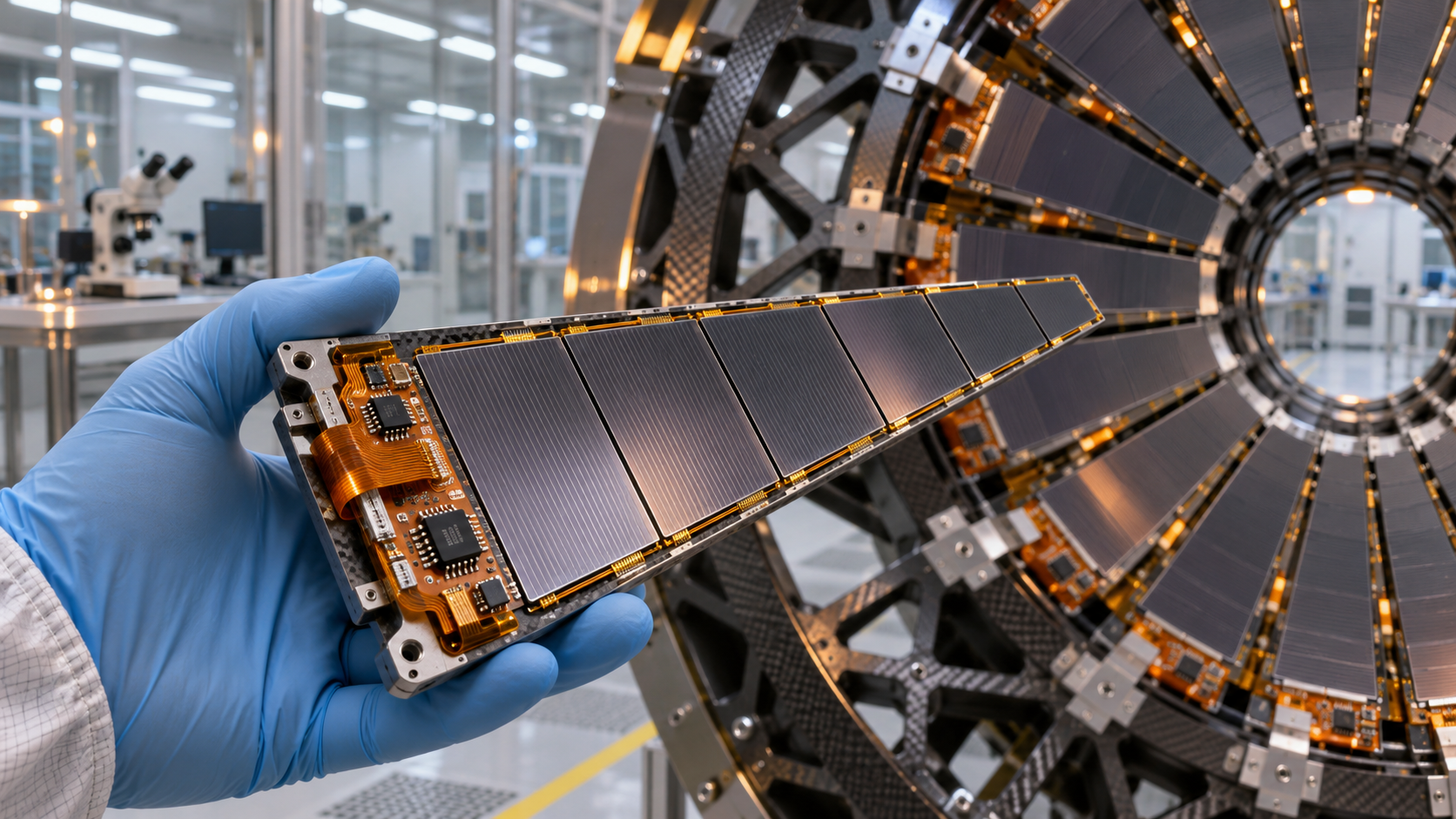
CERN’s ATLAS experiment is building a new Inner Tracker to solve that problem. Its silicon sensors will map the paths of charged particles with micrometre-scale precision. A micrometre is one millionth of a metre. Knowing where a track passed, and tracing it back to where it began, can reveal whether a particle came straight from a proton collision or from something that travelled a short distance before breaking apart.
That distinction gives the tracker two jobs. One is to recognise familiar particles in exceptionally crowded conditions. The other is to preserve the evidence when nature produces something unfamiliar.
How Can Silicon Record a Particle’s Journey?
The coloured curves in pictures of particle collisions look like trails from a long-exposure photograph. What ATLAS actually collects is a series of electrical signals. A charged particle crosses a layer of silicon and frees electric charge along its path. Electronics register where that happened. Farther out, another layer records the next crossing.
Software fits a path through signals that could belong to the same particle. The magnetic field inside ATLAS gives physicists another clue. Positive and negative particles bend in opposite directions. For particles with the same charge travelling across the field, one with greater momentum follows a gentler curve.
Now run that reconstruction backwards. Several tracks that meet at one point suggest a common origin, known as a vertex. One vertex can mark the original proton collision. A second, a short distance away, can mark the place where one of the particles produced in that collision decayed. In a detector display, both look like lines meeting. In physical terms, one marks a birth and the other the end of a brief journey.
The millionth of a metre in the headline describes the scale of the tracker’s spatial precision. A thousand micrometres fit between adjacent millimetre marks on a ruler. The uncertainty on an individual track depends on its angle, its momentum and which sensors it crosses. Physicists can infer the passage of an object far smaller than a micrometre because they measure the charge it leaves behind.
Why More Collisions Make Rare Events Harder to Recognise
The High-Luminosity Large Hadron Collider is scheduled to begin operating in 2030. In collider physics, higher luminosity means more opportunities for protons to collide. That is an obvious advantage when looking for a process that may occur only once in a trillion collisions. The complication is that the apparatus receives many of those collisions together.
Suppose a collision produces a spray of particles travelling close together. A second collision nearby sends another charged particle into the same patch of detector. Include that stray track in the first spray and a physicist can draw the wrong conclusion about what produced it. This overlap is called pile-up. Taking more data helps only if researchers can sort out which signals belong together.
The new Inner Tracker will be about six metres long and two metres across. Its innermost pixel sensors will sit just 33 millimetres from the beam, where the tracks are most tightly packed. Farther out, where the paths have had room to separate, silicon strips cover a much larger area. The different designs put the finest segmentation where it earns the greatest return.
Position alone can still leave two origins looking much the same. A separate ATLAS upgrade will measure the arrival times of charged particles in parts of the detector. If two tracks appear to have started in the same place, a difference of a few tens of trillionths of a second can help establish that they belonged to different collisions.
What Could Two Higgs Bosons Tell Us About the Universe?
One of the strongest cases for the tracker begins with a particle CERN has already found. The discovery of the Higgs boson in 2012 gave physicists a way to investigate the field through which elementary particles acquire mass. A question still open is how strongly the Higgs boson interacts with itself. The rate at which two Higgs bosons emerge from a single proton collision is sensitive to that interaction.
ATLAS puts the expected frequency of Higgs-pair production at roughly one in a trillion proton collisions. Even then, the two Higgs bosons disappear before they reach the tracker. The experiment has to recognise what they leave behind.
One particularly useful combination occurs when one Higgs boson decays into two photons, the particles of light, and the other produces a bottom quark and its antimatter counterpart. The photons deposit energy in another part of ATLAS. The quarks produce narrow sprays of particles known as jets. Within those jets, particles containing bottom quarks can travel a short distance before decaying. A cluster of tracks starting slightly away from the proton collision helps identify the jet’s origin.
Put the two photon measurements together with the two jets and physicists have a candidate. Other processes can produce much the same debris. What matters is how often the pattern appears, how its properties compare with expectations, and whether the difference persists as the sample grows.
A reliable measurement would reach beyond a single particle. The strength of the Higgs self-interaction helps determine the shape of the Higgs field’s energy landscape, which matters to calculations of how the field settled into its present state as the early universe cooled. A few tracks in silicon can contribute to that question because they help identify which collisions belong in the calculation.
Could a Particle Travel Through ATLAS Unseen?
A more speculative possibility starts with a gap. Imagine a neutral particle produced in a proton collision. It travels through several inner layers without leaving a charged track, then decays into particles the tracker can register. Reconstruct their paths and they meet some distance from the original collision. The missing stretch between those two points is where the parent particle may have travelled.
ATLAS has already searched earlier data for a version of this pattern. In one proposed model, a Higgs boson can decay into two previously unknown, relatively long-lived particles. Each could travel outward before decaying into familiar matter. Some versions of the idea would give physicists a way to investigate a hidden family of particles connected to dark matter, whose gravitational effects astronomers can measure.
There is a difficulty here that goes beyond making a better sensor. Software designed to find tracks emerging near the beam can overlook tracks that begin farther out. ATLAS researchers went back to an existing dataset and used reconstruction methods that could recognise those displaced tracks. They found no evidence of the proposed Higgs decay. Yet for the scenarios they examined, they tightened previous limits by a factor of ten to forty using the same collision data.
That result puts the new hardware in perspective. A sensor can record an electrical signal perfectly, but the search still depends on which patterns the software knows how to assemble. If a future analysis did reveal an unfamiliar particle, physicists would then have to measure how it behaves. Showing that it explains any of the unseen mass in galaxies would be a further discovery.
What Could Change for Someone Outside CERN?
For someone having a wrist examined, one answer already exists. In April 2026, CERN announced that MARS Bioimaging had received US regulatory clearance for a portable CT scanner designed to image upper limbs. At its heart is Medipix3, a chip descended from earlier work on silicon pixel detectors for particle physics.
The useful connection is what happens to an individual signal. In the collider, researchers want electronics that can register separate particles arriving at a sensor. In the scanner, related electronics count individual X-ray photons and measure their energies. Different materials absorb X-rays differently at different energies. Retaining that information helps clinicians distinguish tissues and materials in a three-dimensional image of a wrist or arm.
The scanner took its own route through engineering, clinical evaluation and regulatory clearance. It predates the new Inner Tracker. Its history answers a harder question about the value of fundamental research. A discovery about the Higgs field could change our account of the early universe without producing a foreseeable medical treatment. Meanwhile, an engineer trying to count individual particles reliably can develop a device that a clinician recognises as the answer to a different problem.
The next person to benefit from detector research may never need to know what a Higgs boson is. They may simply hold their wrist still while a chip counts the X-rays that come through.
Sources
ATLAS Collaboration — High-Luminosity ATLAS — The expected collision density, tracker dimensions, silicon layout and separate timing detector.
ATLAS Collaboration — ATLAS sets record limits on Higgs self-interaction using Run 3 data — The predicted rarity of Higgs pairs and how photons and bottom-quark jets help identify them.
ATLAS Collaboration — ATLAS chases long-lived particles with the Higgs boson — The search for displaced decays and the stronger limits obtained from an existing dataset.
CERN — CERN’s Medipix3 technology on track to help more patients — The transfer of pixel-detector technology into a portable photon-counting CT scanner.
Next Reads
Why Was The Higgs Boson Such A Huge Discovery — And What Could It Lead To? — What the 2012 discovery established about mass and which properties of the Higgs field physicists still need to measure.
After 42 Years, Scientists Find Evidence of a One-in-Ten-Billion Particle Decay — How another CERN experiment identified a rare decay from the two particles left behind.
What Is Dark Matter? The Evidence, Leading Ideas And What Remains Unknown — Why measuring the gravitational effects of dark matter and identifying a dark-matter particle are different achievements.
