How the Shade of an Ancient Rainforest Left Its Mark in Human Teeth
Two Of The Teeth May Once Have Shared A Mouth.
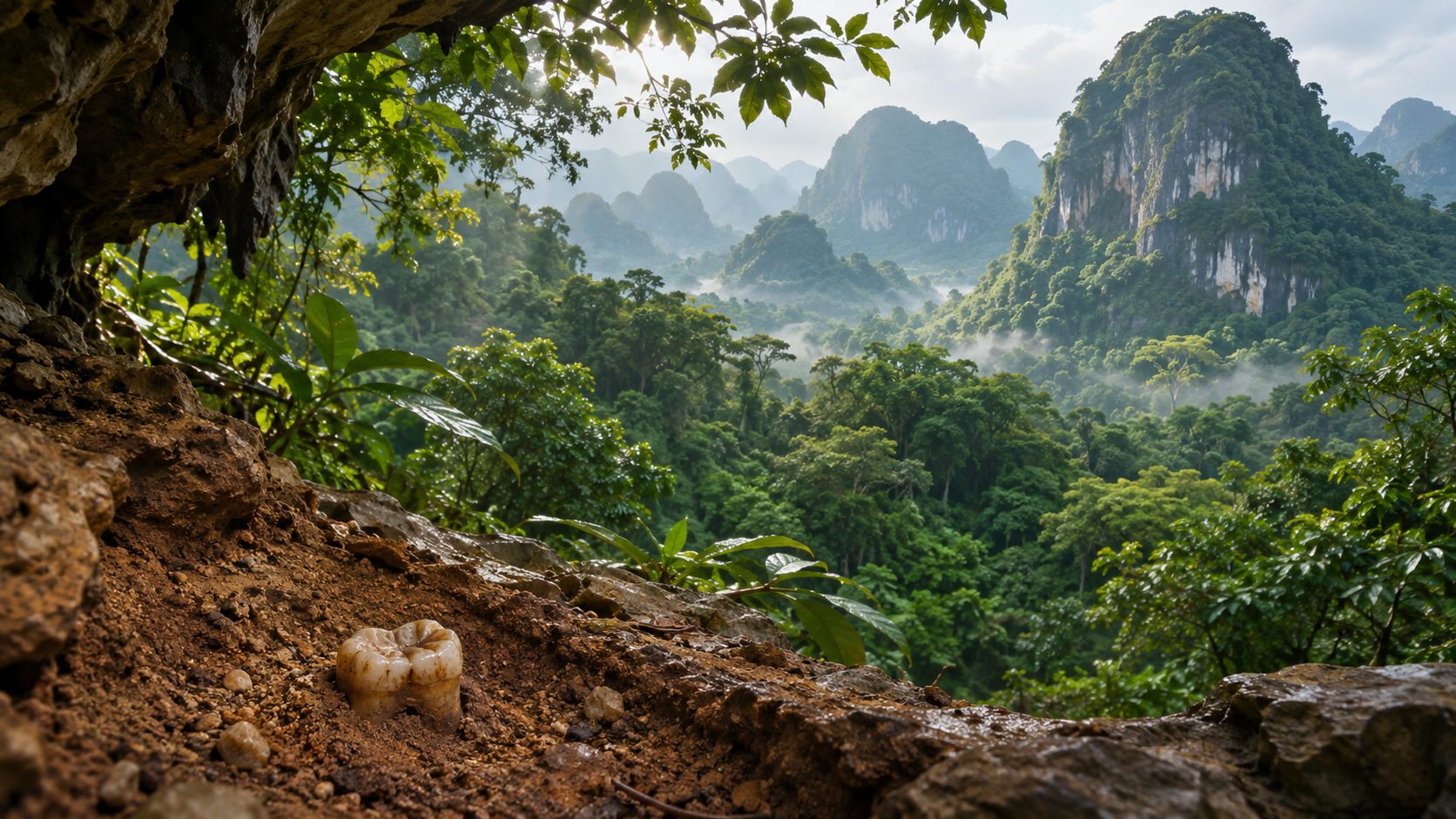
Among the thousands of teeth recovered from two limestone caves in southern China, a pair of upper molars may once have sat on opposite sides of the same mouth. Their owner belonged to Homo erectus, an extinct human relative often pictured walking through open woodland. What that individual ate while those molars were growing helps explain why the familiar picture needs a forest in it.
Researchers identified eight teeth from the Naxian and Baxian caves in Guangxi as Homo erectus. Their shape helped establish the species, and ancient proteins supported the identification in the teeth tested. The rainforest evidence came from another property of enamel. Its carbon reflected the food web that had sustained the growing humans. Compared with teeth from animals found in the same deposits, the results place Homo erectus in a rainforest landscape in southern China between roughly 324,000 and 184,000 years ago. The human measurements even give clues to how much daylight reached the plants at the base of their diet.
How Porcupines May Have Helped Preserve the Evidence
The excavations grew out of a search for a different primate. Palaeontologist Yingqi Zhang and colleagues were investigating the limestone country around Chongzuo, a region known for fossils of Gigantopithecus, the enormous extinct ape. Baxian and Naxian lie about 15 kilometres apart. Both held collections of animal remains in which teeth far outnumbered recognisable pieces of skeleton. Among thousands of specimens from animals including elephants, pigs and monkeys, researchers picked out nine teeth belonging to members of the human lineage.
Porcupines may deserve some of the credit. These animals collect and gnaw bones, and researchers think their activity helped bring remains together in the caves. Teeth can outlast much of the material around them. What looks, in an excavation photograph, like the remains of a remarkably crowded animal community may owe its arrangement to the habits of one bone collector.
That possibility changes the question an excavator can ask. A human tooth beside an orangutan tooth tells us little about how the two met their ends. It gives us no particular reason to imagine that a person hunted the ape, or even entered the chamber where the teeth came to rest. Yet a porcupine could move a molar without altering the chemical record laid down years earlier inside its crown. For evidence of what sustained a living animal, the tooth itself is a better witness than its position on the cave floor.
How Scientists Recognised Homo erectus Beneath the Enamel
Six of the teeth attributed to Homo erectus came from Naxian. The other two were premolars from Baxian. All nine human teeth were relatively large, including the one that ultimately fell outside the group. Size alone would have been a poor guide. Other ancient humans had teeth in a similar range, and even some modern human teeth approach those dimensions.
Part of the answer lay beneath the surface that did the chewing. The enamel cap sits on a core of dentine. Where the two tissues meet, the boundary follows a landscape of peaks and depressions. Wear can flatten the visible tip of a cusp while leaving the underlying shape available for comparison. Researchers could therefore look for a combination of features shared with previously identified fossils, down to structures a dentist looking into a living mouth would never see.
The team also recovered fragments of enamel proteins from all five teeth selected for molecular analysis. One protein, ameloblastin, helps enamel develop. Its sequence varies, and four specimens carried a change previously recorded in older Chinese Homo erectus teeth. At another position in the protein, the Guangxi specimens differed from the earlier comparison group. They shared a recognisable family resemblance while adding evidence for a population researchers had yet to sample in this way.
The distinction matters when counting the discovery. Four teeth had molecular as well as anatomical support for their identification. Comparisons of shape brought another four into the group. And those two Naxian molars are so similar that they could be a left and right pair. Turning eight fossils into eight separate people would lose a small but rather intimate possibility preserved in the collection.
How the Shade of a Forest Enters a Tooth
A leaf growing beneath a thick canopy takes up carbon under different conditions from a blade of tropical grass growing in full sun. The plants can use different forms of photosynthesis. Even among forest plants that make food by the same pathway, shade and carbon dioxide recycled close to the forest floor can influence the proportions of lighter and heavier carbon they contain. Those differences travel through a food web.
Consider a forest herbivore. Carbon from leaves becomes part of its body. A human eating plants from the same forest can acquire a related signal, as can a human eating an animal that fed there. While a permanent tooth is forming, some carbon from that diet becomes incorporated into the mineral of the enamel. Once the crown has formed, it preserves a record of that period of growth. A fossil can therefore tell us something about where food came from even when the food itself has vanished.
For Guangxi, the particularly valuable comparison was with the other mouths in the caves. Animal enamel helped the researchers reconstruct the range of vegetation on which the local food webs depended. Orangutans provided a further ecological clue. A collection containing forest apes makes a wooded habitat plausible. With the carbon evidence, researchers could also ask where the humans fitted within it. Had human food consistently come from open grassland, the presence of an orangutan in the same deposit would have been much less persuasive.
The human carbon values fell in the forest range, close to the transition between densely covered forest and more open vegetation dominated by plants using the same photosynthetic pathway. Picture daylight reaching a gap in the canopy. A person could use food from that opening and from the shade beyond it, and the resulting enamel would carry a combined signal. The data leave room for that kind of variation. They put forest foods in the lives of these humans while leaving a tantalising question open. How much came from fruit or other edible plant parts, and how much came from animals that had fed among the trees?
The Stone That Grew Over the Fossils Helped Date Them
One of the most useful objects for dating the fossils was the stone that grew over them. Water passing through limestone can deposit calcite inside a cave. Where that mineral formed a layer over sediment containing teeth, it established an order of events. The teeth had arrived before the mineral sealed the deposit. Measuring the decay of uranium in the calcite helped put a time limit on what lay beneath.
A crust alone gives only one side of the story. The researchers combined 43 age estimates from five dating techniques, including work on sediments and teeth. One Baxian human tooth could itself be studied by measuring the accumulated effects of natural radiation and modelling how uranium had entered its tissues. These approaches date different events in the history of a cave. Their value together lies in testing whether the proposed sequence makes sense for the fossil, the material enclosing it and the mineral laid over both.
The estimates for Naxian put its fossil deposit between 319,000 and 241,000 years ago. Baxian had a wider interval, around 324,000 to 184,000 years ago. That younger figure is the end of a dating range. Treating it as the year the last Homo erectus died in China would give the measurements a precision they cannot supply. Equally, the two dates at Baxian do not require a single community to have occupied the same valley continuously for 140,000 years.
How Far Did These Rainforest Humans Travel?
The most intriguing geographical clue came from a different element. Strontium enters food and water from the surrounding geology. Rocks of different ages and compositions can give rise to distinct isotope ratios. A tooth growing in one geological setting can retain a value that looks out of place when the fossil turns up in another.
Researchers sampled four Homo erectus teeth for strontium, three from Naxian and one from Baxian. Some measurements fitted limestone country within roughly 30 to 50 kilometres of the sites. For the most distinctive values, especially in the Baxian specimen, the regional model favoured places much farther afield. Among the possible matches were foothills near the Red River, roughly 250 kilometres south of the caves.
It is tempting to draw a route between the two places. What the map gives us is a set of places where food and water could plausibly have acquired the measured signature. Distant areas can share similar geology, and the available samples represent only a few periods of tooth growth. Seasonal travel is one possibility. A move during childhood could also leave a non-local signature. Dense forest and considerable mobility appear compatible in this population. Calling these people “rainforest dwellers” can make them sound far more settled than the evidence suggests.
Who Owned the Ninth Tooth?
The two Baxian premolars had an unusual companion. An upper molar from the same cave differed in shape from Homo erectus and lacked the distinctive protein change seen in the four matching specimens. Researchers also found differences from Neanderthal and modern human teeth. Here was evidence for a second human lineage in the region, preserved by the same processes that brought the first one to light.
Could its owner have been a Denisovan? The possibility is credible given what other discoveries have revealed about ancient human relatives in Asia. The protein fragments recovered from this particular tooth, however, carried no sequence change that uniquely tied it to the Denisovan comparison specimen. Several populations might share the features that survived. More securely identified Denisovan teeth from southern Asia would give researchers a much better comparison. Until then, the most precise name anyone can give this fossil is its specimen number, PA1796.
What Guangxi Changes About the Last Homo erectus Populations
Before the Guangxi work, unequivocal Chinese Homo erectus fossils younger than about 400,000 years were exceptionally scarce. Much later remains were known from Ngandong on Java, where a fossil bed containing skullcaps dates to around 117,000 to 108,000 years ago. Parts of the Javan record associated the species with open woodland and grassland. It was reasonable to ask whether the spread of rainforest had eventually squeezed these humans out of habitats they could use.
Guangxi changes what such an explanation would have to account for. A mainland population could draw nourishment from a rainforest, including places with substantial canopy cover. Any account of what happened on Java now has to allow for differences between populations, forest types and local conditions. A change in vegetation might still have mattered greatly on one island. The teeth from southern China make it much harder to argue that a closed canopy marked a boundary for the species everywhere.
The next discovery with the most to add might be an ordinary-looking molar from somewhere between Guangxi and the Red River. If its age, protein sequence and strontium signature could all be established, researchers could begin to test whether the distant match seen at Baxian reflects a wider pattern of movement. For now, the clearest glimpse of a life comes from those two possible partner teeth at Naxian. Before either molar had finished growing, food from a forest had already left a trace inside it.
Sources
Nature — Rainforest adaptation in late Homo erectus from southern China
Nature — Evidence for late Middle Pleistocene Homo erectus in mainland East Asia
National Geographic — Homo erectus may have survived in China 200,000 years longer than we thought
